
EV Charger in a Detached Garage: Do You Need a Subpanel?
Key Takeaways
- A detached garage requires a 4-wire feeder and its own grounding electrode system under NEC 250.32. A simple circuit extension from the house panel is not code-compliant.
- Whether you need a new subpanel depends on what your garage already has: no electricity, an undersized panel, or a panel with room to grow.
- Minnesota adopted the 2026 NEC effective August 17, 2026. Any permit filed on or after that date must comply with the new code.
- All 240V garage receptacles now require GFCI protection under NEC 210.8(A)(2).
- Xcel Energy rebates can cut your total project cost by up to $2,000: up to $500 for EV charger wiring and up to $1,500 for a qualifying panel upgrade.
- Minneapolis and St. Paul have their own electrical inspection authority. Pull your permit with the city, not the state electrical office, or the job gets delayed.
- Call 763-200-5956 or book an estimate online to get started.
Does a Detached Garage Need a Subpanel for an EV Charger?
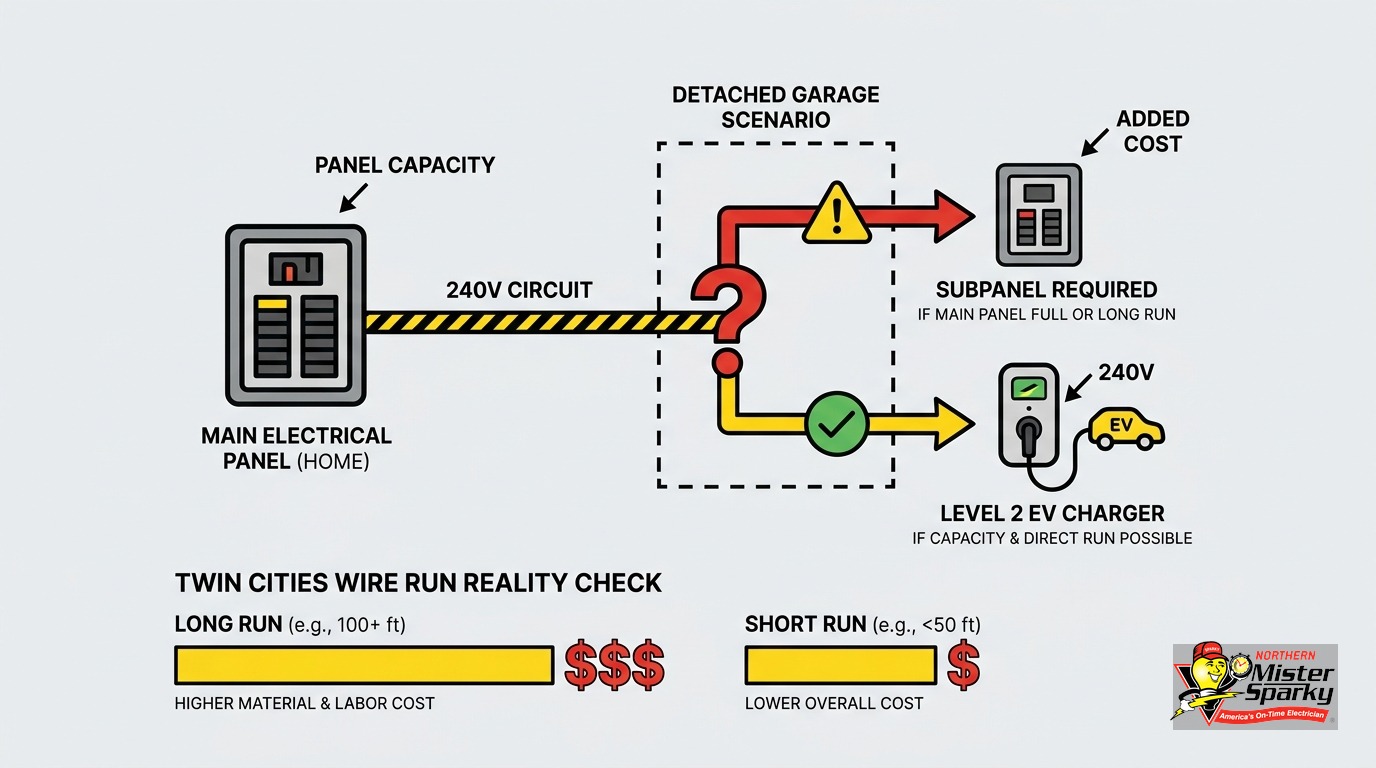
Short answer: It depends on what your garage already has. If it has a subpanel with an open double-pole slot and enough feeder capacity, you can add a circuit and be done. If it has no panel, an undersized one, or no power at all, a subpanel is the right and code-compliant path.
A Level 2 EV charger is a dedicated 240V circuit. A 32-amp charger needs a 40-amp breaker. A 48-amp charger needs a 60-amp breaker. That is a meaningful load before you factor in anything else happening in the garage.
Before that circuit gets installed, the power has to travel from your main house panel to a structure that is legally separate from the house. That path has specific requirements. Under NEC 250.32, a feeder to a detached building must use 4 wires: two hots, a neutral, and a separate equipment grounding conductor. The detached structure also needs its own grounding electrode system, typically two 8-foot ground rods spaced at least 6 feet apart. You cannot bond the neutral to ground at the garage subpanel. Minnesota inspectors check for all of this at rough-in.
That 4-wire requirement eliminates the “just run a circuit from the house” approach. Once you accept that a proper feeder is required, the question becomes: does the garage need a full subpanel, or can the feeder terminate directly at the charger?
Technically, NEC permits a single-branch-circuit feeder using the equipment grounding conductor method. In practice, that exception is rarely the right call. The moment you want lights, outlets, a heater, or a second charger, you need a panel. Most electricians, and most homeowners who think the project through, skip the exception and go straight to a subpanel. It costs more upfront and saves you from digging a trench twice.
The Three Scenarios Twin Cities Homeowners Face
Every detached garage job starts in a different place. Here is how the work changes based on what you already have.
Scenario 1: Your Garage Already Has a Subpanel with Room
This is the easiest path. If the existing panel has an open double-pole breaker slot and the feeder from the house is sized to handle the added load, the job is: run a 240V circuit to the charger location, install a 2-pole GFCI breaker (required for all 240V garage receptacles under NEC 210.8(A)(2)), mount the charger, and schedule both inspections.
Before anything is installed, your electrician checks the existing feeder wire gauge and the panel’s remaining capacity. A 60-amp feeder handles one charger comfortably. If you are planning on a second EV in the next few years, now is the time to upsize the feeder. Re-trenching later costs far more than pulling larger wire while the job is already open.
Scenario 2: Your Garage Has No Subpanel or an Undersized One
This is the most common setup in the Minneapolis and St. Paul inner ring. The garage has basic lighting on a single 15- or 20-amp circuit fed from the house, with no room to add a 240V load.
You need a subpanel. A subpanel installation typically runs around $2,700. That gets you a panel with room to grow: the charger circuit now, outlets and lighting later, a second charger if you add another EV. If the panel will hold more than 6 breakers, it must include a main breaker under NEC 408.36. Plan for that upfront rather than finding out at inspection.
Scenario 3: Your Garage Has No Electricity at All
This is the full job: trench from the house to the garage, 4-wire feeder, grounding electrode system at the garage, a new subpanel, and then the charger circuit on top of all of that. Full trench-and-wire jobs in the Twin Cities typically run $6,000 to $10,000, depending on run length, burial conditions, and whether you size the feeder for future expansion now.
That range is real. Alley-accessed garages in Minneapolis and St. Paul typically sit 40 to 70 feet from the main panel. Corner or side-yard garages can reach 80 to 120 feet. Distance affects both material cost and wire sizing decisions in ways that matter. For larger jobs in this range, ask about financing options when you call. Spreading a $7,000 to $10,000 project over time makes the decision easier for a lot of homeowners.
What Does It Actually Cost to Wire an EV Charger to a Detached Garage?
Short answer: Plan for $2,700 for a subpanel installation alone, or $6,000 to $10,000 for a complete feeder-and-panel job. Wire run distance is the biggest single variable, and Twin Cities lots vary widely.
Several factors drive the spread in that estimate:
- Run length: A 40-foot run is a different job than a 100-foot run, both in materials and labor.
- Wire gauge: A 60-amp feeder on a short run uses 6 AWG copper. On runs over 75 feet, voltage drop math requires 4 AWG copper, which is thicker and more expensive. Generic guides online usually quote 6 AWG without flagging the distance issue. We flag it.
- Burial method and depth: Rigid conduit requires 24 inches of burial in a frost zone per NEC Table 300.5. PVC requires 18 inches minimum, but most Minnesota electricians go 24 inches or deeper to clear frost heave and future landscaping. That is real labor cost.
- House panel capacity: If the main panel is already near its limit, the project may trigger a service upgrade before the garage feeder is discussed.
The only reliable way to know your actual cost is a site visit. We measure the run, check the house panel, and quote you a number based on your lot, not a national average. Call 763-200-5956 or book online.
How Do Minnesota’s Xcel Energy Rebates Change the Math?
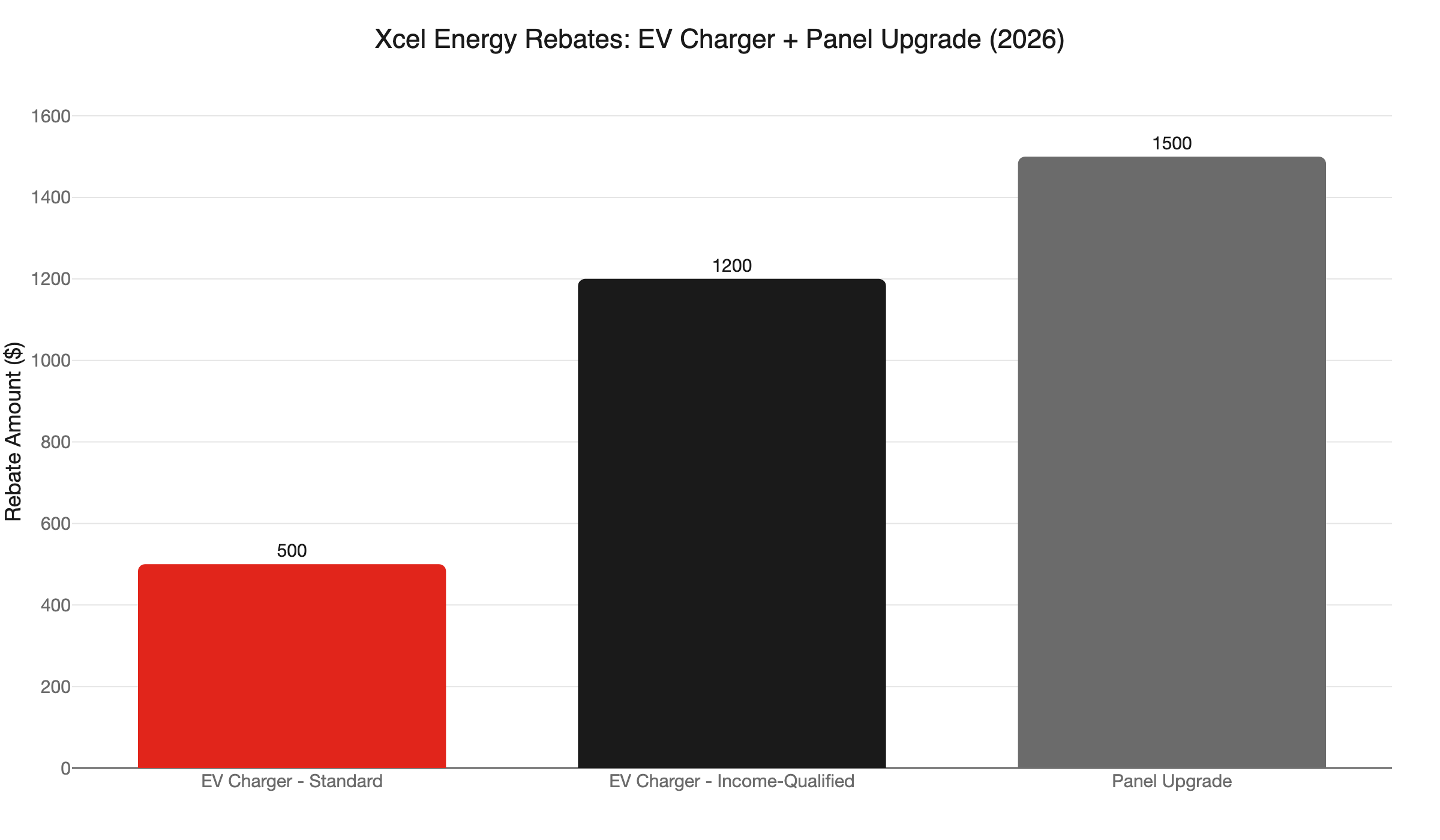
Short answer: Meaningfully. Xcel offers up to $500 for the EV charger wiring (up to $1,200 income-qualified) and up to $1,500 separately for a panel upgrade. They stack. A qualified homeowner doing both can get up to $2,000 back on a single project.
Here is what each rebate covers:
Xcel Energy EV Charger and Wiring Rebate:
- Up to $500 for standard customers
- Up to $1,200 for income-qualified customers
- A licensed electrician is required; self-installation does not qualify
- First come, first served: the rebate is not guaranteed to be available year-round
Xcel Energy Electrical Panel Upgrade Rebate:
- Up to $1,500 for upgrading to a higher-amperage panel
- Replacement at the same amperage does not qualify
- Stacks with the EV charger rebate above
One rebate that is no longer on the table: the federal 30C EV charger tax credit ended for property placed in service after June 30, 2026. If you were waiting on that credit, the window has closed.
Rebate programs change. Verify current availability at Charge Home Solutions’ Minnesota rebate tracker or directly with Xcel before your project begins. We help our customers submit the paperwork so the money they are owed comes back to them.
What Does Minnesota Code Require for a Detached Garage Feeder?
Short answer: A 4-wire feeder, a grounding electrode system at the garage, no neutral-to-ground bond at the subpanel, GFCI protection on all 240V receptacles, and a UL 2594-listed charger. Minnesota is under the 2026 NEC as of August 17, 2026.
Here is each requirement in plain language:
2026 NEC is now in effect. Minnesota adopted the 2026 NEC effective August 17, 2026. Permits filed before that date used the 2023 NEC. Anything filed on or after August 17 must comply with the 2026 code. Your electrician needs to know which version applies to your permit date.
NEC 250.32, the 4-wire feeder rule. The feeder to the garage requires two hots, a neutral, and a separate equipment grounding conductor. The neutral cannot be bonded to ground at the detached subpanel. Two 8-foot ground rods, spaced at least 6 feet apart, serve as the grounding electrode system for the garage.
NEC 625.41, charger circuit sizing. The circuit must be sized at 125% of the EVSE nameplate amperage. A 32A charger needs a 40A breaker. A 48A charger needs a 60A breaker. Running a charger on an undersized circuit is both a code violation and a fire risk.
NEC 210.8(A)(2), GFCI on 240V receptacles. All 240V garage receptacles require GFCI protection. A 2-pole GFCI breaker at the panel is the simplest and most reliable solution.
UL 2594 listing. The charger itself must be UL 2594-listed. No malarky on this one: inspectors verify at the final inspection. Bring the documentation.
NEC Table 300.5, burial depth. Rigid conduit requires 24-inch burial in a frost zone. PVC requires 18 inches minimum, but standard Minnesota practice is 24 inches or deeper to stay clear of frost heave and future landscaping work. Do not let a contractor cut this depth to save a day of digging.
For more on what a complete subpanel job involves from start to finish, see our guide on detached garage subpanel installation.
How Far Is Your Garage from the Main Panel?
Short answer: Twin Cities alley-accessed garages typically run 40 to 70 feet from the main panel. Corner and side-yard garages can reach 80 to 120 feet. At 100 feet on a 60-amp circuit, voltage drop requires 4 AWG copper, not the 6 AWG most national guides assume.
Wire sizing for a garage feeder is not uniform. The standard recommendation for a 60-amp feeder is 6 AWG copper or 4 AWG aluminum. That holds for short runs. On longer runs, voltage drop becomes a real problem that shows up as a charger that runs slower than it should or throws faults.
The standard threshold is keeping voltage drop below 3% on a feeder. At 100 feet on a 60-amp circuit, 6 AWG copper exceeds that. The fix is upsizing to 4 AWG copper. That adds material cost, but the charger gets full voltage and operates correctly.
If you are planning for two EVs in the future, consider sizing for a 100-amp feeder now. A 100-amp feeder requires 3 AWG copper or 1 AWG aluminum. Running the larger wire while the trench is open costs a fraction of what re-trenching and re-pulling wire would cost later. One trench, one inspection, done.
This is where a locally owned electrician with knowledge of Twin Cities lots earns the fee. We have wired garages across Minneapolis, St. Paul, Woodbury, Maple Grove, Blaine, Plymouth, and the surrounding communities. We know what these lots typically look like before we arrive. Call 763-200-5956 or book an estimate.
What About Permits in Minneapolis and St. Paul?
Short answer: Minneapolis and St. Paul are local-authority cities. Pull your permit with the city, not the state. About 40 Minnesota cities have their own electrical inspection authority. File with the wrong office and the job gets delayed, every time.
Minnesota has a permit-authority split that routinely catches contractors who work primarily outside the metro. Most of the state files electrical permits through the Minnesota Department of Labor and Industry. But Minneapolis, St. Paul, and roughly 40 other cities operate their own electrical inspection programs. Pull a state permit for a Minneapolis job and the inspection does not happen correctly.
A licensed Minnesota electrician who works in the Twin Cities knows which office to use. That is part of what the license and local experience mean.
Two inspections are required for any detached garage wiring project:
- Rough-in inspection: Scheduled before walls close. The inspector checks wire routing, box placement, conduit burial depth, and the grounding electrode system.
- Final inspection: Scheduled after the circuit is energized. The inspector verifies the GFCI breaker, the charger’s UL 2594 listing, and overall code compliance.
One thing worth knowing: Minnesota law allows the owner of a single-family homestead to pull their own electrical permit. No one else without a license can legally do it. But pulling the permit and doing the wiring are two different things. An unlicensed installation gets hard scrutiny at both inspections. We pull permits on every job we run, and we schedule both inspections.
For a complete walkthrough of how the permit process works in Minnesota, see our guide on electrical permits in Minnesota.
Level 2 vs. Level 1: Is It Worth the Upgrade?
Short answer: For a detached garage that already needs a feeder run, Level 2 is almost always worth it. The cost difference between wiring for Level 1 and wiring for Level 2 is small once the trench and subpanel are already on the quote.
A Level 1 charger runs on a standard 120V outlet. It charges slowly, which works for some drivers. A Level 2 charger runs on a dedicated 240V circuit and charges much faster, enough that most homeowners wake up to a full battery regardless of when they plugged in.
For a detached garage that already needs a feeder, subpanel, and conduit run, the incremental cost of wiring for Level 2 instead of Level 1 is relatively small. The trench labor, the conduit, and the subpanel are the same either way. Spending a little more on the circuit while everything is open is almost always the right call.
Our post on Level 1 vs. Level 2 EV charging covers the decision in more detail if you want to run the numbers for your specific situation.
Ready to Add an EV Charger to Your Detached Garage?
A detached garage EV charger project has more moving parts than most homeowners expect: a code-compliant 4-wire feeder, a grounding electrode system, a GFCI breaker, proper wire gauge for your specific run length, the correct permit office for your city, and two inspections. Getting any one of those details wrong delays the project or creates a hazard.
We are locally owned and operated in the Twin Cities. As America’s On-Time Electrician(R), we pull permits correctly the first time, handle both inspections, and get your garage charging-ready. We also help you apply for Xcel rebates so the money you are entitled to comes back to you, not back to the utility.
Call 763-200-5956 or book an estimate online. We serve Minneapolis, St. Paul, Bloomington, Brooklyn Park, Woodbury, Blaine, Maple Grove, Plymouth, and the surrounding area. Every job we do comes backed by the UWIN(R) 100% satisfaction guarantee.
Frequently Asked Questions
Does a detached garage need its own subpanel to install a Level 2 EV charger? +
How much does it cost to wire an EV charger to a detached garage in the Twin Cities? +
Can I stack Xcel Energy rebates for an EV charger and a panel upgrade? +
Need an electrician now?