
Condo Electrical Panel Upgrade Minneapolis: What to Know
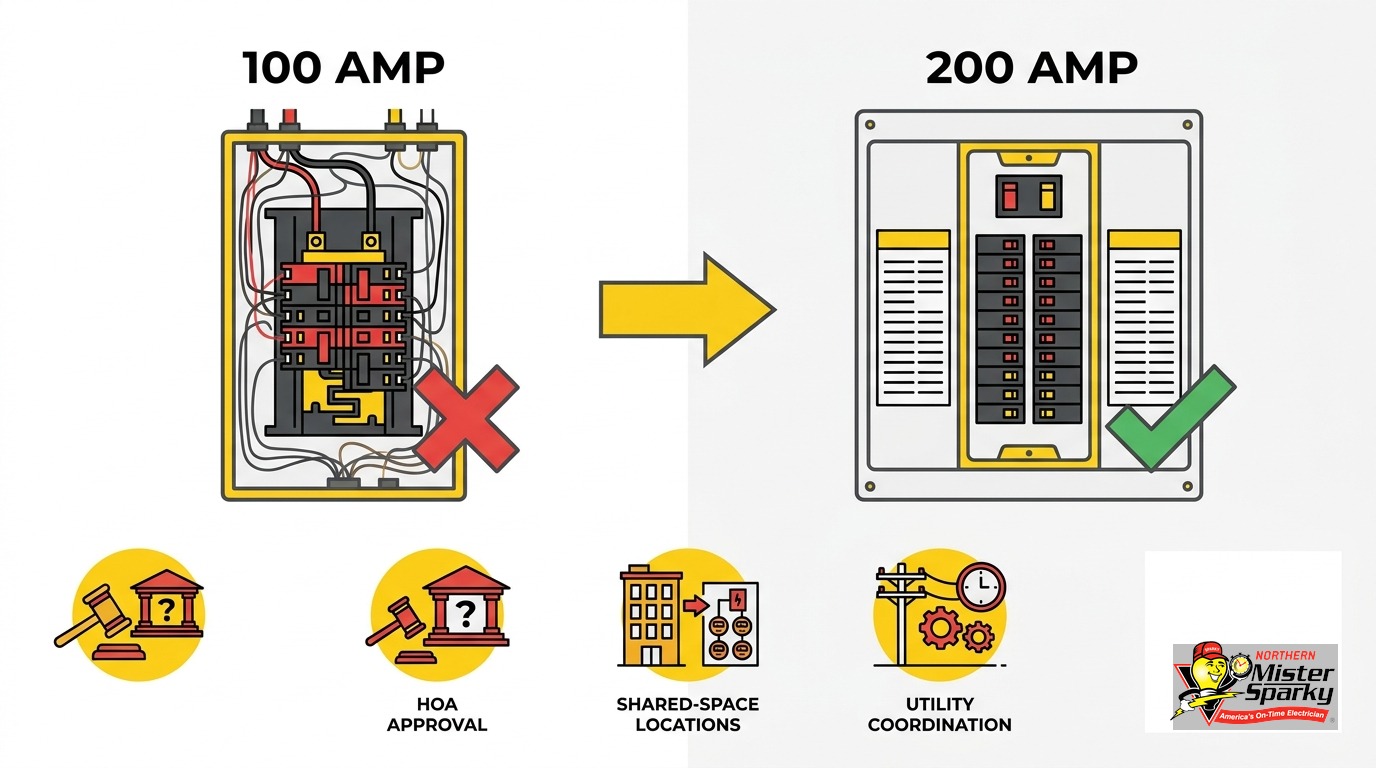
Key Takeaways
- A condo electrical panel upgrade in Minneapolis is not a one-day job. Plan for three to six weeks from the first call to full power restoration.
- Minnesota law requires a licensed electrical contractor for condo panel work. The homeowner DIY exemption does not apply in condos.
- Minneapolis runs its own electrical permits through the city, not the state DLI portal. Filing with the wrong office costs weeks.
- The Xcel Energy panel upgrade rebate, worth up to $1,500, does not apply to condo buildings with more than four units.
- The Minnesota Save Energy grant, potentially worth up to $50,000 for qualifying multifamily buildings, has not launched as of September 2026.
- If your panel is in a shared electrical room, your HOA controls access and may control the scope of the work.
What Makes a Condo Electrical Panel Upgrade in Minneapolis Different?
A condo panel upgrade involves the same physical work as a single-family job. The difference is the parties involved. You coordinate with your HOA, property manager, city inspector, and Xcel Energy, often at the same time. None of those parties move on your timeline.
Most panel upgrade guides assume you own a house. You own the basement, the breaker room, the meter. You call one number and schedule the work. A condo is a different environment.
Your building has shared infrastructure. It has a governing board, a property manager, and a utility that requires multi-party documentation before it processes a service application. The city electrical inspector, not a state inspector, reviews the work. And before Xcel restores your power, they require a signed inspection release from that city inspector.
That sequence cannot be rushed. No rush fee compresses it.
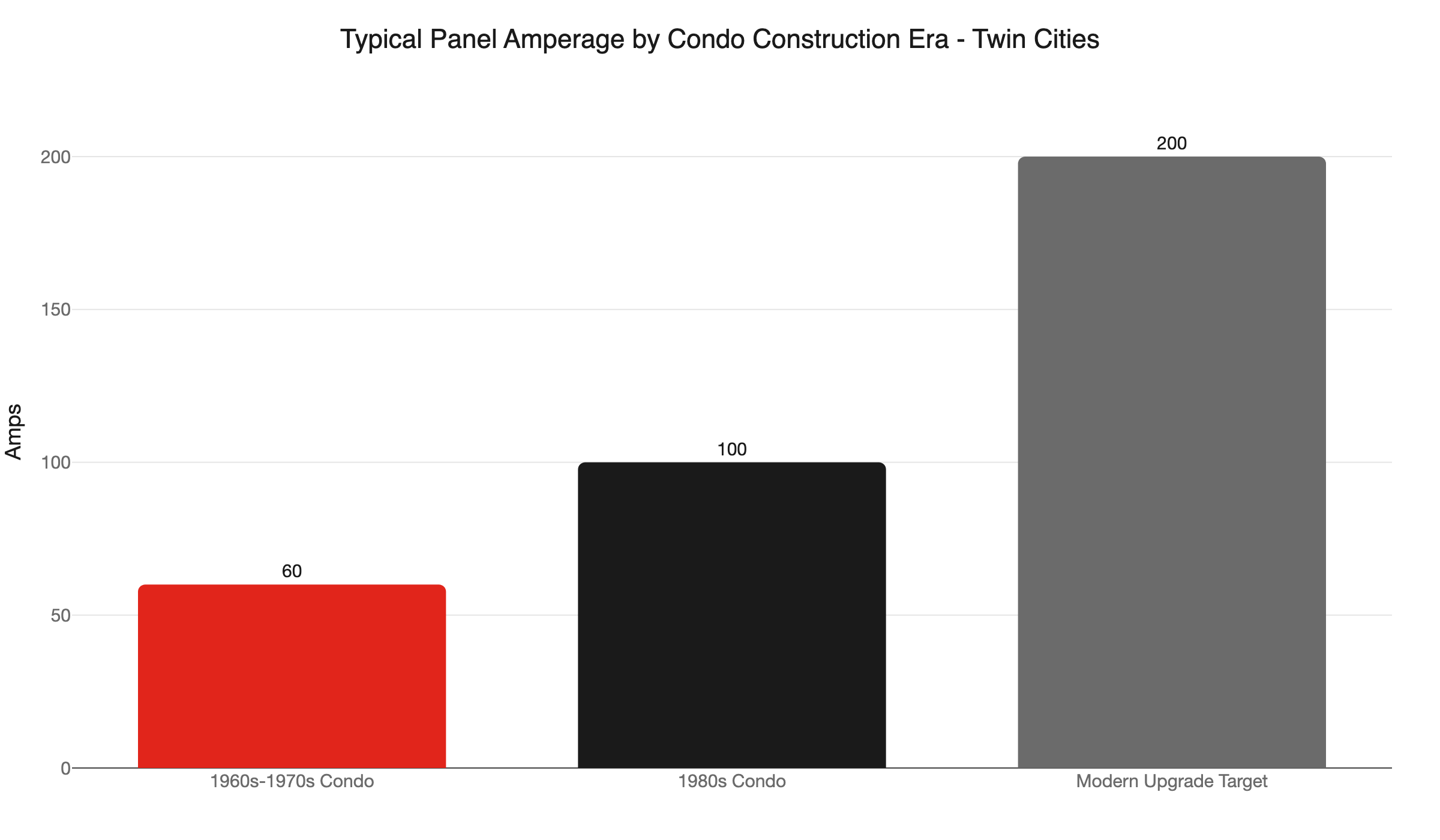
Twin Cities condos built from the 1960s through the 1980s often have 60-amp or 100-amp service per unit. Those panels were sized for resistive electric baseboard heat. Most buildings have since switched to gas or district steam. Now EV chargers, heat pump water heaters, and induction ranges are pushing those original panels past their limits.
The upgrade is overdue in many buildings. The coordination around it is the part no one explains upfront. Understanding every step before you start is what keeps a manageable three-week project from becoming a three-month ordeal.
Who Actually Owns Your Condo’s Electrical Panel?
The answer is in your CC&Rs. Some associations classify the panel as a “limited common element,” meaning the building owns it even though it serves only your unit. Others place it within your unit’s scope. Read your governing documents before you call anyone.
Pull up your condo association’s declaration and bylaws. Find the section defining “limited common elements.” If the panel appears there, the association may have authority over any upgrade, not just access to the room where it lives.
If your CC&Rs put everything inside your unit walls in your control, you have more autonomy. But you likely still need access to a shared space, and that access is never unilateral.
The ownership question matters for a practical reason. If the HOA owns the panel, replacing it may require a board vote, not a simple notification. A board vote means an agenda item, a meeting, and a recorded decision. In associations with quarterly meeting cycles, that process can add months.
Get the ownership question resolved before you schedule anything else. Ask your property manager directly and get the answer in writing. If they cannot answer, ask to see the relevant section of the CC&Rs. Most HOA management companies keep a copy on file and can send it within a day.
Does Your HOA Need to Approve the Panel Upgrade?
Interior unit work rarely requires a formal board vote in most associations. The exception is when the work involves a shared electrical room or a common element. Confirm the requirement in writing before scheduling anything.
Most HOA documents give unit owners autonomy over work inside their own unit space. A panel swap entirely within your walls is usually yours to schedule. You notify the board as a courtesy, not a prerequisite.
The complication is panel location. Many Twin Cities condo buildings from the 1970s and 1980s house all unit panels in centralized, floor-by-floor electrical rooms. Those rooms are common elements. You do not control them.
When the work involves a shared space, the board controls access and may impose conditions. Common requirements include proof that the contractor is licensed and bonded (which Minnesota law already mandates), specified work hours, and a certificate of insurance from the electrician.
Getting written confirmation from your property manager or board president before pulling a permit is worth one email. It prevents your electrician from arriving and being turned away at a locked electrical room door.
How Does the Minneapolis Permit Process Work for a Condo Panel Upgrade?
Minneapolis administers its own electrical permits. Roughly 66 Minnesota cities run their own electrical inspection programs, and Minneapolis is one of them. Your electrician files with the City of Minneapolis, not the state DLI portal. Filing with the wrong office restarts the clock.
Minnesota law requires a licensed electrical contractor for all condo panel work. The homeowner DIY exemption applies only to owner-occupied single-family homesteads. A condo is not a homestead under the law. No exceptions.
Your licensed electrician files the permit through the Minneapolis electrical inspection division. Minnesota’s current electrical code is NEC 2023, adopted effective July 1, 2023. Your new panel must meet those standards. The DLI has already published a 2026 NEC inspection checklist, signaling a coming code update. Work done now should be completed to a standard that holds up through the next adoption cycle.
After installation, the city inspector visits the site. If the work passes, they issue an inspection release. That release is the document Xcel Energy requires before they restore your power. The permit process and the Xcel reconnect are linked. You cannot skip or shortcut either one.
For a broader overview of how Minnesota electrical permits work, see our guide to getting an electrical permit in Minnesota.
Shared Electrical Rooms: The Coordination Challenge
This is the step that surprises most condo owners, especially those who have managed similar projects in a single-family home.
In a house, the electrician works in your basement. You let them in and they finish by afternoon. In a condo, the electrician may need access to a shared electrical room that houses panels for several neighboring units. Power work in that room can affect neighbors. It may require the building to temporarily restrict access to the entire floor’s electrical infrastructure.
Property managers need advance notice before any work touches a shared space. Thirty days is a typical minimum. Some buildings require 60 days for work affecting common areas. If your building has a facilities manager or building engineer, they may need to be on site during the entire work window.
Work hours in common areas are often restricted by association rules. Evening and weekend access may not be permitted. If your electrician needs two days in the electrical room but can only enter between 8 a.m. and 4 p.m. on weekdays, the schedule fits the building, not the other way around.
None of this is unusual. Experienced condo electricians build this coordination into their estimate and their timeline. Electricians who have only done single-family residential work sometimes do not. Ask directly whether your contractor has managed panel projects in multi-unit condo buildings. It is a reasonable question and the answer matters.
Before your first call to an electrician, prepare a brief summary. Note your building’s age and the approximate number of units. Know whether the panel is in your unit or a shared electrical room. Include your HOA contact information. That gives the electrician what they need to provide an accurate estimate and a realistic timeline from the start.
What Does Xcel Energy Require for a Condo Panel Upgrade in Minneapolis?
Xcel will not reconnect your meter until the city electrical inspector issues a release. That is not optional. No inspection release means no meter, and no meter means no power. Build that into your timeline from day one.
Multi-unit buildings face an additional documentation requirement. Xcel’s service guide requires a site plan or plat with all unit numbers identified as part of any service application for a multi-unit building. If unit numbers are not yet assigned, the total number of units must be noted. This documentation must come from someone who knows the building. That means your HOA or property manager is part of the Xcel paperwork chain from the start.
Xcel serves the overwhelming majority of the Twin Cities metro. Their Builders Call Line handles service upgrade coordination. Your electrician should be the one calling. But they will need building-level documentation from the association to complete the application.
Even after the city issues the inspection release, Xcel’s meter reconnection typically takes several business days. During high-demand periods, it can take longer. Factor this into your timeline when you notify building management and schedule the installation date.
Does the Xcel Panel Upgrade Rebate Apply to Your Condo?
Most condo owners in larger buildings are not eligible. Xcel’s residential panel upgrade rebate applies to single-family homes and small multi-unit buildings with four or fewer units. A ten-unit or twenty-unit condo building does not qualify.
If you live in a smaller building, perhaps a converted duplex or four-unit structure organized as condominiums, check with Xcel directly before you rule it out. You may still qualify. But if your building has five or more units, the rebate is not available to you.
Budget for the full project cost without this rebate. Condo panel upgrades cost more than the same job in a single-family home. The additional cost reflects coordination overhead, permitting, and any work required to route conduit through finished walls or connect to the building’s main service. The rebate would have helped offset that cost. It just does not apply here.
What About the Minnesota Save Energy Grant?
This program could be significant for qualifying condo associations. But it has not launched. As of September 2026, the Minnesota Commerce Department is still waiting on federal DOE approval. No grants are being issued, and applications are not open.
Under Minnesota Statute 216C.45, a multifamily building qualifies if at least 50% of its units are occupied by households at or below 150% of Area Median Income. Grants scale per unit and cap at $50,000 per building. For an older affordable condo building with 20 qualifying units, that could cover a meaningful share of a whole-building electrical upgrade.
The state will not issue grants retroactively. If you need the upgrade done now, do it. Do not wait on this program.
Watch the Minnesota Commerce website. When the program opens, your HOA board should apply quickly. Individual unit owners do not apply. The association applies on behalf of the building. If your building might qualify under the income thresholds, flag it with the board now so they are ready when applications open.
How Long Does a Condo Panel Upgrade Take in Minneapolis?
Plan for three to six weeks total. The physical installation takes one to two days. Permitting, city inspection, and Xcel meter reconnection add one to three weeks. HOA scheduling can add more time on either end.
Here is the typical sequence:
- Read your CC&Rs. Know whether the panel is a limited common element and whether the work touches a shared electrical room.
- Notify your HOA or property manager. Get written sign-off on access, timing, and any building-specific requirements.
- Hire a licensed Minneapolis electrician. Confirm they have condo project experience before you sign anything.
- Pull the permit. Your electrician files with the City of Minneapolis electrical inspection division.
- Schedule the installation. Coordinate access to any shared spaces with building management.
- Complete the installation. One to two days of physical panel work.
- City inspection. The inspector visits and issues a release if the work passes.
- Xcel meter reconnect. Xcel schedules the reconnect after receiving the inspection release.
The most common delays are a failed inspection that requires rework, Xcel scheduling backlogs, and slow property manager response times. Your electrician prevents the first one. The second is outside anyone’s control. The third is why you start the conversation with building management before you do anything else.
For more context on when a panel upgrade is the right call, see signs you need an electrical panel upgrade.
Signs Your Condo Panel Needs an Upgrade
You may already be seeing the symptoms. Watch for:
- Breakers that trip every time the microwave and the toaster run together
- Lights that flicker or dim when a large appliance starts
- Breakers that feel warm or show scorch marks or discoloration around the panel face
- No open breaker slots when you want to add a circuit for an EV charger or a new appliance
- A 60-amp or 100-amp service panel in a unit where you are planning an EV charger or heat pump conversion
No malarky: if two or more of those apply and your building dates from before 1990, schedule a panel diagnostic before a breaker fails at a bad moment. Twin Cities winters are not the time to discover you are out of capacity.
An undersized panel is not only a capacity problem. It can also be a home insurance issue. Some insurers flag panels below 150 or 200 amps as a condition of coverage, particularly in older buildings. If you are concerned about older panel hardware that inspectors or insurers have flagged in your building type, read our guide on dangerous electrical panel brands in Minnesota.
Ready to Start?
A condo electrical panel upgrade in Minneapolis involves real coordination. The electrical work itself is straightforward. The multi-party sequencing is where projects move smoothly or stall for months.
Northern Mister Sparky is locally owned and operated in the Twin Cities. As America’s On-Time Electrician(R), we have managed condo panel projects in multi-unit buildings throughout Minneapolis, St. Paul, Bloomington, Brooklyn Park, Woodbury, Blaine, Maple Grove, and Plymouth. We handle permit filing, city inspection coordination, Xcel documentation, and property manager communication.
If you are financing a panel or service upgrade, ask about options when you call. Panel upgrades qualify.
Call 763-200-5956 or schedule your appointment online. We will walk you through the coordination steps before we ever pull a permit.
Frequently Asked Questions
Do I need HOA approval for a condo electrical panel upgrade in Minneapolis? +
Why can't I use the Xcel Energy panel upgrade rebate for my condo? +
How long does a condo electrical panel upgrade take in Minneapolis? +
Do I need a permit for a condo panel upgrade in Minneapolis? +
Need an electrician now?