
Duplex Electrical Service Upgrade Minneapolis Guide
Key Takeaways
- Minnesota law bars owner-occupants from pulling their own electrical permit on a duplex. A licensed electrician handles the permit regardless of whether you live in one unit.
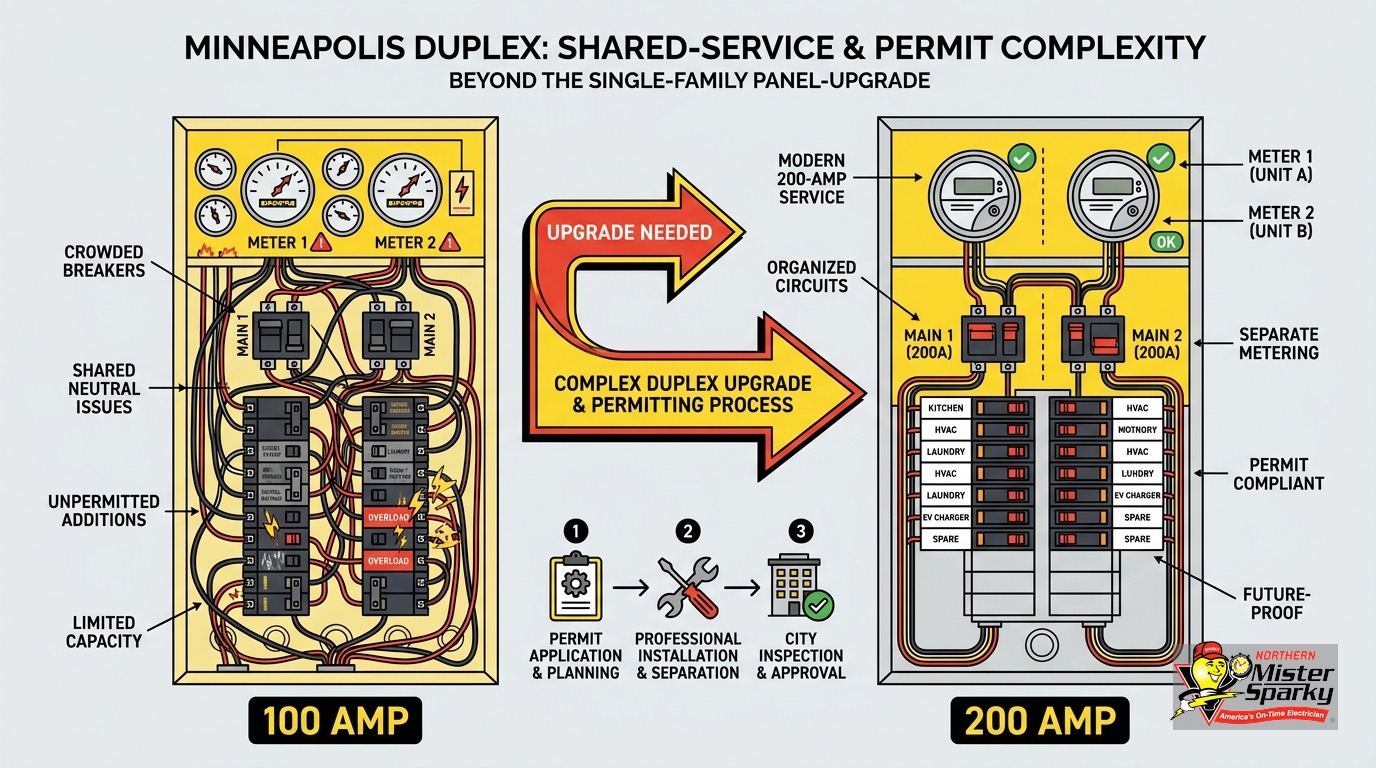
- Most Minneapolis duplexes have one shared service drop and one tandem meter stack. Upgrading service means upsizing the shared conductors and the meter stack, not just swapping two panels.
- NEC 220.85 gives two-unit buildings a blended demand factor that can reduce the required service size. Your electrician runs this calculation before sizing anything.
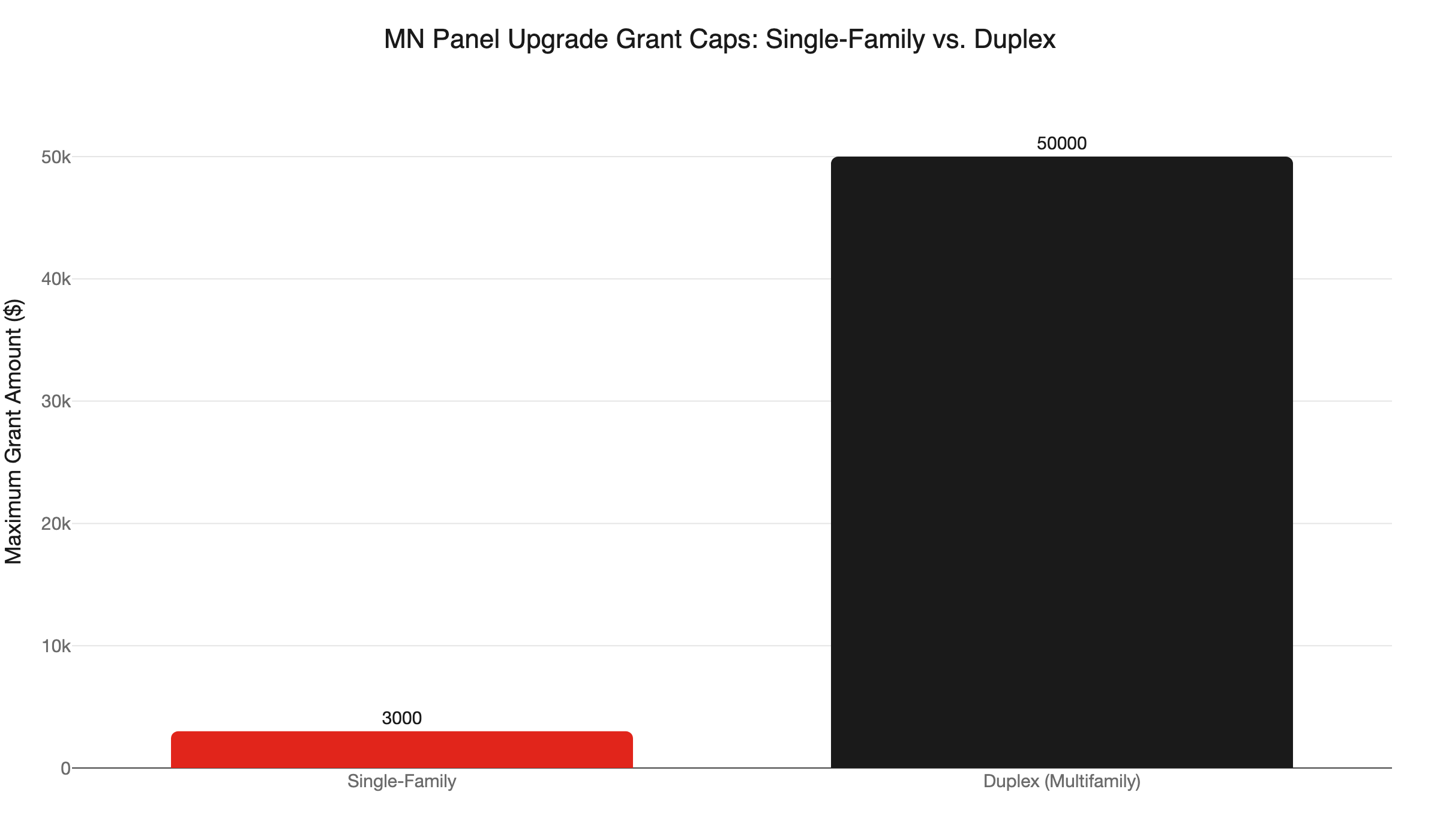
- Duplex owners qualify for Minnesota’s multifamily panel upgrade grant track, worth up to $50,000. Single-family owners are capped at $3,000.
- Xcel Energy requires approved meter sockets on both positions of the tandem stack. Three brands are approved. No substitutes.
- The state DLI electrical permit runs separately from any Minneapolis city building permit. Many owners do not realize this until inspection day.
What Makes a Duplex Electrical Service Upgrade Different?
A duplex electrical service upgrade in Minneapolis is not two single-family panel swaps running side by side. It is a fundamentally different job: one service drop, one meter stack with two positions, shared service conductors, and two unit panels, all under one permit and sized together.
Most Minneapolis duplexes in Uptown, Longfellow, Nokomis, and Northeast date from 1910 to 1950. A 60A fused service per unit was code-legal when those buildings went up. It is not adequate for modern loads. Adding a washer and dryer in the lower unit, an EV charger in the garage, or electric heat in either unit can push both panels past their limits quickly.
A full duplex service upgrade typically covers all of the following:
- Replacing the overhead mast and weatherhead
- Replacing the tandem meter stack with Xcel-approved sockets on both positions
- Upsizing the service entrance conductors for the combined load
- Replacing or upgrading both unit panels to 200A each
- Coordinating with Xcel Energy for the meter pull, DLI inspection, and meter re-set
Each of those steps involves decisions that do not exist in a single-family job. The shared service entrance is the central one. Understanding it before you talk to any electrician makes the rest of the project easier to navigate.
Can You Pull Your Own Electrical Permit on a Minneapolis Duplex?
No. Minnesota law bars owner-occupants from pulling their own electrical permit on any building with a second dwelling unit. A licensed electrical contractor must pull the permit and do the work, even if you live in one unit and the other is vacant.
Minnesota Statute 326B limits homeowner permits to single-family, owner-occupied residences. A duplex is legally a multifamily building under Minnesota law. The moment your property has a second dwelling unit, the homeowner exemption disappears. There is no variance, no local exception, and no workaround.
This surprises a lot of experienced owner-builders. If you have pulled your own permits on previous single-family renovations, that option is gone here. Your licensed electrician handles the DLI permit application and coordinates the inspection.
DLI permit fees effective July 1, 2025: $25 application fee, plus $12 per service in the 0-200A range, plus $2 per reconnected circuit, with a $55 minimum. A two-panel job means two service line items in that fee calculation. These fees had not changed for 18 years before the July 2025 revision. Older cost estimates you find online may understate the permit cost.
One more thing worth knowing: the DLI electrical permit is a state permit and runs on a separate track from any Minneapolis city building permit. Minneapolis CPED Construction Code Services administers its own zoning and building code reviews. The electrical work is not covered under the city permit. Owners who file a building permit for a remodel and assume electrical is included often get a surprise at inspection. Run both permits concurrently from the start.
The Shared Service Entrance Problem
The core complexity of any duplex electrical service upgrade in Minneapolis is the shared service entrance.
Here is the typical Minneapolis duplex setup: one overhead service drop from Xcel’s lines to the building. That drop feeds a tandem meter stack mounted on the exterior wall. From the meter stack, two sets of service entrance cables run to each unit’s panel.
When you upgrade from 60A per unit to 200A per unit, every link in that chain has to be upsized. The meter stack has to handle 200A on each position. The service entrance conductors from the meter to each panel must be rated for the new load. The mast has to meet current Xcel clearance requirements. Swapping the two panels and calling it done is not an option.
Xcel Energy sets specific requirements for tandem meter stacks in multi-unit buildings. Approved meter socket brands are limited to three: Milbank HD (Heavy Duty), Eaton MSL with the “XCH” suffix, and Cooper B-Line. Both positions in the tandem stack must use approved hardware. Xcel will not set meters if the socket does not comply, and both sockets must be labeled before Xcel personnel arrive on site.
Your electrician coordinates a meter pull with Xcel before work begins. After DLI passes the inspection and labeling is confirmed, Xcel schedules the meter set. The outage window is when the physical work happens. A good contractor sequences this tightly to minimize disruption. Plan for at least a day or two without power to the building. Give your tenants advance notice.
What Is the NEC 220.85 Demand Factor, and Does It Apply to My Duplex?
NEC 220.85 is a code provision that lets your electrician calculate a lower effective service size for a two-unit building on a shared feeder. Two-unit buildings typically qualify for a blended demand factor of roughly 67.5%, which can prevent a full 400A upgrade when loads are modest.
Here is why it matters. Many duplex owners hear “200A per unit” and assume that automatically means a 400A service entrance. It often does. But not always.
NEC 220.85 requires your electrician to use two calculation methods. The first is the standard two-dwelling-unit method. The second runs the optional calculation as if there were three units under NEC 220.84. Your electrician uses the lesser result. If that number comes in under what a straight 400A service would require, the smaller service is code-compliant.
In plain terms: if your units are modest in square footage and neither has electric heat, the demand calculation may show that a 320A service entrance satisfies code. That is a real cost difference in equipment and conductors. It comes directly from applying the code correctly, and no competitor in the Twin Cities seems to mention it in writing.
This calculation does not appear in any generic single-family panel-upgrade article because it does not apply to single-family homes. Your electrician is required to run it before recommending a service size on a duplex. If anyone quotes a service size before running the load calculation, ask to see the numbers.
A few caveats. The demand factor applies to the shared feeder, not to the service conductors between Xcel’s attachment point and the meter. If both units have or will have electric heat, the calculation often still points to 400A. And if you plan to add EV charging or large appliances in the near future, sizing to 400A now avoids a second upgrade later. Xcel’s space heating rate discount, available October through May with no equipment requirement, adds further incentive for duplex owners with electric heat in both units to size up now.
Where Both Disconnects Need to Go
NEC requires both unit disconnects to be co-located when there is no rated fire separation between units. On a Minneapolis duplex without a full firewall, that almost always means both main breakers live in the meter stack itself, not in the unit panels.
This surprises owners who have one panel in the basement and another in the rear entry. If those panels each hold a main breaker as the primary disconnect, and there is no rated separation between the two units, that is a code problem. The fix is main breakers in the meter stack so both disconnects are accessible at one location.
Your electrician will flag this during the permit plan review. It is common on pre-war Minneapolis duplexes and it is not a project-stopper. It does add scope to the meter stack installation. Account for it in your budget before the first quote arrives.
Is There Grant Money Available for Minneapolis Duplex Owners?
Yes. Minnesota’s residential electrical panel upgrade grant program classifies duplexes as multifamily buildings, making them eligible for up to $50,000. That is more than 16 times the $3,000 cap for single-family homes. Income eligibility requirements apply, and the program is not retroactive.
Minnesota Commerce defines a multifamily building as “a single building containing at least two dwelling units, including apartment buildings, duplexes, and condos.” A two-unit duplex meets that definition. Single-family owners qualify for a maximum of $3,000. Duplex owners access the multifamily track at up to $50,000.
The income requirement for the multifamily track: at least 50% of units must be occupied by households at or below 150% of area median income. If you owner-occupy one unit and rent the other to an income-qualifying tenant, you may be eligible. Contact MN Commerce to confirm before scheduling any work.
Grants are not retroactive. You must apply before work begins. As of September 2026, the program launch is pending DOE approval, with approximately $5.8 million available statewide. The funds are limited. Apply early.
One additional credit worth noting for landlord-owners who qualify: the IRA Section 25C panel upgrade tax credit offers up to $600. It requires a paired qualified heat pump installation to unlock. It stacks on top of any grant money and is claimed at tax filing time.
What Does Xcel Energy Require Before They Set the Meters?
Xcel will not set meters until the DLI inspection passes and both meter sockets are labeled. Approved socket hardware is required on both positions of the tandem stack. Three brands are approved. No substitutes are permitted.
Xcel’s metering standard for multi-unit dwellings, Sections 4.14.3-4.14.5, covers labeling, socket compliance, and service connection requirements for buildings with multiple meters. For new or rewired underground residential installations, Xcel requires a slip sleeve or expansion joint. Xcel furnishes this component. Your electrician coordinates the request before work starts.
The practical sequence: your electrician schedules a meter pull with Xcel before the outage begins. Physical work and DLI inspection happen during the outage window. After the inspection passes and both sockets are labeled, your electrician calls Xcel to schedule the meter set. Non-compliant hardware or missing labeling sends you back to the beginning.
This is one of the strongest arguments for hiring an electrician who regularly handles duplex and multi-unit service work in Minneapolis. They know Xcel’s requirements, they order approved hardware in advance, and they do not arrive at inspection with the wrong socket brand. An electrician new to multi-unit service work may not know the Xcel requirements until they fail the first inspection.
400A or Two 200A Panels: What Does Your Duplex Actually Need?
Most duplex electrical service upgrades in Minneapolis result in a single 400A service entrance feeding two 200A panels, one per unit. Whether the service entrance actually needs to be 400A depends on the NEC 220.85 demand calculation. Your electrician runs it before recommending a size.
The factors that push toward a full 400A service entrance:
- Both units have or will have electric heat, whether heat pump or electric resistance
- One or both units plans to add an EV charger
- Either unit has a high-draw appliance cluster: induction range, tankless electric water heater, or large spa
- You want headroom for future electrification without another service upgrade
The factors that may allow a smaller service entrance:
- Modest unit square footage, generally under 1,200 sq ft per unit
- Gas heating and gas water heaters in both units
- No EV charging now or planned in the near future
- The NEC 220.85 demand calculation comes in under 400A
Do not let anyone size your service without running the load calculation first. It is a code requirement and it is what the DLI inspector reviews. A gut-feel recommendation is not enough.
If you are already thinking about adding an EV charger for one or both units, our EV charger installation guide for Twin Cities homeowners covers what to expect. Knowing your charging plan before the service upgrade lets your electrician size both panels correctly the first time rather than coming back for a costly revision.
What Does a Duplex Electrical Service Upgrade Cost in Minneapolis?
Duplex upgrades cost more than single-family panel jobs. Plan for it. A full scope upgrade, including a new overhead mast, tandem meter stack with approved Xcel sockets on both positions, upsized service entrance conductors, and two new 200A panels, typically runs between $8,000 and $18,000 in the Twin Cities.
The wide range reflects real variables. Older Minneapolis duplexes with original service entrance cable routed through plaster and lath walls add significant labor time. See our guide to electrical wiring in plaster and lath walls in older Twin Cities homes for a sense of that added scope. Buildings where both unit panels sit far from the meter stack, or where underground service is involved, also push the cost up.
A partial-scope job, upgrading only one unit’s panel while leaving the other in place, costs less upfront. But the shared service entrance still has to meet current code. If the meter stack is original equipment, it often has to be replaced regardless of which unit’s panel you are touching. Your electrician will identify what the shared components require before you settle on scope.
Get at least two written quotes with itemized scope. Each quote should specify the service entrance size, both panel sizes, and whether meter stack replacement is included. Any quote that only says “200A panel upgrade” without addressing the shared service entrance is incomplete for a duplex job.
Our panel upgrade service page explains the process in more detail, including what to expect during inspection and Xcel coordination.
Getting Your Duplex Upgrade Right in Minneapolis
A duplex electrical service upgrade in Minneapolis has more moving parts than any generic panel-upgrade article covers. Shared service entrance, tandem meter stack compliance, the NEC 220.85 demand calculation, a state DLI permit separate from city permits, Xcel Energy hardware requirements, and a grant program worth up to $50,000: all of it applies to your property in ways that single-family guides skip entirely.
Our team at Northern Mister Sparky handles duplex and multi-unit electrical work throughout the Twin Cities. We pull the permit, run the load calculation, coordinate with Xcel, and make sure your meter stack is compliant before inspection day. Locally owned and operated, backed by the UWIN(R) 100% satisfaction guarantee.
If you are not sure whether your current service is adequate, start with our guide on signs you need an electrical panel upgrade. It covers the most common symptoms and gives you the right questions to ask when you call.
Call 763-200-5956 or book online to schedule a service evaluation. We serve Minneapolis, St. Paul, Bloomington, Brooklyn Park, Woodbury, Blaine, Maple Grove, Plymouth, and the Twin Cities metro. America’s On-Time Electrician(R).
Frequently Asked Questions
Can a Minneapolis duplex owner pull their own electrical permit? +
What is the NEC 220.85 demand factor? +
How much grant money can a Minneapolis duplex owner get for a service upgrade? +
What meter sockets does Xcel Energy approve for a duplex tandem meter stack? +
Need an electrician now?