
Running Electrical Wire in Plaster Walls in the Twin Cities
Key Takeaways
- Running electrical wire in plaster walls is routine work for licensed electricians who know the housing stock. The tools and techniques differ significantly from new-construction wiring.
- Balloon framing, standard in Twin Cities homes built before the 1940s, allows long vertical wire runs without opening multiple floors. Hidden fire blocking can interrupt those runs unexpectedly.
- Plaster keys, hardened plaster that squeezed between lath strips inside the wall cavity, can catch and bend fish tape without warning.
- Knob-and-tube wiring cannot be extended or connected to modern cable. Any K&T in the path of a new circuit must be replaced first.
- Minnesota requires a permit for any new circuit or outlet addition. Permits filed after August 17, 2026 fall under the 2026 NEC.
- In most jobs, 60 to 80 percent of the wire run stays inside existing cavities. Small, patchable access holes handle the rest.
- Call 763-200-5956 or book online to schedule an estimate with a locally owned Twin Cities electrician who knows these homes.

Running electrical wire in plaster walls is one of the most common jobs we do in the Twin Cities. Minneapolis and St. Paul are dense with pre-1950 housing stock. These homes were built long before most households needed more than a handful of circuits. Adding outlets, upgrading to a dedicated circuit, or bringing wiring up to code means navigating a wall system that demands the right tools and real experience.
According to NeighborhoodScout, 42.82% of Minneapolis homes were built before 1939. Another 21% were built between 1940 and 1969. In Longfellow, more than half the housing stock predates 1940. The Craftsman bungalows, Foursquares, Tudor revivals, and brick colonials that define these neighborhoods were built with plaster-and-lath walls. Most of them were wired with far fewer circuits than a modern household needs.
Plaster-and-lath walls are not a defect. They are a feature of homes built to last. But adding electrical wire to them requires a different skill set than wiring new construction. This post explains how we approach the job, what complications arise in real Twin Cities homes, and what Minnesota code requires.
Does Balloon Framing Make Running Electrical Wire in Plaster Walls Easier?
Yes, in many cases. Balloon-framed homes have stud bays that run continuously from the foundation sill to the roof, so a chain dropped from the attic can reach the basement in a single pass. That open vertical channel is an electrician’s best tool on these jobs. The complication comes when fire blocking has been added during a later renovation, cutting the bay and requiring a wall opening to bypass.
Balloon framing dominated Minnesota construction from roughly the 1840s through the 1940s. Unlike platform framing, which became standard in the 1950s, balloon-framed walls have no floor-level top plates and bottom plates breaking up the stud bay between stories. Every stud runs from the foundation all the way to the top of the wall. The stud bay is one long, uninterrupted channel from basement to attic.
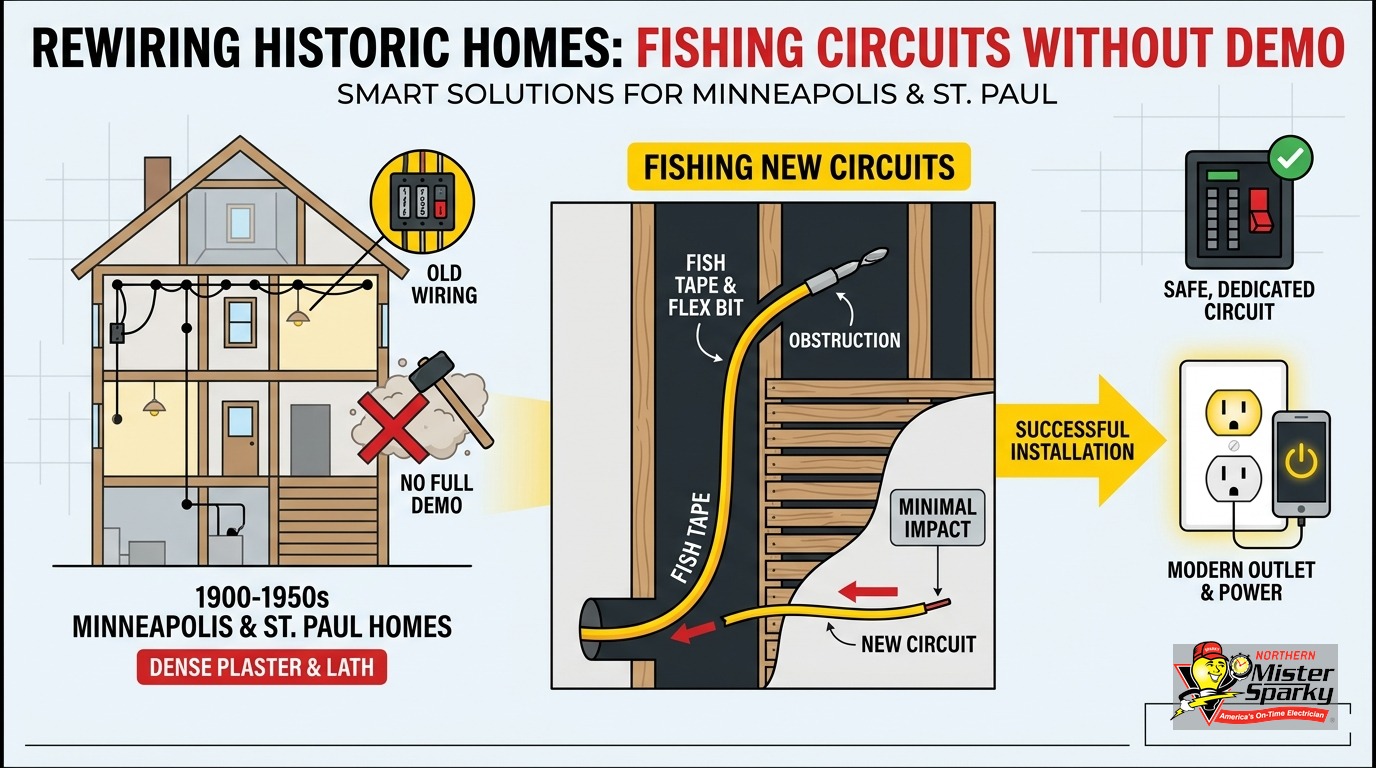
That design has real implications for wire fishing. To run a new circuit from the electrical panel in the basement to a second-floor bedroom, an electrician can often drop fish tape from an attic access point and pull cable all the way down in a single operation. In a platform-framed home, each floor level has a double top plate and a separate bottom plate. Every floor-to-floor transition requires drilling through framing and pulling a separate length of cable. Balloon framing collapses that into one pull.
The uncertainty is fire blocking. Balloon framing has no inherent fire stops between floors. Model codes began requiring fire blocking starting in the late 1920s, but adoption was inconsistent, and enforcement was spotty for decades. When fire blocking is present in a pre-1940 Twin Cities home, it was almost always added during a later renovation, not during original construction. You cannot know it is there until the fish tape hits it.
When blocking stops the run, there are two options. The electrician drills through it at a small access hole or opens a section of plaster to pass the cable manually. Either adds time and cost, but neither requires tearing out the full wall. We use an inspection camera and a weighted chain to map the bay before committing to a route.
What Are Plaster Keys and Why Do They Stop Fish Tape Cold?
Plaster keys are blobs of hardened plaster that squeezed through gaps between lath strips during original construction. They set inside the wall cavity and project inward, narrowing an already tight space. Fish tape can catch on them without warning, especially on horizontal runs where the tape must navigate multiple lath bays in sequence.
The cavity behind plaster-and-lath is narrow by design. Lath strips are typically 1.5 inches wide with gaps of roughly a quarter inch between them. Wet plaster pressed against the lath squeezed through those gaps and hardened behind the face. The resulting keys lock the plaster coat to the lath permanently. They are sharp enough to nick cable insulation if a tool is forced past them.
Forum discussions among working electricians confirm that plaster keys are a genuine and underappreciated obstacle, particularly on horizontal runs. The answer is not more force. Forcing fish tape past a plaster key can nick the tape, snap it, or crack the plaster face. The right approach is a set of flexible fiberglass rods, which bend around keys more gracefully than stiff steel tape. An inspection camera shows what you are dealing with before you push too far.
Minnesota’s climate adds another layer. Decades of freeze-thaw cycles cause old plaster to crack and settle. Many homes in Longfellow or Northeast Minneapolis have hairline cracks in their plaster that are invisible to the eye until a drill runs nearby. Vibration from a standard hammer drill can open those cracks. We use oscillating multi-tools and low-vibration drill bits near plaster surfaces to avoid widening damage that is already there.
How Electricians Fish Wire Through Plaster Walls Without Full Demolition
Every job starts with a route survey. The electrician identifies where the outlet or fixture will land, where the circuit originates, and what sits between them. The goal is to find paths that use existing cavities, access the run from above (attic) or below (basement or crawl space), and minimize the number of openings in the plaster face.
Here is how a typical vertical run in a balloon-framed plaster home proceeds:
- Probe to locate the stud bay using a stud finder or drill probe, then map the bay’s path from the planned outlet location to the attic or basement access point.
- Drop a weighted chain or string from the attic floor to confirm the bay is clear all the way through.
- Feed fish tape or a fiberglass rod from the attic down to the outlet location, or from the basement up, depending on which direction has cleaner access.
- Drill the outlet box opening in the plaster face. Use an oscillating tool to score the perimeter before cutting. This keeps the plaster face from cracking past the opening edges.
- Attach cable to the fish tape and pull steadily from the other end. Keep consistent tension. If resistance spikes, stop and probe before pushing.
- Install an old-work (remodel) outlet box with wing-clip anchors. These grip the back of the lath without requiring a stud behind the box.
- Secure the cable within 12 inches of each box entry, connect, and test.
NEC 334.30(B) explicitly permits NM cable to run unsupported through concealed spaces in finished buildings when support is impracticable. That is the code basis for fishing wire without demolition. The rule is clear: fishing a finished wall does not require stapling the cable at intermediate points along the concealed run.
NEC 300.4(A)(1) also applies. Where cable passes through drilled studs, it must sit at least 1-1/4 inches from the face of the framing member. If that clearance is not achievable, a 1/16-inch steel nail plate covers the hole. That requirement holds in retrofit plaster-wall work the same as in new construction. We never skip it.
What Happens When We Find Knob-and-Tube Wiring?
When our team encounters knob-and-tube while fishing a new circuit, the K&T section cannot be connected to modern cable and must be replaced before the job continues. Connecting NM cable to knob-and-tube at a junction point is a code violation. The materials are incompatible, and the fire risk is not theoretical.
Knob-and-tube wiring remains present in many pre-1950 Twin Cities neighborhoods, including Longfellow, Northeast Minneapolis, and St. Paul’s East Side. K&T uses rubber-insulated cloth conductors with no grounding wire. That insulation deteriorates with age, heat, and humidity. When we open a wall and find it, we stop, document its location, assess the scope, and discuss options before we proceed.
There is a second issue that is live in many Twin Cities homes right now: blown-in insulation. Heating costs push homeowners toward attic and wall insulation retrofits. Insulation cannot legally be installed over active knob-and-tube without written approval from a licensed electrician. K&T needs open air around the conductors to dissipate heat. Burying active K&T in cellulose or fiberglass traps that heat. If you are planning a weatherization project and new wiring in the same season, address the electrical first.
See our guide on knob-and-tube wiring replacement for what circuit-by-circuit and whole-house K&T replacement looks like in Minneapolis and St. Paul homes. If your home has cloth-wrapped wiring of any kind, read about cloth wiring hazards in older homes before scheduling any insulation or renovation work alongside electrical upgrades.
Do You Need a Permit to Run New Wire Through Plaster Walls?
Yes, without exception. Minnesota requires an electrical permit for any new circuit, outlet addition, or wiring modification in a finished space, including plaster-wall homes. No permit means no legal inspection, and an unpermitted wiring change can affect your homeowners insurance if a claim ever involves that work.
Permits for electrical work in Minnesota are filed through the Department of Labor and Industry (DLI) for most addresses in the Twin Cities metro. Minneapolis is among approximately 66 Minnesota cities that serve as their own authority having jurisdiction (AHJ). For those addresses, the permit process runs through the city building department rather than DLI directly. Confirming which authority covers your address before filing matters, because the forms and inspection scheduling differ between them.
The 2026 NEC took effect in Minnesota on August 17, 2026. Any permit filed on or after that date must comply with the updated code. Changes relevant to new circuits in older homes include updated AFCI protection requirements for circuits serving living areas, revised grounding requirements, and updated rules for cable protection through framing. We file permits on your behalf as part of every job and schedule the required inspections.
Rough-in inspection is required before any opened wall section is closed. If fishing your plaster walls requires opening a section for access or for K&T replacement, that section stays open until the inspector approves the rough-in. We coordinate the inspection timing to minimize how long any opening sits exposed, and we schedule plaster repair after the approval comes through.
For a full breakdown of what an electrical permit covers and what to expect during inspections in Minnesota, see our guide on electrical permits in Minnesota.
How Much of Your Plaster Wall Has to Open?
In a straightforward job with a clear stud bay, a single circuit run requires modest access: the outlet box hole, a probe hole at the top of the run (often tucked inside a closet or behind a piece of furniture), and possibly one access hole at an intermediate point if the path changes direction. That is patching work, not reconstruction.
Most jobs fall into the 60 to 80 percent range for concealed runs. That means most of the cable travels inside existing wall cavities without exposing any plaster face. The remaining portion of the run runs through visible access holes, which can be patched with plaster mix or drywall compound and painted to match.
That range shifts when complications arise:
- Unexpected fire blocking requires an additional access hole to drill through or manually pass the cable.
- Plaster keys that cannot be navigated by rod or tape require an opening to clear the path.
- Knob-and-tube in the run path requires opening additional wall sections for the replacement work.
- Horizontal runs across multiple stud bays are inherently more invasive than vertical runs through a clear bay.
When the scope of new wiring grows beyond one or two circuits, the math changes. A full home rewire done on a planned timeline allows coordinated plastering across all the opened sections at once. That is usually less expensive and less disruptive than patching five separate jobs over several years. We will tell you honestly when a partial job makes sense and when a full rewire is the smarter path.
Why Running Electrical Wire in Plaster Walls Needs a Licensed Electrician
The physical skills involved, reading resistance on a fish tape, choosing the right tool for a tight plaster cavity, keeping the plaster face intact while drilling near it, come from doing this work in real homes over time. The code knowledge required, AFCI requirements for new circuits, NM cable support rules, the K&T interaction rules, permit jurisdiction questions, is not something to reason through on your own home.
Licensing protects your insurance. Most homeowners policies require permitted, licensed electrical work. An unpermitted wire run that later causes a problem can affect your ability to make a claim. In pre-1950 plaster homes with layered wiring histories, the surprises are real. We have opened walls in Longfellow and found three generations of wiring in a single stud bay.
We are locally owned and operated as America’s On-Time Electrician(R) in the Twin Cities. We serve Minneapolis, St. Paul, Bloomington, Brooklyn Park, Woodbury, Blaine, Maple Grove, Plymouth, and surrounding communities. We know the Craftsman bungalows in Longfellow, the Foursquares in Tangletown, and the brick colonials in St. Paul’s Mac-Groveland neighborhood. We file permits through the correct authority for your address, schedule inspections, and give you a straight answer on scope and cost before any work begins.
Call 763-200-5956 or book online to schedule an estimate. We will walk the space with you, map the cleanest path for your new circuit, and tell you exactly what will need to open.
Frequently Asked Questions
Can you run new electrical wire through plaster walls without removing the plaster? +
Do I need a permit to add an outlet or circuit in my older Twin Cities home? +
What happens if electricians find knob-and-tube wiring when fishing new wire? +
How much of my plaster wall will have to be opened? +
Need an electrician now?