
Cloth Wrapped Wiring in an Older Home: Twin Cities Guide
Key Takeaways
- “Cloth wrapped wiring” covers three systems: knob-and-tube (K&T), cloth-sheathed NM cable (early Romex), and BX armored cable. The type you have changes your risk profile and your options.
- Most Twin Cities homes from 1940 to 1970 have cloth NM cable, not K&T. That distinction matters for code and insurance.
- Minnesota adopted the 2026 NEC effective August 17, 2026. Permits filed today must meet the new code.
- NEC Article 394.12 bars covering active K&T with blown or spray insulation. This blocks attic insulation upgrades and the Xcel and CenterPoint rebates that go with them until the wiring is remediated.
- Three insurer responses to cloth wiring in Minnesota: outright refusal, bind with a 30-to-90-day remediation deadline, or coverage with the electrical system excluded. Higher premiums with no exclusion is the best realistic outcome.
- Remediation is not binary. GFCI protection, AFCI breakers, selective circuit replacement, and full rewire each address different parts of the problem at different costs.
- Call 763-200-5956 or book online. We serve Minneapolis, St. Paul, Bloomington, Brooklyn Park, Woodbury, Blaine, Maple Grove, Plymouth, and surrounding communities.
If your Twin Cities home was built between 1940 and 1970, cloth wrapped wiring in your older home is likely behind the walls right now. Most homeowners discover it during a renovation, an insurance inspection, or when they try to qualify for an energy rebate - and then get contradictory advice about what it means and what to do.
This post sorts it out. Three distinct wiring systems use cloth insulation. They have different hazard profiles, different code implications, and different remediation paths. Here is the straight answer, grounded in Minnesota code and Twin Cities housing stock.
What Is Cloth Wrapped Wiring in an Older Home?
Short answer: Cloth wrapped wiring is any electrical cable insulated with woven cotton, rayon, or similar fabric material rather than modern PVC plastic. It was standard in homes built roughly from 1910 to 1970. The phrase covers three systems with different risk profiles and different remediation requirements. Identifying which one you have is the first step.
Most homeowners find it in attics, behind junction boxes, and wherever old wiring is exposed. The fabric sheath looks braided or woven - often black, brown, or gray - and feels brittle or crumbly in wiring that is 50 or more years old.
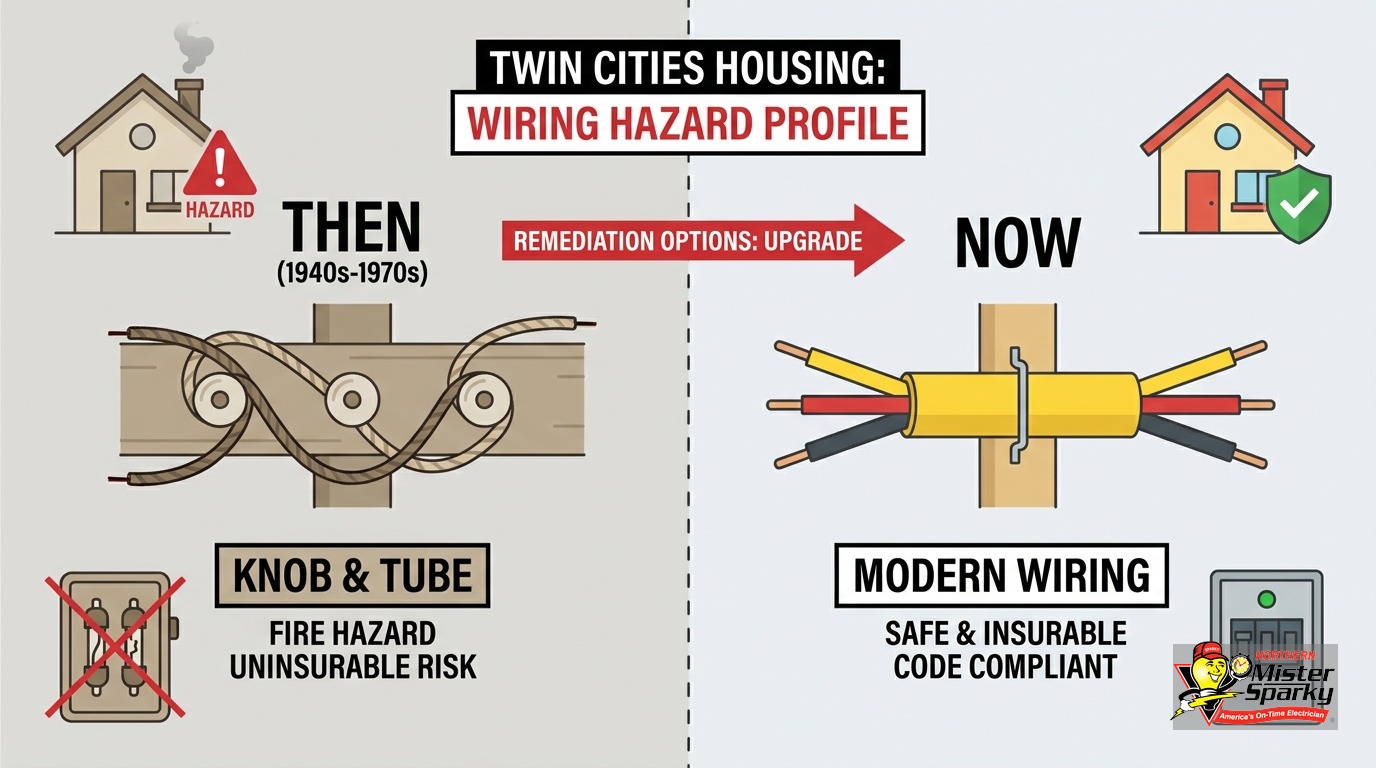
Knob-and-tube wiring (K&T): The oldest system, installed roughly from 1880 to 1950. Individual hot and neutral conductors run separately through the walls and ceilings, supported by ceramic knobs and routed through ceramic tubes where they pass through wood framing. No outer sheath. No ground conductor. K&T is the system most homeowners picture when they hear “old wiring,” but it is not the dominant type in Twin Cities homes from 1940-1970.
Cloth-sheathed NM cable (early Romex): Manufactured as early as 1922 using cotton braid impregnated with pitch or tar. Rayon replaced cotton around 1950. PVC plastic sheathing took over by approximately 1970, and a third ground conductor was added in the 1960s. This cable looks like modern Romex but with a woven outer braid instead of a smooth plastic jacket. It is the most common old-wiring type in Twin Cities homes built from 1940 to 1970.
BX armored cable: A metal-sheathed cable with cloth-insulated conductors inside. The spiral interlocking steel armor was common in 1930s-1960s construction. The metal armor itself is supposed to serve as the equipment ground - which creates a specific hazard described below.
If you have a mix of renovation eras in your home, you may have more than one of these systems behind different walls.
How Do I Know Which Type I Have?
Short answer: Look at the cable’s outer covering. K&T has no outer sheath - each wire runs alone, suspended by ceramic insulators attached to the framing. Cloth NM looks like Romex but with a fabric braid on the outside instead of smooth plastic. BX has a spiral metal armor with cloth-insulated wires inside. A licensed electrician can confirm during an assessment.
One important warning before you investigate: some older cloth insulation contains asbestos. Specifically, Type AVB wire uses asbestos-impregnated insulation, and visual inspection alone cannot distinguish AVB from non-asbestos cloth wire. Do not disturb old cloth wiring in attics or wall cavities before a professional has assessed it. This is especially important if insulation work is planned - disturbing AVB wiring without testing first is a health hazard on top of an electrical one.
Is Cloth Wrapped Wiring Dangerous?
Short answer: The hazards are real but specific. Insulation decay, electrical capacity mismatch, and fixture incompatibility are the three main threats. A home with intact cloth NM wiring and modest electrical loads carries different risk than one with crumbling insulation, a home office, and modern LED fixtures swapped onto 60-year-old conductors. The details matter.
Hazard 1: Insulation decay
Cotton and rayon braid does not last forever. After 50 to 70 years, the fabric becomes brittle, cracks, and separates from the underlying conductor. Bare wires contacting wood framing, blown insulation, or stored items in an attic are a fire risk. NFPA data shows electrical distribution and lighting equipment is a leading cause of home structure fires each year. Older homes with degraded insulation carry a disproportionate share of that number. A separate CPSC study found more than 25 distinct code violations in most examined homes older than 40 years.
Hazard 2: Electrical capacity mismatch
Homes wired in the 1940s and 1950s were designed for roughly 25 to 50 percent of modern household electrical demand. A circuit sized for a lamp and a radio is not built for a home office running two monitors, a standing desk, a printer, and a space heater. Overloading is a primary fire hazard in older homes - separate from and in addition to insulation decay. The breaker protects the circuit, but if the wiring is already thermally stressed, the protection arrives too slowly.
Hazard 3: Temperature rating mismatch
Older cloth conductors are rated for 60 degrees Celsius. Modern LED fixtures and many appliances require wire rated for 90 degrees. Connecting a new fixture to cloth-covered conductors accelerates insulation failure and creates an immediate fire hazard. This is one of the most common ways older wiring becomes an active problem - during what the homeowner treats as a routine fixture swap.
The BX ground problem
BX armored cable has its own distinct failure mode. The spiral interlocking armor is designed to serve as the equipment grounding conductor, but the design creates high impedance in the grounding path. In a fault, that impedance can prevent a circuit breaker from tripping fast enough. The result combines shock risk with fire risk in a way that GFCI protection alone does not resolve - a hazard profile separate from the cloth insulation issue.
What Does Minnesota Code Say About Cloth Wrapped Wiring in an Older Home?
Short answer: Minnesota adopted the 2026 NEC effective August 17, 2026. Permits filed before that date follow the 2023 NEC. No code requires you to immediately rewire a home with existing old wiring, but any additions, repairs, or alterations must comply with the current code. Two provisions directly affect Twin Cities homeowners with cloth wiring.
The 2026 NEC cutover
Minnesota’s Department of Labor and Industry adopted the 2026 NEC on August 17, 2026. If you started a permitted project before that date, you work under the 2023 NEC. Any permit application filed today falls under the 2026 code. This matters when you price remediation work: the code your permit follows determines which specific requirements apply to the new circuits and connections.
Minneapolis, St. Paul, and the other 64 cities
Many Minnesota cities have adopted local electrical inspection authority, including Minneapolis and St. Paul. In those cities, city inspectors issue and review permits - not the state DLI. Outside those cities, DLI handles your permit. Before applying for any permit, confirm which jurisdiction covers your address. The inspection requirements do not change dramatically between DLI and city authority, but the office you contact and the permit form you use do.
Minnesota homeowners in owner-occupied single-family homes may pull their own electrical permit. A final inspection is required regardless of who pulls the permit. If you are considering DIY remediation work, confirm the specific scope with your jurisdiction before you start.
NEC Article 394.12: the insulation blocker
This is the provision that catches the most Twin Cities homeowners off guard. NEC Article 394.12 bars active knob-and-tube wiring from being surrounded by loose, rolled, or foam insulation. If your attic has active K&T and you want blown-in insulation - a project that qualifies for Xcel Energy, CenterPoint Energy, and the state’s weatherization rebates - you cannot install the insulation until the K&T is remediated first.
Cloth NM cable does not carry the same blanket prohibition. But degraded cloth NM insulation creates equivalent risk when disturbed by insulation work. Either way, an electrician assessment before any attic insulation project is the right starting point and often a program requirement.
Will Insurance Cover a Home With Cloth Wrapped Wiring?
Short answer: Maybe - and the terms are usually unfavorable. Three responses are common in Minnesota: outright refusal to bind coverage, binding with a 30-to-90-day remediation deadline rider, or coverage with the electrical system excluded from claims. Higher premiums with no exclusion is the best realistic outcome most homeowners see.
Policy non-renewals and bind-with-deadline riders are increasingly common in Minnesota, particularly when an insulation upgrade request prompts the insurer to look at the electrical system. Insurers cross-reference the two questions: can this home hold new insulation safely? If old wiring is the answer, the underwriters take notice.
If your insurer sends a remediation letter, have a licensed electrician document the specific work completed before you respond. GFCI-only protection satisfies NEC requirements for upgrading ungrounded receptacles, but most Minnesota insurers will not accept it as a permanent resolution and will not remove an exclusion rider based on GFCI work alone.
For detail on what insurers inspect and what satisfies their requirements in Minnesota, see our guide to home insurance electrical inspection requirements.
The Insulation Catch-22 in Minnesota Homes
Minnesota’s climate makes attic air sealing and blown-in insulation one of the best return-on-investment weatherization upgrades available to homeowners. Xcel Energy, CenterPoint Energy, and the state’s Efficient Homes weatherization program all offer rebates for this work - sometimes covering a meaningful share of the project cost.
Every one of these programs requires the electrical system to be cleared by a licensed electrician before insulation is installed.
For homes with active K&T, NEC Article 394.12 is a hard wall. The insulation physically cannot go over the wiring. For homes with cloth NM cable, the barrier is softer - the electrician determines whether the wiring is in good enough condition to be enclosed and whether the insulation work would disturb the conductors in an unsafe way.
Either path runs through an electrical assessment. If you are planning an insulation project this fall or winter - when most Twin Cities homeowners start thinking about heating bills and drafty attic bypasses - schedule the electrical assessment first. It determines what insulation you can install, what remediation needs to happen before the insulation crew arrives, and whether your rebate application qualifies now or after electrical work is complete.
The assessment is the cheapest item in this sequence. It prevents you from scheduling an insulation project that has to stop when the crew opens the attic and sees K&T.
What Are My Remediation Options?
Short answer: Remediation is not a binary choice between “do nothing” and “rewire the entire house.” There is a meaningful spectrum from targeted protection to full replacement. The right answer depends on your wiring type, the insulation condition in accessible areas, what your insurer requires, and what you plan to do with the home.
Option 1: GFCI protection
Installing GFCI protection at the first outlet on an ungrounded circuit mitigates shock hazard and is NEC-compliant for upgrading two-prong ungrounded outlets to three-prong. It is the least expensive and least invasive option. The limits are significant: GFCI does not add a true equipment ground, does not address insulation decay, and most Minnesota insurers do not accept GFCI-only work as a permanent resolution.
Good fit for: a limited number of ungrounded outlets in an area where insulation is still intact and no insurer letter has been issued. See our guide to ungrounded outlets in older homes for more on when this path makes sense.
Option 2: AFCI breakers
Arc-fault circuit interrupter breakers detect arcing in deteriorated wiring - the kind of fault that starts a wall fire before the breaker trips on overcurrent. Adding AFCI protection is a real safety improvement over a standard breaker for aging circuits. The limits: no ground conductor is added, AFCI does not make it legal to cover old wiring under blown insulation, and most Minnesota insurers do not accept AFCI-only remediation as a final answer.
AFCI works best as one layer of a broader remediation strategy, not as the standalone solution. Our post on AFCI breaker requirements covers when they are required and how they interact with older wiring systems.
Option 3: Selective circuit replacement
Replace the highest-risk circuits - kitchen, bathrooms, laundry, home office, and any circuits showing signs of overloading at the panel - while leaving lower-demand circuits in place where insulation is intact and accessible runs are clean. A licensed electrician assesses which circuits carry the greatest hazard and sequences the work to match your budget and insurer’s specific requirements.
This middle path costs significantly less than a full house rewire and often satisfies an insurer’s remediation requirement when documented correctly. For most Twin Cities homeowners with cloth NM cable who do not have an insulation project planned, selective circuit replacement is where the assessment lands.
Option 4: Full house rewire
A full rewire replaces all cloth wiring with modern cable. In Twin Cities homes with lath-and-plaster walls - standard in 1940s-1960s construction - this used to mean tearing out wall sections. It does not have to.
Electricians experienced with older Minnesota homes use minimally invasive fishing techniques: routing new cable through existing wall cavities via planned access points, reusing existing pathways where possible, and patching small openings rather than demolishing plaster. For a homeowner who wants to preserve the character of a 1950s bungalow, this distinction is significant in both cost and disruption.
A full rewire typically pairs with a panel upgrade in homes still running a fuse box. See our detailed breakdown of what a full house rewire costs in the Twin Cities for current pricing in this market. For larger rewire projects, ask about financing options when you call.
When Should I Call an Electrician?
Short answer: Before any renovation, before adding attic insulation, before listing or buying a home with old wiring, or any time you see the warning signs below. An assessment costs a fraction of what emergency repairs or an insurer exclusion will cost later.
Warning signs that need attention now
- Outlets or switch covers feel warm to the touch
- A burning or musty electrical odor near an outlet, panel, or in the attic
- The same circuit breaker trips repeatedly under normal loads
- Lights dim or flicker when a large appliance starts
- Two-prong outlets throughout the house and years of adapter use
- An upcoming attic insulation project and no knowledge of what wiring is up there
- A purchase offer on a pre-1970 Twin Cities home pending inspection
Any one of these in a home with cloth wiring is a reason to call before the next step.
What the assessment covers
A licensed electrician will identify the wiring type, assess insulation condition in accessible areas including the attic and basement, check for overloaded circuits, flag immediate hazards, and give you a clear remediation roadmap. That assessment is the starting document for responding to an insurer’s remediation letter, preparing for a pre-sale inspection, or planning a renovation without mid-project surprises.
We are Northern Mister Sparky, locally owned and operated in the Twin Cities. As America’s On-Time Electrician(R), we show up when we say we will and give you a straight answer on what you have and what it takes to fix it - no malarky, no upsell pressure. Our work is backed by the UWIN(R) 100% satisfaction guarantee.
Call 763-200-5956 or book online to schedule your assessment. We serve Minneapolis, St. Paul, Bloomington, Brooklyn Park, Woodbury, Blaine, Maple Grove, Plymouth, and surrounding Minnesota communities.
Frequently Asked Questions
What is cloth wrapped wiring and is it legal? +
Do I have to rewire my house if it has cloth wiring? +
Can I add attic insulation if my home has knob-and-tube wiring? +
Need an electrician now?