
Rewire Old Home: Homeowners Insurance Savings in Minnesota
Key Takeaways
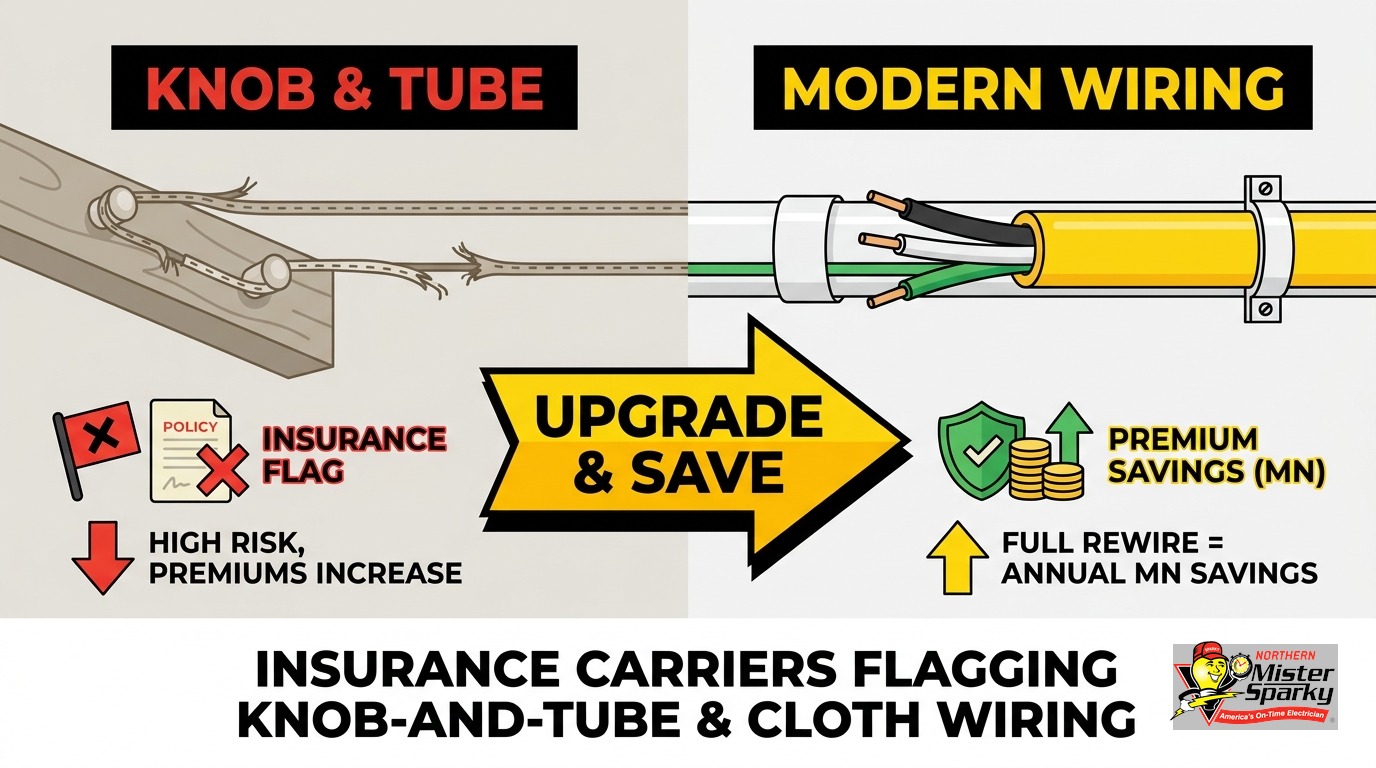
- Rewiring an old home unlocks real homeowners insurance savings: Minnesota carriers surcharge knob-and-tube (K&T) homes by 50 to 100 percent, or deny coverage outright.
- On Minnesota’s 2025 average premium of $3,530 per year, the K&T surcharge can add substantially to your annual costs every year the old wiring stays. The savings begin immediately once it comes out.
- Minnesota recorded the largest single-year home insurance increase in the United States in 2025. The K&T surcharge now lands on top of an already-painful base rate.
- Under NEC Article 394.12, active K&T wiring cannot be covered by insulation. That blocks every efficiency upgrade and adds a heating penalty on top of the insurance hit.
- A full rewire, permitted through MN DLI and completed by a licensed electrician, returns you to standard insurance rates and unlocks every insulation upgrade.
- Call 763-200-5956 or book online to find out what your home needs.
What Does Rewiring an Old Home Save on Homeowners Insurance in Minnesota?
The short answer: On Minnesota’s current average premium, the K&T surcharge costs $1,765 to $3,530 per year. After a full rewire, standard carriers remove the surcharge. The savings begin at your first renewal after the permit closes.
Standard insurers price risk. Knob-and-tube wiring represents a specific, documented risk: ungrounded circuits, rubber insulation that becomes brittle with age, and no arc protection. When an underwriter finds K&T during a home inspection or policy review, the response falls into one of three categories.
The first is a surcharge: 50 to 100 percent added to the base premium. The second is an ultimatum: remove the K&T within 30 to 60 days or the policy is cancelled. The third is an outright denial. Standard carriers routinely decline K&T homes or push them to non-standard markets, where premiums are higher still.
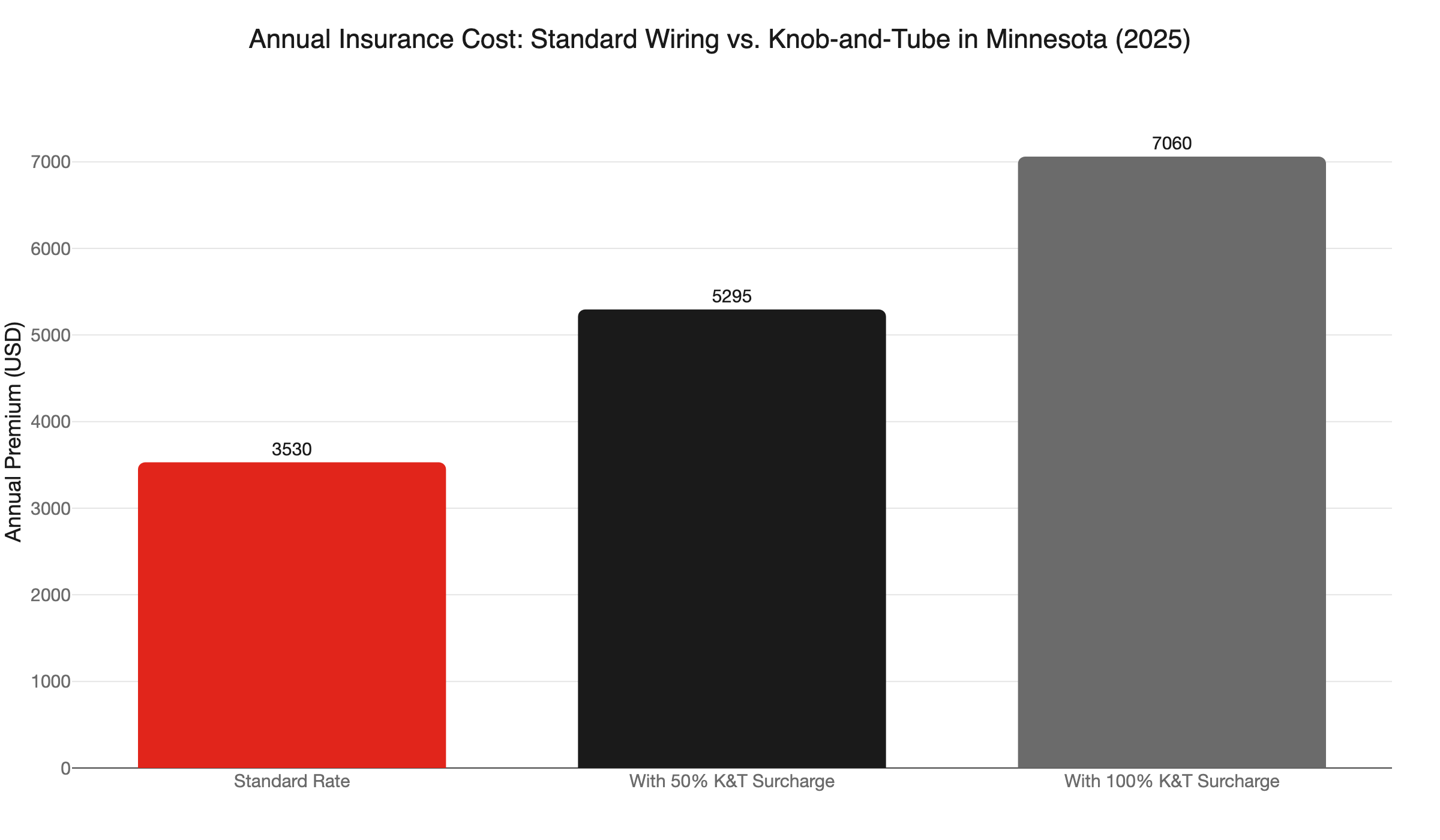
The dollar impact is concrete. Minnesota’s average homeowners premium hit $3,530 in 2025, a 34 percent single-year increase, the largest of any state nationally. Add a 50 percent surcharge and the total is $5,295 per year. Add a 100 percent surcharge and it reaches $7,060. In the Twin Cities metro, where property values and hail frequency push premiums above the state average, the numbers climb further.
The rewire old home homeowners insurance savings calculation is simple: multiply the surcharge percentage by your current annual premium, then add that figure back every year until the wiring comes out. A three-year delay at the low surcharge end is $5,295 you will not recover.
After the rewire is complete and the permit is closed, you document the work, notify your insurer, and request a rate review. Most policies return to standard rates at the next renewal. Some carriers issue a mid-term adjustment. Either way, the annual savings start immediately.
Why Minnesota Homeowners Are Getting Hit Harder Right Now
Minnesota’s 34 percent single-year premium spike was not an accident. The state sits in a high-hail corridor. The Twin Cities metro sees hail events regularly, and reinsurance costs tied to hail claims have passed directly into retail premiums. Property values in Minneapolis, St. Paul, Edina, St. Louis Park, and the first-ring suburbs have also risen sharply. Minneapolis home coverage can run above the state average.
The result: the base rate against which a K&T surcharge is applied has never been higher. A 50 percent surcharge on a $2,200 base premium two years ago was $1,100 per year. That same surcharge on today’s $3,530 base is $1,765. Same percentage. Much larger dollar amount.
Homes built before 1950 are common throughout Minneapolis, St. Paul, South Minneapolis, Nordeast, Edina, St. Louis Park, and the western first-ring suburbs. If your home is in that era and has never had a full electrical inspection, there is a real chance that K&T or cloth-insulated wiring is still active in the walls. Many of these homes were “updated” decades ago, but the update substituted cloth-insulated wire for K&T rather than modern Romex. Insurers treat cloth wiring identically to K&T: brittle insulation, no ground, arc risk.
Minnesota’s record rate environment makes this the worst possible time to carry a K&T surcharge. Every month you wait is a dollar amount you will not recover.
What Is Knob-and-Tube Wiring, and Why Do Insurers Flag It?
The short answer: K&T is pre-1940s two-conductor wiring with no ground wire and rubber insulation that dries out and cracks over decades. Insurers flag it because overloaded and degraded K&T circuits produce the arc conditions that lead to structure fires.
Knob-and-tube gets its name from the ceramic knobs used to anchor wire to framing and the ceramic tubes that protect it where it passes through framing members. The system is two-conductor: a hot and a neutral, with no ground wire. The design assumed air would cool the wire. Home electrical loads in the 1930s were light: a few fixtures, a radio, maybe a refrigerator.
Modern loads, including dishwashers, central air, EV chargers, and home offices, can exceed what K&T circuits were sized for by a wide margin. Over 80 or 90 years, the rubber insulation dries out, cracks, and falls away from the conductor. The combination of degraded insulation and overloaded circuits is where arc conditions originate.
Electrical fires cause a significant number of house fires every year in the U.S., resulting in substantial annual damage. Insurers price against that data. K&T wiring is a well-documented variable in that equation.
One misconception worth addressing directly: adding AFCI breakers resolves the insurance problem. It does not. AFCI breakers do not satisfy insurance underwriters and do not make K&T legal to cover with insulation. The arc fault interrupter monitors the circuit. The problem is the wire itself. Insurers want the wiring removed, not monitored.
The Insulation Catch-22: How K&T Costs You Twice
Most articles stop at the insurance surcharge. They miss the heating bill.
Under NEC Article 394.12, knob-and-tube wiring cannot be surrounded by loose, rolled, or foamed-in-place insulation in walls, ceilings, or attics. K&T was designed to dissipate heat into open air. Cover it and the heat has nowhere to go, creating a fire hazard that is not hypothetical. The code reflects that physics.
For Minnesota homeowners, this creates a specific financial trap. You cannot add blown-in attic insulation. You cannot fill wall cavities with batt or blown-in material. You cannot spray-foam rim joists or attic penetrations anywhere K&T is active. In Minnesota, where heating costs are a real line item for eight months of the year, the inability to properly insulate adds hundreds of dollars per year in energy costs on top of the insurance surcharge.
This is the number most competitors miss entirely. The rewire old home homeowners insurance savings figure needs two lines, not one: the annual insurance surcharge removed, plus the annual heating savings unlocked when you can finally insulate. Bright Haven Electric’s breakdown makes this point clearly for Minnesota homeowners. Active K&T blocks every insulation upgrade. You are paying an insurance penalty and a heating penalty simultaneously.
When you account for both, the payback period on a full rewire compresses significantly. And once the insulation is in, those heating savings recur every winter.
Rewire Old Home Homeowners Insurance Savings: Running the Real Math
No other source in this conversation runs the actual numbers. Here they are.
Minnesota’s 2025 average homeowners premium: $3,530 per year. K&T surcharge range: 50 to 100 percent. Annual surcharge in dollar terms: $1,765 to $3,530. Total annual cost with surcharge: $5,295 to $7,060. That is the number a Minnesota homeowner with active K&T wiring is paying right now, before the heating penalty.
With the surcharge removed after a full rewire, the policy returns to the base rate. The savings are $1,765 per year at the low end, $3,530 at the high end. Over five years, that is $8,825 to $17,650 that stays in your pocket.
The Twin Cities metro pushes those numbers higher. Property values and hail frequency lift Minneapolis-area premiums above the state average. If your annual base premium is $4,200, the 50 percent surcharge is $2,100 per year. The 100 percent surcharge is $4,200 per year. The range widens with the base.
According to Wirechief Electric’s review of K&T insurance costs, homeowners in non-standard policies often see their premium cut substantially after a full rewire. Standard market access, which is restored by the clean permit and inspection documentation, is itself a financial benefit.
Add the heating savings. Proper attic insulation commonly cuts heating bills by 10 to 20 percent on homes that were previously unsealed. On a home spending $3,000 per year in heating, a 10 percent reduction is $300 per year, also recurring. The total annual value of a completed rewire, insurance savings plus heating savings, continues indefinitely. The rewire is not an expense on a spreadsheet. It is a number of years of compounded cost that stops.
Does the Type of Old Wiring Matter to Insurers?
The short answer: Cloth-insulated wiring and knob-and-tube are treated identically by most insurers. Both are flagged for brittle insulation, no ground wire, and arc risk. Aluminum wiring from the 1960s and 1970s is a separate category, also flagged.
Many Twin Cities homeowners assume their home is fine because a previous owner “updated” the wiring. That update may have replaced K&T with cloth-insulated wire rather than modern Romex. Cloth wiring uses a rubber-core conductor wrapped in a braided cloth jacket, common from the 1930s through the 1960s. The insulation degrades the same way K&T does. The circuits are still ungrounded. Insurers treat it the same way.
The distinction matters because cloth wiring can appear in homes that look partially updated. A previous electrical job may have replaced some circuits while leaving cloth wiring on others. If your outlet boxes have fabric-wrapped wires running into them alongside newer wiring, you have a mixed system. The insurer sees K&T-equivalent risk, not a partial exception.
For a detailed look at what cloth wiring looks like and how to identify it in your home, see our post on cloth wiring hazards in older homes.
Aluminum wiring is a third category, installed in many homes from the mid-1960s through the 1970s when copper prices spiked. The CPSC found that homes with aluminum wiring face a significantly higher risk of fire hazard conditions than copper-wired homes. Insurers flag it separately, often requiring either full replacement or CO/ALR-rated connectors at every outlet. An electrical inspection will clarify which type of wiring your home contains and what remediation looks like for your specific situation.
What Does a Full Rewire Cost in the Twin Cities, and How Does the Math Work Out?
The short answer: Rewire costs vary by home size and construction type. Even at the higher end of the project range, a K&T surcharge of $1,765 to $3,530 per year means the investment pays back faster than most homeowners expect.
We break down the specific cost ranges at cost to rewire a house in the Twin Cities. The variables that drive cost most are square footage, number of circuits, wall material (plaster and lath versus drywall), and how much of the K&T is concentrated in accessible areas like attics and unfinished basements.
Homes that have been partially updated over the years are often less expensive to rewire than homes where 100 percent of the wiring is original K&T. A full electrical inspection identifies which circuits are still K&T and which have already been replaced, so you know the actual scope before committing to a project.
On the savings side, the insurance math is straightforward. A $1,765 annual insurance surcharge at the low end begins repaying the rewire cost from year one. At the $3,530 high end, the arithmetic is compelling even on larger homes. Add heating cost recovery from unlocked insulation work and the payback period shortens further.
Tax credits are worth noting. Under the Inflation Reduction Act’s 25C provision, homeowners can claim up to $600 on qualifying electrical panel upgrades and up to $1,200 on qualifying energy efficiency improvements in the same tax year. Rewires on older homes commonly pair with a panel upgrade. See our post on IRA electrical upgrade tax credits for homeowners for what qualifies under current rules. Financing is also available for larger projects, so ask our team when you call.
What Should I Expect From the Rewire Process in Minnesota?
The short answer: A full rewire requires a permit through MN DLI, work by a licensed Minnesota electrical contractor, and a final inspection. The closed permit with inspection sign-off is the document your insurer needs to remove the surcharge.
Minnesota adopted the 2026 National Electrical Code, effective August 17, 2026. Any permit filed today is governed by the 2026 NEC, which includes updated requirements for AFCI and GFCI protection, tamper-resistant receptacles, and grounding. A properly permitted rewire brings your electrical system fully into compliance with current code, which matters for insurance purposes and for future home sales.
Homeowners can verify electrician license status and track permit progress through the MN DLI online portal. The permit number, the licensed electrician’s credential number, and the final inspection sign-off together form the packet your insurer needs to process the rate adjustment. Have your electrician document all three before the project closes.
In practice, the scope of work varies by house. Older Minneapolis and St. Paul homes with plaster and lath walls require wire-fishing techniques to route new circuits with minimal wall damage. K&T is often concentrated in attics and unfinished basements, where access is straightforward and the work moves quickly. An inspection makes the scope concrete: which circuits are K&T, which have already been updated, and what a full rewire involves in your specific home before any work begins.
See whole home rewire process: what to expect for a detailed walkthrough of what the project looks like from first inspection through final sign-off.
Is It Worth Rewiring Before Selling Your Home?
The short answer: Often yes. K&T wiring is a common deal-killer in home inspections, and some mortgage lenders will not underwrite a loan on a K&T home. Selling with the rewire done removes a significant negotiating liability and opens the property to conventional financing.
Buyers who find K&T in an inspection typically respond in one of three ways: they walk, they ask for a price reduction well above the cost of the rewire, or they make the rewire a condition of closing. All three outcomes are worse than walking in with the work done and the permit documentation in hand.
Some FHA and conventional lenders require K&T to be fully removed as a condition of financing. A buyer who loves the home may lose their financing if the inspection surfaces active K&T. The rewire removes that contingency entirely.
For homeowners who plan to stay, the case is clear on the insurance and heating numbers alone. For homeowners considering a sale in the next one to three years, the rewire also unlocks the conventional buyer pool and removes the negotiation liability. Our team can walk you through what the scope looks like and what documentation you will have in hand to present to buyers and their agents when the time comes.
Ready to Stop Overpaying?
The rewire old home homeowners insurance savings are not theoretical. On Minnesota’s current premiums, carrying K&T or cloth wiring costs $1,765 to $3,530 more per year on insurance alone. After Minnesota’s record 34 percent rate spike in 2025, that surcharge lands harder than it ever has. Add the heating cost from insulation you cannot yet install, and the total annual cost of waiting is real and recurring.
Our team inspects older Twin Cities homes every week. We know the construction patterns in Minneapolis, St. Paul, Edina, St. Louis Park, Nordeast, and the first-ring suburbs. We know where K&T hides, how to route new wire through old construction cleanly, and what documentation your insurer needs to remove the surcharge.
We are locally owned and operated. As America’s On-Time Electrician(R), we show up when we say we will. Our UWIN(R) 100% satisfaction guarantee backs every job.
No malarky: if your home needs a rewire, we will tell you. If it does not, we will tell you that too.
Call 763-200-5956 or book online.
Frequently Asked Questions
How much can rewiring an old home save on homeowners insurance in Minnesota? +
Does rewiring a house lower homeowners insurance? +
Can I get homeowners insurance with knob-and-tube wiring in Minnesota? +
Need an electrician now?