
Knob and Tube Wiring Replacement Cost: Twin Cities Guide
Key Takeaways
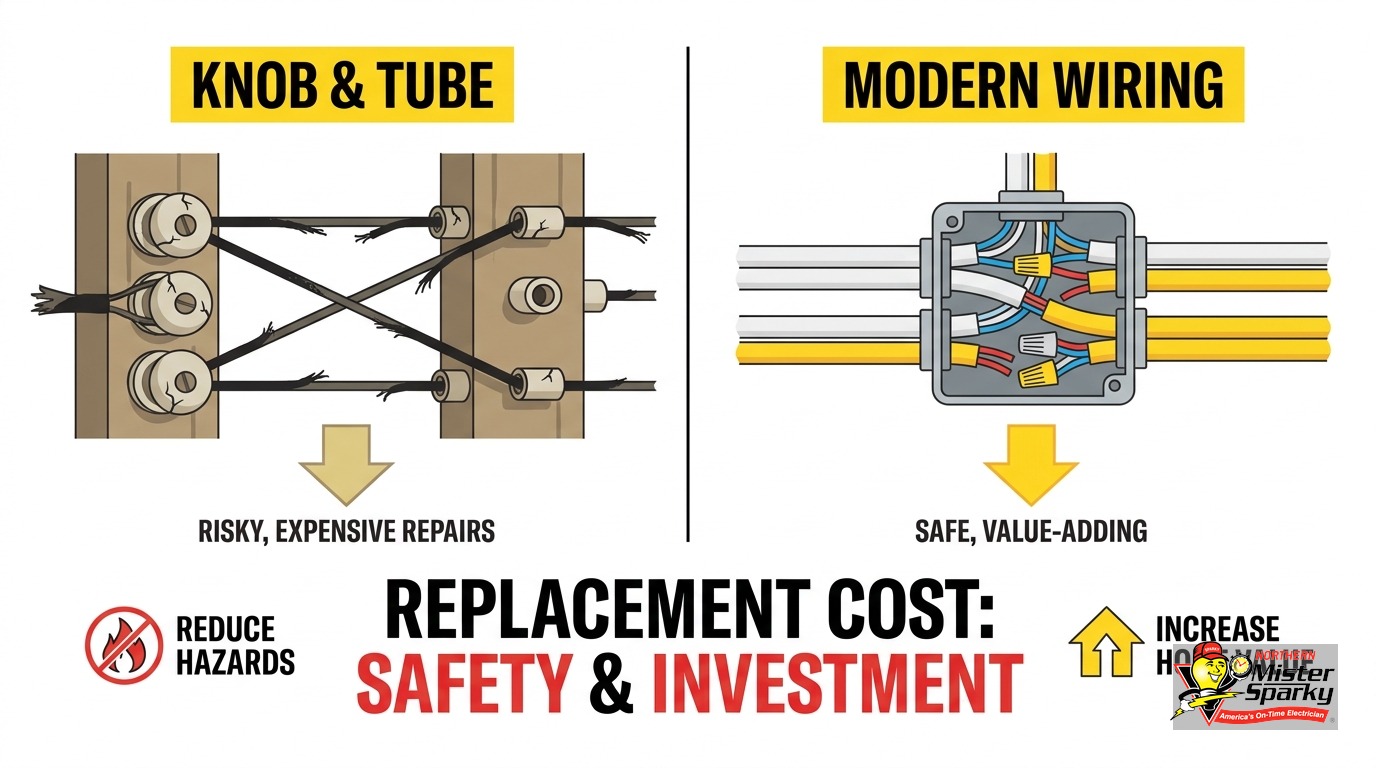
- Knob and tube wiring replacement cost in the Twin Cities runs $12,000 to $36,000 before rebates. Most mid-size homes land between $18,000 and $28,000.
- Three events force the decision: an insurer’s remediation letter, a failed home-sale inspection, or a weatherization contractor stopped by code from proceeding with attic insulation.
- Minnesota adopted the NEC 2026 code effective August 17, 2026. Permits filed today fall under the 2026 code, not the 2023 edition most competitors still cite.
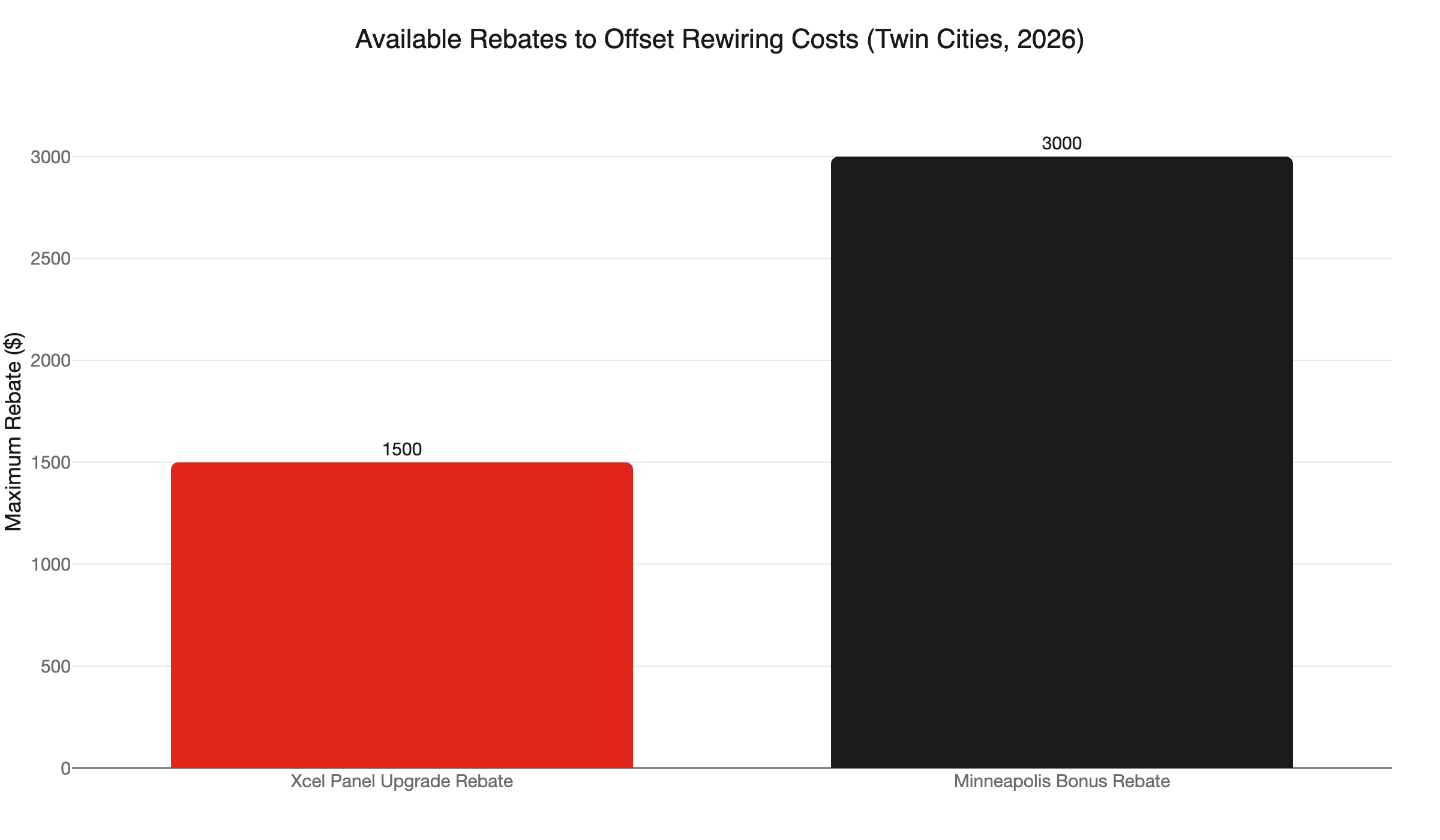
- Xcel Energy offers up to $1,500 on a panel upgrade. Minneapolis homeowners pairing the project with a heat pump can stack an additional $3,000 bonus rebate.
- The federal Section 25C tax credit expired December 31, 2025. Federal HEAR rebates are not yet available in Minnesota as of mid-2026.
- Replacing knob and tube wiring unlocks attic insulation, a second project with its own rebates that NEC code currently blocks while the old wiring is live.
What Forces a Twin Cities Homeowner to Replace Knob and Tube Wiring?
Three events send Twin Cities homeowners to Google this query. An insurer’s 30-to-90-day remediation deadline, a buyer’s inspector killing a home sale, or a weatherization contractor stopped by NEC 394.12 from adding attic insulation while active knob and tube wiring runs through the same space.
Most homeowners replacing knob and tube wiring are not doing it by choice. They are responding to a deadline, a failed deal, or a contractor’s stop order. Understanding which scenario you are in shapes the timeline and cost decisions that follow.
An insurer’s remediation letter. Minnesota carriers increasingly refuse to write or renew policies on homes with active knob and tube wiring. When they do agree to cover the home, they often exclude electrical from the policy or attach a rider requiring documented repairs within 30 to 90 days. The Minnesota FAIR Plan serves as a last-resort carrier when standard insurers decline, but FAIR Plan premiums run higher and coverage is more limited.
Our post on knob and tube wiring and homeowners insurance in Minnesota covers what to expect from your carrier and how to document the completed repair to close a policy rider.
A failed home-sale inspection. A buyer’s inspector flags active knob and tube wiring in older Twin Cities homes almost without exception. The deal pauses for remediation or collapses entirely. Sellers in Minneapolis, St. Paul, and the first-ring suburbs are increasingly scheduling an electrical assessment before listing to get ahead of this conversation.
A weatherization contractor’s stop order. You schedule attic insulation to capture a Xcel or CenterPoint rebate. The contractor scopes the attic, finds active knob and tube wiring, and cannot proceed. NEC Article 394.12(5) prohibits surrounding active knob and tube wiring with loose, rolled, or foam-in-place insulation. The insulation job stops. Now you have two projects to fund instead of one.
If you are still evaluating whether your wiring is a problem, our post on knob and tube wiring hazards and what to expect during an inspection covers those fundamentals so this post can focus on cost and decision-making.
How Much Does Knob and Tube Wiring Replacement Cost?
A full rewire in the Twin Cities costs $12,000 to $36,000. Most 1,200-to-1,800-square-foot homes land between $18,000 and $28,000. Square footage, wall accessibility, and whether a panel upgrade is required are the three biggest drivers of that range.
Here is how each factor moves the number:
Square footage. More square footage means more wire runs, more outlet and switch devices, and more labor hours. A 1,000-square-foot bungalow and a 2,500-square-foot two-story Victorian are entirely different scopes.
Accessibility. A home with an open, unfinished basement and accessible wall cavities costs considerably less to rewire than a fully finished home with plaster-and-lath walls throughout. Twin Cities neighborhoods like Cathedral Hill, Summit Ave, Longfellow, and Macalester-Groveland have a high density of plaster construction. Plaster adds patching cost and labor time to every wire run that goes through a wall.
Panel capacity. Most homes with active knob and tube wiring have a 60-amp or 100-amp service panel. That capacity cannot support modern electrical loads. A panel upgrade to 200 amps is frequently required alongside the rewire, adding roughly $2,000 to $5,000 to the job. It also makes you eligible for the Xcel rebate covered below.
Permit fees. A full-home rewire permit in Minnesota typically runs $200 to $500, depending on job valuation and the local fee schedule.
Cost-per-square-foot ranges published in national articles are a useful starting point, but they often reflect lower-cost labor markets. The Twin Cities has its own labor rates and its own housing stock complexity. Get a written estimate from a DLI-licensed electrician before committing to any national benchmark.
What Does the Price Actually Include?
A complete knob and tube replacement covers demo of old wiring, new cable runs to every device, updated GFCI and AFCI protection, a panel upgrade if required, the permit, and basic drywall patching. Finish painting and texture matching are typically excluded from the base scope.
Here is the typical line-item breakdown:
- Removal of all accessible knob and tube wiring
- New NM cable or conduit run to every outlet, switch, and fixture
- Updated devices, including GFCI and AFCI protection where the 2026 NEC requires it
- Panel upgrade to 200 amps if the existing panel cannot support the new load
- DLI electrical permit filing and final inspection
- Basic drywall patching where wire runs require wall access
What the price does not usually include: finish painting, full texture matching on plaster or drywall, or any structural repair a permit inspection flags.
Ask your electrician to itemize labor, materials, panel work, and permit cost separately. That breakdown makes it clear which line items qualify for the Xcel rebate, and it gives you an apples-to-apples basis for comparing bids.
How Do Minnesota Rebates Reduce Your Net Out-of-Pocket Cost?
Stacked rebates can cut your knob and tube wiring replacement cost by $1,500 to $4,500. Apply before the work starts, not after, or you may miss program eligibility requirements.
Xcel Energy offers up to $1,500 on a residential panel upgrade when you upgrade to higher amperage using a DLI-licensed electrician on Xcel residential service. The rebate is paid after the work is complete and inspected.
Minneapolis homeowners who pair the panel upgrade with a qualifying heat pump or heat pump water heater can stack the Minneapolis Bonus Rebate of up to $3,000. That program is first-come, first-served, applies to projects completed after December 15, 2025, and operates on a finite annual budget. Apply early in the project cycle, not after the permit closes.
What the numbers look like for a Minneapolis homeowner doing a rewire, panel upgrade, and heat pump together:
- Gross rewire and panel cost: $18,000 to $36,000
- Xcel panel rebate: -$1,500
- Minneapolis bonus rebate: -$3,000
- Net out-of-pocket: roughly $13,500 to $31,500
CenterPoint Energy runs weatherization incentives as well, but those apply to the attic insulation project that the knob and tube replacement unlocks, not to the wiring work itself.
For a full breakdown of available utility programs, see our post on Xcel Energy electrical rebates for Minnesota homeowners.
Financing is available on larger rewire-and-panel jobs. Ask our team when you call.
What Happened to the Federal Tax Credit for Electrical Upgrades?
The Section 25C tax credit for electrical panels and wiring work expired December 31, 2025. There is no federal credit available for 2026 installations. Articles still citing a $600 credit are outdated.
The One Big Beautiful Bill Act (PL 119-21), signed July 4, 2025, ended the credit. The IRS Energy Efficient Home Improvement Credit page confirms the 2025 expiration date.
Federal HEAR rebates under the Inflation Reduction Act could have offered up to $4,000 on panel upgrades and $2,500 on wiring. Those rebates are not yet launched in Minnesota as of mid-2026. They are also not retroactive. Delaying a rewire project to wait for a federal program with no confirmed Minnesota launch date is not a sound financial strategy.
Plan your budget around the programs that exist today: the Xcel panel rebate and the Minneapolis bonus rebate. Those are real, active, and available now.
How Long Does a Full Rewire Take Against an Insurance Deadline?
On a 1,200-to-1,500-square-foot Twin Cities home, active rewire work runs two to five business days. Factor in permit processing and inspection scheduling, and the full timeline from first call to closed permit is typically three to six weeks.
A 30-day insurer deadline is tight. A 90-day deadline is manageable if you call in the first week, not the last.
Here is the realistic sequence:
- Call for an estimate. A licensed electrician can usually schedule a site visit within a few business days.
- Pull the permit. This happens before any work starts. Processing time varies by jurisdiction.
- Complete the rough-in work. Two to five days on a mid-size home, depending on accessibility and scope.
- Schedule the electrical inspection. Inspection slots can run one to two weeks out during busy periods. This step is outside your control.
- Pass inspection and close the permit.
- Submit documentation to your insurer to close the remediation rider.
Do not wait until day 50 of a 60-day window to make the first call. The inspection scheduling step is the one that blows deadlines, and you cannot compress it.
If a home sale is the forcing event, note that the open permit must close before the closing date. Our post on electrical permits in Minnesota explains the filing and inspection process in detail.
What Do I Need to Know About Permits in Minneapolis, St. Paul, and the Suburbs?
Minnesota routes most electrical permits through the state DLI, but roughly 40 cities, including Minneapolis and St. Paul, run their own electrical inspection programs. Which jurisdiction governs your address directly affects your inspection timeline.
Your electrician will file the permit either through the state online system at ims.dli.mn.gov or directly with the local building department, depending on your address. City inspection queues in Minneapolis and St. Paul run on different schedules than the state DLI queue. Confirm which applies to your project before locking in a timeline.
Minnesota adopted NEC 2026 effective August 17, 2026. Any permit filed today falls under that code, not the 2023 edition. The 2026 NEC expands AFCI and GFCI protection requirements in ways that affect both scope and material costs. An electrician quoting the job under 2023 code may underbid what the 2026 NEC actually requires for your permit.
If your electrician is unfamiliar with the jurisdiction split, that is a signal worth noticing before you sign a contract.
The Insulation-Rebate Trap: Why Knob and Tube Wiring Delays More Than One Project
This is the scenario that catches the most homeowners off guard. You schedule attic insulation to cut heating bills and capture a Xcel or CenterPoint weatherization rebate. The contractor scopes the attic, finds active knob and tube wiring, and cannot proceed.
NEC Article 394.12(5) is the governing rule. Active knob and tube wiring cannot be surrounded by loose, rolled, or foam-in-place insulation. In an uninsulated or under-insulated Minnesota attic, that wire is usually live and running through open joist bays. The insulation job stops until the wiring is removed and the permit is closed.
What this means in practice: the knob and tube replacement is not only an electrical upgrade. It is the gating item for a second project with its own rebate potential. Once the wiring is out and the permit closes, the attic insulation project can proceed. Xcel and CenterPoint both run insulation incentives through their efficiency programs. Running both projects in sequence, with a short gap between them, often makes the combined net cost look very different from the wiring estimate alone.
If you have a weatherization project on the calendar, flag the knob and tube situation with both contractors upfront. A coordinated sequence prevents a second mobilization charge and keeps both rebate windows open.
Your Pre-Rewire Decision Checklist
Work through these steps before you call for a quote or sign a contract:
- Verify your electrician’s license. Confirm they hold a current DLI license. Unlicensed work voids the Xcel rebate and does not satisfy an insurer’s remediation rider.
- Confirm your permit jurisdiction. Ask whether your address files with state DLI or the local building department. This affects inspection timeline planning.
- Apply for rebates before work starts. Both the Xcel panel rebate and the Minneapolis bonus rebate require pre-approval steps. Read each program’s terms before signing a contract.
- Do not wait on federal programs. The 25C credit is gone. HEAR is not available in Minnesota yet. Budget around what exists today.
- Get the insurer’s requirements in writing. Know exactly what documentation closes the remediation rider before the first wire gets pulled.
- Sequence the insulation project. If attic insulation is on the calendar, plan it to start right after the electrical permit closes. Do not let the insulation rebate window expire while the wiring project sits.
- Ask about financing. Larger rewire-and-panel jobs often qualify. Surface that conversation early if cash flow is a concern.
Ready to Get Started?
Locally owned and operated in the Twin Cities, we bring the standards of America’s On-Time Electrician(R) to Minneapolis, St. Paul, Bloomington, Brooklyn Park, Woodbury, Blaine, Maple Grove, Plymouth, and the surrounding area. We pull the permits, coordinate the inspection, and give you the documentation your insurer needs to close the rider.
No surprises. No malarky.
Call 763-200-5956 or book online to schedule a knob and tube assessment. We will give you a written estimate, walk through every rebate you qualify for, and lay out a realistic timeline against your deadline.
Frequently Asked Questions
How much does knob and tube wiring replacement cost in the Twin Cities? +
Will my homeowners insurance be cancelled if I have knob and tube wiring? +
Is the federal tax credit still available for electrical panel upgrades in 2026? +
Can I add attic insulation while knob and tube wiring is still active? +
Need an electrician now?