
IRA Federal Tax Credit Electrical Panel Upgrade: 2026 Truth
Key Takeaways
- Both IRA federal tax credits for electrical upgrades are now expired. The 25C panel credit ended December 31, 2025. The 30C EV charger credit ended June 30, 2026.
- The 25C panel credit was never available for a standalone upgrade. The panel had to be installed alongside a qualifying appliance, such as a heat pump, central AC, or electric water heater.
- Most Twin Cities suburban homeowners never qualified for the 30C EV charger credit. The credit required the property to be in a low-income community or non-urban census tract. Most of the metro does not meet that test.
- Utility rebates through Xcel Energy and state programs through the MN Department of Commerce may still offset upgrade costs. Verify current availability before budgeting.
- A panel upgrade and EV charger installation still make strong financial and practical sense for most Twin Cities homeowners. The credits were a bonus, not the reason to do the job.
What Were the IRA Electrical Credits?
Two credits came out of the Inflation Reduction Act of 2022. Section 25C covered heat pumps, insulation, windows, and panel upgrades under specific conditions. Section 30C covered EV chargers installed at a principal residence. Both were originally set to run through the mid-2030s. Both are now expired.
Section 25C was formally called the Energy Efficient Home Improvement Credit. Section 30C was the Alternative Fuel Vehicle Refueling Property Credit. Both credits got heavy coverage as the Inflation Reduction Act rolled out, and both were genuinely useful when structured correctly.
Neither was as straightforward as the headlines made them sound. Both had qualifying conditions that disqualified a meaningful share of homeowners who assumed they were eligible. Understanding those conditions matters, especially if you completed an install before the cutoffs and have not yet reviewed your tax situation with a professional.
Why Did Both Credits Expire?
The One Big Beautiful Bill, signed July 4, 2025 (Public Law 119-21, 139 Stat. 72), ended both credits ahead of schedule. Section 25C expired December 31, 2025. Section 30C expired June 30, 2026. The IRS released its formal FAQ on these changes as FS-2025-05, published August 21, 2025.
The credits were originally scheduled to run through 2032. The One Big Beautiful Bill moved those deadlines up by years. That legislative change is why so many articles still cite the original expiration dates. Most were written before the bill passed and never updated.
If you completed a qualifying project before the cutoff, your situation may still be worth reviewing. A 25C claim for a 2025 panel upgrade paired with a heat pump is still possible if every condition was met. A 30C claim for an EV charger installed before June 30, 2026, in a qualifying census tract may also still be claimable. In either case, a licensed tax preparer is the right call. We handle the electrical side.
What Did Section 25C Cover for Panel Upgrades?
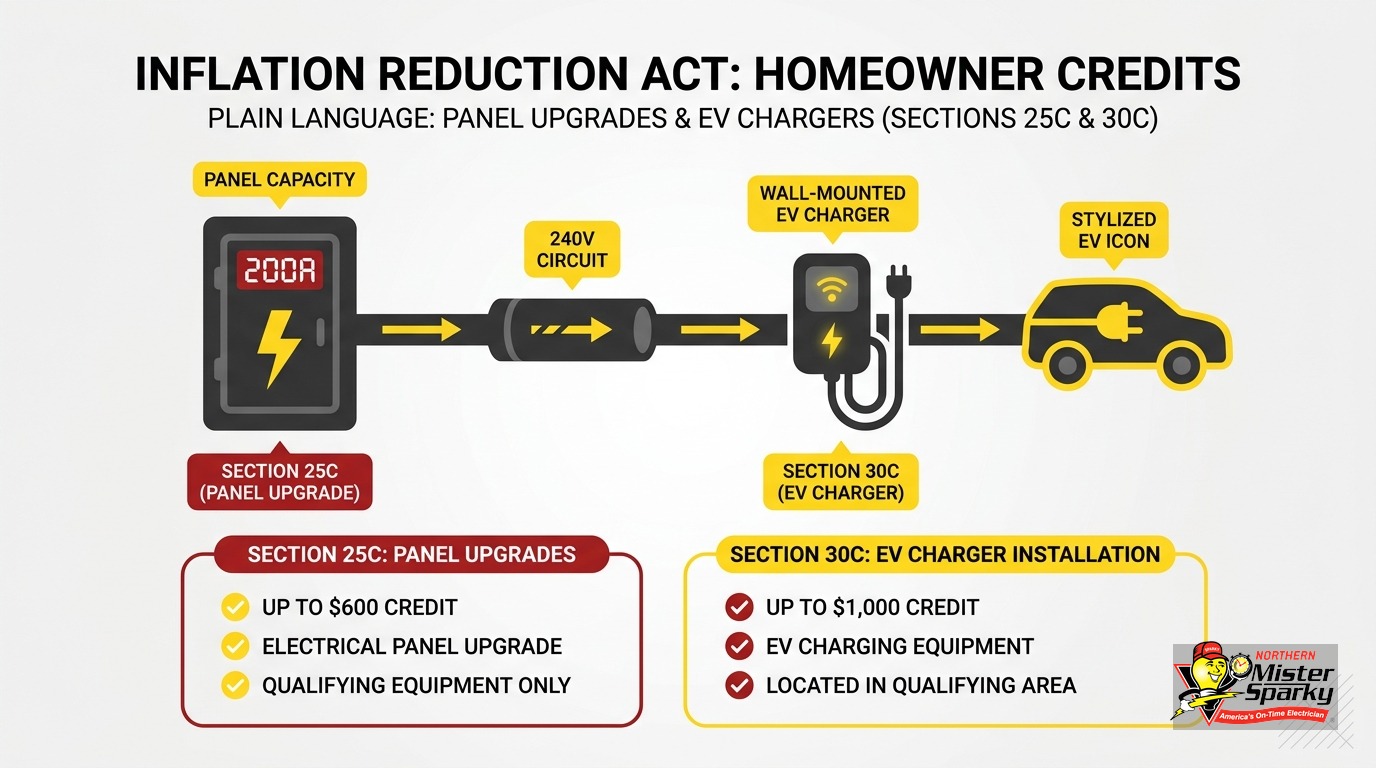
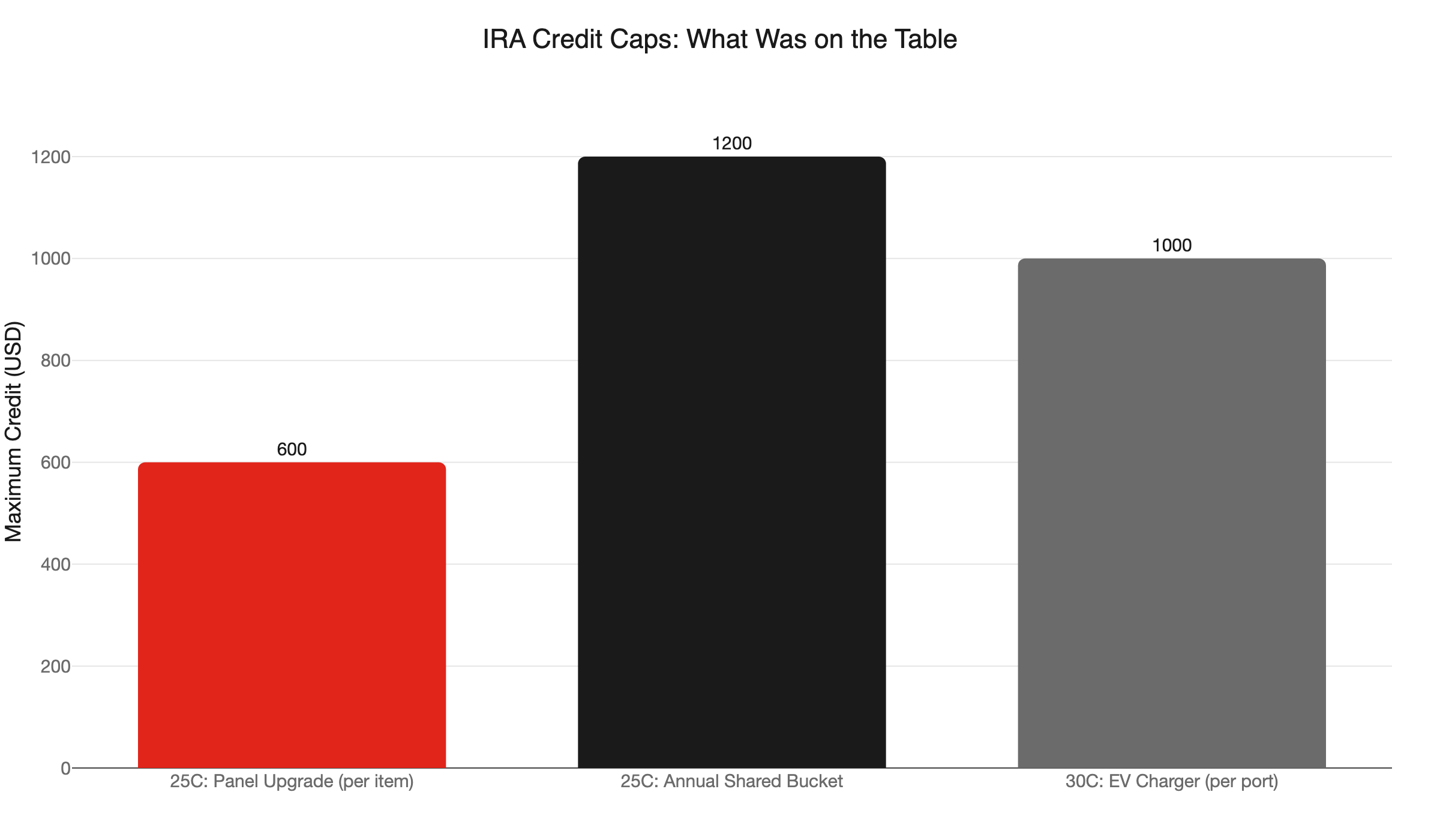
The 25C panel credit was 30% of the cost of a qualifying panel, up to $600 per item. That $600 fell inside a $1,200 annual shared bucket that also covered windows, doors, and insulation. The panel had to meet National Electrical Code standards and be rated for at least 200 amps.
The Energy Star guidance on the electric panel upgrade credit lists the qualifying components: panelboards, sub-panelboards, branch circuits, and feeders. The 200-amp requirement reflects a real-world threshold in the Twin Cities. Older Minneapolis and St. Paul homes frequently carry 100-amp service, installed in a time before EV chargers, heat pumps, and induction ranges became common household loads.
In practical terms, a full panel upgrade in the Twin Cities runs roughly $2,500 to $5,000 depending on complexity. The $600 maximum credit was real money, but it covered a small fraction of the total project cost.
The broader 25C credit also included a separate $2,000 annual bucket for heat pumps and heat pump water heaters. That bucket was distinct from the $1,200 shared one. If you installed a heat pump and a panel upgrade in the same year, you could potentially stack credits from both buckets. But each project still had to meet its own qualifying conditions independently.
Did a Panel Upgrade Alone Qualify for the Credit?
No, and this is the detail almost nobody writing about 25C bothered to explain clearly. The Energy Star guidance states it directly: the panel upgrade must be installed “in conjunction with” a qualifying appliance, and it must enable the installation and use of that appliance.
The qualifying appliance list is specific: heat pumps, central air conditioners, electric water heaters, furnaces, and biomass stoves. If you upgraded your panel because it was full or aging, but you did not install one of those appliances at the same time, the panel did not qualify for 25C.
This detail caught a significant number of homeowners off guard. They did a panel upgrade in 2023 or 2024 expecting a $600 credit. Then their tax preparer told them no qualifying appliance anchored the claim. The conjunction requirement appeared in the statute and in the Energy Star fine print. Most popular coverage of the IRA credits omitted it entirely.
For homeowners who completed a panel upgrade alongside a heat pump or central air installation: the conjunction requirement may have been satisfied. Review the specifics of the job with a tax professional.
For the practical side of when a panel upgrade makes sense, regardless of credit status, see our guide to signs you need an electrical panel upgrade.
What Was the 30C Credit and Who Could Claim It?
Section 30C offered 30% of the cost of a qualifying EV charger at a principal residence, up to $1,000 per charging port. For a single Level 2 home charger install, which runs $1,200 to $2,000 in the Twin Cities, that was a meaningful offset. It covered close to half the cost on the low end of the range.
But the location requirement was the problem. The credit required the property to be in a low-income community census tract or a non-urban census tract. That location gate applied to individual homeowners at their primary residence, not just commercial properties. The IRS census tract FAQ for 30C addresses this in Q3 and Q4. The requirement was not a commercial-only rule. It applied to you.
The credit also covered only one charging port per installation on the residential side. Multi-port commercial setups had different rules.
Could Most Twin Cities Homeowners Claim the 30C Credit?
Probably not. The Twin Cities metro, including Bloomington, Brooklyn Park, Woodbury, Blaine, Maple Grove, Plymouth, Eagan, and most of the suburban ring, is broadly urban and does not qualify as a low-income community for census purposes. Most suburban addresses were never in an eligible tract.
This is the census tract trap that received almost no coverage in mainstream articles about EV charger tax credits. Many homeowners in the suburbs installed Level 2 chargers expecting a $1,000 credit. They found out from their tax preparer that their address was never in a qualifying tract. The credit was unavailable to them from the start.
You can look up any Minnesota address at the U.S. Census Bureau’s 2020 Census Tract lookup tool. If you had a charger installed between 2023 and June 30, 2026, and your address is in a qualifying tract, review your prior-year return with a tax professional. The IRS updated its 30C census tract FAQ on July 10, 2026, to reflect the credit’s expiration under the One Big Beautiful Bill.
For more on what the installation involves for Twin Cities homeowners, see our EV charger installation guide.
What Financial Help Is Still Available in 2026?
Federal credits are gone, but other paths remain. Utility rebates through Xcel Energy may still apply to EV charger installs. Minnesota Department of Commerce programs may offset other electrical work. Financing is available for larger jobs. Verify each option directly before budgeting around it.
Xcel Energy rebates. Xcel serves most of the Twin Cities metro, including Minneapolis, St. Paul, and the majority of the suburban ring. Their EV charging rebate program has historically offered residential incentives for Level 2 charger installations. Check Xcel’s current EV charging rebates page directly before your project. Rebate programs change frequently, and current availability may differ from what you read in an older article.
MN Department of Commerce programs. The Minnesota Department of Commerce manages energy incentive programs at mn.gov/commerce/energy. These have faced funding changes at both the state and federal levels. Verify current status and specific program availability before assuming any incentive applies to your project.
Other utilities. If your home is served by Minnesota Power, CenterPoint’s electric service, or another provider outside Xcel’s coverage area, contact that utility directly. Rebate structures vary by provider and do not mirror each other.
Financing. Panel upgrades, EV charger installs, and major electrification projects are substantial investments. Spreading the cost over time can make a project that already pencils out on its own merits easier to schedule. Call 763-200-5956 and ask our team about current financing options.
Is a Panel Upgrade Still Worth It Without the Credit?
Yes, for the vast majority of Twin Cities homeowners with older service. The practical reasons for a panel upgrade have not changed. The safety case is the same. The $600 credit was a modest subsidy on a $3,000-plus project. Its absence changes the out-of-pocket number slightly. The underlying reasons to upgrade are identical.
Capacity. If you are planning to add an EV charger, a heat pump, an induction range, or a major home addition, the panel has to handle the combined load. Older Minneapolis-area homes on 100-amp service were not built for that combination. Our comparison of 100-amp versus 200-amp service covers what the difference means in daily practice.
Safety. Overloaded and aging panels are genuine fire hazards. Breakers that trip repeatedly, a panel that feels warm to the touch, flickering lights throughout the house, and a box with no remaining open slots are all signals worth taking seriously. Our signs you need an electrical panel upgrade guide covers each of these in detail.
Resale value and insurance. Home inspectors flag problematic panels. Some insurers require an upgrade before issuing or renewing a homeowner’s policy. A properly permitted and inspected panel upgrade adds documented value to the home and removes a liability that can delay a sale.
The credit was a tool for lowering the out-of-pocket cost. With it gone, the project cost looks modestly higher on paper. The reasons to do the work are the same as they were in 2022.
The 200-Amp Upgrade: Why It Still Makes Sense for Twin Cities Homes
The 200-amp minimum written into the 25C qualifying criteria was not arbitrary. It reflects real load math. A Level 2 EV charger draws 24 to 48 amps. A heat pump pulls 15 to 30 amps depending on the system. An induction range needs a dedicated 40- to 50-amp circuit. Running all three alongside your baseline household loads requires headroom. A 100-amp panel does not have it.
We work on Twin Cities homes every week where the panel is full and the homeowner wants to add something: a charger, a workshop subpanel, a hot tub circuit, a whole-home generator connection. The answer is nearly always the same. Upgrade the panel first, then add what you need. The upgrade creates capacity for everything that follows, credits or not.
The 200-amp threshold is also where most modern homes land when they are built or seriously renovated. Meeting that benchmark positions the home for any electrification additions a future owner might want, which is worth considering at resale time.
What to Do Now
Here is the practical checklist for a Twin Cities homeowner who was planning around one of these credits.
If you completed a qualifying project before the cutoff: Talk to a tax professional. The 25C deadline was December 31, 2025. The 30C deadline was June 30, 2026. If your project met every qualifying condition, the credit may still be claimable on the applicable return. That means the conjunction requirement for 25C and the census tract test for 30C. Your project invoice and the permit documentation are the starting point.
If you are planning a panel upgrade or EV charger now: Skip the federal credit math entirely. It is not available for new work. Focus on utility rebates, financing, and the project’s standalone value.
Verify Xcel rebates before finalizing any EV charger job. A quick check before you sign a proposal can surface real savings. Utility incentives move around, but they are real money when available.
Do not wait for legislative reinstatement. There is no current indication that either credit will be restored. Waiting for a policy reversal that may not come means deferring a project that already makes practical and financial sense on its own.
Our team serves Minneapolis, St. Paul, Bloomington, Brooklyn Park, Woodbury, Blaine, Maple Grove, Plymouth, and the broader Twin Cities area. As America’s On-Time Electrician(R), we show up when we say we will, every time. Our UWIN(R) 100% satisfaction guarantee backs every job we complete. Locally owned and operated, we give you straight answers before you commit to anything.
Call 763-200-5956 or book online to schedule your panel upgrade or EV charger consultation.
Frequently Asked Questions
Are IRA federal tax credits for electrical panel upgrades still available? +
Can I still claim the IRA EV charger tax credit in 2026? +
Did the IRA panel upgrade credit apply to any panel upgrade? +
Need an electrician now?