
Insurance Company Requiring Electrical Inspection
Key Takeaways
- When an insurance company requires an electrical inspection, your policy is either up for renewal, your home changed hands, or a coverage review flagged a known hazard in your wiring or panel.
- The four most common triggers in Twin Cities homes: a Federal Pacific or Zinsco panel, knob-and-tube wiring, aluminum branch wiring, and missing GFCI or AFCI protection.
- Minnesota’s inspection authority is split. In Minneapolis, electrical reinspections always route to the state DLI inspector at 651-284-5064, not city inspections. Your permit issuance email tells you which applies to your address.
- To restore coverage, you need two documents: a signed compliance letter from a licensed electrician and a state DLI inspection card confirming the work passed.
- Minnesota adopted the 2023 NEC on July 1, 2023. AFCI protection is now required in virtually all living spaces, not just bedrooms. Older homes frequently fail on this point during reinspection.
- Call Northern Mister Sparky at 763-200-5956. We pull the permit, complete the work, schedule the inspection, and deliver the paperwork your insurer needs.
What Does It Mean When an Insurance Company Requires an Electrical Inspection?
Your insurer has identified a feature of your home’s electrical system it considers a material fire or safety risk. The letter is a condition, not a cancellation. Fix the listed items, submit the right documentation, and your coverage continues.
Insurance underwriters do not inspect homes themselves. They work from public records, home-sale disclosures, Truth-in-Housing (TISH) evaluations, and prior claim data. When a red-flag system appears in those records, a demand letter goes out. The letter names the hazard, sets a deadline (typically 30 to 90 days), and spells out the documentation the carrier wants when the work is done.
Coverage usually stays active during the remediation window. Ignoring the letter is the only guaranteed path to losing it.
This type of letter is more common in the Twin Cities than in many markets. A large share of inner-ring suburb housing dates to 1955 through 1980. That era produced a concentration of Federal Pacific Stab-Lok panels, aluminum branch circuits, and homes where knob-and-tube wiring was never fully removed. Insurers have grown more systematic about flagging these over the past decade. If you own a home from that period in Bloomington, Richfield, Columbia Heights, or Roseville, the letter should not come as a complete surprise.
The process is solvable. The steps are predictable: identify the trigger, hire a licensed electrician, pull a permit, complete the work, pass inspection, and deliver the right paperwork. This post walks through each step with Minnesota-specific details the national articles consistently miss.
What Triggers an Insurance Company to Require an Electrical Inspection?
The letter almost always traces to one of four systems: a flagged panel brand, knob-and-tube wiring, aluminum branch wiring, or missing ground-fault and arc-fault protection. In Minneapolis and several first-ring suburbs, a pre-sale TISH evaluation can generate the same demand independently of your insurer’s routine review.
Flagged panel brands
Federal Pacific Stab-Lok and Zinsco panels are concentrated in Twin Cities homes built between 1955 and 1980. Insurers name these brands explicitly because their breakers have a documented history of failing to trip under overload. Heat and arcing build unchecked, and house fires follow. Many carriers will not renew a policy on a home that still has one installed. The issue is not the age of the equipment but the specific design flaw in how those breakers hold contact under load.
For a complete rundown of which brands raise flags in this region, see our post on dangerous electrical panel brands in Minnesota.
Knob-and-tube wiring
Knob-and-tube (K&T) was standard from roughly the 1880s through the 1940s. It has no ground conductor, no jacket, and relies on open-air cooling. Those design assumptions are roughly 80 years obsolete. Most insurers in Minnesota will not write a new homeowner’s policy on a home with active K&T circuits. If your policy transferred to a new buyer at closing and K&T showed up in the disclosure, a demand letter is close to a certainty.
Our post on knob-and-tube wiring and home insurance in Minnesota covers the distinction between full replacement and partial remediation, and what each achieves with a carrier.
Aluminum branch wiring
Aluminum branch circuits went into many Twin Cities homes during the copper shortage of the mid-1960s and early 1970s. The core problem is thermal expansion. Aluminum expands and contracts at a different rate than the steel contacts inside standard outlets and switches. Over years of seasonal cycling, the connections loosen. Loose connections overheat.
Minnesota’s climate amplifies the risk. The swing from -20F to 95F puts aluminum wiring through far more expansion-contraction cycles per year than homes in moderate climates. The national fire-risk figures do not account for regional temperature extremes, which means they understate the hazard for Twin Cities homes. Read about aluminum wiring dangers and how to fix them.
Missing GFCI and AFCI protection
Missing or failed GFCI protection in kitchens, bathrooms, and outdoor circuits can alone trigger a coverage repair requirement. AFCI (arc-fault circuit interrupter) protection is a second layer. Under the 2023 NEC, AFCI is required in virtually all living spaces. Older Twin Cities homes that have never had permitted work done since that code took effect are frequently out of compliance throughout the house. What was a bedroom-only requirement is now a whole-home requirement, and many homeowners do not know that.
The Minnesota TISH Connection: A Trigger Many Homeowners Miss
Minneapolis and several first-ring suburbs require a Truth-in-Housing evaluation before any home sale. A licensed evaluator inspects the property and documents deficiencies for buyer disclosure. Electrical problems in the TISH report frequently generate a parallel insurer demand letter. This happens most often when a policy transfers to a new buyer at closing and the carrier sees the TISH deficiencies in the transaction records.
The process trips up homeowners because they assume the city handles both the TISH follow-up and the electrical reinspection. It does not. In Minneapolis, electrical reinspections route to the state DLI inspector at 651-284-5064, not the city’s building inspection office. Buyers have 90 days from closing to complete flagged electrical repairs and pass reinspection. Any corrective work requiring a permit must be filed with the state before work starts.
Calling city inspections for a Minneapolis electrical reinspection gets you routed to another department. That bounce costs time you may not have. Go directly to the state at 651-284-5064.
If you received an insurer letter shortly after purchasing a Minneapolis home, pull your TISH report and compare its electrical section to the insurer’s letter. The overlap between those two lists is the core of what needs to be corrected. Items on both lists are urgent. Items flagged only by the insurer may still need to be addressed if they fall under current code.
What Specific Items Does the Reinspection Cover?
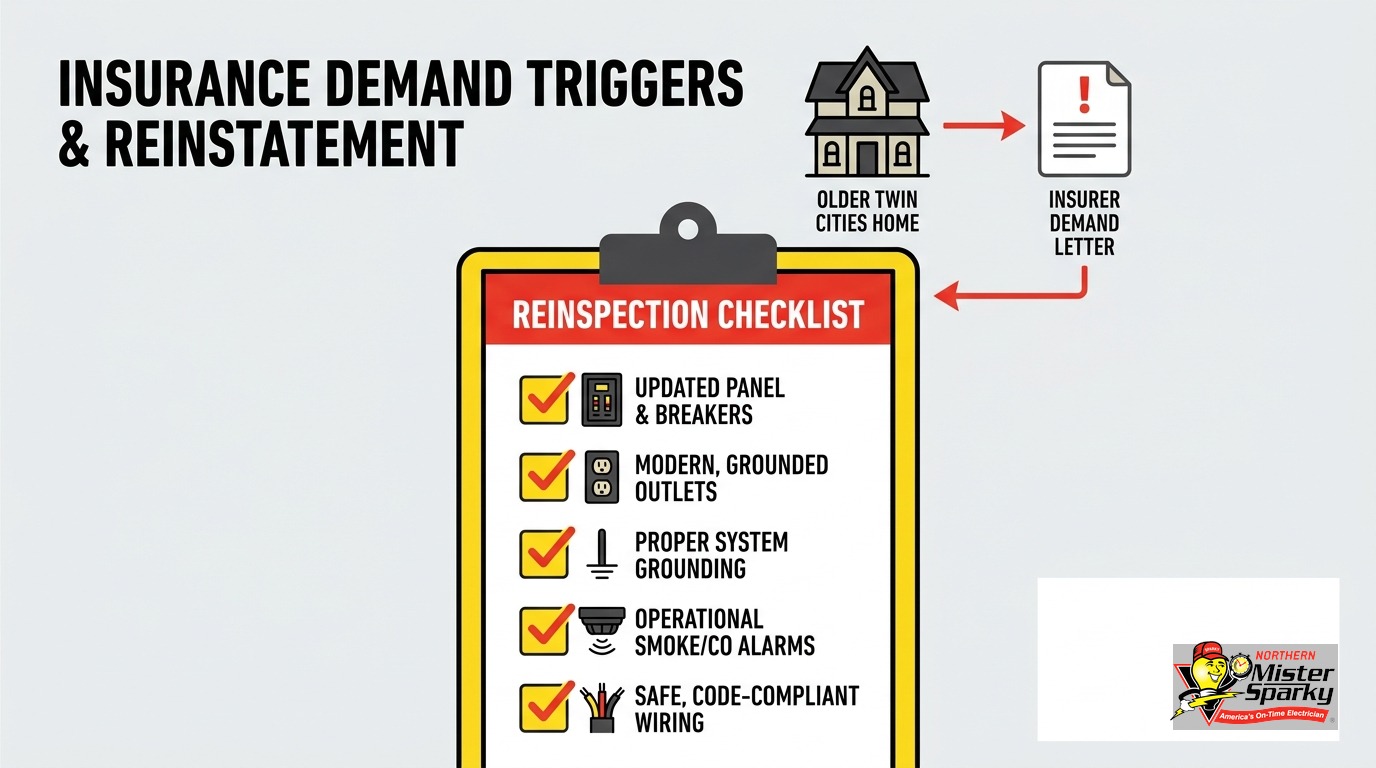
Inspectors work from the 2023 NEC checklist. The most common findings in older Twin Cities homes involve panel deficiencies, missing GFCI and AFCI protection, ungrounded outlets, double-tapped breakers, and wiring type. Any single flagged item can hold up coverage reinstatement.
Minnesota adopted the 2023 NEC on July 1, 2023. Every permit issued after that date is inspected against the current code. The MN DLI 2023 NEC inspection checklist is publicly available and shows exactly what the state inspector will review. Spending 20 minutes on that document before your electrician starts work can prevent costly surprises on inspection day.
Here is what comes up most often in older Twin Cities homes:
Panel and service entrance:
- Federal Pacific Stab-Lok, Zinsco, or other flagged brands still in place
- Double-tapped breakers (two conductors under one breaker terminal, a common DIY shortcut that creates a fire hazard)
- A full panel with no room to add required protection circuits
- Missing or incorrect breaker labeling
Living spaces:
- No AFCI protection on circuits serving bedrooms, living rooms, dining rooms, and hallways (all required under 2023 NEC)
- Ungrounded outlets (two-prong, or a three-prong outlet with no ground conductor behind the wall)
Kitchen:
- Missing GFCI protection within six feet of any water source
- No dedicated circuits for refrigerator, dishwasher, or microwave where code requires them
Bathrooms:
- All bathroom circuits must be GFCI-protected
- Single circuits shared across multiple baths are a common finding in pre-1980 homes
Outdoors and garage:
- Exterior outlets without GFCI protection or weatherproof covers
- Garage circuits without GFCI protection
- Missing AFCI on circuits feeding a finished room above the garage
Wiring type:
- Active knob-and-tube circuits still carrying load
- Unmitigated aluminum branch wiring with no approved splicing or replacement at device termination points
How Does Minnesota’s Inspection Authority Work?
Minnesota uses a split system. Some municipalities run their own electrical inspections. Others route to the state DLI. In Minneapolis, all electrical reinspections go through the state. The permit issuance email you receive specifies which path applies to your address.
Minnesota law requires an inspection even when the homeowner does the corrective work themselves. The permit must be filed with the DLI or the local authority having jurisdiction (AHJ) before any work begins. After-the-fact filing is not accepted.
Once the permit is issued, the DLI’s inspection process follows one of two paths: a state-assigned inspector or a contracted inspection area. The permit issuance email specifies which applies to your address. Read that email before scheduling anything. For Minneapolis addresses, the answer is always the state at 651-284-5064.
For homes outside Minneapolis, your best starting point is the Minnesota electrical permit process. It covers how to determine your local AHJ and what the permit application requires.
One practical note: a reinspection fee may be assessed in writing if deficiencies are not corrected before the inspector arrives for a second visit. Do not schedule the reinspection until the work is complete and your electrician has confirmed it is ready to pass.
What Must the Insurance Company’s Required Electrical Inspection Show?
Most carriers need two things: a signed compliance letter from a licensed electrician that lists each corrected deficiency, and a state DLI inspection card confirming the permit was opened and the work passed final inspection.
The compliance letter is not a work receipt. It needs to name the property address, list each item the insurer flagged, state that corrective work was completed, include the permit number, and carry the signature of the licensed electrician who performed the work. Some insurers provide their own form. Request it before work starts so your electrician can complete it accurately when the job is finished.
The DLI inspection card (or its equivalent in a contracted inspection area) is the state’s official confirmation that a licensed inspector reviewed the completed work and it passed current code. Insurers sometimes call this an “electrical certificate of compliance.” Whatever the carrier’s terminology, it corresponds to the closed permit record in the DLI system.
Minnesota homeowners are not exempt from the inspection requirement, even when they perform the work themselves. You can replace your own outlet. You still need the permit and the inspection. What you cannot do is sign the compliance letter. That signature requires a licensed electrician. If you are handling repairs as a homeowner and need guidance on pulling the permit or completing the compliance documentation, call us. We can walk you through it.
Send both documents to your insurer in the same submission. Sending one and waiting for a response before sending the other adds unnecessary days to your reinstatement.
How Long Does Coverage Reinstatement Take?
Targeted repairs, such as GFCI outlets, a double-tap correction, or a single-panel fix, often take one to two days of labor. Add two to four weeks for permitting and inspection scheduling. Most carriers process documentation and reinstate coverage within five to seven business days of receiving it.
The permit step is where homeowners most often underestimate the timeline. The DLI does not issue permits on demand. Processing time varies by season and workload. Budget at least one to two weeks before a state inspector can be scheduled after the permit is issued.
If the deficiency is a panel replacement, the timeline extends. A panel replacement typically runs one to two days of labor. Permitting, scheduling, and inspection add another two to three weeks in most cases. A whole-home rewire involving knob-and-tube or aluminum branch circuits is a multi-day job and may require temporary power arrangements during the work.
Start the process the day the letter arrives. Do not wait until two weeks before the deadline. Permit delays are real and predictable. Insurance carriers generally do not extend deadlines because of permit backlogs. The timeline is yours to manage from the moment the letter is in your hands.
If you need a realistic estimate for your specific situation, call us at 763-200-5956. We can assess the scope, estimate the labor, and tell you exactly where you stand against the insurer’s deadline given current permit and inspection availability.
How Northern Mister Sparky Handles This for Twin Cities Homeowners
Dealing with an insurance company requiring an electrical inspection is stressful. The letter rarely explains exactly what the inspector will look for. Most homeowners have never navigated Minnesota’s permit-to-inspection process before, and the DLI routing question alone catches people off guard.
We manage every step. Our licensed electricians inspect your home to identify everything the reinspection will catch, including items your letter may not have specifically named. We pull the permit, schedule the state inspector, complete all corrective work, and deliver the signed compliance letter and the closed-permit inspection card your insurer needs.
We are locally owned and operated in the Twin Cities. We know which inner-ring suburb homes still carry Stab-Lok panels. We know how DLI routing works for Minneapolis addresses. We know the 2023 NEC checklist and where older homes fall short of it. No guessing, no malarky.
As America’s On-Time Electrician(R), we arrive when we say we will. Our UWIN(R) 100% satisfaction guarantee means the job is not done until your documentation is in your insurer’s hands and your coverage is confirmed.
For larger jobs, such as a full panel replacement or a whole-home rewire, ask about financing options when you call. We serve homeowners across Minneapolis, St. Paul, Bloomington, Brooklyn Park, Woodbury, Blaine, Maple Grove, Plymouth, and the surrounding Twin Cities area.
Call 763-200-5956 or book online to schedule your inspection and get your coverage back on track.
Frequently Asked Questions
Can I do the electrical repairs myself to avoid hiring an electrician? +
What two documents does my insurance company need after the reinspection? +
How long do I have to complete the electrical repairs and reinspection? +
Need an electrician now?