
Home Electrical Inspection Cost in the Twin Cities
Key Takeaways
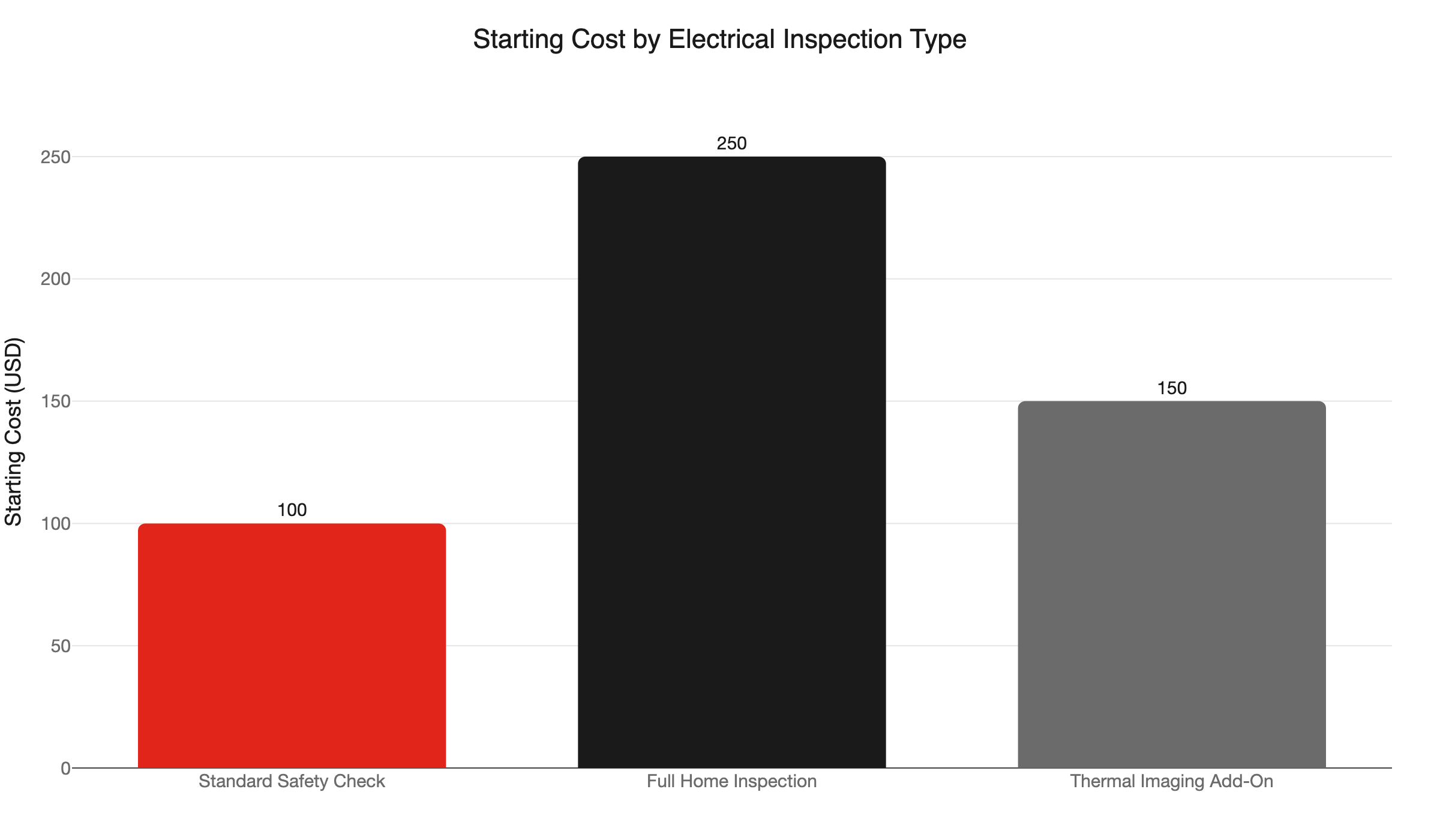
- A standard electrical safety check runs $100 to $200. A full home inspection runs $250 to $400. Thermal imaging adds $150 to $350 on top.
- Most homeowners only schedule an electrical inspection when buying a home or after something breaks. A proactive peace-of-mind check is one of the most underserved electrical services available.
- Minnesota runs two separate fee tracks: your electrician’s service fee, and DLI state or local city permit fees that apply only when permitted repairs are needed.
- NEC 2026 became effective in Minnesota on August 17, 2026. Any repair permits pulled after that date must comply with the new code.
- Xcel Energy offers up to $1,500 for qualifying panel upgrades. Minneapolis homeowners can stack CEE rebates of up to $3,000 in designated Green Zones.
- You can verify your electrician’s license at the DLI license and registration lookup. No account needed.
What Does a Home Electrical Inspection Cost?
A standard electrical safety check starts at $100 to $200. A full home inspection, covering the panel, all visible circuits, and GFCI and AFCI protection, runs $250 to $400. Thermal imaging adds $150 to $350 on top of the base fee. Twin Cities pricing tracks close to these national ranges, though older homes and complex wiring tend to land toward the higher end.
Several factors influence where your bill lands:
- Home age and wiring type. Older homes in Minneapolis, St. Paul, and the inner-ring suburbs often have knob-and-tube or aluminum wiring. These take more time to evaluate and document. Expect a higher fee for homes built before 1975.
- Panel size and condition. A clean, well-labeled 200-amp panel takes less time to inspect than a crowded box with handwritten labels and suspected overheating.
- Scope of the inspection. A targeted safety check focused on GFCI coverage and the panel costs less than a full load-capacity review with a written report. Be clear about what you need before scheduling.
- Location and scheduling. Travel to outlying suburbs, tight scheduling windows, and same-day availability all affect the final bill.
The electrician’s fee is not the only cost to plan for. If the inspection turns up repairs that require a permit, Minnesota charges a separate permit fee. That fee comes from either the state or your city. It is a separate bill on top of whatever the electrician charges for the repair work itself.
Why Get an Inspection When Nothing Is Wrong?
Most homeowners only think about an electrical inspection at two moments: when buying a home, or when something stops working. A proactive peace-of-mind check carries real weight. The U.S. Fire Administration tracks residential electrical fires each year. A proactive inspection is the best way to catch problems before they become emergencies.
The NFPA reports 31,650 fires per year linked to electrical distribution and lighting equipment. Those fires cause 430 deaths, 1,300 injuries, and $1.6 billion in direct property damage each year.
Electrical fires give almost no warning. A loose neutral connection can run hot for months. A panel running near its limit does not always trip before it overheats.
The Twin Cities housing stock makes this more than a theoretical concern. Older Minneapolis and St. Paul neighborhoods have large concentrations of pre-1950 homes. Many still have knob-and-tube wiring in service. Suburbs built between 1965 and 1975 may have aluminum branch circuit wiring. Neither is an automatic emergency. Both deserve a licensed electrician’s review, not a 20-minute walk-through from a general home inspector.
A peace-of-mind inspection gives you a written record of your home’s current condition. That record has real value at insurance renewal, before a renovation, and when you decide to sell.
What Does an Electrician Actually Inspect?
A licensed electrician’s inspection goes well beyond a general home inspector’s review. Expect a close look at your service panel, GFCI and AFCI circuit protection, grounding and bonding, all accessible wiring runs, and load capacity. A dedicated electrical inspection typically takes two to three hours for a full home.
Here is what a thorough check covers:
Service panel. The electrician checks for double-tapped breakers, incorrect breaker sizing, missing knockouts, poor labeling, corrosion, and signs of overheating. Panel brands with known failure histories, including Federal Pacific and Zinsco units still present in some Twin Cities homes, are a specific flag.
GFCI protection. Ground-fault circuit interrupter protection is required in kitchens, bathrooms, garages, outdoors, unfinished basements, and near water sources. Missing or failed GFCI protection is one of the most common deficiencies found in homes built before 1990.
AFCI protection. Arc-fault circuit interrupters are required on bedroom circuits and, under more recent code editions, in additional living areas. Many pre-2000 homes have no AFCI coverage at all.
Grounding and bonding. Ungrounded outlets, missing ground rods, and unbonded metal gas and water lines are shock and fire hazards. These deficiencies are not always obvious without test equipment.
Accessible wiring condition. The electrician examines wiring at the panel, in the attic, and in the basement or crawl space. In-wall wiring cannot be checked without opening walls, but this visual review catches a significant share of problems.
Load capacity. If you have added high-draw circuits in recent years - an EV charger, a home gym, a finished basement - the inspection checks whether the panel can still handle the combined load. An overloaded circuit is a safety concern, not just an inconvenience. It is also one of the most commonly missed items on a general home inspection.
How Does Minnesota’s Electrical Fee System Work?
Minnesota separates the electrician’s fee from the permit fee. You pay your electrician for their time and labor. If the inspection turns up repairs that need permitting, you also pay a DLI state fee or a local city fee - billed separately. The permit fee applies only when permitted work is actually performed.
This surprises many homeowners. If the inspection finds nothing that requires a permit, you pay the electrician’s fee and that is it.
If repairs are needed, the DLI state fee schedule sets these charges for permits filed with the state:
- Permit application fee: $25
- State surcharge: $1
- Minimum inspection fee per site visit: $55
- Per-circuit fee: $12
- Service/feeder inspection (0-400 amp): $35
But not every Minnesota homeowner uses the state system. Many cities in Minnesota have adopted local electrical inspection authority and charge their own fee schedules. If you live in one of those cities, local AHJ fees apply instead. Check with your city’s building department before assuming the DLI schedule covers you.
This matters for budgeting. An inspection that flags three circuits needing AFCI upgrades and a panel concern will generate a permit fee bill. That fee comes on top of the electrician’s labor charge for the repairs. They are separate line items, billed separately.
For a full breakdown of how Minnesota electrical permits work, including what homeowners can and cannot pull themselves, that page covers the process step by step.
How Do You Verify Your Electrician Is Licensed in Minnesota?
Go to the DLI license and registration lookup. Enter the company or individual name. An “Issued” status means the license is active. No account needed. The process takes about 30 seconds.
This step costs nothing and matters a lot. Electrical work performed by an unlicensed contractor is not covered by DLI’s complaint and disciplinary process. If something goes wrong, your options are limited. Verify before work begins.
When you search, look for:
- License type. An electrical contracting company should show an “Electrical Contractor” license. An individual electrician will show a journeyworker or master electrician class.
- Status. “Issued” is active. Any other status, including “Expired” or “Suspended,” warrants a call to DLI before you proceed.
Our detailed post on how to verify your electrician is licensed in Minnesota includes step-by-step instructions and explains what to do if the search returns a status that needs clarification.
What Does the NEC 2026 Transition Mean for Your Home?
Minnesota adopted NEC 2026 on August 17, 2026. Any permit filed on or after that date must comply with the new code. If your inspection turns up work that needs permitting, those repairs fall under the 2026 NEC standard, not the edition your home was originally built under.
For most routine repairs - replacing a GFCI outlet, upgrading a breaker, adding an AFCI circuit - the 2026 transition adds minimal cost or complexity. The most significant NEC 2026 additions are concentrated in new construction requirements, not in standard repair work.
Where the transition matters more is when the inspection reveals substantial deficiencies. A panel upgrade, a service increase, or rewiring a specific zone will all be scoped to the code in effect when the permit is filed.
Permits filed before August 17, 2026 remain under the 2023 NEC. Permits filed on or after that date follow the 2026 NEC. If an electrician filed a permit before the transition for a job that extended past August 17, confirm which edition governs that specific permit.
The practical takeaway: the code transition is not a reason to delay getting an inspection. Getting ahead of known problems means any permit and repair can move forward on a predictable timeline.
Could a Panel Upgrade Pay for Itself After Rebates?
Xcel Energy offers rebates for qualifying panel upgrades to higher amperage, when the work is performed by a DLI-licensed electrician. Minneapolis homeowners can also stack CEE bonus rebates: up to $3,000 in a designated Green Zone or $800 outside one, with income-qualified Green Zone households eligible for additional combined rebates.
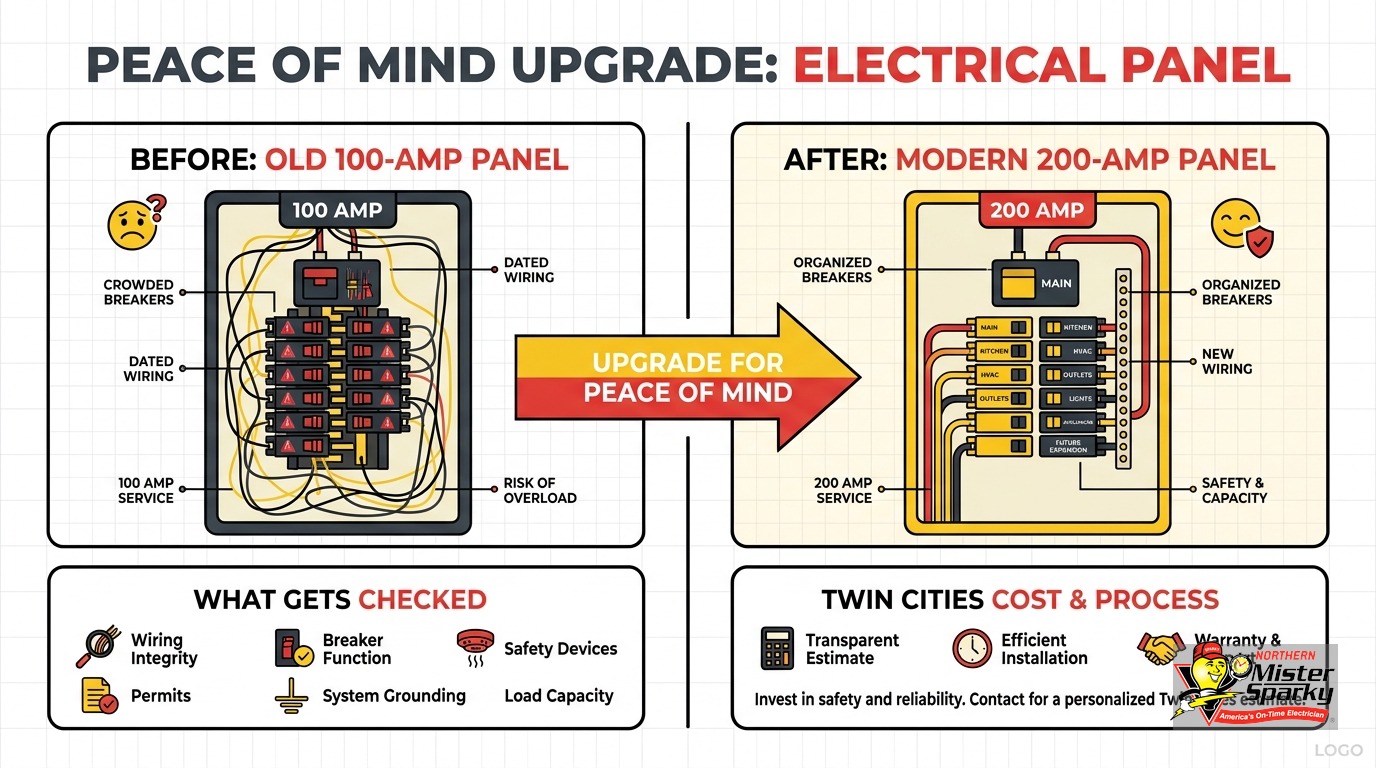
If your inspection reveals an undersized or degraded panel, the Xcel rebate changes the math significantly. A 100-amp to 200-amp upgrade in the Twin Cities often runs $1,500 to $3,000 before rebates. Subtract $1,500 from Xcel and the net cost of moving into a modern, properly sized panel may be smaller than you expect.
Minneapolis homeowners have the additional option to stack CEE rebates on top of the Xcel amount. In a designated Green Zone, the combined rebate reaches $4,500 for most households. Income-qualified households in those zones may reach up to $5,700 in combined rebates. That is a meaningful offset against a major electrical upgrade.
One note on federal credits: the 25C tax credit for panel upgrades expired on December 31, 2025. There is no active federal panel credit in 2026. The Xcel rebate and CEE bonus are the programs currently available to Twin Cities homeowners.
Our post on signs you need an electrical panel upgrade lists the specific symptoms to watch for. If your electrician flags your panel during the inspection, that post puts the concerns in plain terms. We also offer financing on panel upgrades, EV charger installations, and generator projects. Ask our team about financing options when you call.
What About Your Homeowner’s Insurance?
If your home has knob-and-tube or aluminum wiring, your insurer may require a licensed electrician’s inspection letter at renewal, or decline to renew. Getting that letter proactively is faster and cheaper than scrambling when your policy is already in question.
Homes built before 1950 in Minneapolis, St. Paul, and the older inner-ring suburbs often still have knob-and-tube wiring in service. Most Minnesota insurers will not write a new homeowner’s policy on a home with active knob-and-tube circuits. If you bought one of these homes, you will need to rewire the affected circuits or document that the old wiring is safely out of service. A licensed electrician’s letter satisfies the insurer’s requirement and gives you something concrete to hand over at renewal.
Homes built between 1965 and 1975 present a different issue: aluminum branch circuit wiring. Aluminum wiring causes 55 times more connection fires than copper. Insurers often request documentation of remediation or decline to renew without it. Whole-house remediation using AlumiConn connectors addresses aluminum wiring throughout the home.
In both cases, the right move is to know what you have before your insurer asks. A peace-of-mind inspection gives you documentation that either clears the issue or scopes the repair accurately. That document has measurable value at renewal time.
Ready to Book Your Inspection?
We are locally owned and operated in the Twin Cities. No malarky: when you call 763-200-5956, you reach a team that lives and works here.
As America’s On-Time Electrician(R), we show up when we say we will. Every inspection is backed by the UWIN(R) 100% satisfaction guarantee. If something about the job does not meet your expectations, we will make it right.
Whether your home is a pre-war bungalow in South Minneapolis with wiring you have never looked at, or a 1990s build in Maple Grove where you want a clear snapshot before a renovation, a peace-of-mind electrical inspection is the right starting point.
Call us at 763-200-5956 or book online to schedule. We will show up on time and give you a clear, written picture of exactly where your home stands.
Frequently Asked Questions
How much does an electrical inspection cost in the Twin Cities? +
Do I need a permit for a peace-of-mind electrical inspection? +
How is an electrical inspection different from a general home inspection? +
How do I verify my electrician is licensed in Minnesota? +
Need an electrician now?