
How to Verify Electrician License Minnesota Before You Hire
Key Takeaways
- Minnesota requires two separate lookups: one for the electrician’s personal license and one for the company’s contractor registration.
- The official tool is the DLI iMS system. No account required. Search by name or license number.
- License class tells you how much training the person doing the work actually has. Class B and Class A are not interchangeable.
- Every Minnesota electrical contracting company must have a Class A Master Electrician as the responsible licensed individual on file.
- Ask six specific questions before signing any quote. A legitimate contractor answers all of them without hesitation.
- In Minnesota, the contractor pulls the permit, not you. If they ask you to pull it, walk.
- Enforcement actions against a contractor or individual are public record, visible in iMS and on the DLI website.
Why This Check Matters Before You Hire
Electrical work is different from most home services. A bad paint job is visible on day one. A bad electrical connection may be invisible for months, until it causes a shock or starts a fire behind the drywall.
Minnesota has a well-organized licensing system run by the Department of Labor and Industry (DLI). The public lookup tool is free and takes about five minutes per search. Most homeowners never use it.
This guide walks you through how to verify electrician license Minnesota from start to finish, including the lookup steps, what each license class means for you, and the exact questions to ask before a single wire gets touched.
What Are the Two Lookups I Need to Run?
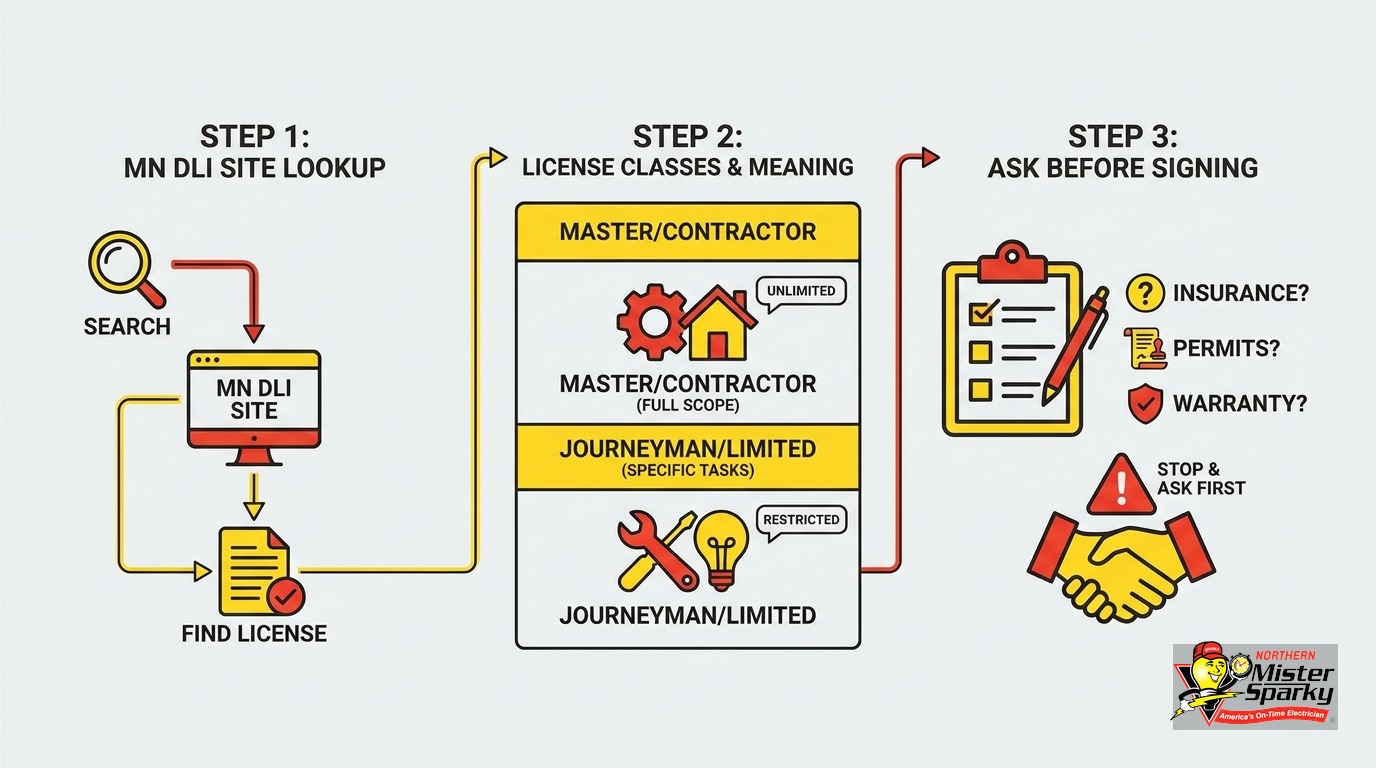
In Minnesota, you need to run two separate searches: one for the individual electrician’s personal license and one for the company’s contractor registration. A person can be individually licensed but working for an unregistered company. Both checks are required.
The Minnesota DLI license and registration lookup is the starting point. It connects you to the iMS system, which holds records for both individual licenses and contractor registrations.
Here is the distinction:
- Individual license: Issued to the electrician as a person. It shows their license class, whether the license is active, when it expires, and any disciplinary history.
- Contractor registration: Issued to the company. It confirms whether the business is legally registered to perform electrical contracting work in Minnesota, and identifies who the Master Electrician of record is.
You need both to come back clean. An active individual license from a company with a lapsed or revoked contractor registration is a problem. Run both searches before any quote becomes a contract.
How Do I Use the iMS Lookup Tool?
Go to ims.dli.mn.gov, click “Continue as guest,” enter the name or license number, and review the result. No account needed. The record shows license type, active or expired status, issue date, expiration date, and any enforcement actions on file.
Here is the step-by-step walkthrough:
- Open ims.dli.mn.gov in your browser.
- Click “Continue as guest” on the welcome screen.
- Choose your search method: name or license number. Name works fine if you do not have the license number yet.
- Enter the electrician’s full name, or the company name for the contractor registration search.
- Review the result for the following:
- License type: What class is this person or company licensed under?
- Status: Active is the only acceptable answer. Expired or revoked is a stop sign.
- Expiration date: Is the license current through the date of your project?
- Enforcement actions: Any history of violations appears here.
If your search returns no result, that is itself information. It may mean the person is unlicensed, or that you have a spelling variation. Try a name variation before concluding. If still nothing, call DLI at 651-284-5034 or email dli.license@state.mn.us before moving forward.
One extra step worth taking: keep the iMS result open when you call the contractor back. Ask them to confirm their license number verbally. If the number does not match what you found, that is a red flag.
What Do the License Classes Mean for Homeowners?
Minnesota has five electrician license classes. The class tells you how much training the person has and what work they are legally permitted to do. For most residential jobs, you want a Class A Journeyman doing the hands-on work, with a Class A Master as the responsible licensed party on the account.
Here is what each class means for the person writing the check:
Class B Installer
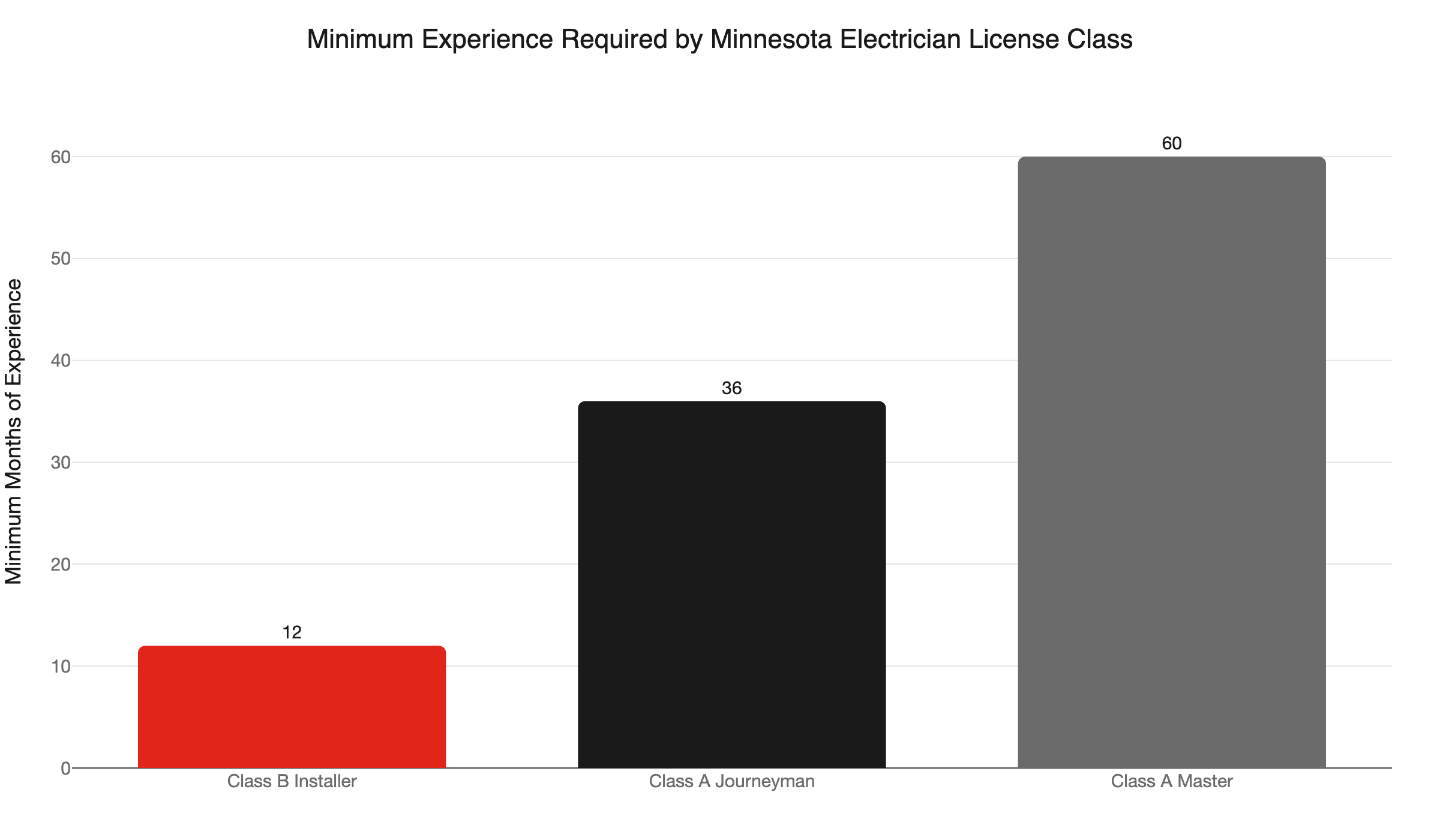
The minimum requirement is about 12 months (roughly 2,000 hours) of experience. This is the entry-level license. Class B Installers can handle certain residential work, but their scope is more limited than a Journeyman. If the only licensed person on your panel upgrade or whole-home rewire holds a Class B license, ask why a Journeyman or Master is not on the job. That is a fair question, and a legitimate contractor gives a direct answer.
Class A Journeyman
This license requires 36 to 48 months of experience plus a passing score on a licensing exam. A Class A Journeyman is fully licensed for residential, commercial, and industrial work. On most residential jobs, the person on the ladder is a Journeyman. That is standard practice and completely appropriate.
Class A Master
A Master Electrician has at least 60 months of experience and has passed an advanced exam. More importantly, Minnesota requires every electrical contracting company to have a Master Electrician as the “responsible licensed individual.” That person is legally accountable for all work performed under the company’s contractor registration. When you hire an electrical company, you are entitled to know who the Master is. Ask for their name and license number, and verify both in iMS.
Power Limited Technician
This license covers low-voltage systems only: fire alarms, communications, signaling, and security wiring. A Power Limited Technician is not licensed for branch circuit or panel work. If someone with only this credential is quoting you a panel upgrade, new circuits, or outlet installation, stop. That work is outside their license scope.
Maintenance Electrician
This license covers within-facility electrical maintenance in commercial and industrial settings. It is not a license for residential contracting across multiple job sites. It occasionally appears on bids where it does not belong.
For context on what each license class requires from the electrician’s side, the ServiceTitan Minnesota electrician licensing guide covers the applicant requirements in detail.
How Do I Check for Enforcement Actions Against a Contractor?
Enforcement actions are public record. They appear directly in the iMS record and on the DLI’s electrical contractors page. Check both sources for the most complete picture.
DLI also publishes a standalone enforcement actions list at dli.mn.gov/business/electrical-contractors/electrical-enforcement-actions. This is worth checking separately, since it may surface actions not yet reflected in the license record.
What to consider when reviewing enforcement history:
- A single citation from several years ago: Not automatically disqualifying. Context matters. Ask the contractor about it directly.
- A pattern of violations: Multiple citations for the same issue, or several violations in a short window, warrant real concern.
- Permit-related violations: Any history of performing work without permits is a serious red flag for exactly the kind of job you are about to hire them for.
- Active suspension or revocation: This disqualifies the contractor. Do not proceed.
When in doubt, call DLI at 651-284-5034. They can confirm whether a license is in good standing and whether any pending enforcement has not yet been finalized in iMS.
Does the Contractor Have to Pull the Permit?
Yes. In Minnesota, permits for electrical work are pulled by the licensed electrical contractor, not the homeowner. If a contractor asks you to pull the permit yourself, or says no permit is needed, those are serious red flags. Do not proceed.
Minnesota runs its electrical inspection program statewide through DLI. This is unusual compared to most states, which delegate electrical inspections to local city building departments. In Minnesota, the inspector who shows up is a DLI state employee, regardless of whether the job is in Minneapolis, Woodbury, or Blaine.
Why this matters for you:
When a contractor pulls a permit, they put their license on the line. The permit triggers a DLI inspection after the work is complete. An independent inspector reviews the work against code. If no permit is pulled, no inspection happens, and no one catches a mistake in your walls.
Beyond safety, unpermitted electrical work creates real problems when you sell your home. A buyer’s inspector may uncover unpermitted work, and you may be required to remediate it before closing. Homeowner’s insurance can also deny claims tied to unpermitted electrical work.
For more on what the permitting process looks like from the homeowner’s side, our post on electrical permits in Minnesota walks through what to expect at each stage.
If you are already noticing warning signs you need an electrician and are comparing quotes, add the permit question to the top of your list. It is the fastest filter for separating legitimate contractors from those cutting corners.
What Questions Should I Ask Before Signing a Quote?
Ask these six questions before any paperwork is signed. A licensed, registered, above-board contractor will answer all of them directly. Evasion, irritation, or vague answers tell you what you need to know.
1. What is your DLI contractor registration number?
Write it down. Look it up in iMS before you sign. This is not an aggressive question. Any legitimate contractor gives you the number without hesitation.
2. Who is the Master Electrician of record on this job, and what is their license number?
Get both the name and the number. Verify both in iMS. The Master is legally accountable for everything done under the company’s contractor registration.
3. What license class will the person physically doing the work hold?
You are entitled to know whether a Class A Journeyman, a Class B Installer, or an apprentice will be on the ladder in your home. The answer shapes every follow-up question.
4. Will you pull the permit with DLI, or do you expect me to?
The only acceptable answer is some version of “we pull it.” Anything else is a reason to walk.
5. Are you bonded, and can I see your bond status in iMS before I sign?
Bond status is visible in iMS for registered contractors. Bonding protects you if the contractor fails to complete the job or causes damage to your property. Licensing and bonding are separate requirements. You want both.
6. Have you had any enforcement actions with DLI in the last five years?
They know you can check this yourself. How they respond tells you a great deal. Honesty about a past citation, with a clear explanation, is far less concerning than deflection or irritation at being asked.
These are not gotcha questions. They are standard due diligence for any licensed professional working in your home. If a contractor treats them as offensive, that is the answer.
What About Xcel Energy Rebates on Larger Jobs?
Xcel Energy offers rebates for qualifying electrical upgrades in the Twin Cities, including EV charger installations and panel upgrades that support energy-efficiency projects. To qualify, the work must be done by a licensed, registered contractor who pulls the required permits. Unlicensed or unpermitted work is disqualified from these programs.
This is one more practical reason to verify before signing. Hiring an unlicensed or unregistered contractor may appear to save money upfront, but it can eliminate rebates that offset a meaningful portion of the project cost. Check current rebate availability and eligibility directly at xcelenergy.com, since program terms and amounts change.
For homeowners planning an EV charger installation, our guide on EV charger installation in the Twin Cities walks through what a licensed installation includes and how to prepare for the permit and inspection process.
What to Do If You Already Hired Someone and Now Have Doubts
If electrical work was completed in your home and you now question whether it was done by a licensed, permitted contractor, take these steps:
- Call DLI at 651-284-5034 and ask whether a permit was pulled for electrical work at your address. DLI can confirm whether a permit exists in the system.
- Run the contractor’s name and company through iMS. Check current status and enforcement history.
- Request an independent inspection. Our team can walk through the work and identify whether it meets code. We give you a straight answer.
If you are preparing to sell, unpermitted electrical work can become a significant problem during the buyer’s inspection. A pre-sale electrical inspection surfaces these issues on your timeline, before a buyer’s inspector does it on theirs.
Northern Mister Sparky Is Already in iMS
We are locally owned and operated in the Twin Cities. Our team carries full DLI licensing and contractor registration. We pull permits on every job. Our Master Electrician of record is on file with DLI. Look us up in iMS before you call.
No malarky: if the lookup does not back up what we say, do not hire us. That is the standard we hold ourselves to as America’s On-Time Electrician(R), and it is backed by our UWIN(R) 100% satisfaction guarantee.
Call 763-200-5956 or book online. We will take it from there.
Frequently Asked Questions
How do I look up an electrician's license in Minnesota? +
What is the difference between a Class B Installer and a Class A Journeyman in Minnesota? +
Does an electrician have to pull the permit in Minnesota? +
Need an electrician now?