
Is Your Split Bus Electrical Panel Dangerous?
Key Takeaways
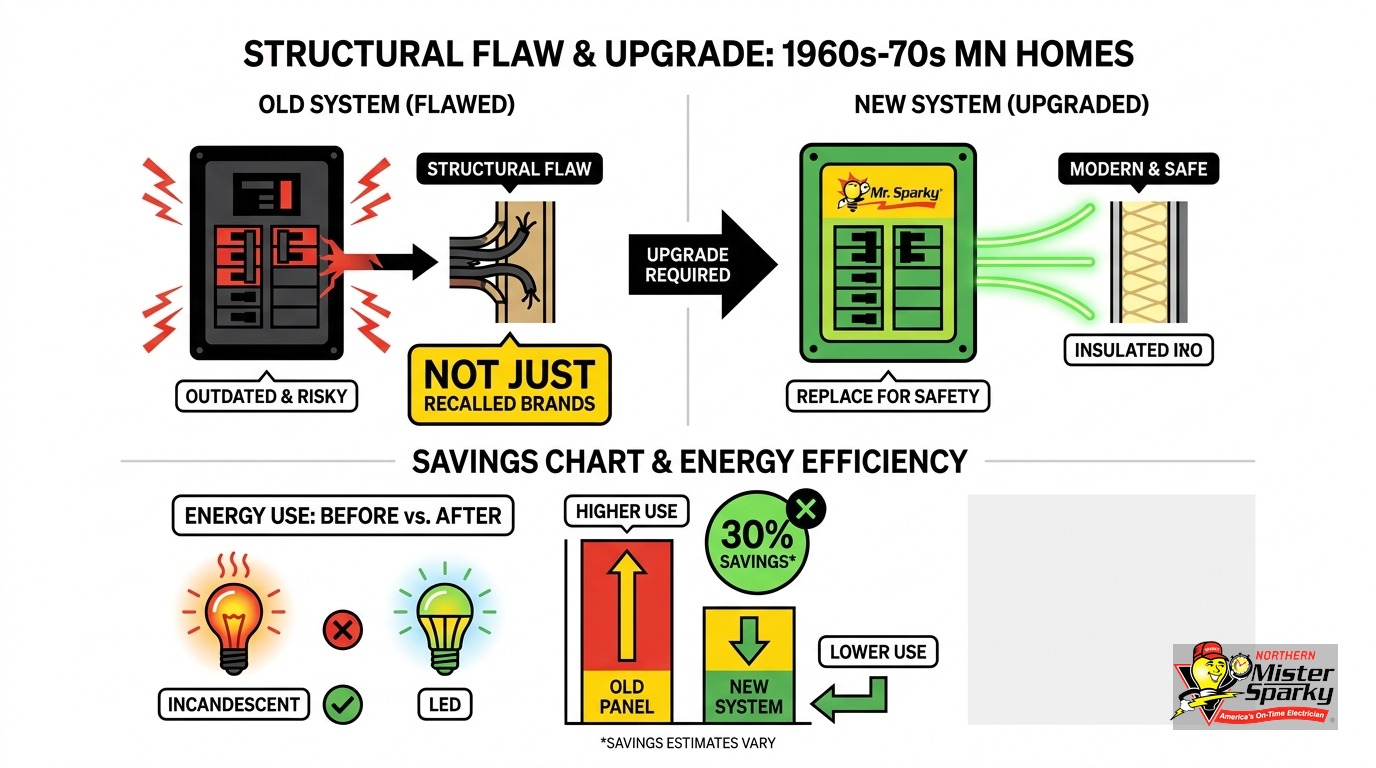
- Split-bus panels in 1960s-70s Minnesota homes carry breakers that are now 50-65 years old. The CPSC estimates residential circuit breaker lifespan at 30-40 years. Breakers past their design life can fail silently without tripping.
- Arc faults cause 50-75% of electrical home fires. Split-bus panels are difficult to upgrade with modern AFCI protection.
- Flipping the “lighting main” in a split-bus panel leaves the upper 240V bus fully live. Many homeowners do not know this.
- Minnesota adopted the 2026 NEC on August 17, 2026. Any permitted panel work now requires a single-disconnect design. Split-bus is no longer allowed in new installations.
- Insurers are increasingly treating split-bus panels as a category risk, not just recalled brands like FPE or Zinsco.
- Call 763-200-5956 to schedule an inspection if your home has a split-bus panel.
Is a Split Bus Electrical Panel Dangerous?
If your Twin Cities home was built between 1955 and 1980, it may have a split bus electrical panel. Many do. Understanding why it is dangerous has become more urgent over time. Every breaker in that panel is now 50 to 65 years old. Age, structural design, and a hidden live-bus hazard make these panels a genuine risk, regardless of the brand stamped on the breakers.
What Is a Split Bus Electrical Panel?
In plain terms: A split-bus panel has two separate bus sections instead of one main breaker. The upper section runs at 240V and feeds large appliances directly. One of those upper breakers, called the “lighting main,” powers the lower 120V section for lights and outlets. There is no single switch to cut all power at once.
In a modern load center, you flip one main breaker and the entire panel goes dead. In a split-bus panel, the National Electrical Code once allowed up to six separate disconnects in place of that single main. You had to throw multiple breakers to de-energize everything. That design saved manufacturers money and was accepted practice from the late 1950s through the mid-1970s.
The result is a panel that is harder to shut down, harder to label clearly, and harder to upgrade to modern protection standards.
Minneapolis neighborhoods like St. Louis Park, Edina, Richfield, and Columbia Heights were heavily developed during that era. So were parts of Bloomington, Brooklyn Park, and Woodbury. If your home was built between 1958 and 1978, check your basement panel. The giveaway is the absence of a single large “MAIN” breaker above everything else. Instead, you will see several large double-pole breakers in an upper section, with a visible gap separating them from the lower row of smaller breakers below.
There may also be no clear label explaining which upper breaker is the “lighting main” for the lower section. That labeling problem is one of three structural defects documented consistently in inspections of split-bus panels: unlabeled or mislabeled sections, too many switch-throws required to kill all power, and original breakers well past their functional lifespan.
Why a Split Bus Electrical Panel Is Dangerous Even Without a Recalled Brand
In plain terms: The split-bus design carries structural hazards that exist regardless of brand name. Aging breakers, missing arc-fault protection, and a permanently live upper bus section create real risk in all split-bus panels, not just FPE Stab-Lok or Zinsco.
Most information available online focuses on specific recalled brands. The argument runs like this: FPE and Zinsco panels have documented manufacturing defects, but a split-bus panel from a reputable manufacturer in good condition is probably fine. That framing misses three concrete problems.
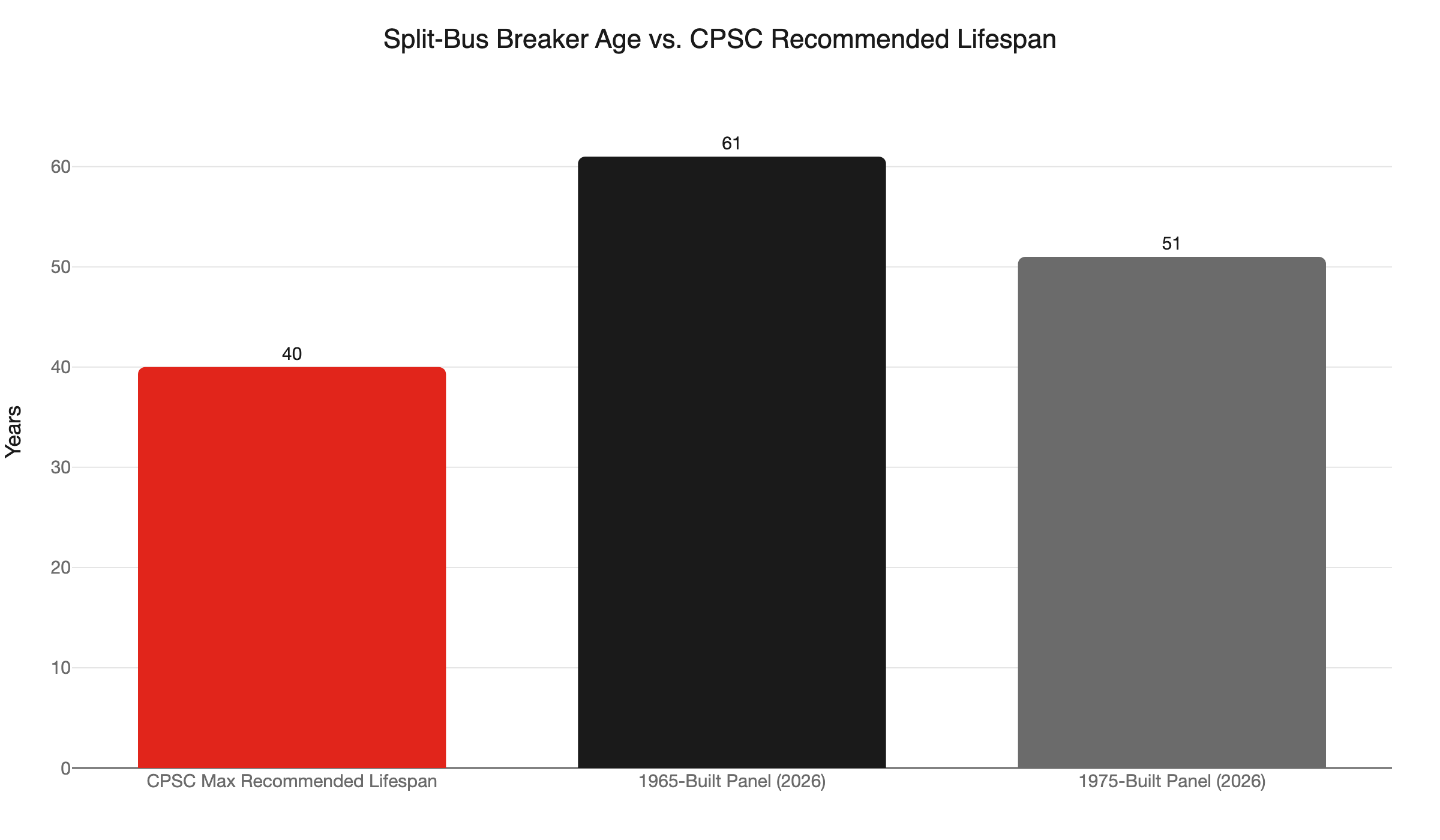
Breaker age. The CPSC estimates the average residential circuit breaker lifespan at 30-40 years. A breaker installed in 1965 is 61 years old in 2026. One installed in 1975 is 51. Both are well past their design life. A breaker that has exceeded its service life does not alert you. It may simply fail to trip when the circuit is overloaded. The wiring downstream overheats without interruption. Insulation begins to degrade quietly.
Missing arc-fault protection. Modern panels accept AFCI breakers in any slot. Retrofitting AFCI breakers into the lower 120V section of a split-bus panel is technically possible, but the upper 240V section operates under different constraints. Many split-bus homes end up with no arc-fault protection at all because retrofitting the design cleanly is difficult and rarely completed fully.
Structural design problems. Unlabeled sections, too many switch-throws, and aged breakers are not brand-specific problems. They come with the design itself.
None of these risks care what name is printed on the breaker.
Why Are Arc Faults the Fire Risk Most Homeowners Overlook?
In plain terms: An arc fault is an electrical discharge that jumps across damaged wiring or a loose connection. It generates intense heat without triggering a standard circuit breaker. AFCI breakers detect that fault signature and cut power before a fire starts. Split-bus panels make adding this protection complicated.
A standard circuit breaker responds to current overload. It trips when the current drawn exceeds its rated amperage. An arc fault can produce dangerous heat at current levels well below the breaker’s trip threshold. The breaker stays on. The insulation around the wiring smolders. Heat builds inside the wall cavity until something ignites.
The NFPA reports more than 28,000 home electrical fires per year are attributed to arc faults. AFCI protection can prevent more than half of those fires. This is why the NEC has expanded the AFCI requirement in every code cycle since 1999, now covering nearly every living space in the home.
Protecting a 4-bedroom home with AFCI breakers costs roughly $392, at about $49 per breaker. On a modern panel with open slots, that is a straightforward afternoon of work. On a split-bus panel, the installation is more complicated, and the upper section sits outside the retrofit. Homeowners on split-bus panels often carry zero arc-fault protection because the retrofit never gets completed.
When you replace the panel entirely, AFCI coverage is part of the new design from day one. For a full explanation of where AFCI protection is required by code, see our overview of AFCI breaker requirements.
The Live Upper Bus Hazard Most Homeowners Have Never Heard Of
This is the risk that almost no online resource explains clearly to homeowners. It is also the single strongest reason a licensed electrician must handle any work on a split-bus panel.
In a split-bus panel, the upper bus section connects directly to your utility meter. No breaker sits between the meter and the upper bus. That section is energized as long as the utility feed is live.
The “lighting main” breaker in the upper section controls the lower 120V section of the panel. When you flip it off, your lights and outlets go dead. The panel feels dead. It is not.
The upper bus is still live at 240V.
Every large double-pole breaker in the upper section carries full voltage. The bus bars running behind those breakers are energized. Any contact with those terminals, under any mistaken assumption that the panel is fully de-energized, means contact with live current.
This is not a hypothetical. Minnesota has a genuine DIY home improvement culture. Homeowners investigate tripped breakers. They swap outlets, replace breakers in the lower section, and add circuits under homeowner permits. The split-bus panel does not come with a warning label explaining that flipping the lighting main does not cut power to the entire panel. A homeowner who has not been specifically told this does not know it.
A licensed electrician is trained to recognize this condition and works accordingly, knowing the upper section stays live regardless of what the lower section is doing. The hazard is present in every split-bus panel, whether it carries a recalled brand or not.
Our post on dangerous electrical panel brands in Minnesota covers recalled-brand hazards in detail. The live-bus risk exists in addition to those concerns, or entirely on its own in panels with no recalled brand at all.
Does Minnesota’s New Electrical Code Affect Split Bus Panels?
In plain terms: Yes. Minnesota adopted the 2026 NEC effective August 17, 2026. NEC 230.71 requires a single main disconnect for all new panel installations. Any permitted panel work in Minnesota today must comply with that standard. You cannot replace a split-bus panel with another split-bus panel.
The 2026 NEC became effective in Minnesota on August 17, 2026. Permits filed on or after that date must meet the current standard. The single-disconnect requirement, first added to the NEC in 2020, is now documented as the standard for all permitted panel installations in Minnesota.
This does not automatically make your existing split-bus panel illegal. It means any permitted work that touches the panel must upgrade it to a compliant design. If you are planning a renovation that involves the electrical system, the panel enters the conversation.
Minnesota homeowners may pull their own electrical permits for work on their primary residence, but panel replacement requires a licensed electrician to perform the work and a state inspection to close the permit. The Minnesota DLI publishes current guidance on homeowner electrical permits.
One additional factor is Xcel Energy. A panel replacement, especially one involving a service upgrade, triggers Xcel’s service entrance requirements. The St. Paul permit office references those Xcel requirements directly. Your electrician should confirm current Xcel requirements before scheduling the job.
Will Your Insurance Company Drop You for a Split Bus Panel?
In plain terms: Possibly. Carriers have historically flagged only recalled brands. They are increasingly treating split-bus as a category risk regardless of brand. A Minnesota homeowner who loses standard coverage falls back to the FAIR Plan, which is more expensive and less comprehensive.
For years, the insurance conversation around electrical panels was almost entirely about FPE Stab-Lok and Zinsco. That is changing.
Carriers are flagging split-bus panels as grounds for coverage denial or non-renewal, independent of any brand-specific recall. From an actuarial standpoint, the logic is straightforward: a panel with breakers well past design lifespan, limited AFCI coverage, and a design that the NEC has since banned carries a different risk profile than a modern load center.
If your insurer sends a notice after a home inspection, you may have 30-90 days to remediate before non-renewal. Once standard coverage lapses, other carriers may decline your application. The Minnesota FAIR Plan exists as the insurer of last resort for homeowners who cannot obtain standard coverage. It is more expensive and carries more restrictions than a standard homeowner policy.
Getting ahead of this is always the smarter move. An electrical inspection before your next renewal cycle gives you documentation and options. Our panel upgrade service explains the replacement process and what you can expect at every step.
What Does Replacing a Split Bus Panel Actually Involve?
In plain terms: Panel replacement is a permitted, inspected, licensed job. In the Twin Cities, it typically takes a full day. You end up with a modern single-disconnect load center, clear circuit labeling, AFCI-ready slots, and room to grow.
Here is what the project looks like from start to finish.
Service size assessment. Many 1960s and 1970s Twin Cities homes were built with 100-amp service. A modern home running central air, an EV charger, a modern kitchen, and a home office often needs 200-amp service. We assess your actual load, not just the nameplate on the old panel. For help thinking through the decision, our post on 100-amp vs. 200-amp electrical service covers the tradeoffs in detail.
Permit and coordination. Panel replacement in Minnesota requires a permit and a state inspection. We handle the permit on your behalf. If the service size is changing, we coordinate with Xcel Energy on their requirements before the job is scheduled. Surprises on installation day delay the project; we avoid them by doing this work upfront.
Installation day. The utility de-energizes the meter base. We remove the old panel, mount the new panel, transfer each circuit to the correct slot, install required AFCI and GFCI breakers, and label every circuit clearly. We restore power and test the system. The state inspector signs off before the permit closes.
What else might surface. Panel replacement sometimes reveals other conditions: aluminum branch wiring, ungrounded circuits, or conductors undersized for the loads they carry. We flag those during the initial assessment or as they appear during the installation, not as a surprise line item on the final invoice.
Minnesota’s cold climate adds one more variable worth mentioning. Panels in unconditioned or semi-conditioned basement spaces experience more thermal cycling than those in conditioned areas. That cycling accelerates connection loosening and contributes to breaker wear over time. Our panel assessment covers the condition of connections inside the panel, not just the panel type.
When Should You Call an Electrician About Your Split Bus Panel?
In plain terms: Now, if your home was built between 1955 and 1980 and the panel has not been professionally inspected recently. Today, if you notice any of the warning signs below.
Warning signs that mean call today:
- A burning smell near the panel, from an outlet, or from any switch.
- A breaker that trips repeatedly or will not stay reset.
- A panel that feels warm or hot to the touch.
- Lights that dim or flicker when large appliances cycle on.
- A home inspection report that flagged the panel type or condition.
- An insurance letter requesting documentation or remediation.
Even without visible symptoms, a panel from the 1960s or 1970s deserves a professional inspection. A breaker that has exceeded its design lifespan does not fail on a predictable schedule. The absence of a symptom is not evidence of safety. It is the absence of a symptom, nothing more.
We are locally owned and operated in the Twin Cities. As America’s On-Time Electrician(R), we arrive when we say we will. Our UWIN(R) 100% satisfaction guarantee backs every panel job we do. Call 763-200-5956 or visit our panel upgrade service to schedule an inspection. We will tell you exactly what you have, what it means, and what it will take to make it right. No malarky.
Frequently Asked Questions
Is a split bus electrical panel dangerous? +
What is a split bus electrical panel? +
Will homeowners insurance cover a split bus panel? +
Does Minnesota code require replacing a split bus panel? +
Need an electrician now?