
Main Breaker Replacement Cost: Fix or Full Panel Job?
Key Takeaways
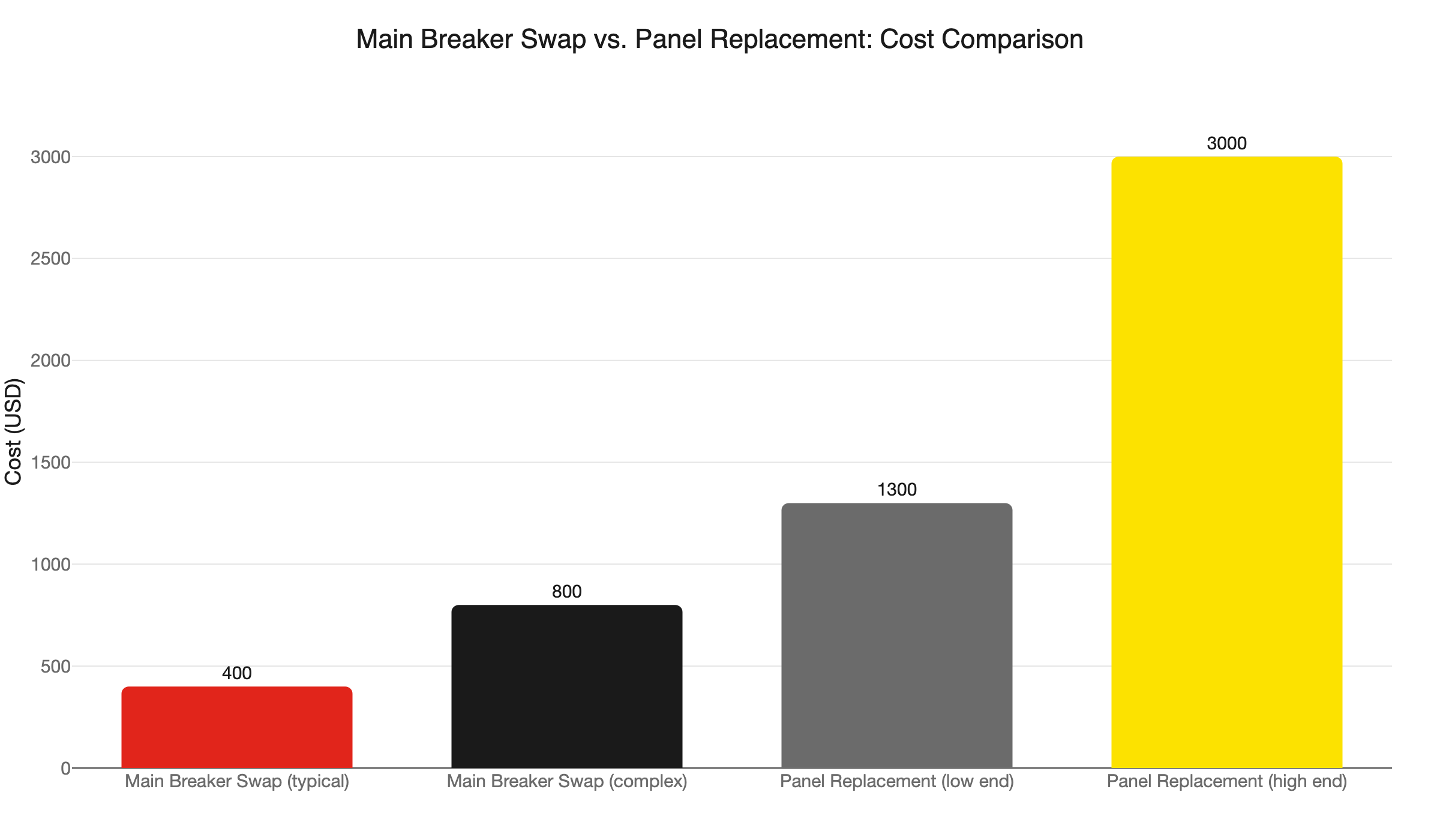
- A main breaker swap on a healthy panel runs $200-$600 all in, up to $800 for complex jobs
- Full panel replacement costs $1,300-$3,000
- “Just the breaker” is appropriate only when the panel is under 20-25 years old, properly sized, free of corrosion, and not a recalled brand (Federal Pacific, Zinsco, or Pushmatic)
- Full panel replacements permitted on or after August 17, 2026, now require a mandatory outdoor disconnect enclosure under the 2026 NEC; an isolated breaker swap does not
- A permit and inspection are required for all panel and breaker work in Minnesota, no exceptions
- Xcel Energy coordinates the meter pull; your licensed electrician handles that, not you
- Unpermitted panel work surfaces at home sales, fire insurance claims, and future remodel permits
The $400 Question vs. the $4,000 Question
Your main breaker trips at odd times. Power cuts out with no visible trip. Or you smell something off near the panel. These symptoms look the same. The repairs do not.
A main breaker swap addresses one component. A full panel replacement is a different job with a different cost and, in Minnesota as of August 2026, different code requirements. One repair runs $200-$600. The other runs $1,300-$3,000. Knowing which job you actually need before the electrician arrives makes you a smarter buyer.
There is a 2026 code wrinkle specific to Minnesota. A full panel replacement now triggers a mandatory outdoor emergency disconnect enclosure under the 2026 NEC. An isolated main breaker swap does not. That distinction alone can change your quote by hundreds of dollars.
Here is how to tell the difference, what each repair costs, and what the process looks like in the Twin Cities.
What Are the Signs Your Main Breaker Is Failing?
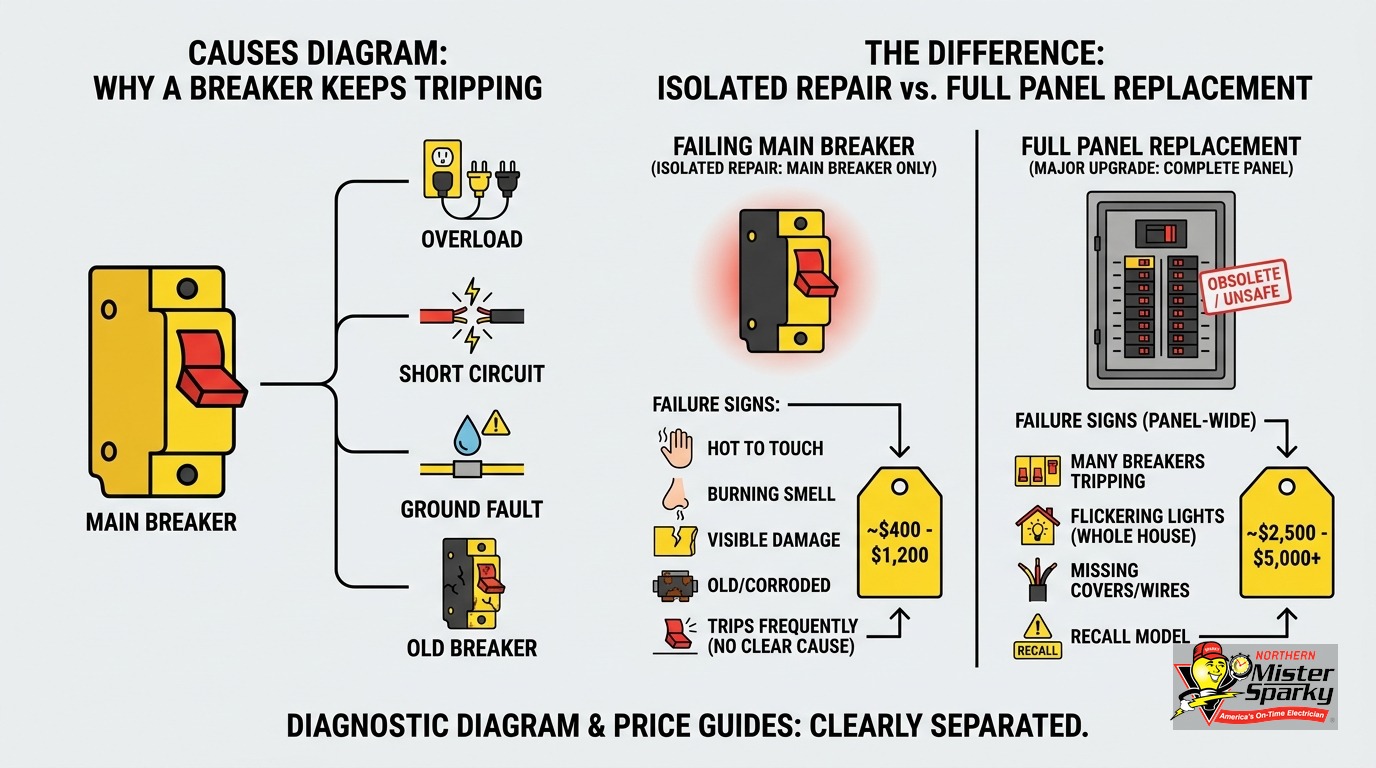
Short answer: A failing main breaker trips under normal load, won’t stay reset, loses power without tripping, or emits a burning or fishy odor. Each symptom points to a specific internal failure in the breaker itself, distinct from the panel behind it. These are targeted, one-component problems.
The main breaker is the large double-pole breaker at the top of your panel. It controls power to the entire home. When it fails on its own, the repair can be straightforward - if the panel is healthy.
Here is what each symptom tells you:
Frequent tripping under normal load. If the main breaker trips while you are running ordinary appliances, the internal spring or carbon buildup on the contacts is the likely cause. Wear on the contacts causes a breaker to trip below its rated threshold.
Breaker won’t stay reset. Flip it back and it trips again immediately. This is mechanical damage to the trip mechanism from a past surge or from repeated overcurrent events. The breaker is detecting a fault, not malfunctioning.
Power loss with no visible trip. The handle sits in the “on” position, but the lights are out. The breaker has failed in the “on” position with its internal connection severed. There was no overcurrent before failure. It simply stopped conducting.
Burning or fishy odor. A burning or fishy smell near the panel points to arcing or overheated insulation. Shut the main off and call an electrician immediately. Do not wait until morning.
Scorch marks or melted plastic. A prior arcing event left physical evidence. The connection or bus stab is damaged and will fail again under load. Scorch marks escalate this from “replace the breaker” to “evaluate the whole panel.”
The critical pattern: these symptoms are isolated to the main breaker. One component, one failure mode. When symptoms spread across the panel, the answer changes.
How Do You Know It Is the Panel, Not Just the Breaker?
Short answer: When the panel is 20-25+ years old, shows corroded bus bars, carries a recalled brand name, or has multiple breakers failing on different circuits at the same time, the panel is the problem. Replacing the main breaker in a failing panel is the wrong repair and buys months, not years.
A main breaker swap is appropriate only when the panel is not too old, properly sized, free of corroded bus bars, and not a recalled brand.
The recalled brands to know:
- Federal Pacific (Stab-Lok). Documented breaker failure rates. Not a safe candidate for a partial repair.
- Zinsco. Similar documented history. The right conversation starts at full replacement.
- Pushmatic. Replacement parts are no longer manufactured. A breaker swap is not a realistic repair path.
If you have one of these, see our overview of dangerous electrical panel brands in Minnesota for what to do next.
Also watch for multiple breakers failing on different circuits at the same time. When three circuits on separate sections of the panel start tripping in the same week, the bus bars are degrading across the board. A new main breaker does nothing for the bus. That is a full replacement job.
If you are unsure which category your panel falls into, our electrical panel lifespan guide covers the full checklist a panel inspection should cover.
What Does Main Breaker Replacement Cost?
Short answer: An isolated main breaker swap on a healthy panel runs $200-$600 all in, up to $800 for complex jobs. A full panel replacement costs $1,300-$3,000. Twin Cities labor rates and permit fees shift the final number, so always ask for a line-item estimate.
Here is the cost breakdown, per Sartell Electrical’s main breaker cost guide:
- 200A main breaker (part only): $40-$100
- Labor (1-3 hours at $50-$130 per hour): $100-$350
- Service call fee (often rolled into labor): $75-$200
- Total, isolated main breaker swap: $200-$600, up to $800 for complex jobs
- Full panel replacement (national range): $1,300-$3,000
A line-item estimate lets you see part, labor, permit fee, and any code-required additions as separate line items. If a quote is a single number with no breakdown, ask for the detail.
How Much Does a 100-Amp Main Breaker Replacement Cost?
Short answer: A 100A main breaker part runs roughly $25-$75, with comparable labor to a 200A job, putting an isolated swap at around $175-$500 on a healthy 100-amp panel. If the panel itself is end of life, those figures become irrelevant.
One practical note: if your home still runs on 100-amp service and the main breaker is failing, this is a natural decision point. An EV charger, heat pump, or major appliance upgrade will likely push that service to its limit anyway. Our guide to 100-amp vs. 200-amp electrical service covers when an upgrade makes more sense than a repair.
Should a 50-Year-Old Electrical Panel Be Replaced?
Short answer: Yes. A 50-year-old panel is well past the 20-25 year threshold for “just replace the breaker.” Decades of thermal cycling have degraded the bus bars, neutral bar, and connection points throughout the panel. Replacing the main breaker leaves all of that in place.
A 1975-era panel may also predate AFCI and GFCI breaker compatibility. Those arc-fault and ground-fault devices are required by code on many circuits today. A panel that cannot accept them cannot be brought into full code compliance without replacement.
If any permitted work touches that panel in the future - adding a circuit, finishing a basement - you may be required to upgrade it at that time anyway. Getting the replacement done now, on your schedule, is typically less disruptive than doing it mid-remodel.
If your older home still has a fuse box rather than a breaker panel, our guide to converting a fuse box to a breaker panel covers what that process looks like in the Twin Cities and what it typically costs.
Do You Need a Permit to Replace a Main Breaker in Minnesota?
Short answer: Yes, always. A permit and inspection are required for all panel and breaker work in Minnesota. Minnesota electrical code via DLI does not carve out exceptions for small jobs or isolated breaker swaps. There are no workarounds.
Homeowners may pull their own permit under a specific exemption. The home must be owner-occupied, a single-family homestead, and the homeowner must personally perform the work. Most homeowners hiring an electrician will not use this path. The electrician pulls the permit.
The DLI homeowner permit form shows the fee structure: a $25.00 base fee plus a $1.00 surcharge. A panelboard replacement adds $2 per reconnected circuit or feeder. Per 3 Rivers Electric’s Minnesota permit guide, small residential jobs including a single breaker swap typically come with modest total permit costs.
One more detail: about 66 Minnesota cities are local authorities having jurisdiction and issue their own permits, separate from DLI. The inspector lookup at dli.mn.gov shows which applies to your address.
Why does this matter? Unpermitted panel work surfaces at the worst times. Home inspections flag it at sale. Fire damage claims can be denied when the damage traces to unpermitted electrical work. Future remodel permits uncover it. Any electrician who quotes work without mentioning a permit is a red flag.
How Does the 2026 NEC Affect Full Panel Replacement Costs?
Short answer: Minnesota adopted the 2026 NEC on August 17, 2026. Full panel replacements permitted on or after that date now require a mandatory outdoor emergency disconnect enclosure as a line item. An isolated main breaker swap does not trigger this requirement. That difference is real cost not reflected in national price guides.
Per DLI’s Electrical Codes and Standards page, permits pulled on or after August 17, 2026, must comply with the 2026 NEC. Work permitted before that date falls under the 2023 NEC.
Under NEC 2026 Section 230.70(A)(1), the service disconnect for one- and two-family dwellings must be in a readily accessible outdoor location on or within sight of the dwelling. Section 230.70(E) triggers this requirement on any service equipment replacement. Full panel replacement is service equipment replacement.
A main breaker swap inside an existing panel is not. That is the distinction that matters when comparing quotes.
If you are getting full panel quotes right now, ask specifically whether the outdoor disconnect enclosure is included. If a contractor’s quote does not mention it and they will be pulling a permit after August 17, 2026, ask why.
The 2026 NEC also added a mandatory surge protection device requirement on residential service under Section 230.67. On a full panel replacement, this becomes another required line item. Our whole-home surge protection guide explains what an SPD protects against and what installation involves.
Should I Replace My Circuit Breaker or Hire a Pro?
Short answer: Hire a licensed electrician. The main breaker cannot be de-energized safely without Xcel pulling the meter. The work requires a permit. And misdiagnosing breaker vs. panel costs far more than any service call.
Here is the coordination piece most homeowners miss: Xcel Energy owns the service entrance up to the meter. Per Xcel’s Standard for Electric Installation and Use, the licensed electrician on the job must submit the disconnect and reconnect service order. You cannot call Xcel yourself to schedule the shutoff. That is a published requirement, not a formality.
Xcel’s reconnection fee is $13.50 for AMI (smart meter) customers, or $50.00 for manual meter reading service.
The diagnostic value of a service call is the other practical reason to hire out. An electrician opens the panel and tells you which job you actually have. A homeowner who buys a replacement breaker online and installs it in a panel that actually needs full replacement has spent $200-$400 on the wrong repair. The original problem is still there.
Minnesota’s temperature swings are worth noting here too. Twin Cities panels in garages and on exterior walls cycle from -20 degrees F to 90 degrees F-plus across the year. That thermal stress accelerates wear on breaker contacts and bus connections. A trained inspection during a service call catches what those temperature cycles have done to the interior.
If your panel evaluation points toward a larger job and you are thinking about adding an EV charger, it may be possible to install an EV charger without a full panel upgrade using smart load management technology. Or you may want to size the panel and charger installation together and ask about Xcel’s rebate for qualifying service upgrades.
What Happens When You Schedule a Service Call?
Short answer: We open the panel, give you a straight diagnostic answer, and quote the repair with line items. If you approve, we handle Xcel coordination, pull the permit, complete the work, and get the inspection signed off. The UWIN(R) 100% satisfaction guarantee backs every job.
As a locally owned and operated Twin Cities electrician, we show up on time. That is the America’s On-Time Electrician(R) promise, and it applies to diagnostics the same as installations. Here is the sequence when we arrive:
- We open the panel and inspect the main breaker, bus bars, neutral bar, connections, and wiring condition.
- We give you a straight answer: main breaker swap or full panel replacement.
- We quote the work with line items, including part, labor, permit fee, and any code-required additions.
- If you approve, we coordinate the Xcel meter pull and pull the permit before any work starts.
- We complete the work, call for inspection, and get the job signed off.
No surprises on the final bill.
Financing is available for larger jobs. A full panel replacement or service upgrade does not have to be a same-day out-of-pocket expense. Ask us about options when we are on site.
Ready for a Straight Answer?
Call us at 763-200-5956 or book online. We will send a licensed electrician to your home, open the panel, and tell you exactly what you are looking at, what it costs, and how fast we can get it done.
No malarky.
Frequently Asked Questions
Will homeowners insurance cover electrical panel replacement? +
Need an electrician now?