
Condo Electrical: Who Is Responsible - Owner or HOA?
Key Takeaways
- Minnesota law defaults to: HOA maintains common elements, you maintain your unit. Your declaration can override that default entirely.
- High-rise and townhome associations have different physical layouts. The layout is your first clue before the CC&Rs even come out.
- The main service entrance, meter bank, and primary distribution panel are almost always common elements. The HOA or Xcel Energy owns them.
- Branch circuit wiring inside your unit - outlets, switches, light fixtures - is almost always your responsibility.
- The breaker panel itself is a genuine gray area. Three different ownership splits exist across real Minneapolis buildings.
- Any electrical work in a Minneapolis condo requires a permit pulled by a licensed electrician.
- Minnesota has a free CIC Ombudsperson for ownership disputes. Use that resource before hiring an attorney.
Condo Electrical Responsibility: Understanding the Split
Condo electrical who is responsible - owner or HOA - is the question that sends Minneapolis condo owners in circles. You search online and get told to read your CC&Rs. You read your CC&Rs and find legal language that raises three more questions. You call your property manager and get voicemail.
This post cuts through that. It covers the physical reality for high-rise and townhome associations, the two Minnesota statutes that set the default rules, and a fast call matrix so you know exactly who to contact before spending a dollar.
Understanding the split matters for two concrete reasons. First, you should not pay for work the HOA owes. Second, you should not wait on the HOA when the problem is yours and ignoring it creates a fire hazard.
Why Does Your Building Type Change the Entire Answer?
The short answer: In a Minneapolis high-rise, the main distribution panel typically sits in a locked common electrical closet, placing it clearly in HOA territory. In a townhome association, the breaker panel usually lives on an interior wall inside your unit - same hardware, completely different ownership question.
This single distinction resolves most of the confusion. Yet almost no general guide addresses it.
In a stacked high-rise - think Uptown tower condos, downtown Minneapolis buildings from the 1970s, or older Nicollet Island units - the electrical riser runs vertically through a common utility chase. The floor-level distribution panels and sub-metering banks typically live in a locked common electrical closet on each floor. Reaching that panel requires a building key and often building staff. The HOA controls that space entirely.
In a townhome association, your unit typically has its own breaker panel on an interior wall. You can reach it without involving anyone else. But “inside your walls” does not automatically mean “your panel.” If that wall is a demising wall - one shared with a neighboring unit or with a common structural element - your declaration’s unit-boundary language determines who owns the wiring running through it.
Xcel Energy’s role adds another layer in Minneapolis high-rises. Xcel owns the transformer and the service entrance up to the meter bank. The building owns from the meter bank downstream. Some outages that feel like “your building’s electrical problem” are actually Xcel’s responsibility. Xcel makes that repair, not your HOA and not you.
The practical rule: if a building employee needs to unlock a door to reach a piece of electrical equipment, it is almost certainly a common element. If you can reach it without involving anyone else, you probably own it - but verify against your declaration before assuming.
What Does Minnesota Law Say About Default Condo Electrical Responsibility?
The short answer: Minnesota Statute 515B.3-107 (MCIOA) places common element maintenance on the association and unit maintenance on the owner. For older Minneapolis buildings, Statute 515A.3-107 states the same default. In both cases, the declaration can override the default rule.
Minnesota has two statutes in play. Which one governs your building depends on when it was created.
MCIOA (Minnesota Statute 515B) covers most condos and planned communities formed after 1994. According to the HOPB Minnesota guide, roughly 40 MCIOA sections also reach back to govern older Chapter 515 condominiums created before 1999. The default rule in 515B.3-107 is direct: the association is responsible for maintenance, repair, and replacement of common elements, and each owner is responsible for their unit - “except to the extent provided by the declaration.”
The Uniform Condominium Act (Minnesota Statute 515A) covers condos created before MCIOA. Many older Minneapolis high-rises built in the 1960s through 1980s still run under 515A.3-107, which carries the same default rule. Cooperatives and pre-1994 planned communities may fall outside MCIOA entirely. If your building is older, confirm which chapter governs it before assuming MCIOA applies.
The age of your building is a critical first check. A 1972 downtown Minneapolis high-rise and a 2005 Maple Grove townhome association follow different statutory frameworks. Both call themselves condos. Both use CC&R language. The rules that govern them are not the same.
How Can Your Declaration Override the Default State Rules?
The short answer: Your declaration is your building’s private constitution. It can reassign electrical maintenance from the HOA to you, or from you to the HOA. The key clause is the “unit boundary” definition - whether your unit extends to the interior unfinished surface, the finished surface, or the stud face.
The declaration defines what “unit” means in your specific building. That definition directly controls which wiring is legally yours.
CondoWorkbook documents three common ownership split patterns for electrical panels in condo buildings:
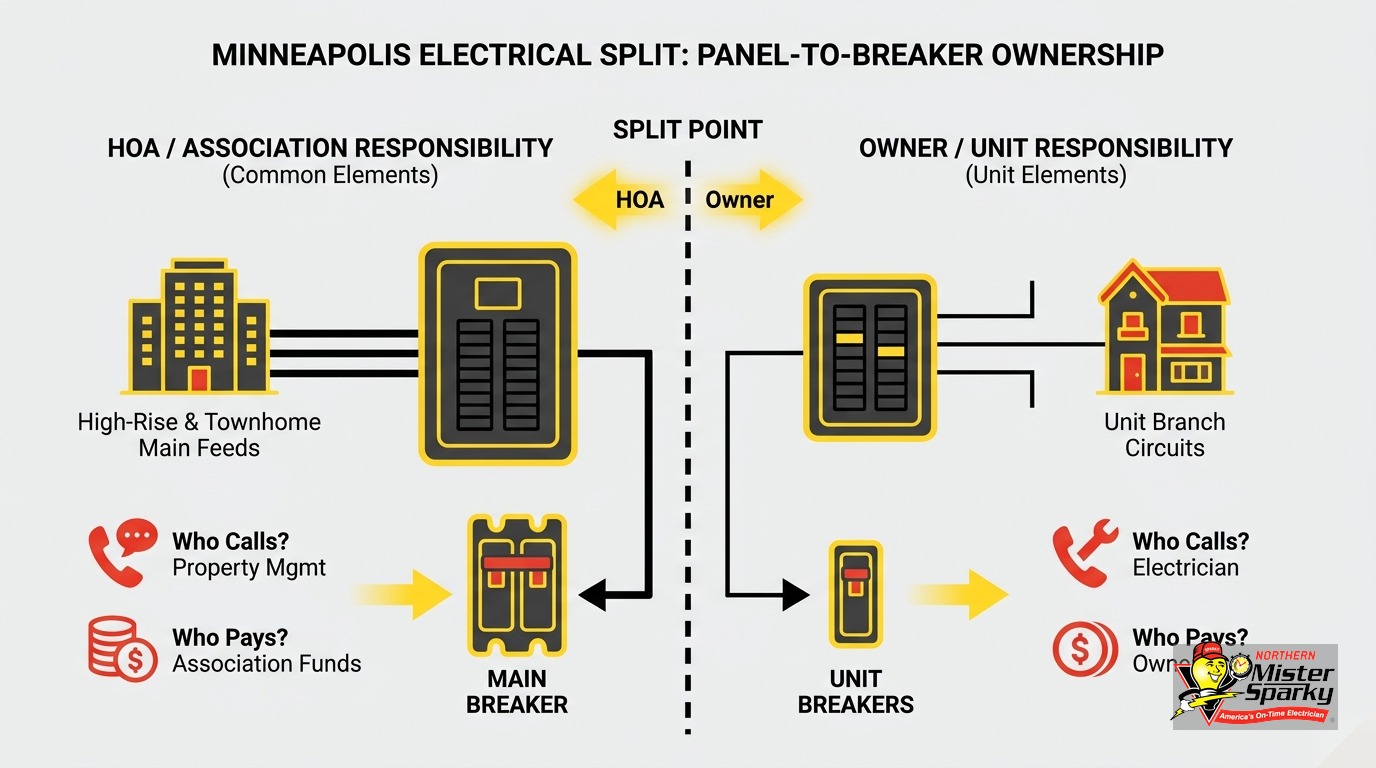
- HOA owns the enclosure and the feed wire; you own the breakers and everything downstream. This is common in high-rises where the panel cabinet is mounted on a common-element wall.
- You own the entire panel. More common in townhomes where the panel sits clearly inside your unit’s defined boundary.
- HOA owns the entire panel because it is physically mounted on a common-element wall - even if it feeds only your unit.
The hinge is always the unit-boundary language. If your declaration says your unit runs to the “interior unfinished surface,” the drywall, insulation, studs, and any wiring in the stud bays belong to the building. If it says “interior finished surface,” the drywall is yours - but the wiring behind it may still be a common element. Small language differences produce large ownership differences, and large differences in who writes the check.
Pull your declaration and find the unit-boundary definition before spending any money arguing about an electrical repair. Two buildings on the same Minneapolis block can - and often do - answer this question differently.
Breaking Down the Panel Layer by Layer
Not all panel components carry the same ownership question. Here is how CondoWorkbook maps the components for typical condo structures, and how it applies in the Twin Cities.
The electrical service entrance (meter bank, main disconnect, primary distribution panel): Almost always a common element in every building type. In most Minneapolis high-rises, Xcel Energy owns the transformer and the service entrance up to the meter bank. The building owns from the meter bank downstream. Neither you nor the HOA touches what Xcel owns.
The unit sub-panel: Varies. This is the true gray area, and it is where most disputes concentrate. Your declaration controls this component. The physical location on a wall - common-element wall versus interior unit wall - is a strong signal, but the declaration’s boundary definition is the legal answer.
Branch circuit wiring inside your unit - the runs feeding your outlets, switches, and fixtures: Almost always the unit owner’s responsibility. If a circuit in your bedroom fails, it is your electrician and your permit.
Common-area wiring - hallways, elevators, parking structures, exterior lighting: Always the HOA’s responsibility. No gray area here.
Demising wall wiring: Ambiguous in almost every building. Your unit-boundary definition resolves it. If you own to the “studs,” wiring in the stud cavity may belong to the building.
For older Minneapolis panel brands flagged for safety issues - a separate but related concern in aging buildings - our post on dangerous electrical panel brands in Minnesota covers what inspectors flag most often.
Who Pays When Something Goes Wrong?
The short answer: Follow the ownership. Common elements are the HOA’s bill. Unit components are yours. For gray-area items like the panel itself or demising wall wiring, check your declaration before calling anyone.
Here is how the most common condo electrical problems break down.
Tripped breaker in your unit’s panel: Almost always your responsibility. Reset the breaker once. If it trips again under normal load, the circuit has a problem. Call a licensed electrician. Repeated trips signal undersized wiring, a failing breaker, or a circuit fault.
Sparking outlet or burning smell in your unit: Your responsibility - and an emergency. A burning smell from an outlet or breaker is a fire warning, not a maintenance item to schedule for next week. Call an electrician the same day. Expect a permit for the repair.
Flickering lights throughout the building: Call your building manager first. Building-wide symptoms point to the common electrical system - the riser, the main distribution panel, or the utility feed. This is HOA territory, and your electrician cannot repair what the HOA or utility owns.
No power to your unit only, after a storm: Call Xcel Energy before calling anyone else. Xcel owns the service entrance up to the meter bank. If the outage is upstream of the meter, it is their repair.
No power to your unit only, no storm, neighbors have power: Check your breaker panel first. If all breakers look normal and neighbors have power, call the building manager. The issue may be in the sub-metering bank, the riser tap, or the floor distribution panel - all common elements.
Water damage to your unit’s wiring after a pipe leak: This scenario crosses the electrical-plumbing boundary. The wiring repair is almost certainly yours. The water source may be the HOA’s liability. Document everything and photograph the damage before calling either party - it matters for determining who covers what.
A code-triggered upgrade that affects your unit: Minnesota adopted NEC 2020 effective 2023. If your HOA initiates a riser upgrade or common-panel replacement, that project may require your unit’s sub-panel to meet current code as part of the same work. Who pays for that unit-level upgrade is, again, a question your declaration answers - but plan for the possibility before the project starts.
Who Do You Call First? A Fast Decision Matrix
The short answer: Unit-level problem - call a licensed electrician. Building-wide problem - call the building manager. Storm outage with no power - call Xcel first. Ownership dispute - call the Minnesota CIC Ombudsperson before hiring an attorney.
| Symptom | Call First | Why |
|---|---|---|
| Tripped breaker in your panel | Licensed electrician | Unit component; your bill |
| Sparking or burning outlet | Licensed electrician | Emergency; unit wiring |
| Flickering lights, building-wide | Building manager | Common electrical system |
| No power, building-wide | Building manager or Xcel | Utility or main panel fault |
| No power to your unit only, post-storm | Xcel Energy | Utility owns the service entrance |
| No power to your unit only, no storm | Building manager first | Sub-metering or riser issue likely |
| Dispute about who pays | Minnesota CIC Ombudsperson | Free state resource under Minn. Stat. 45.0137 |
The Minnesota CIC Ombudsperson is a free state resource that helps owners and associations understand their maintenance responsibilities when a dispute arises. It is non-binding and does not replace legal counsel, but it resolves many disagreements before they reach an attorney.
Do You Need a Permit for Condo Electrical Work in Minneapolis?
The short answer: Yes. Any condo electrical work beyond a lamp replacement requires a permit from Minneapolis Department of Safety and Inspections (DSI). A licensed electrician must pull the permit. Condo owners cannot self-permit the way detached homeowners sometimes can.
In a detached single-family home, a homeowner can sometimes pull their own permit for systems they exclusively own. In a condo, shared infrastructure changes the equation. Minneapolis DSI requires a licensed electrician for any work touching the service entrance, meter bank, or any system not exclusively owned by the unit owner.
Even for entirely unit-level work - replacing a sub-panel, adding a circuit, moving an outlet to a different wall - you still need a licensed electrician and a permit. This is not a shortcut-friendly process, and a condo repair done without a permit can create problems at resale.
Minnesota adopted NEC 2020, effective 2023, through Minnesota Rules 1315. Any electrical work must meet current code regardless of who initiates it or why. For a full walkthrough of what the Minnesota electrical permit process looks like from first call to final inspection, see our post on electrical permits in Minnesota.
If you are planning to add an EV charger in your designated parking space, the HOA approval and permit requirements add a specific sequence of steps that is different from a single-family install. Our guide on EV chargers for condo and townhome HOA owners walks through that process from HOA request to final inspection.
For situations where the panel itself needs upgrading - whether the trigger is code compliance, an HOA project, or failing equipment - our post on condo electrical panel upgrades in Minneapolis covers what that project requires, including HOA coordination and permit steps.
What If You and Your HOA Disagree About Who Pays?
Disputes over maintenance responsibility are common in condo associations. Work through these steps in order.
1. Read the declaration. Find the unit-boundary definition and the maintenance responsibility section. These two sections resolve most disputes without involving anyone else. Most owners who call us frustrated have not yet read their declaration. The answer is usually in there.
2. Request a written response from your HOA board. Submit your question in writing. Ask for a written ruling. Written responses create a record and tend to produce clearer answers than phone calls.
3. Contact the Minnesota CIC Ombudsperson. Free. State-level. Non-binding, but often persuasive. This is the right move before you pay for an attorney.
4. Consult a Minnesota HOA attorney. If the ombudsperson’s guidance does not resolve the dispute, a short consultation with an attorney familiar with Minnesota Statutes 515A or 515B is worth the cost before you absorb a large repair bill on work that may not be yours.
Do not skip step one. It is the only step that costs nothing and takes under an hour.
Ready to Sort Out Your Condo’s Electrical?
If breakers are tripping, outlets have gone dead, or you need a licensed electrician who knows the Minneapolis DSI permit process and works in condo buildings regularly, we are ready.
Northern Mister Sparky is locally owned and operated in the Twin Cities. We work in Minneapolis, St. Paul, Bloomington, Brooklyn Park, Woodbury, Blaine, Maple Grove, Plymouth, and the surrounding area. We know how to coordinate with building managers, navigate HOA approval processes, and pull permits correctly so the work passes inspection.
We are America’s On-Time Electrician(R), and we back every job with the UWIN(R) 100% satisfaction guarantee. Call 763-200-5956 or book online to schedule. We will be there on time - no malarky.
Frequently Asked Questions
Who is responsible for condo electrical repairs in Minnesota? +
Does my HOA own my condo's breaker panel? +
Do I need a permit for electrical work in my Minneapolis condo? +
Need an electrician now?