
EV Charger Condo HOA Minneapolis: What You Need to Know
Key Takeaways
- Minnesota has no right-to-charge law. HOA approval is a governance process, not a legal right.
- The HOA’s primary objection is almost always metering: who pays for the electricity your charger draws from the building’s shared supply?
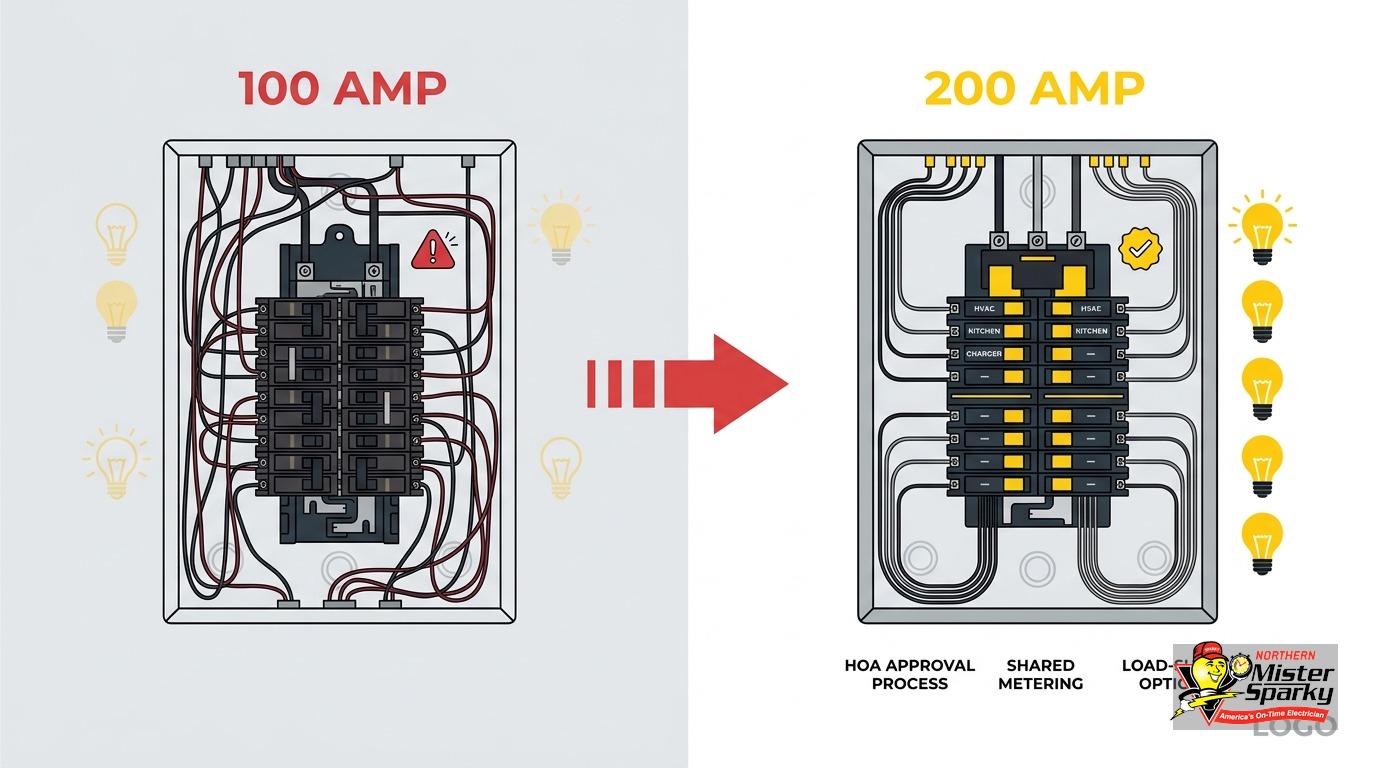
- Dedicated circuits fail at scale. Smart load management is how The Legacy, a 374-unit Minneapolis condo, added charging capacity for 210 units without upgrading the building’s service.
- Xcel Energy’s EVSI program, approved by the Minnesota PUC in May 2026, pays up to $11,800 per port in Environmental Justice communities. Most HOA finance committees have not seen this number yet.
- The federal 30C tax credit expired June 30, 2026. Do not factor it into your project budget.
- Minneapolis requires a licensed electrical contractor, a permit, and two inspections for every condo EV charger install. No homeowner exemption applies.
- Call 763-200-5956 or schedule your EV charger assessment online before you draft anything for the HOA. The load study is the document every other step depends on.
How Is a Condo EV Charger Different From a House Install?
A house install gives you full control: your panel, your parking surface, your wiring path. A condo install is different. You share electrical infrastructure with every other unit, and the HOA governs how it is used. Approval, load planning, and a metering solution all come before any wire is pulled.
In a single-family home, adding a dedicated 240V circuit for an EV charger is a permit-and-install job. The homeowner owns the panel and the wiring path. In a condo, that same circuit may cross common-area infrastructure. It may require board approval and a metering plan before work begins.
Three questions drive every condo EV project:
- Who controls the parking space? Deeded, assigned, and common-area spaces each carry different approval paths.
- Where does the electricity come from? Your unit’s panel, a parking garage subpanel, or the building’s shared service each creates different billing implications.
- How does the HOA get reimbursed? This is the question most proposals fail to answer, and the main reason HOA boards say no.
A condo-experienced electrician walks through all three before quoting anything. Skipping this step produces a proposal the board will find easy to table.
Does Minnesota Law Give Minneapolis Condo and HOA Owners the Right to Charge?
No. Minnesota has no statewide right-to-charge law. HOA boards are not legally required to approve EV charger installations. Unlike more than 30 other states, Minnesota gives condo owners zero statutory protection. HOA denial is not legally challengeable under state law. A well-built proposal is your only path to a yes.
This is the fact most national EV charging guides get wrong. They treat right-to-charge laws as standard across all 50 states. They are not. The AFDC database confirms Minnesota is not among the protected states.
Minneapolis condos built after 1994 are governed by the Minnesota Common Interest Ownership Act. Chapter 515B of Minnesota Statutes covers the HOA governance process. It contains no EV-specific provision. The board has full discretion to approve or deny any request involving modifications to shared electrical infrastructure.
Pre-1994 buildings have only partial MCIOA coverage. If your building predates 1994, confirm which governance documents apply before drafting anything. Your CC&Rs may include specific amendment procedures that affect the approval path.
What this means practically: your proposal must give the board a clear path to yes. Every open question they have to investigate on their own is a reason to delay or deny. A licensed electrician’s load study and metering plan close most of those questions before the board raises them.
Plan for 60-90 days from proposal submission to a board vote. Most HOA boards need at least one regular meeting cycle and a follow-up vote to approve any change to building infrastructure.
Dedicated Circuits vs. Smart Load Management: Which Works for Your Condo?
For most condos with more than 20 to 30 parking spaces, smart load management is the right answer. Dedicated circuits work well at low EV adoption but fail as demand grows. Each new circuit adds permanent load to the building’s service. Smart load management distributes the same total capacity dynamically across all active sessions.
Dedicated circuits give each parking space its own 240V run from the building’s electrical service. The billing model is simple: each circuit is on the owner’s own meter, or it is sub-metered individually. But they scale poorly. Every new circuit consumes permanent capacity even when the space is empty. A 200-space building cannot give every space a dedicated 48-amp circuit without transformer upgrades, underground trenching, or a full service upgrade costing hundreds of thousands of dollars.
The Legacy, a 374-unit condo in Minneapolis’s Mill District, shows the limit clearly. The building has 700 resident-owned parking spaces and 1,700 amps of building service. Its original dedicated-circuit chargers worked at low EV adoption. As demand grew, the building faced transformer replacement and major trenching costs. The Legacy made a different choice. Smart load management software allowed 80 active chargers and 67 charger-ready circuits to fit within the same existing 1,700-amp service. Capacity for 210 total units. No new transformer. No trenching. The HOA avoided what would have been hundreds of thousands in infrastructure costs.
Smart load management distributes available electrical capacity dynamically. When fewer cars are charging, each session gets more power. During peak demand, the system throttles individual sessions to stay within the building’s capacity ceiling. A homeowner doing overnight charging never notices the difference.
Smart load management also makes board approval easier. It directly answers the “what happens when everyone charges at once?” question that kills most condo EV proposals at the first meeting. The answer is built into the system design.
For a smaller building with a parking garage subpanel that has genuine headroom, dedicated circuits may still be cost-effective. That determination requires an electrician to review the building’s electrical drawings. Our team can complete that review before you present anything to the board.
What Is the Metering Problem, and How Do You Solve It?
If your charger draws power from the building’s shared electrical service, the HOA absorbs your charging cost inside its utility bill. No HOA board will approve a project with an unresolved electricity cost. A metering plan is not optional. It is the document that unlocks board approval.
This is the HOA’s real objection in almost every condo EV conversation. It rarely surfaces as “we don’t want chargers.” It comes out as “how do we know who pays for what?” or “we can’t take on additional utility expense.” Both mean the same thing: no metering plan, no approval.
Three solutions work reliably in Minnesota condo settings:
1. Individual sub-meters at each charger. A revenue-grade meter at each station records the kWh drawn per session. The HOA or a billing service invoices each owner monthly. The cost flow is fully transparent. Most boards can approve this without extended legal review.
2. Networked charging with built-in billing. Smart charger platforms bill residents directly by credit card or app. The HOA receives a single reimbursement rather than chasing individual invoices. The Legacy operates this way: residents pay the platform, and the platform reimburses the building for electrical cost. The HOA’s administrative burden is near zero.
3. Owner-supplied electrical source. If your parking space is served by a subpanel on your unit’s own meter, the electricity is already billed to you. The HOA has no billing exposure. This is the cleanest arrangement, but it depends on the building’s existing electrical design.
There is also a regulatory layer to address. Under MN Statute 239.90 and NEC Article 625, any charger offered as a shared amenity must display price per kWh and comply with Minnesota’s retail metering standards. The Department of Commerce inspects those chargers annually at $100 per port. A licensed electrician who knows Minnesota utility law can design a metering solution that satisfies both the HOA governance requirement and state statute.
How Do You Build an HOA Proposal for a Minneapolis Condo EV Charger?
Lead with a load study, a metering plan, a licensed contractor named on the cover page, and the Xcel rebate amounts that reduce the HOA’s out-of-pocket cost. Those four elements close every standard objection before the board raises one. The rest of the proposal is supporting detail.
HOA boards are not against EV charging as a concept. They are against financial risk, liability exposure, and administrative burden they did not budget for. A strong proposal removes all three before the board has to ask.
What a winning proposal includes:
- Load study. A licensed electrician’s written assessment of the building’s existing service and available capacity. It answers “can our building handle this?” before the board asks.
- Metering plan. Which solution you are proposing and who administers it. Take billing administration off the HOA’s plate entirely.
- Code-compliant design summary. NEC Article 625 requirements addressed. Minneapolis permit path identified. Licensed contractor named with license number. These details signal a professionally managed project.
- Rebate summary. Show the board exactly what Xcel’s EVSI program pays per port. A $6,500-per-port infrastructure rebate changes the financial math. Note whether the building qualifies as an Environmental Justice community, because that classification nearly doubles the rebate.
- Phased installation option. Offer to start with conduit, panel work, and charger-ready circuits (the make-ready infrastructure), then add charger hardware as resident demand grows. Phasing reduces the HOA’s upfront commitment and keeps the initial vote to a smaller dollar amount.
If your building is in North Minneapolis, Brooklyn Center, or another inner-ring suburb, confirm EJ eligibility during the load study phase. That designation belongs in the proposal because it directly reduces the HOA’s net cost.
Our guide on avoiding a panel upgrade with EV load management covers the capacity math in plain language. It is a useful attachment for a finance committee that has questions about electrical headroom. For larger condo EV projects, financing is also available. Ask our team during the assessment.
What Rebates Apply to Condo and HOA EV Charger Projects in Minneapolis?
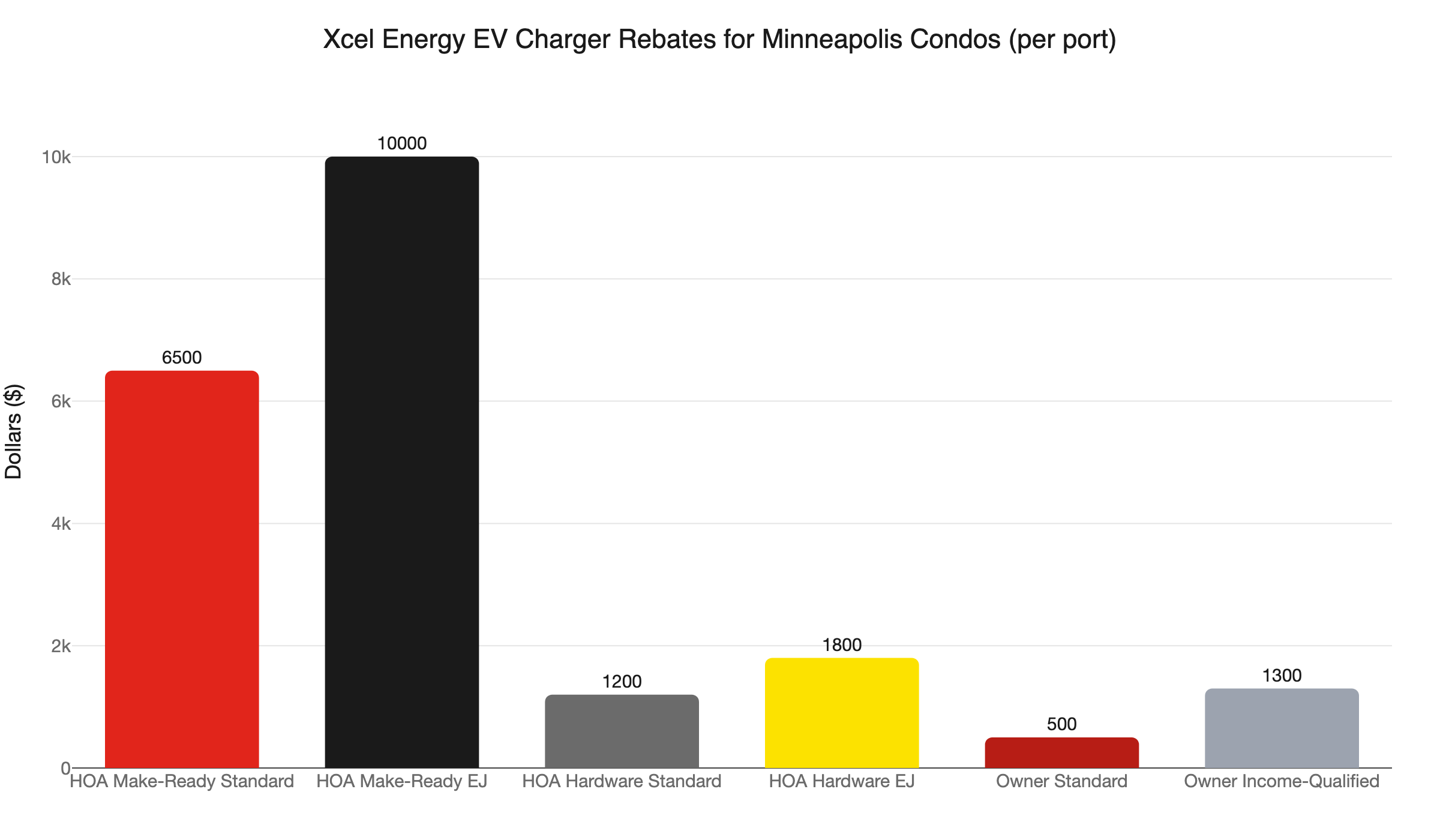
Xcel’s EVSI program, approved by the Minnesota PUC in May 2026, pays up to $6,500 per port for infrastructure and $1,200 per port for hardware at standard sites. In Environmental Justice communities, those stack to $11,800 per port. The federal 30C credit expired June 30, 2026, and does not apply to new projects.
This is new money. Most HOA finance committees have not seen it yet. It belongs in every condo EV proposal.
Multifamily and HOA rebates (Xcel EVSI):
Xcel’s Commercial EV Infrastructure program pays the building, not the individual condo owner, for both infrastructure and charger hardware:
- Level 2 make-ready (conduit, wiring, panel work per parking space): $6,500 per port at standard sites; $10,000 per port in Environmental Justice communities
- Level 2 charger hardware: $1,200 per port standard; $1,800 per port in EJ communities
- Combined maximum in an EJ community: $11,800 per port
Environmental Justice designation applies to portions of North Minneapolis, Brooklyn Center, and some inner-ring suburbs of the Twin Cities. Confirm eligibility during the load study phase. It can more than double the infrastructure rebate.
Individual owner rebates (Xcel residential):
If your parking space draws from your unit’s own electrical meter, separate rebates apply. Minnesota’s residential EV incentives include:
- $500 standard for a new Level 2 circuit and charger
- $1,300 if income-qualified
- Up to $1,500 additional if a panel upgrade is needed to support the new load
Do not assume HOA and individual rebates stack automatically. The EVSI program applies to the building as the applicant. Residential rebates apply to unit-level service. Confirm with Xcel which programs apply before starting any work.
Timing matters. The EVSI program was approved in May 2026 and applications were opening in the months that followed. Contact Xcel before work begins. Starting before program approval typically voids the rebate.
Federal 30C credit: no longer available for new projects. The Alternative Fuel Refueling Property Credit expired June 30, 2026. Only installations placed in service by that date in an eligible census tract can still claim it. Use IRS Form 8911 when filing if that applies to you. Do not budget for this credit on any project starting now.
What Does the Minneapolis Permit Process Look Like for a Condo EV Charger?
Every EV charger installation in a Minneapolis condo requires a permit, a licensed electrical contractor with no homeowner exemption, a rough-in inspection before walls close, and a final inspection after the charger is energized. Permit fees typically run $150-$300 and are valid for 180 days.
The Minneapolis EV charger permit and inspection process follows this sequence:
- Contractor pulls the permit before any work begins. Starting before permit approval triggers an investigation fee on top of the standard cost.
- Rough-in inspection happens before walls or conduit chases are closed. The inspector checks conductor sizing, conduit fill, grounding method, and NEC Article 625 compliance.
- Final inspection happens after the charger is energized and functional. The inspector verifies the installation meets code before signing off.
- DLI sign-off. All permitted electrical work in Minnesota requires Department of Labor and Industry approval. Minneapolis Inspections coordinates the sign-off sequence.
If the building installs shared chargers for multiple residents, those chargers require annual inspection at $100 per port. This falls under Minnesota’s retail metering statute and Department of Commerce enforcement authority.
Permit timing also affects rebate eligibility. Get Xcel rebate pre-approval before pulling the permit. The right sequence is: HOA approval, then Xcel rebate application, then permit pull, then work. A condo-experienced electrician will keep all three tracks moving without one blocking another.
Panel capacity questions often surface during permit review. Our condo electrical panel upgrade guide for Minneapolis covers the panel decisions that come up at this stage.
Schedule Your Minneapolis Condo EV Charger Assessment
An ev charger condo HOA Minneapolis project has more moving parts than most residential electrical jobs. HOA governance, a load study, metering design, Xcel rebate sequencing, and a two-inspection permit process all run in a specific order. Each step depends on the one before it. A mistake at any stage can cost you rebate eligibility, board approval, or both.
Our team is locally owned and operated in the Twin Cities. We have worked with HOA boards on load studies. We design metering solutions that remove the billing burden from property managers. We have pulled condo EV permits in Minneapolis and know which Xcel programs are active. We time the rebate application so your eligibility is locked before the first wire is pulled.
We back every job with the UWIN(R) 100% satisfaction guarantee. No malarky: if something is not right, we fix it.
The load study is the right starting point. It answers what the HOA board will ask, what the permit inspector will check, and which rebate path fits your building’s electrical profile.
Call 763-200-5956 or book online. As America’s On-Time Electrician(R), we will be there when we say we will.
Frequently Asked Questions
Does Minnesota give condo owners the right to install an EV charger? +
What Xcel Energy rebates are available for condo EV charger installation in Minneapolis? +
Do I need a permit and licensed contractor for an EV charger in my Minneapolis condo? +
Need an electrician now?