
Refrigerator Dedicated Circuit Requirements: Minnesota Code
Key Takeaways
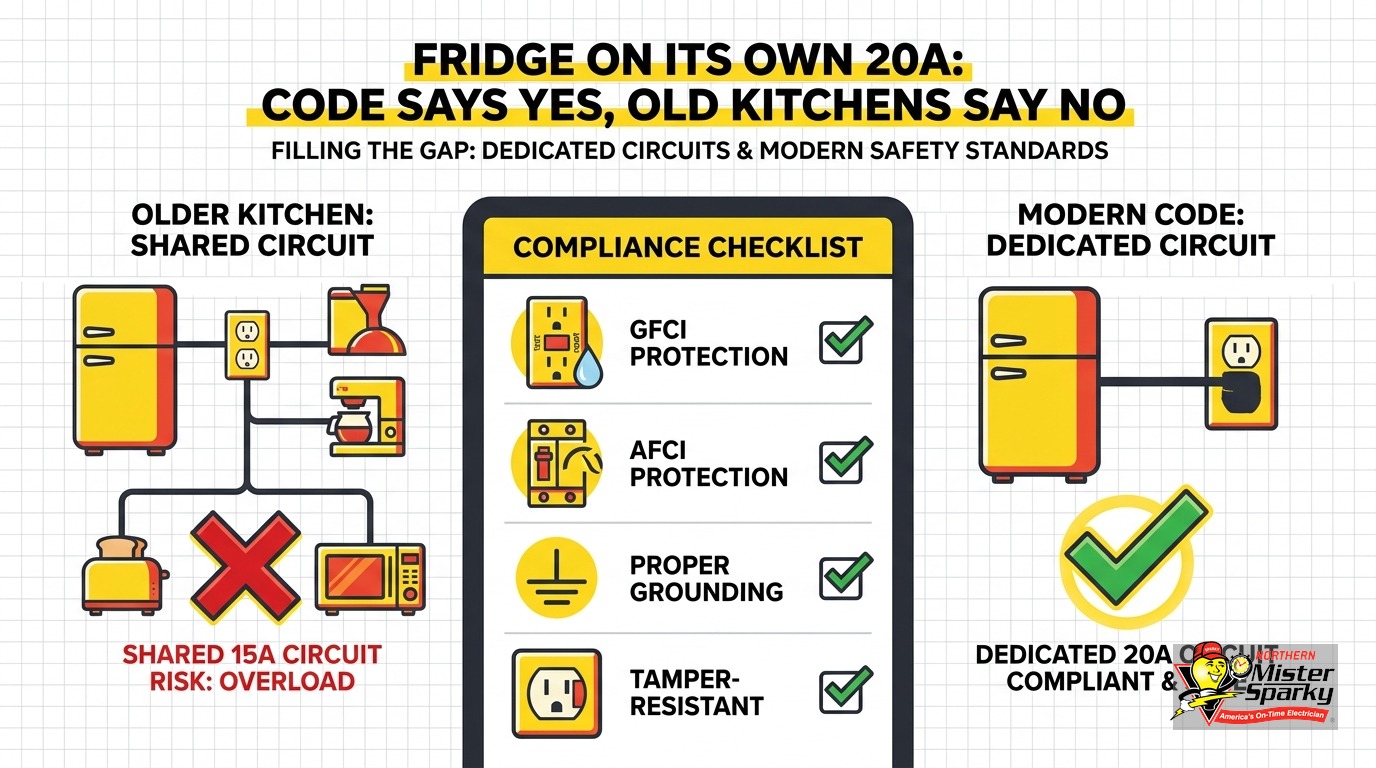
- NEC 210.52(B) permits a refrigerator on a shared small-appliance circuit. It does not require a dedicated one by name.
- NEC 110.3(B) changes that picture: a listed appliance must be installed per its manufacturer’s instructions. Most major brands require a dedicated circuit in the installation manual, which makes that instruction part of the code.
- All 120V, 15/20A kitchen circuits require AFCI protection under NEC 210.12(A). That applies to the refrigerator circuit whether it is dedicated or shared, and it adds an AFCI breaker to the job cost.
- Twin Cities homes built before 1970 commonly have a single 15A kitchen circuit wired with No. 14 AWG. That wiring is undersized and non-compliant by today’s standards.
- Minnesota transitioned to the 2026 NEC on August 17, 2026. Permits filed on or after that date require 2026 NEC compliance.
- Xcel Energy customers may qualify for up to $1,500 back if a refrigerator circuit job triggers a panel upgrade.
- Minneapolis, St. Paul, and roughly 66 other suburbs route permits through the city, not Minnesota DLI.
Does a Refrigerator Need a Dedicated Circuit?
Short answer: The NEC permits the fridge to share one of two required 20A small-appliance kitchen circuits. However, most major manufacturers require a dedicated circuit in their installation manuals. NEC 110.3(B) makes those instructions part of the electrical code. In practice, your refrigerator almost certainly needs its own circuit.
This is the point most generic articles get wrong. The framing you’ll see online - “the NEC doesn’t require it, but best practice says you should” - misses the 110.3(B) issue entirely. That section says a listed appliance must be installed according to its listing and labeling instructions. If your Whirlpool, Samsung, LG, or GE installation manual requires a dedicated circuit, that instruction is not a suggestion. It carries the force of code.
The practical test is simple. Find your refrigerator’s installation guide and look for the electrical requirements section. In most modern appliance manuals, you’ll find language specifying a dedicated 15A or 20A circuit. Once you know about NEC 110.3(B), that language tells you exactly what the code requires your electrician to install.
The warranty angle reinforces this. Whirlpool’s warranty documentation excludes damage caused by “improper installation.” If the manual says dedicated circuit and you don’t have one, you have an improper installation on paper. That exclusion can leave you paying out of pocket for a compressor failure or electrical damage that would otherwise be covered. The cost of a proper dedicated circuit is modest compared to an out-of-warranty appliance repair.
What Does the NEC Actually Say About Refrigerator Circuit Requirements?
Short answer: NEC 210.52(B) requires at least two 20A small-appliance branch circuits for kitchen receptacles and permits the refrigerator on one of them. NEC 110.3(B) and NEC 210.12(A) fill the rest of the gap. Together, those three sections mean most refrigerator dedicated circuit requirements include a 20A AFCI-protected run with No. 12 AWG wire.
Here is what each section actually covers.
NEC 210.52(B) - Small-appliance branch circuits. Your kitchen must have at least two 20A branch circuits to serve countertop receptacles. A refrigerator receptacle is permitted on one of those circuits. “Permitted” means allowed, not mandated. It does not force the fridge onto a shared circuit. It does not prevent you from giving it a dedicated one. This is the section people cite when they argue a dedicated fridge circuit isn’t required - and it is accurate, as far as it goes.
NEC 110.3(B) - Installation per instructions. A listed appliance must be installed according to its listing and labeling instructions. If the refrigerator manual specifies a dedicated circuit, NEC 110.3(B) makes that requirement part of the electrical code. This is the provision that collapses the “it’s just a recommendation” argument, and most homeowner-facing articles skip it entirely.
NEC 210.12(A) - AFCI protection. The 2023 NEC requires AFCI protection on all 120V, 15/20A branch circuits in dwelling unit kitchens. This requirement applies to the refrigerator circuit whether it is dedicated or shared. AFCI breakers detect arc faults - the type of electrical fault that starts a fire inside a wall before any smoke detector activates. Adding a dedicated fridge circuit means specifying an AFCI breaker, which is a genuine line item in any code-compliant quote.
NEC 210.8(A) - GFCI protection. Kitchen receptacles in dwelling units require GFCI protection. A receptacle behind a refrigerator in a kitchen location falls under this requirement as well. Homeowners often assume GFCI applies only to countertop outlets near the sink. The code is broader than that.
When an electrician quotes this job correctly, the price reflects four components: 20A circuit with No. 12 AWG wire, an AFCI breaker, and a GFCI receptacle. A quote that skips any of those components is skipping code requirements.
Why Are Older Twin Cities Homes a Bigger Problem?
Short answer: Post-war ramblers and split-levels built from the 1950s through the 1960s in the Twin Cities were typically wired with a single 15A kitchen circuit - No. 14 AWG wire feeding the refrigerator, countertop outlets, and often the kitchen light on the same breaker. That wiring predates both the two-circuit requirement and AFCI protection. Bloomington, Richfield, St. Louis Park, Roseville, and North Minneapolis have a high concentration of these homes.
The University of Minnesota Extension documented this clearly: No. 14 AWG wire is rated for 15A maximum. A 20A small-appliance circuit requires No. 12 AWG. A house wired in 1962 with 14 AWG throughout the kitchen needs more than one new wire for the fridge. The entire kitchen circuit wiring may need to be replaced to meet the current small-appliance branch circuit requirements.
The scope expands further when the panel is involved. A 60A or 100A service panel from the early 1960s often has no open breaker slots. Adding two 20A kitchen circuits plus a dedicated 20A refrigerator circuit may require a panel upgrade before the first new wire is run. That changes the cost picture considerably, but it also opens the door to the Xcel Energy rebate.
Aluminum branch wiring. Homes built between 1965 and 1973 in the Twin Cities may have aluminum branch wiring rather than copper. Aluminum wiring requires CO/ALR-rated devices, anti-oxidant compound at all connections, and specific installation techniques at every termination point. It changes the material spec and the labor for every outlet in the project. Our post on aluminum wiring dangers and fixes covers what to look for and what remediation involves. If your home was built in that era, mention it when you call. It matters to the scope and the quote.
What Does a Dedicated Refrigerator Circuit Cost in the Twin Cities?
Short answer: No reliable estimate exists without first looking at the panel. The circuit run, the AFCI breaker, and the GFCI receptacle are separate costs. If the panel lacks open slots or is undersized, a panel upgrade changes the project scope entirely. Simple jobs in newer homes with open panels cost less. Post-war homes with full panels and undersized wiring cost more.
What drives the total on a refrigerator dedicated circuit job:
Wire run length and routing. A straight shot from the panel through an open basement ceiling costs less than fishing wire through finished walls on a two-story home with no accessible path to the kitchen.
Panel capacity. Open slots and adequate service amperage keep the job straightforward. A full panel or undersized service means a panel upgrade before any new circuits can be added. Our guide on signs you need an electrical panel upgrade explains what typically triggers that decision.
AFCI breaker cost. AFCI breakers cost more than standard breakers. The additional price reflects the arc-detection electronics inside the device. This is a real line item in every code-compliant quote, not a markup.
Existing circuit assessment. A thorough job starts with mapping what is already in place. Are both required 20A small-appliance circuits present? Does any aluminum wiring change the material spec? Is the panel labeling accurate? An experienced electrician identifies these factors before work begins, not after.
The Xcel Energy rebate. Xcel Energy customers in Minnesota may qualify for up to $1,500 back on a qualifying panel upgrade. If the refrigerator circuit job surfaces an undersized panel and you proceed with the upgrade, that rebate is available. Work must be done by a licensed electrician. We help our customers navigate the rebate application as part of the project.
The food spoilage argument. A shared-circuit breaker trip on a Friday night can mean $300 to $500 in lost refrigerator and freezer contents. A dedicated circuit eliminates that specific failure mode. The payback on the project is shorter when you factor in what one trip costs.
Does Minnesota Have Additional Requirements Beyond the NEC?
Short answer: Minnesota adopts the NEC directly through Chapter 1315 of the State Building Code. The state transitioned to the 2026 NEC on August 17, 2026. Permits filed on or after that date require 2026 NEC compliance. Permits filed before that date use 2023 NEC. The Minnesota DLI page tracks this transition in real time.
The permit routing detail trips up more homeowners than you might expect. Minnesota DLI oversees state-licensed electrical work, but Minneapolis, St. Paul, and roughly 66 other Twin Cities suburbs serve as their own authorities having jurisdiction. If you live within one of those city limits, your permit goes to the city building department, not the state. An electrician who files with the wrong authority creates inspection and record-keeping problems that surface at the worst moments: closing, renovation, or an insurance claim.
The 2026 NEC transition is live as of this post. If your job was quoted before August 17, 2026, and the permit has not been pulled yet, verify which code cycle applies to your address. The 2026 edition carries forward AFCI and GFCI requirements for kitchens from the 2023 edition and includes additional updates to circuit specification and labeling. A licensed electrician who regularly pulls permits in Twin Cities cities tracks these transitions as a matter of course. That local knowledge is a practical difference between hiring a neighborhood pro and hiring a generalist.
What Are the Signs My Refrigerator Shares a Circuit?
Short answer: The clearest sign is a breaker trip when the refrigerator and another kitchen appliance run at the same time. A single “kitchen” breaker in the panel, a 15A breaker serving the kitchen, or no AFCI breakers anywhere in the panel are also strong indicators. An electrician can map your circuit layout in under an hour if the picture is unclear.
Here is what to look for:
- Breaker trips when the microwave and fridge run together. A shared circuit shows its limits most clearly at high-load moments. If the breaker trips when both run simultaneously, they are almost certainly on the same circuit.
- A single breaker labeled “kitchen” or “lights/recept.” Pre-1960s wiring often combined everything on one circuit. One breaker label covering the entire kitchen is a strong indicator of outdated wiring.
- A 15A breaker serving the kitchen. Modern small-appliance circuits must be 20A. A 15A kitchen breaker signals wiring that predates current code.
- No AFCI breakers in the panel. Standard breakers in every slot mean the kitchen circuits lack the protection the 2023 NEC requires. Our post on AFCI breaker requirements explains where AFCI protection applies and what it protects against.
If any of these match your home, the conversation is about more than one new wire to the fridge. The kitchen circuit picture as a whole needs evaluation. Our guide on dedicated circuits for appliances covers which appliances need their own circuits and why shared-circuit problems tend to compound.
What Happens If We Just Leave It?
Leaving a shared refrigerator circuit in place is not an immediate crisis in most cases. The risks accumulate over time, and some of them surface at inconvenient moments.
Arc fault exposure. Shared circuits under repeated overload stress develop loose connections and micro-arcs that standard breakers do not detect. AFCI breakers catch them. Kitchen circuits that predate AFCI requirements lack that layer of protection. Arc faults cause house fires. The protection exists because the risk is documented and real.
Voided appliance warranty. If the installation manual required a dedicated circuit and you do not have one, the “improper installation” exclusion in the Whirlpool warranty - and similar clauses in other major brand warranties - may apply to your repair claim. You may learn this at the worst possible moment.
Permit and inspection exposure. A kitchen remodel permit pull or a home sale inspection can flag non-compliant wiring. Fixing it under time pressure at closing costs more than addressing it on your own schedule.
Food spoilage risk. A circuit trip while you are out of town means a full refrigerator and freezer of spoiled food when you return. That cost shows up in one bill and is more visible than any slow-building wiring problem.
How Northern Mister Sparky Handles This
We are locally owned and operated in the Twin Cities. Our electricians know the permit routing for Minneapolis, St. Paul, Bloomington, Maple Grove, Woodbury, and the other cities we work in. We know what to expect when we open a panel in a 1963 split-level in Richfield or a 1958 rambler in Roseville.
When we quote a refrigerator dedicated circuit job, we look at the full kitchen circuit picture. We check the panel capacity and count open slots. We confirm the wire gauge on existing kitchen runs. We verify whether AFCI protection is already in place. We tell you what we find before we start the work, not after.
If the job involves a panel upgrade, we walk you through the Xcel Energy rebate process and help with the application. If your city is the permit authority, we file with the city. You do not need to sort out the permit routing on your own.
Every job is backed by the UWIN(R) 100% satisfaction guarantee. America’s On-Time Electrician(R) shows up when we say we will and does the work right.
Call 763-200-5956 or book online. We will evaluate your kitchen circuits, confirm which refrigerator dedicated circuit requirements apply to your home and your current code cycle, and get it done correctly.
Frequently Asked Questions
Does the NEC require a dedicated circuit for a refrigerator? +
What size circuit does a refrigerator need in Minnesota? +
Can a refrigerator share a circuit with a microwave? +
Do I need a permit to add a refrigerator circuit in Minneapolis? +
Need an electrician now?