
Home Bakery Electrical Requirements for MN Cottage Bakers
Key Takeaways
- MN’s Tier 2 cottage food license allows up to $78,000 per year in gross sales. Hitting that ceiling means running production-grade equipment around the clock. A standard kitchen was never wired for that.
- Every kitchen gets at minimum two 20A small-appliance branch circuits under the NEC. At the 80% continuous load rule, each circuit safely handles only 16A.
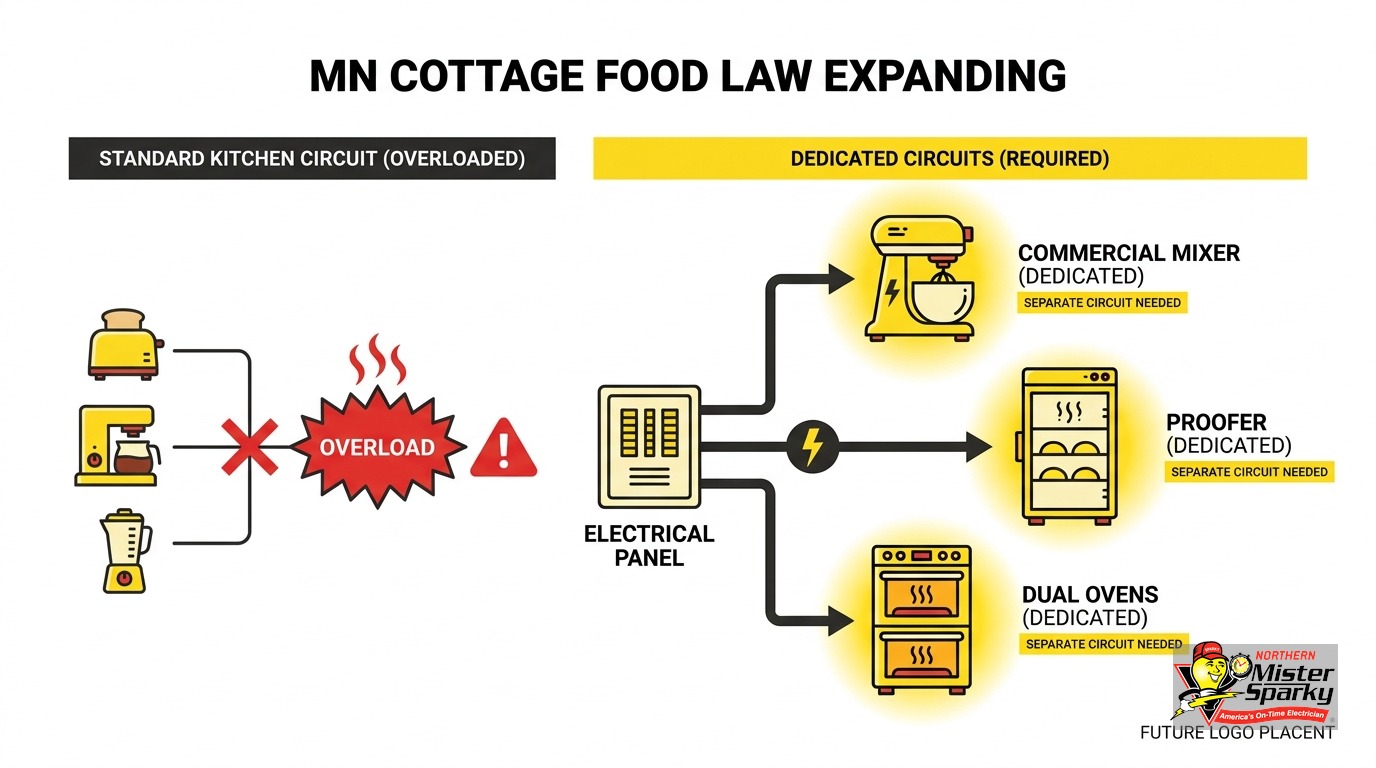
- A commercial-grade mixer at 9.5A and a mid-size proofer at 10A together reach 19.5A on one 20A circuit. That circuit trips on every production run.
- A dual wall oven draws up to 40A at 240V. It needs its own dedicated 40-50A circuit and cannot share with anything else.
- Minnesota adopted the 2026 NEC on August 17, 2026. New wall oven installations now require GFCI protection.
- Any new dedicated circuit requires an electrical permit and two inspections, filed with DLI or your local AHJ.
- A Minnesota Residential Electrical Panel Upgrade Grant of up to $3,000 exists but has not launched as of October 2026. It is worth watching.
What Does MN Cottage Food Law Allow in 2026?
MN currently has two tiers. Tier 1 allows up to $7,665 per year with a free online training requirement and no registration fee. Tier 2 allows up to $78,000 per year for a $50 annual fee and a food safety course every three years. Both tiers allow production in your home kitchen within those gross sales limits.
Minnesota’s cottage food law was built for small-scale producers who want to operate without a commercial kitchen license. The $78,000 cap applies per registered individual, not per household. A two-person bakery with two separate registrations could each reach the cap. Production logistics in a shared kitchen get complicated at that scale, but it is legally allowed.
Reaching the Tier 2 ceiling is a real business. It means volume. At a modest $15 average sale, $78,000 is roughly 5,200 orders per year. That is about 100 orders per week. Producing at that pace requires a commercial mixer. It requires a proofer holding fermentation temperature between batches. And it requires a second oven running alongside your primary range. That combination of equipment is what overloads a standard kitchen’s electrical infrastructure.
If gross sales exceed $78,000, production must shift to a licensed commercial kitchen. That triggers a food establishment license with no gross sales cap. But the work of growing from $30,000 to $78,000 per year happens at home, on the wiring your house was built with.
What changes in 2027: A new law, passed in 2025 and effective August 1, 2027, collapses the two tiers into one, drops the annual fee to $30, and legalizes in-state shipping of cottage food products by mail or commercial carrier. The MDA is in planning mode now. No action is needed before the changeover if you are already registered.
What Does a Standard Kitchen Actually Provide?
NEC 210.11(C)(1) requires at minimum two 20A small-appliance branch circuits for countertop outlets. At the NEC 80% continuous load rule, each circuit safely handles 16A. Homes built before 2000 often have only 15A circuits on those outlets, limiting safe continuous load to 12A per circuit.
Two 20A circuits sounds like plenty. The problem is what those circuits serve. Every countertop outlet in the kitchen shares those two circuits. Your mixer, your proofer, your toaster, your food processor, and any other counter appliance compete for the same two circuits. The NEC requires that lighting and non-kitchen loads stay off those circuits, but there is no automatic separation of “mixer side” from “proofer side” unless they were deliberately wired that way during construction or a renovation.
On a 20A circuit, the practical continuous ceiling is 16A. On a 15A circuit, it drops to 12A. A properly wired breaker does what it is supposed to do when you push past that limit: it trips. That is the safety system working correctly, not a malfunction to work around by swapping in a larger breaker.
Older Twin Cities homes add another complication. Homes built before the widespread adoption of 20A kitchen circuits often have 14 AWG wiring on 15A breakers at those countertop outlets. Running a commercial mixer on that circuit stresses the wiring, not just the breaker. Sustained overloading over time degrades insulation inside the wall.
For a detailed look at how kitchen circuits are supposed to be laid out and what an upgrade involves, read our guide on kitchen electrical circuit code requirements.
What Do Commercial Baking Appliances Actually Draw?
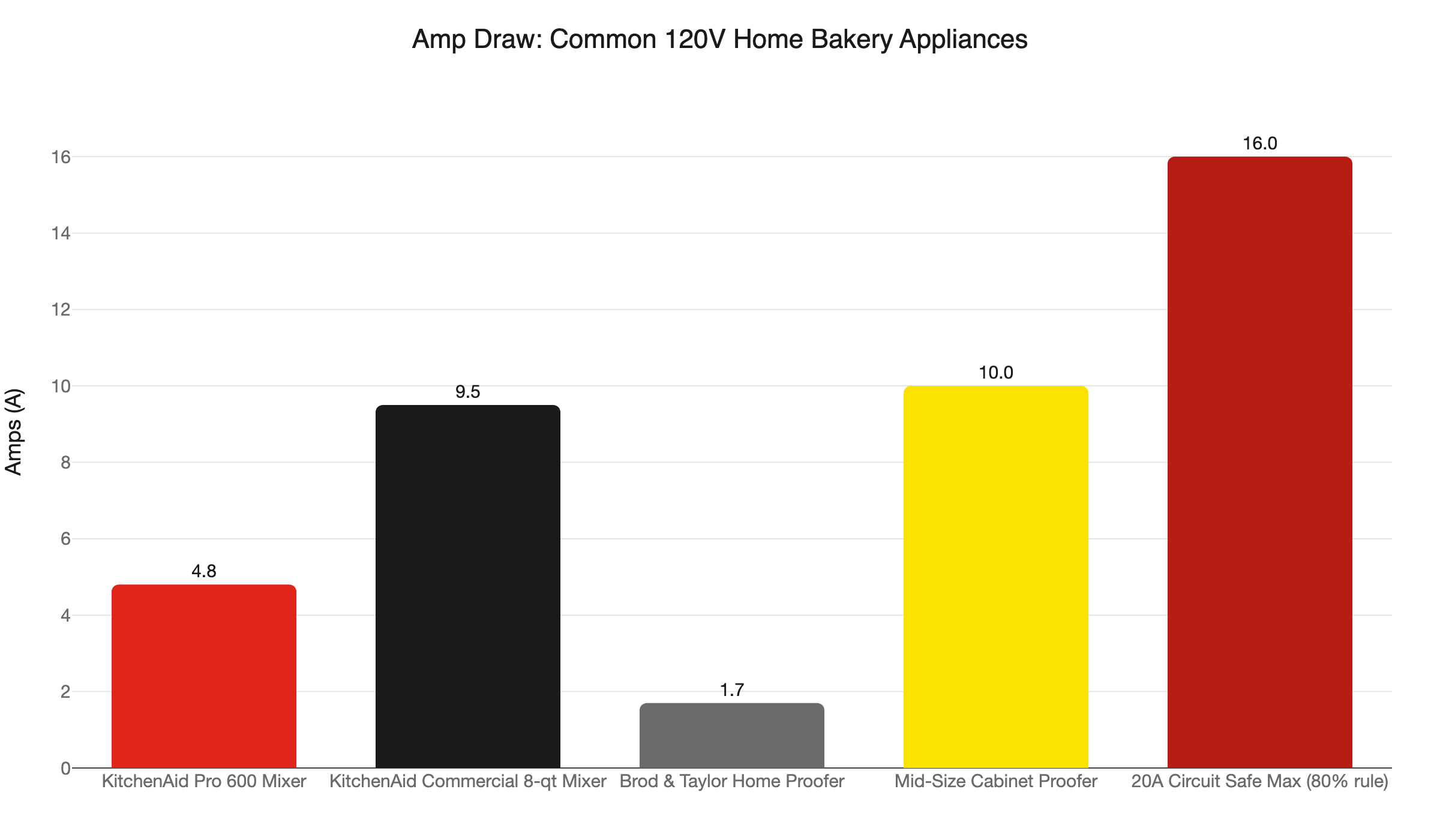
A KitchenAid Pro 600 draws 4.8A at 120V. The commercial-grade 8-quart model draws up to 9.5A. A mid-size cabinet proofer draws about 10A continuously. A dual wall oven draws up to 40A at 240V and requires its own dedicated circuit with nothing else on it.
Here is the full breakdown by appliance category:
Stand mixers
Using KitchenAid amp draw specifications:
- KitchenAid Pro 600 Series (575W): about 4.8A at 120V. Manageable on a shared circuit, though it leaves limited room for other loads running simultaneously.
- KitchenAid Commercial KSM8990 NSF (8-quart, approximately 500W motor): 8 to 9.5A at 120V. NEC Section 430.22 requires a motor circuit sized to 125% of full-load amps. A 9.5A mixer needs a dedicated 20A circuit at minimum. It does not belong on a shared counter circuit.
- Heavy-duty spiral mixers start at 208-240V, 20A. These are not residential-circuit equipment. Each requires its own 240V home run from your panel.
Proofers
- Brod & Taylor Folding Proofer (200W): runs on standard 120V. This home-scale unit is fine on a shared counter circuit.
- Mid-size cabinet proofer (120V, approximately 1,200W): about 10A, running continuously through a full production session. Running it alongside a commercial mixer on one 20A circuit puts you at 19.5A. The breaker trips every time.
- Full commercial cabinet proofer (208-240V, 1,000 to 3,000W): requires its own dedicated 240V circuit.
Dual wall ovens
A dual wall oven draws 8,000 to 9,600W at 240V, approximately 40A continuously. A dedicated 240V circuit rated at 40 to 50A is required. The 50A circuit is standard for most dual oven installs.
Wire gauge is not flexible. NEC 240.4 requires 8 AWG copper for a 40A circuit and 6 AWG copper for a 50A circuit. Using the smaller gauge wire on the larger breaker is a code violation and a fire hazard. The wire gauge and breaker size must match exactly. Nothing else shares the oven circuit. It runs directly from your panel to the oven location, period.
Why Those Loads Stack Past What Your Circuits Can Handle
Here is what a typical production morning looks like for a Tier 2 baker:
- Dual wall oven preheating on its own dedicated 240V circuit: no issue there.
- Commercial mixer running at 9.5A on Circuit 1.
- Mid-size proofer holding temperature at 10A, also on Circuit 1.
- Circuit 1 total: 19.5A on a 20A breaker. It trips within minutes.
That is before anything else runs. Add a range hood fan at 2A, a food processor for filling prep at 5A, or an under-counter freezer cycling on at 1.5A, and Circuit 2 starts filling up too. A standard kitchen was designed for one household cooking one meal at a time, not 100 production orders per week.
The two 20A circuits required by the NEC were sized for a refrigerator, a microwave, a toaster, and a coffee maker. Running a commercial mixer and a full-capacity proofer on those circuits asks the wiring to carry a load it was never sized for.
The fix is dedicated circuits. Each appliance with a significant continuous load needs its own home run back to the panel. The mixer circuit carries the mixer only. The proofer circuit carries the proofer only. They cannot interfere with each other because they are entirely independent wiring runs.
Our post on dedicated circuits for home appliances explains what qualifies and how the wiring is run in practice.
What Does MN Require When You Add Dedicated Circuits?
Any new dedicated circuit in Minnesota requires a separate electrical permit, not a building permit. Most Twin Cities suburbs file through DLI. Minneapolis, St. Paul, and about 64 other cities serve as their own authority having jurisdiction (AHJ) and issue permits through their local departments.
The Minnesota Department of Labor and Industry provides an inspector lookup tool. Enter your address to confirm whether DLI or your local city handles permits for your property. Suburbs that have their own building departments sometimes redirect electrical permits to DLI. The lookup confirms it.
Two inspections are required for every permit:
- Rough-in inspection: before the walls close. The inspector checks wire routing, box placement, conductor sizing, proper stapling, and junction box accessibility.
- Final inspection: after the work is energized. The inspector verifies breaker size, conductor gauge match, required GFCI or AFCI protection, and correct panel labeling.
Typical DLI fee structure: approximately $25 permit fee, $1 surcharge, $55 inspection fee, and $12 per circuit. Expect $80 to $150 minimum per circuit. Each re-inspection adds $55.
A homeowner can self-permit and legally DIY electrical work on a single-family owner-occupied homestead in Minnesota. The rules around what qualifies are specific. Our guide on electrical permits in Minnesota covers who is eligible and how to file.
For panel work or multiple simultaneous circuits, a licensed electrician handles permit filing, rough-in, inspection scheduling, and any corrections required by the inspector. That is one coordinated scope instead of several separate permit applications managed on your own schedule.
Does Your New Oven Need a GFCI Breaker?
Yes. Minnesota adopted the 2026 NEC effective August 17, 2026. Permits filed on or after that date must include GFCI protection on wall-mounted oven circuits. GFCI at 240V means a 2-pole GFCI breaker in the panel, not a standard receptacle-level solution.
Minnesota’s 2026 NEC adoption also extends GFCI requirements to countertop cooking equipment and microwaves. This requirement was introduced in the 2023 NEC and carried into the 2026 edition. Minnesota adopted it through Minnesota Rules Chapter 1315. If your current oven was installed before August 2026, GFCI was not required at that time. If you are adding a second wall oven today, under a permit filed now, GFCI is required.
GFCI protection at 240V uses a 2-pole GFCI breaker in your panel. These breakers cost significantly more than standard double-pole breakers. They must also be compatible with your specific panel brand and bus design. Square D GFCI breakers do not install cleanly into older Siemens or Eaton panels without compatibility issues. The breaker type matters and is not interchangeable.
A 240V circuit with missing or incorrect protection is a code violation. It may void homeowner’s insurance coverage on a related claim. And it is a genuine safety risk. This is not a difficult installation for a licensed electrician who works with these breakers regularly. It is an important one to get exactly right.
Is There Financial Help for Electrical Upgrades?
The Minnesota Residential Electrical Panel Upgrade Grant (MN Stat. 216C.45), administered by the Minnesota Department of Commerce, offers up to $3,000 for households below 80% AMI and up to $2,000 for households between 80% and 150% AMI. Approximately $5.8 million is available statewide. The program has not launched as of October 2026 and is awaiting US DOE approval.
No retroactive awards are available under the current program design. Completing your panel upgrade before the program opens means you will not be eligible after the fact. If the launch timeline aligns with your production expansion plans, it is worth confirming the program status before you pull permits.
To get on the notification list, contact the MN Department of Commerce at Residential.Rebates.COMM@state.mn.us.
Adding three or four dedicated circuits to a production kitchen often surfaces an underlying panel capacity issue. A 100A service running a full household load and a second oven circuit may already be near capacity. A panel upgrade to 200A service is exactly the category of work this grant targets. Our post on signs you need an electrical panel upgrade walks through what to check before you call.
The federal IRA Section 25C tax credit also applies to qualifying panel upgrades tied to energy efficiency improvements. That is separate from the state grant and can stack with it in the right circumstances. A tax professional can confirm whether your planned scope qualifies before you finalize timing.
When to Call a Licensed Electrician
A licensed electrician is required in Minnesota whenever the work is done by someone other than the owner of a single-family owner-occupied homestead. For renters, all electrical work must be done by a licensed contractor.
For owner-occupants planning a home bakery electrical upgrade, the practical trigger points for hiring a pro are:
- Multiple circuits in one scope. Pulling three or four permits, coordinating multiple rough-in and final inspections, and landing new breakers in a panel is manageable but time-intensive to DIY. A licensed electrician handles the full scope in one planned visit.
- Panel at or near capacity. If your panel has no open slots, you need an upgrade assessment before adding circuits. That evaluation and the work that follows it are not a DIY call.
- The 240V oven circuit. Running 6 AWG wire through finished walls, installing a 2-pole GFCI breaker, and roughing in the outlet box is achievable for an experienced homeowner. But errors on 240V circuits carry more serious consequences than 120V mistakes. GFCI breaker compatibility adds another variable most homeowners should not navigate alone.
- Older home unknowns. Twin Cities homes from the 1940s through the 1960s may have aluminum branch wiring, knob-and-tube remnants, or undersized service entrance cables. Any of those discoveries changes the scope significantly.
We are locally owned and operated in the Twin Cities and part of the Mister Sparky network, America’s On-Time Electrician(R). No malarky: our team shows up when scheduled and does the work right. Every job is backed by our UWIN(R) 100% satisfaction guarantee. Call 763-200-5956 or book online to get your kitchen’s electrical capacity assessed before your next round of equipment purchases.
Frequently Asked Questions
How many dedicated circuits does a home bakery need? +
Does Minnesota require a permit to add a kitchen circuit? +
Do new wall ovens require GFCI protection in Minnesota? +
Is there a grant for electrical panel upgrades in Minnesota? +
Need an electrician now?