
Switching from Gas Dryer to Electric: Wiring Cost in MN
Key Takeaways
- A dedicated 30A, 240V circuit is required for any electric dryer. No other loads may share it.
- Total Twin Cities project cost runs $400 to $900 for a straightforward installation, including the permit.
- A permit is legally required in Minnesota for any new dedicated appliance circuit. Skipping it creates real risk at resale and with your insurer.
- Minnesota’s 2026 electrical code takes effect August 17, 2026. Permits filed before that date use the 2023 NEC. Permits filed on or after that date must comply with the 2026 NEC.
- The gas line must be capped by a licensed plumber or CenterPoint Energy. That is a separate trade and a separate cost.
- Minnesota’s HEAR wiring rebates are not yet available. Do not schedule work early expecting reimbursement.
- A full panel adds $150 to $300 for a tandem breaker fix, or $2,000 to $5,000-plus for a full upgrade.
When you research switching from gas dryer to electric, wiring cost is usually the first question. In the Twin Cities, most homeowners pay $400 to $900 for a new 30-amp circuit. That range assumes your breaker panel has an open slot and the run to the laundry room is relatively direct.
This is also a two-trade project. The electrician handles the new circuit. A licensed plumber handles the gas line. Both steps are required, and neither trade does the other’s job.
This guide covers the electrical side in detail: what the circuit requires, the permit you must pull, a Minnesota code transition happening this month, what to do if your panel is full, and what the rebate situation actually looks like right now.
What Does Switching from a Gas Dryer to Electric Actually Involve?
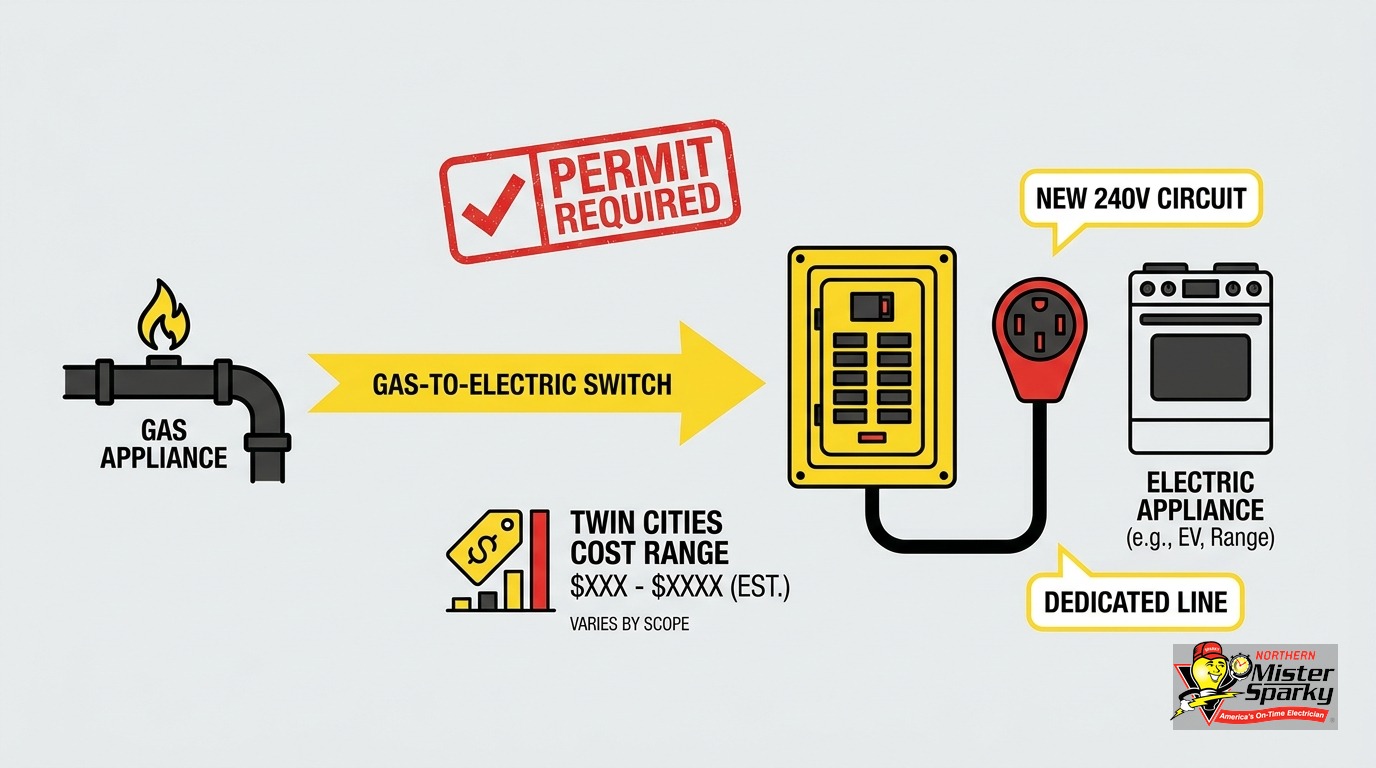
This is a two-trade project. The electrician installs a new 240V circuit and outlet. A licensed plumber or CenterPoint Energy caps and pressure-tests the gas line. Both steps require permits and inspections. Neither trade does the other’s job.
On the electrical side, you need a new dedicated 240V, 30A circuit run from your breaker panel to the laundry area. The circuit ends at a new four-prong NEMA 14-30 outlet. A permit is required. A passed inspection is required. That is the scope this post covers in full.
On the gas side, the corrugated flex line behind your old dryer must be capped at the wall stub-out. The plumber then performs a pressure test to confirm the cap is sealed. CenterPoint Energy can handle this too if they originally installed that gas connection. Budget $150 to $300. Shut the wall valve immediately when you disconnect the dryer. Do not leave the line uncapped while you wait to schedule.
Once both trades finish and both inspections pass, you plug in the new electric dryer. That is the full project.
What Electrical Work Is Required for an Electric Dryer?
A dedicated 30A, 240V circuit is required. It needs 10 AWG copper wire minimum, a double-pole 30A breaker, and a NEMA 14-30 four-prong outlet. No other appliances or outlets may share this circuit.
The requirement comes from NEC Article 210, which specifies dedicated circuits for high-draw appliances. “Dedicated” means the circuit serves only the dryer. A refrigerator, a light, an extra outlet - none of that shares the circuit. One dryer, one circuit, full stop.
The outlet matters too. If a previous owner once had an electric dryer and left behind a three-prong 240V outlet, that outlet does not meet current code. Our post on 240V outlet installation for dryers and ranges covers the outlet upgrade in detail.
Run length is the biggest labor variable. A direct run from an unfinished basement panel to the laundry room takes about three hours. A run that navigates finished walls and multiple floors takes five or six. The electrician should walk the route before quoting. Any contractor who prices a dryer circuit without seeing the panel location and the laundry room is guessing.
What Is the Switching from Gas Dryer to Electric Wiring Cost in the Twin Cities?
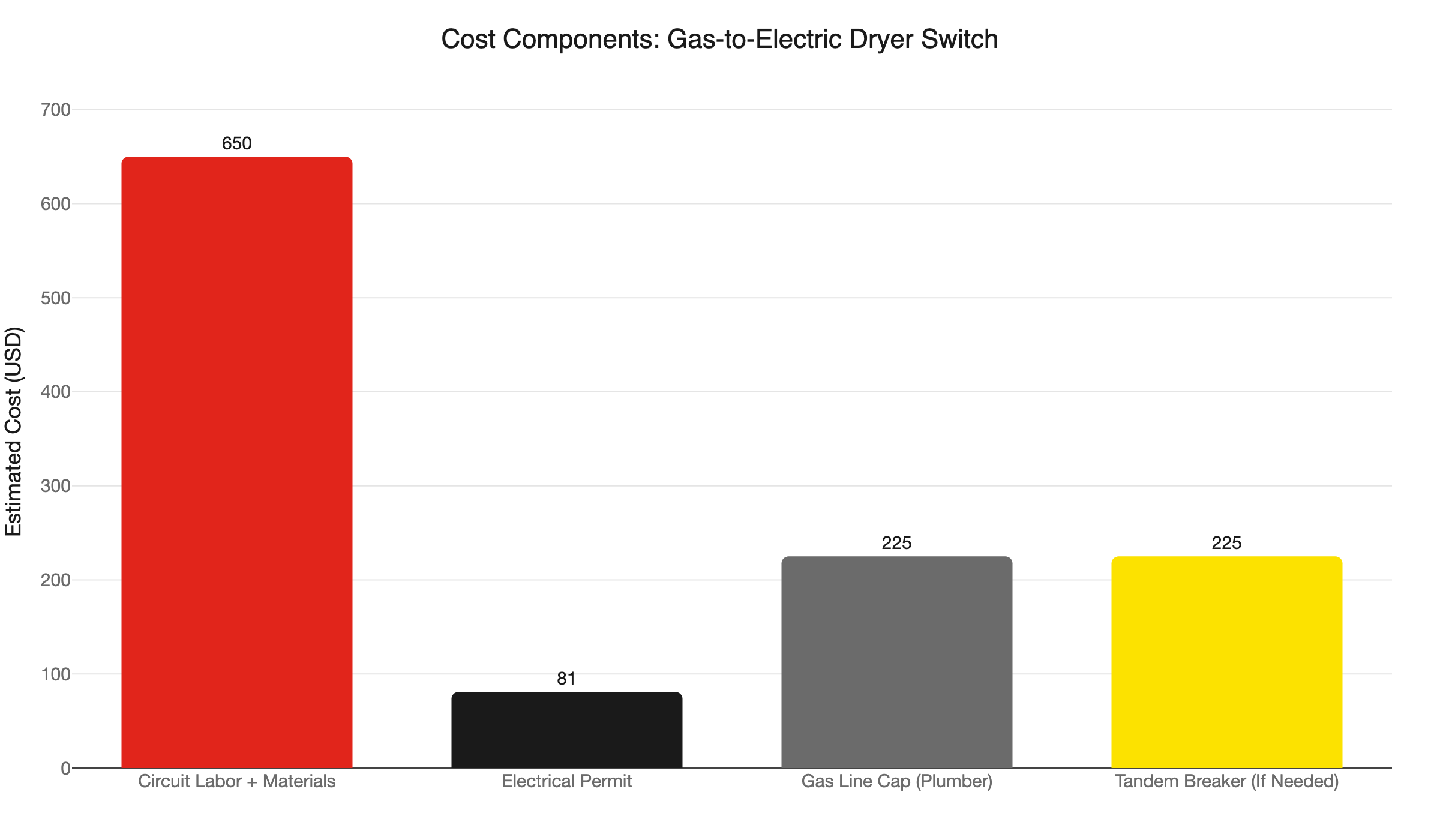
Most homeowners pay $400 to $900 total for a new 30-amp circuit, covering labor, materials, and the permit for a typical installation with an available panel slot. Add $150 to $300 for a gas line cap and another $150 to $300 if the panel needs a tandem breaker to free a slot.
Here is how each component breaks down:
Labor: Twin Cities electricians typically charge $100 to $140 per hour. A standard dryer circuit installation takes three to five hours. That puts labor at $300 to $700 for most jobs.
Materials: Wire, breaker, outlet box, and connectors typically run $50 to $150. Run length and whether conduit is required move this number.
Permit: The Minnesota state permit base fee is approximately $81 - a $25 permit fee, a $55 minimum inspection fee, and a $1 surcharge. Minneapolis and Saint Paul residents file with their city departments, and those fee schedules vary by jurisdiction.
Gas line cap: Budget $150 to $300 for a licensed plumber. This expense does not appear in electrician quotes because it is a separate trade.
For context, our post on the cost to add a standard outlet in Minneapolis shows 120V outlet work running $170 to $580. A 240V dryer circuit is more involved: heavier wire, a dedicated double-pole breaker, and its own slot in the panel.
What Drives Switching from Gas Dryer to Electric Wiring Cost Higher?
Complex wire runs through finished walls, a full breaker panel, and aging electrical service are the three biggest cost drivers. City-track permit fees in Minneapolis and Saint Paul can also run above the state $81 baseline.
Long or complex runs. An unfinished basement with a direct line from panel to laundry room is the cheapest scenario. A finished house where the electrician drills through multiple walls or runs conduit across a ceiling adds labor hours quickly.
No open panel slot. If your breaker box has no available double-pole slot, the electrician cannot add the circuit without addressing the panel first. See the panel section below.
Older panels. A panel from the 1970s or 1980s may have room for a breaker but still need evaluation before you add load. An older panel that is already running near capacity handles a new 30A circuit poorly.
City-track permits. Minneapolis and Saint Paul have their own permit fee schedules. Ask your electrician what the permit will cost in your specific jurisdiction before accepting a quote.
Material pricing. Copper prices fluctuate. Contractors who bill materials separately may adjust based on current cost. Ask whether materials are included in the flat quote or billed at cost plus markup.
An itemized quote with labor, materials, and permit clearly separated lets you compare bids accurately. A quote that bundles everything with no breakdown is harder to evaluate.
Do You Need a Permit to Add an Electric Dryer Circuit in Minnesota?
Yes, always. Minnesota law under Minn. Stat. § 326B requires a permit for any new dedicated appliance circuit. There are no exceptions for small jobs or “just an outlet.”
The permit triggers an inspection by a licensed electrical inspector. That inspector confirms the circuit is wired correctly, the breaker is sized properly, and the outlet meets current code. A wiring error caught during inspection costs nothing meaningful to fix. The same error caught after a fire is a different situation entirely.
Two concrete risks of skipping the permit:
- Resale. A buyer’s inspector will flag unpermitted electrical work. You may be required to open walls, redo the circuit, and repermit it at your expense before closing.
- Insurance. If a fire starts in the laundry room and no permit is on record, your insurer has grounds to deny the claim.
For most Twin Cities residents outside Minneapolis and Saint Paul, permits go through the state system at ims.dli.mn.gov. Minneapolis and Saint Paul residents file with their city building departments. Saint Paul has its own permit process and fee schedule for circuit work. Our post on electrical permits in Minnesota explains the state-track versus city-track split in full.
One note for owner-occupants: homeowners may legally do their own electrical work on their own single-family homestead, provided they pull the permit first and personally perform all the work. This does not apply to rentals, condos, or properties you do not owner-occupy. The permit must be in hand before work begins - not applied for after the fact.
What Is the August 17, 2026 Electrical Code Deadline?
Minnesota adopted the 2026 NEC, effective August 17, 2026. Permits filed before that date are inspected under the 2023 NEC. Permits filed on or after that date must comply with the 2026 NEC.
Minnesota’s Board of Electricity has adopted the 2026 NEC with an effective date of August 17, 2026. That date is roughly two weeks from today.
For a standard 30A dryer circuit, the practical impact is small. The core requirements - 10 AWG copper, double-pole 30A breaker, dedicated circuit, four-prong NEMA 14-30 outlet - are not changing between code editions.
Where the transition matters is if your project includes a panel upgrade or other scope beyond the dryer circuit. The code your electrician designs to affects specific methods and materials. If you are permitting in the next two to three weeks, ask which code version your job will fall under before work starts. Getting inspected under the wrong version creates paperwork problems and possible re-inspection fees.
If you are planning for later this fall, the 2026 NEC will govern your project. Ask your electrician what, if anything, changes for your specific scope. For a straight dryer circuit, the answer will likely be “not much” - but it is worth confirming.
What Happens If Your Electrical Panel Is Full?
A full panel adds cost and a decision. You can sometimes free a slot with a tandem breaker ($150 to $300 extra). If the panel is genuinely maxed out or aging, a panel upgrade runs $2,000 to $5,000.
Adding a 30A double-pole breaker requires an open double-wide slot. If your panel has no open slot, the electrician has two paths forward.
Option 1: Tandem breaker. Some panels allow tandem breakers, which fit two single-pole breakers into one slot. Not every panel supports them, and not every circuit can use a tandem breaker under code. If it is an option for your panel and circuit, it adds $150 to $300 to the project. This is the lower-cost fix for a tight panel.
Option 2: Panel upgrade. If the panel is genuinely full, or if it is old enough to raise safety concerns, a panel upgrade is the correct long-term answer. A full upgrade typically runs $2,000 to $5,000. The exact cost depends on panel size, permit fees, and whether the service entrance needs upgrading as well.
Many Twin Cities homes built before 1990 have 100-amp panels. Some are already loaded to capacity. Adding a high-draw appliance to a maxed-out panel is a real safety concern, not a minor inconvenience to work around.
Our post on what to do when your panel has no open breaker slots walks through both options in detail. If your panel is a known problem brand - Federal Pacific Stab-Lok, Zinsco, or a pre-1970s fuse box - the dryer project is a natural forcing function to address the panel rather than add more load to it.
Who Caps the Gas Line When You Switch Dryers?
A licensed plumber caps the gas line. Not the electrician. Not the homeowner. Budget $150 to $300, and schedule this step separately - neither trade depends on the other’s timing.
The yellow or black corrugated flex line behind your gas dryer must be capped at the wall stub-out. The plumber then performs a pressure test to confirm the seal. CenterPoint Energy can also handle this if they originally installed that gas connection to the appliance location.
When you disconnect the old dryer, close the ball valve at the wall immediately. Do not leave the line accessible and uncapped while you wait to schedule the plumber. A licensed plumber makes the cap permanent.
Two things to keep in mind:
- The plumber’s cap work is a separate permit in most cases. Ask your plumber whether they pull one for this scope.
- If you are rethinking other gas appliances at the same time - a gas range or a gas water heater - coordinate that scope with your plumber. Your electrician handles whatever wiring those appliances need on the electrical side. The gas disconnects stay in the plumber’s lane, always.
CenterPoint serves most Twin Cities gas customers. If you are not sure who installed your gas line, call them first. They can tell you whether they have a record of the connection and whether they handle the cap at your location.
Are There Rebates for Switching to an Electric Dryer in Minnesota?
Minnesota’s HEAR program includes rebates up to $840 for heat pump dryers and up to $2,500 for wiring upgrades, but the program has not launched as of mid-2026. Federal rules prohibit retroactive rebates, so completing work now does not earn you a rebate when the program opens.
As of mid-2026, the Minnesota HEAR program has not launched. The Department of Energy issued new program rules and Minnesota is still working through implementation. Households below 80% of area median income would qualify for the highest rebate tiers. Households between 80-150% AMI qualify for reduced amounts. But none of that is available yet.
Do not schedule work based on a rebate you cannot yet access. Federal guidelines prohibit retroactive payments. Work completed before the program opens is not eligible when the program eventually launches. Check mn.gov/commerce for updates before making any timing decisions around rebates.
On the utility side: Xcel Energy’s residential rebate portfolio covers heat pumps, smart thermostats, and insulation. As of this writing, Xcel does not offer a rebate specifically for electric clothes dryers. Check xcelenergy.com/rebates directly - their program catalog changes periodically, and what is unavailable today may be offered in a future cycle.
Should You DIY the Dryer Circuit?
Legal on your own owner-occupied single-family home with a permit - but only advisable if you have real 240V wiring experience. A dryer circuit is a high-draw dedicated circuit, and errors on 240V systems carry serious consequences.
Minnesota allows homeowners to do their own electrical work on their own homestead, provided the permit is obtained before work begins and the work passes inspection afterward. The law is clear on this.
The distinction between legal and advisable matters here. A 240V circuit carries roughly four times the voltage of a standard household outlet. Errors do not show up as a flickering light. They show up as equipment damage or fire.
If you have wired 240V circuits before, understand wire gauge selection, and know how to size a double-pole breaker correctly, a dryer circuit is within your capability. Still get the permit. Still pass the inspection.
If your electrical experience tops out at swapping outlets and switches, hire a licensed electrician. The $400 to $900 professional install is the right call.
A few scenarios where DIY is a particularly poor fit:
- Your panel is full or aging. Diagnosing what is safe inside an older panel is not beginner territory.
- The run goes through finished walls. Fishing wire without damaging drywall requires experience and proper tools.
- Your laundry room is far from the panel or on a different floor.
In any of those situations, the voltage and the complexity both argue for a licensed electrician.
What to Ask Your Electrician Before Booking
Get clear answers to these questions before scheduling:
- Does the quote include the permit fee and inspection?
- Is there an open double-pole slot in my panel, or will panel work be needed?
- Which NEC version will my permit fall under? (Ask this if you are permitting near August 17, 2026.)
- How long is the wire run from my panel to the dryer location?
- Does your quote include a NEMA 14-30 four-prong outlet, or will I need a separate outlet upgrade?
- Who handles the gas line cap - is that in your scope, or do I need to hire a plumber separately?
The most common invoice surprises on dryer circuit jobs are a permit that was not included in the quote and a full panel discovered after work starts. Both are avoidable if you ask upfront. Any electrician worth hiring will answer all six questions before scheduling.
Ready to Schedule Your Dryer Circuit Installation?
Northern Mister Sparky is locally owned and operated in the Twin Cities. We install dedicated dryer circuits across Minneapolis, Saint Paul, Bloomington, Brooklyn Park, Woodbury, Blaine, Maple Grove, and Plymouth. As America’s On-Time Electrician(R), we show up when we say we will and give you a straight quote before any work begins.
We pull the permit. We handle the inspection. You get the paperwork. No malarky.
If your panel has no open slot, we tell you your options before we start - not as a line item on the final invoice.
Call 763-200-5956 or book online to schedule your dryer circuit installation.
Frequently Asked Questions
What does it cost to switch from a gas dryer to electric in the Twin Cities? +
Do I need a permit to add an electric dryer circuit in Minnesota? +
Who caps the gas line when I switch from a gas to electric dryer? +
Is there a rebate for switching to an electric dryer in Minnesota? +
Need an electrician now?