
Laundry Room Electrical Requirements for Minnesota Homes
Key Takeaways
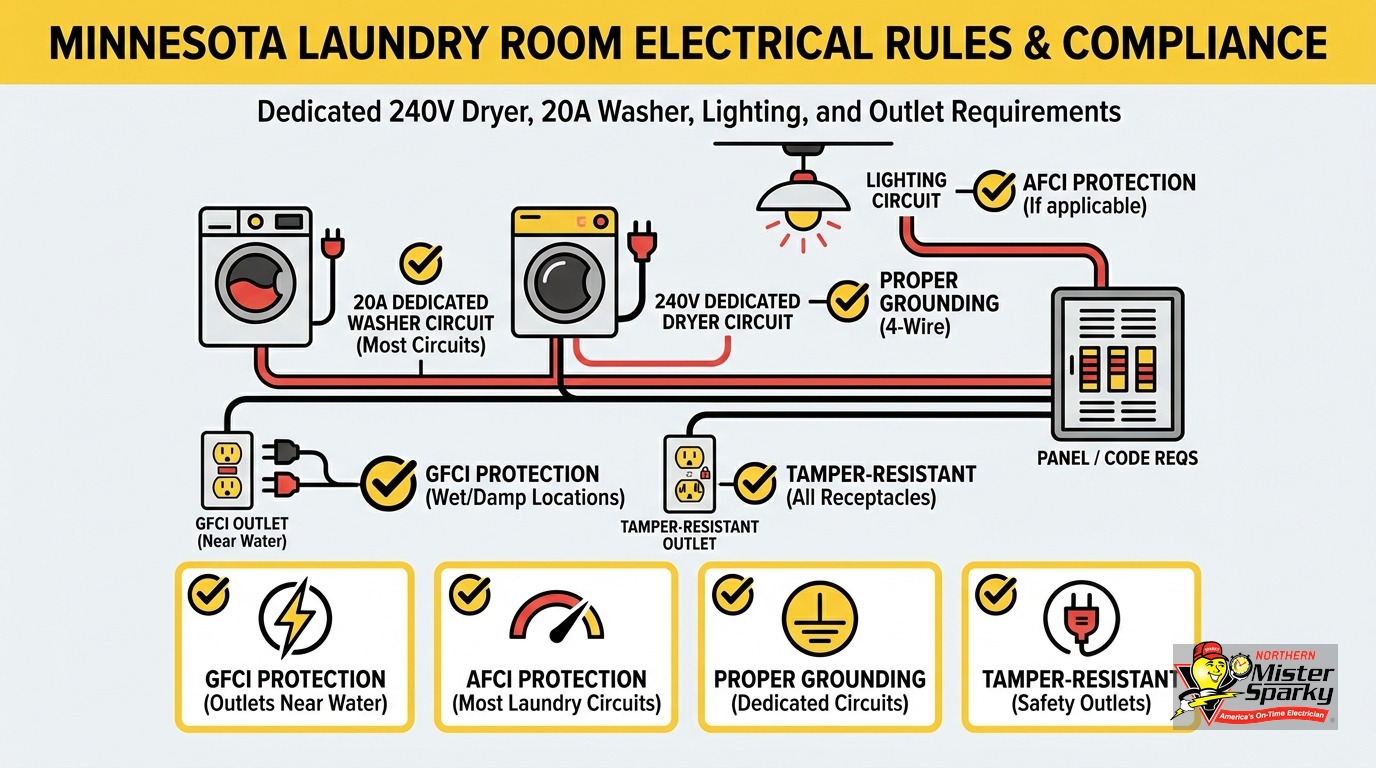
- Minnesota’s laundry room electrical requirements call for at least three dedicated circuits: a 20A washer circuit, a 30A 240V electric dryer circuit, and a separate lighting circuit.
- NEC 2023, 210.8(A)(10) requires GFCI protection on all laundry area receptacles, including the washer outlet, with or without a nearby sink. This rule was added in 2020 and remains the most commonly missed item on inspections.
- NEC 2023, 210.8(D) now explicitly requires GFCI protection on clothes dryer branch circuits up to 60A, closing the old hardwired-dryer loophole.
- AFCI protection is required on the washer and lighting circuits under NEC 2023, 210.12(A).
- Minnesota adopted the 2023 NEC on July 1, 2023. Any permit filed after that date must meet these updated standards.
- Twin Cities basement laundry rooms face a second independent GFCI rule (NEC 210.8(A)(5)) on top of the laundry area rule.
- A permit is required for any new circuit, outlet addition, or panel work in Minnesota. A licensed electrician must pull the permit for most residential work.
What Are the Laundry Room Electrical Requirements in Minnesota?
Short answer: A compliant Minnesota laundry room needs a dedicated 20A washer circuit, a dedicated 30A 240V dryer circuit, a separate lighting circuit, GFCI on every receptacle including the dryer outlet, and AFCI on all 120V circuits. Minnesota adopted the 2023 NEC on July 1, 2023, so every permit filed today is held to these standards.
That is the checklist in one paragraph. The rest of this post unpacks each item so you know exactly what to expect before you call an electrician, open a permit, or buy a new appliance.
Most Twin Cities homeowners only think about laundry room wiring when a breaker trips, a new dryer will not fit the old outlet, or a home inspector flags the setup during a sale. Knowing the requirements ahead of time saves that headache and, in some cases, avoids a fire risk that has been sitting behind the dryer for years.
How Many Circuits Does a Laundry Room Need?
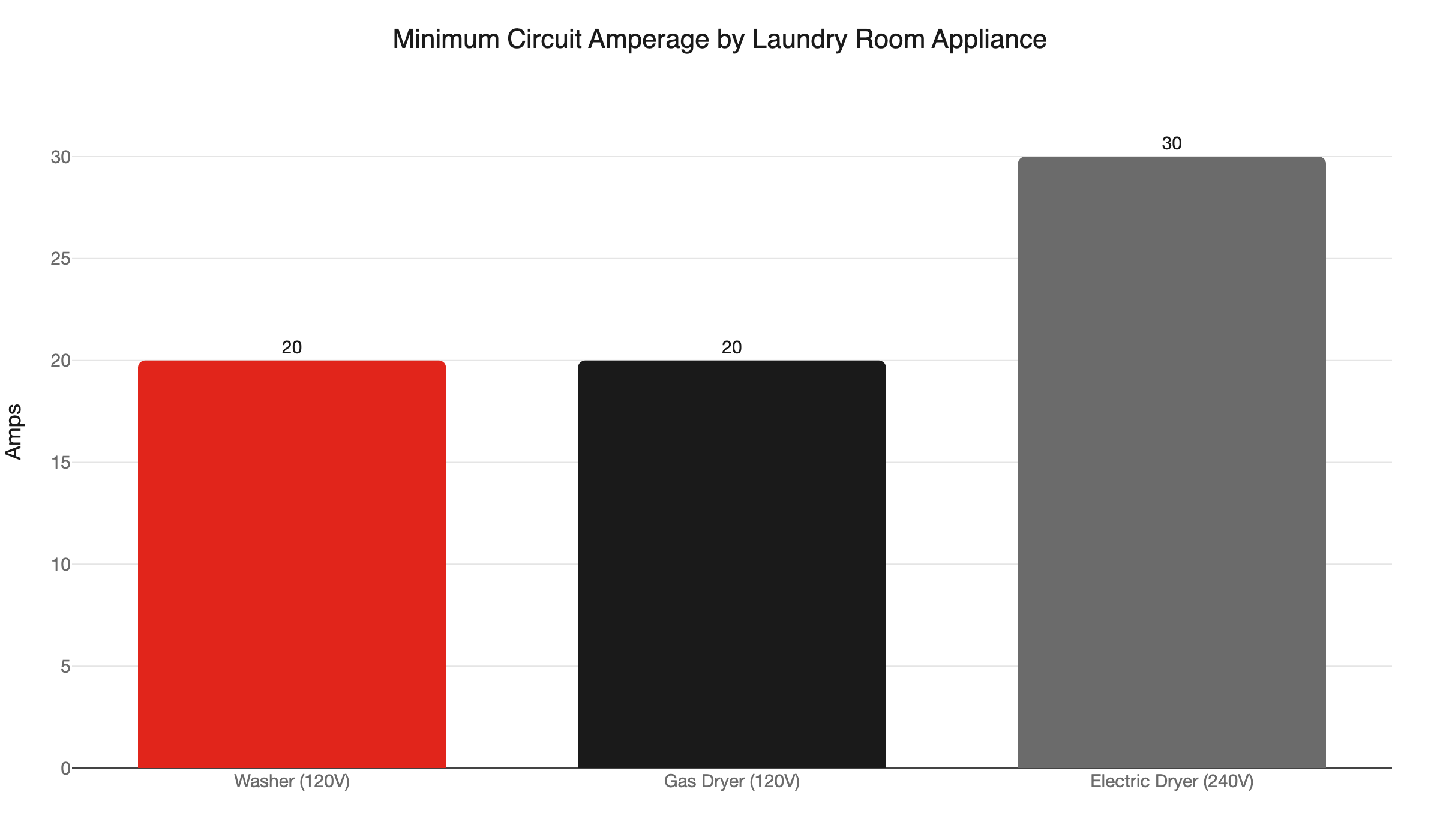
Short answer: At minimum, three. One dedicated 20A circuit for the washer, one dedicated 30A 240V circuit for an electric dryer (or a separate 20A 120V circuit for a gas dryer), and one separate circuit for lighting. Every circuit must serve only its designated load.
NEC 2023, 210.11(C)(2) requires at least one 20A branch circuit dedicated to laundry receptacles. That circuit cannot serve any other outlet in the home. The laundry room lights cannot share it either. The NEC is specific: the laundry circuit is for laundry receptacles only.
The washer circuit
A washing machine draws 10 to 13 amps in normal operation. A spin cycle pushes closer to 15 amps. Put that load on a shared circuit with a bathroom or hallway and you have a tripping breaker waiting to happen. The dedicated circuit requirement prevents exactly that.
The gas dryer circuit
A gas dryer still needs electricity. It uses a 120V circuit to power the drum motor, controls, and electronic ignition. That circuit must be dedicated, separate from the washer. Running both appliances off a single 20A circuit violates the dedicated-circuit requirement and creates an overload condition under combined load.
The lighting circuit
Laundry room lights cannot share the 20A washer circuit. The washer circuit is a receptacle-only circuit under NEC 210.11(C)(2). In practice, the lighting usually connects to the general lighting circuit serving the basement or utility area, provided that is not the washer circuit.
Three circuits is the minimum. If you are adding a utility sink pump, a chest freezer, or a secondary refrigerator in the laundry area, each of those appliances benefits from its own dedicated circuit.
What Circuit Does an Electric Dryer Require?
Short answer: A dedicated 30A, 240V circuit wired with minimum #10 AWG copper, terminating at a four-wire NEMA 14-30 outlet. The older three-wire NEMA 10-30 is not permitted for new installations.
An electric dryer is one of the highest loads in a residential home. It runs on 240V and draws 20 to 30 amps continuously while heating. Minimum #10 AWG copper wire is required for this circuit because smaller wire overheats under sustained high-amperage draws.
The outlet matters too. New installations must use a NEMA 14-30 four-wire outlet: two hots, a neutral, and a ground. The older three-wire NEMA 10-30 (two hots and a neutral, with no separate ground) was allowed for new installations until 1996. Homes built or wired before that cutoff often still have the three-wire version. If yours does, there is a full section on that conversion below.
Laundry Room Electrical Requirements: GFCI Rules That Surprise Most Homeowners
Before the 2020 NEC, GFCI protection in a laundry room was only required within six feet of a sink. If your washer sat in the middle of an unfinished basement with no sink nearby, no GFCI was required. That changed with the 2020 NEC and carried forward into the 2023 NEC Minnesota adopted.
Washer outlets
NEC 2023, 210.8(A)(10) requires GFCI protection on all 125V through 250V laundry area receptacles rated at 50A or less, single-phase, 150V or less to ground. That covers the washer outlet. GFCI is required regardless of where the outlet sits in the laundry room. Proximity to a sink is no longer the determining factor. This is the most commonly missed item on laundry room electrical inspections.
Electric dryer outlets
NEC 2023, 210.8(D) explicitly names clothes dryers as appliances requiring GFCI protection on the branch circuit or outlet, covering circuits up to 60A. This closed the loophole in earlier code versions where hardwired dryers or 240V appliances without a receptacle were exempt.
For the 240V dryer circuit, a standard GFCI outlet will not work. You need a 2-pole 30A GFCI breaker at the panel. There is no outlet-based solution for a 240V circuit.
If your home was wired before 2020, the washer and dryer outlets almost certainly lack GFCI protection. They were compliant when installed. They will not pass a current permit inspection.
Does Minnesota Follow the 2023 NEC?
Short answer: Yes. Minnesota adopted the 2023 NEC effective July 1, 2023. Any electrical permit filed on or after that date must comply with 2023 NEC standards, including all updated GFCI and AFCI requirements for laundry areas.
This is a hard cutoff. A permit pulled in 2022 was judged under the 2020 NEC. A permit filed today is judged under the 2023 NEC. The Minnesota Department of Labor and Industry publishes the official 2023 NEC Electrical Inspection Checklist for one-family dwellings. That document confirms the 210.8(D) clothes dryer GFCI requirement. That checklist is what the inspector brings to your house.
Northern Mister Sparky wires to the 2023 NEC on every permitted job in the Twin Cities. We do not guess which version of the code applies.
Do Basement Laundry Rooms Have Extra Rules?
Short answer: Yes. Most Twin Cities laundry rooms are in unfinished basements. Those spaces trigger a second GFCI rule (NEC 210.8(A)(5)) that applies independently of the laundry area rule. Both rules apply at the same time.
Walk through any block of older homes in South Minneapolis, St. Paul, Bloomington, or Brooklyn Park. The laundry room is almost always in the unfinished basement. That location matters electrically.
NEC 210.8(A)(5) requires GFCI on all receptacles in unfinished basements, for any reason, not just laundry. The rule exists independently of the laundry area GFCI rule under 210.8(A)(10). The two rules overlap rather than replace each other. A washer outlet in an unfinished basement must satisfy both.
In practice, meeting one usually satisfies the other because the GFCI requirement is the same either way. The key point is that “there is no sink nearby” does not exempt a washer outlet from GFCI when it is in an unfinished basement. The basement rule would require it even if the laundry area rule did not apply.
The Minnesota DLI inspection checklist confirms both rules apply to unfinished basements in one-family dwellings. Our inspectors look at both.
If you are finishing the basement and moving the laundry area into a finished space, the finished-basement rules govern instead. That distinction is one reason a licensed electrician familiar with Minnesota code pays for itself on a basement project. See our post on basement finishing electrical costs for what to budget.
What Is a Dual-Function AFCI/GFCI Breaker and Do You Need One?
Short answer: A dual-function (DF) breaker provides both AFCI and GFCI protection in a single panel device. The washer circuit requires both under NEC 2023. A DF breaker satisfies both requirements with one unit and eliminates the nuisance-tripping that GFCI outlets on washer circuits can cause.
The AFCI requirement
NEC 2023, 210.12(A) requires arc-fault circuit interrupter (AFCI) protection on all 120V, single-phase, 15A and 20A circuits supplying outlets or receptacles in laundry areas. The washer circuit qualifies. The lighting circuit qualifies. The 240V dryer circuit does not: AFCI requirements currently apply only to circuits rated 20A or less at 120V.
An AFCI detects dangerous arcing inside wiring that a standard breaker will not catch. Standard breakers trip on overcurrent. An AFCI trips on the electrical signature of arcing that occurs inside damaged or aging wire, before a true overcurrent event develops. It is the layer of protection that catches the fires standard breakers miss entirely.
Why a DF breaker beats a GFCI outlet for the washer circuit
Your washer circuit needs both AFCI and GFCI. You could install a GFCI outlet at the receptacle and a separate AFCI breaker at the panel. That works on paper. But a dual-function AFCI/GFCI breaker at the panel handles both with one device and removes a common field problem. Modern washers with variable-speed motors can cause older GFCI outlets to nuisance-trip mid-cycle. A DF breaker is less prone to this and is the installation we recommend for new washer circuits.
For a deeper look at where AFCI breakers are required throughout a Minnesota home, read our post on AFCI breaker requirements.
What About the Old 3-Prong Dryer Outlet?
Many Twin Cities homes built between the 1960s and mid-1990s still have three-wire NEMA 10-30 dryer outlets. Modern dryers ship with four-wire cords. Homeowners often solve the mismatch by buying a cord adapter or swapping the cord to fit the old outlet.
Adapters are not a permanent fix. The three-wire NEMA 10-30 routes the neutral and ground together through the appliance frame. If the neutral wire develops a fault, the metal body of the dryer can become energized. The four-wire NEMA 14-30 standard separates the neutral and ground conductors because the independent ground path is safer.
Converting a three-wire dryer outlet to a four-wire NEMA 14-30 requires running new four-wire cable from the panel to the dryer location. This is not a simple outlet swap. It means opening walls or running conduit and it requires a permit in Minnesota.
If you have a three-prong dryer outlet and just bought a new appliance, schedule the upgrade rather than relying on an adapter as a long-term solution. Our post on dryer outlet 3-prong to 4-prong conversion covers exactly what the job involves and what to expect.
Do You Need a Permit for Laundry Room Electrical Work in Minnesota?
Short answer: Yes. Any new circuit, outlet addition, or panel work requires a permit under Minnesota Statutes, section 326B. A licensed electrical contractor must pull the permit for most residential work. Homeowners may self-permit on their own single-family residence, but the work is still inspected.
This is not box-checking. The permit creates a record that the work was inspected and meets current code. That record matters when you sell the home. Unpermitted electrical work flagged during a sale can require re-inspection, rework, or price reductions.
Minnesota DLI administers electrical permits under Minn. Stat. § 326B. When Northern Mister Sparky handles laundry room electrical work in the Twin Cities, we pull the permit, coordinate the inspection, and see the job through final approval. You do not have to manage the inspector. That is part of the service.
For a full breakdown of how the Minnesota electrical permit process works and what to expect on inspection day, see our post on electrical permits in Minnesota.
Warning Signs Your Laundry Room Wiring Needs Attention
You do not need to be mid-renovation to check on your laundry room wiring. These signals point to a setup that may be unsafe, non-compliant, or both:
- The washer or dryer trips the breaker regularly, especially mid-cycle.
- You smell something burning near the dryer outlet or the panel when the dryer runs.
- The home has a three-wire NEMA 10-30 dryer outlet and was built before 1996.
- There is no GFCI on the washer outlet and the home predates 2020.
- The washer and dryer share a circuit with other rooms or outlets.
- The laundry room lights are on the same circuit as the washer.
- The panel has no room for additional circuits.
- Outlets or the dryer outlet show discoloration, scorch marks, or heat damage.
Any one of these warrants a call. Some are code violations. Some are fire risks. All are fixable.
Schedule With Northern Mister Sparky
Northern Mister Sparky is locally owned and operated in the Twin Cities. We know which Minnesota rules apply to your home, we wire to the 2023 NEC on every permitted job, and we show up when we say we will. That is the America’s On-Time Electrician(R) promise, backed by the UWIN(R) 100% satisfaction guarantee.
If your laundry room needs a new circuit, a GFCI upgrade, a dryer outlet conversion, or an inspection before a home sale, call 763-200-5956 or book online. We serve Minneapolis, St. Paul, Bloomington, Brooklyn Park, Woodbury, Blaine, Maple Grove, Plymouth, and the surrounding Twin Cities area.
Frequently Asked Questions
Does a laundry room need GFCI outlets? +
How many circuits does a laundry room require? +
Can the washer and dryer share a circuit? +
Do I need a permit for laundry room electrical work in Minnesota? +
Need an electrician now?