
Dryer Not Heating Electrical Problem: What's Really Wrong
Key Takeaways
- A dryer that spins with no heat almost always has a dryer not heating electrical problem, not a broken appliance component.
- A 240V dryer needs both supply legs. Lose one and the motor runs on 120V while the heating element gets nothing.
- One pole of a double-pole breaker can trip while the other stays live, leaving the circuit in a dangerous half-powered state.
- Minnesota adopted the 2026 NEC on August 17, 2026. Dryer circuits now require GFCI protection on any new or modified installation.
- Many Twin Cities homes built before 1996 still have 3-prong NEMA 10-30 dryer outlets. Those no longer meet code for new or modified circuits.
- Call 763-200-5956 or book online. We test the panel, outlet, and wiring before anyone touches the appliance.
Dryer Not Heating Electrical Problem: What’s Really Wrong
Your dryer is running. The drum spins, the timer counts down, and the display is lit. The clothes come out just as damp as they went in. No heat at all.
Before you call an appliance repair tech, check the panel. A dryer not heating electrical problem is one of the most commonly misdiagnosed service calls in residential electrical work. In many cases, the appliance is fine. The circuit feeding it is not.
Here is what that means, how it happens in Twin Cities homes, and what our team checks before anyone opens the dryer.
Why Does the Drum Spin but the Dryer Produce No Heat?
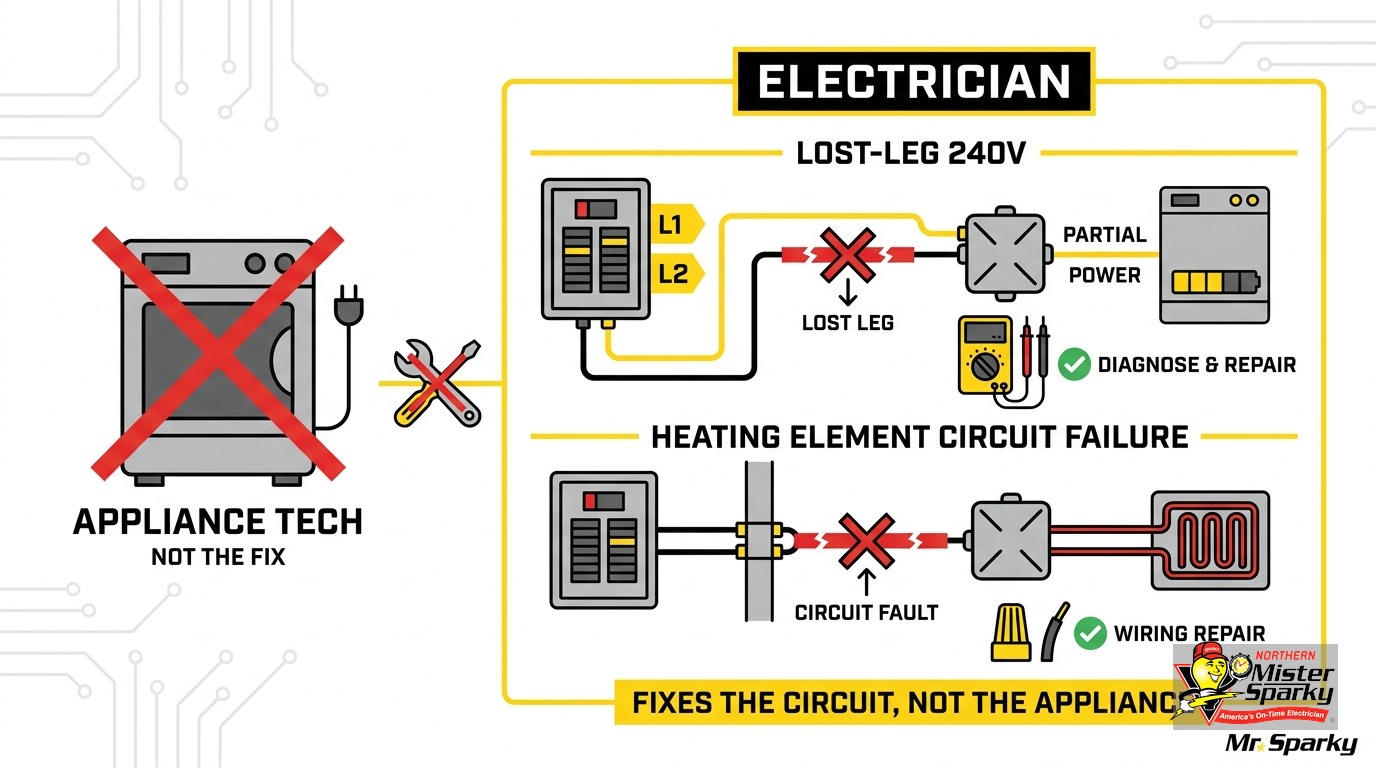
A 240V dryer draws power from two 120V legs. The motor runs on one leg. The heating element needs both legs together. When one leg fails, the drum keeps turning and the air stays cold. That is the lost-leg signature.
Your dryer is a 240-volt appliance. It pulls power from two separate 120-volt conductors in your panel. Those two conductors combine to deliver the 240 volts the heating element requires.
The motor, drum light, and controls connect to one hot leg and the neutral. That is a 120-volt load. It runs fine with one leg gone.
The heating element connects across both hot legs. No second leg means no heat, regardless of how new the appliance is or how recently it was serviced.
This pattern has a name in the trade: a lost leg, or open phase. Your clothes may have been tumbling in cold air for every cycle since the fault developed. Many homeowners run the dryer three or four times assuming the load is too wet before realizing something is wrong.
According to ask-the-electrician.com, one pole of a double-pole breaker can trip while the other stays live. The dryer circuit stays energized enough to run the drum on 120V while the heating circuit sees nothing. The breaker may look like it is in the ON position the entire time.
The same pattern appears on electric ranges: the clock and oven light work, but the burners and bake element stay dead. Same root cause, same first call to an electrician.
What Is a Lost Leg, and How Dangerous Is It?
A lost leg means one of the two 120V supply conductors has failed. The dryer appears to run but cannot complete a 240V load. Backfeed can push unstable voltages between 60V and 180V into sensitive electronics throughout the home. This situation needs immediate attention.
A lost leg can start in three places: at the utility transformer on the street, at the weatherhead where service enters your home, or inside the panel at a breaker lug or wire termination.
When a 240V load tries to draw on a single leg, it pulls through the neutral and pushes current backward. That backfeed can force voltages anywhere from 60 to 180 volts onto circuits that expect 120. Televisions, computers, refrigerator control boards, and other appliances can be damaged or destroyed before anyone realizes the supply is unstable.
The right move while waiting for service: turn off all double-pole 240V breakers in the panel. That means the dryer, range, water heater, and central AC. Killing those circuits stops the backfeed. Leave the main breaker on so lighting and single-pole outlets keep working while you wait.
For more on this failure pattern and what to shut off first, our post on lost-leg power and half-house outages covers how to identify a lost leg before an electrician arrives.
What Does a Standard Twin Cities Dryer Circuit Look Like?
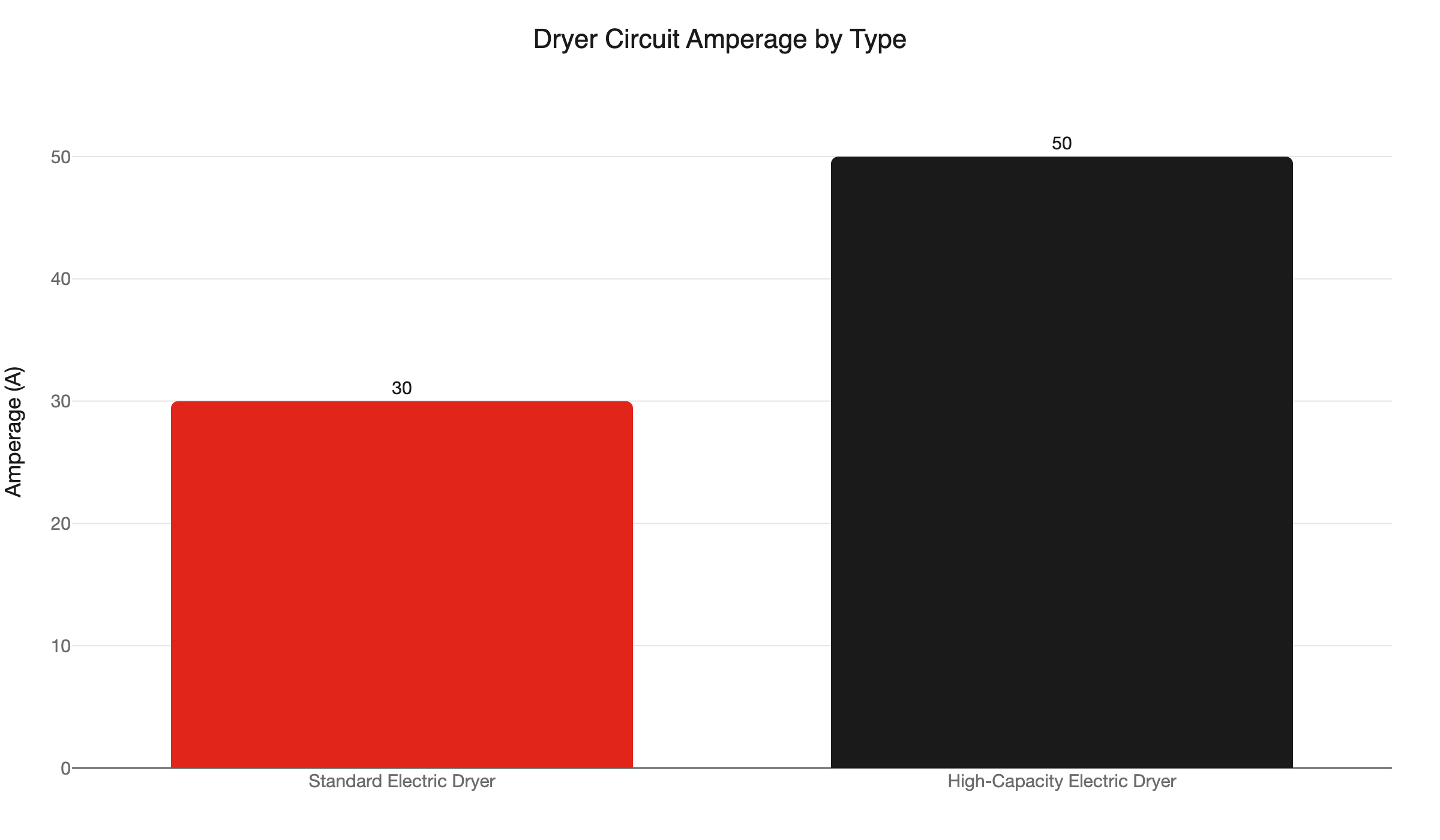
A code-legal dryer circuit in Minnesota uses a 30-amp double-pole breaker, 10 AWG copper wire, and a NEMA 14-30R four-wire outlet. High-capacity dryers step up to 50 amps and 8 AWG wire. Any deviation from these specs is worth investigating before anyone touches the appliance.
The standard Twin Cities dryer circuit is built from:
- 30-amp double-pole breaker
- 10 AWG copper wire on a dedicated circuit with no shared loads
- NEMA 14-30R four-wire outlet: two hots, one neutral, one ground
High-capacity dryers, including many front-loaders and steam models, can draw up to 50 amps. Those machines require 8 AWG wire and a 50-amp breaker. Running a 50-amp draw on a 30-amp circuit trips the breaker repeatedly. Over time, repeated trips weaken the breaker mechanism and generate heat in the undersized wire, creating a fire risk.
Before calling an appliance tech, check the dryer’s nameplate rating on the back panel. If the appliance calls for more amperage than the circuit is built to deliver, the dryer is not the problem. The circuit is.
A correctly sized breaker that keeps tripping points to loose terminations or internal breaker fatigue. Both are straightforward electrical repairs.
The 3-Prong to 4-Prong Dryer Outlet Problem in Twin Cities Homes
Homes across Minneapolis, St. Paul, Bloomington, and the metro suburbs built before the mid-1990s often have a NEMA 10-30 three-prong dryer outlet. That older configuration routes the neutral and the equipment ground through the same conductor. The dryer frame bonds to the neutral at the appliance.
If that neutral develops a fault or a loose connection, the metal body of the dryer can become energized. That is a shock hazard, not a minor code issue.
NEC 250.140 allows a 3-wire connection to stay in place under one narrow exception: the circuit must originate at the existing panel, use the original wiring, and have no modification made to it. Any new installation or any wiring change requires a four-wire NEMA 14-30R outlet with a separate ground conductor.
Adapters that convert a 3-prong outlet to a 4-prong plug are not a permanent fix. They rearrange the contacts. They do not add a ground conductor. The correct fix requires running new cable and pulling a permit in Minnesota.
Our post on 3-prong to 4-prong dryer outlet conversion covers the full process: what the permit requires, what the inspector checks, and why adapters fall short. If your home still has a NEMA 10-30 and you are seeing heating issues, the outlet upgrade belongs on the same service call.
What Does Minnesota Code Require for Dryer Circuits in 2026?
Minnesota adopted the 2026 NEC on August 17, 2026. Under NEC 210.8(D), all dryer branch circuits up to 60 amps now require GFCI protection. Any new installation or modification must use a four-wire outlet. Permits are required for new circuits, outlet upgrades, and panel work.
Minnesota’s electrical code authority is the DLI, the Department of Labor and Industry. The DLI, not individual municipalities, sets the statewide code. The 2026 NEC checklist at dli.mn.gov is what inspectors carry to every job today. Permits filed before August 17, 2026 ran under the 2023 NEC; permits filed today run under the 2026 NEC.
Under NEC 210.8(D), listed as Item 027 on the DLI’s 2023 NEC inspection checklist, all clothes dryer branch circuits up to 60 amps require GFCI protection. This closed the old loophole that exempted hardwired dryers from GFCI on the theory that no one could plug in a different appliance.
One consequence worth knowing: if your dryer circuit was recently upgraded with a GFCI breaker and it keeps tripping without an obvious cause, check the dryer’s bonding jumper. Older dryers that used a 3-wire cord have a bonding strap connecting the neutral terminal to the dryer frame. On a 4-wire circuit with a separate ground conductor, that strap must be removed. If it stays in place, the GFCI detects current returning on the ground path and trips. That is a wiring error at the appliance, not a defective breaker.
Minnesota homeowners may pull their own permit for owner-occupied, single-family homes. The work must pass inspection. For most homeowners, hiring a licensed electrician is faster and removes the inspection liability from their plate.
For more on what a laundry room needs under current Minnesota code, our guide on laundry room electrical requirements covers dedicated circuits, AFCI requirements on the washer circuit, and the basement-specific GFCI rules that apply to rooms below grade.
What Does an Electrician Check That an Appliance Tech Does Not?
An electrician tests both poles of the breaker, checks voltage at each outlet slot, inspects wire terminations for corrosion and looseness, and verifies the circuit size matches the appliance draw. An appliance tech works on the dryer. An electrician works on the circuit feeding it.
Here is the diagnostic sequence our team runs on every dryer not heating electrical problem call:
At the panel:
- Both poles of the double-pole breaker, measured for correct voltage (240V across both hot legs; 120V from each hot leg to neutral)
- Breaker and lug for heat discoloration, arc pitting, or loose wire connections at the terminals
- Wire gauge compared to breaker rating (10 AWG must be on a 30-amp breaker; 8 AWG on a 50-amp breaker)
- GFCI protection on the circuit per current code
At the outlet:
- Voltage at each slot of the NEMA 14-30R (each hot slot should read 120V to neutral; across both hot slots, 240V)
- Ground continuity from outlet to panel
- Outlet condition, including scorch marks, loose contacts, or signs of arcing at the terminals
At the appliance cord:
- Cord for heat discoloration or loose terminal connections at the dryer’s terminal block
- Bonding strap status on 4-wire installations (the strap must be removed on a 4-wire circuit)
If the panel, breaker, and outlet all read correctly, the fault is inside the appliance. At that point, a thermal fuse, burned heating element, or failed cycling thermostat is the likely diagnosis, and an appliance tech is the right next call. But you skip a wasted service visit when the electrician clears the circuit first. No amount of appliance work fixes a lost leg.
Is a Failing Breaker a Common Cause of This Dryer Not Heating Electrical Problem?
Yes. A breaker that has tripped repeatedly can develop internal contact fatigue. One pole may no longer seat firmly in the ON position, reading near zero volts while the other pole reads 120V. Replacing the breaker is straightforward and costs far less than an appliance service visit.
Circuit breakers are mechanical devices with a finite lifespan. Breakers handling high-draw 240V loads for years are especially susceptible to internal wear. A fatigued breaker may look fully ON with no visible trip indication. But one pole reads 120V while the other reads 10 or 20 volts under load.
Before replacing any breaker, our team always checks the wire terminations at the lug. A single loose screw at a terminal creates exactly this symptom: the heating element starves for voltage while the drum keeps spinning. Tightening the lug is a five-minute fix. If the terminations are tight and one pole still reads low voltage under load, the breaker gets replaced.
For more on what causes breakers to fail, trip, and wear out over time, read our guide on why circuit breakers keep tripping.
When Is the Problem the Appliance and Not the Circuit?
If the breaker reads 240V across both poles and the outlet reads correctly at both hot slots, the fault lives inside the dryer. Thermal fuse failure, a burned heating element, or a failed cycling thermostat are the most common appliance-side causes of a no-heat condition.
Here is the handoff point every diagnostic reaches: if an electrician has tested both poles at the breaker and confirmed 240V at the outlet with solid ground continuity, the electrical supply to the dryer is healthy.
At that point, the appliance tech takes over. A failed thermal fuse is the most common appliance-side cause. It is a one-use safety device that opens permanently when the dryer overheats. It cannot be reset. A burned heating element is the next most common cause. A failed cycling thermostat can also produce a no-heat condition while the drum continues to run normally.
None of those are electrical problems. But none of them can be found by an appliance tech if the circuit is the actual culprit. Starting with the electrician is the correct diagnostic sequence. It saves time and money for everyone involved.
Minnesota Winters Push Dryers Harder Than Most Climates
Minnesota’s cold winters create a local factor worth understanding. Wet, heavy outdoor gear, soaked snow pants, hockey equipment, and bulky parkas take longer to dry than a standard load. Longer run cycles put more thermal stress on the heating element, more mechanical load on the drum motor, and more repetitive cycling on the breaker.
That extra strain accelerates failures that might take years to surface in a milder climate. If your dryer lost heat in January or February, the Minnesota winter load may have pushed a marginal connection or a weakened breaker past its limit. Our team is locally owned and operated in the Twin Cities, and we see this pattern regularly during cold stretches across Minneapolis, St. Paul, Woodbury, Maple Grove, Blaine, and Brooklyn Park.
Running dryers longer and more often also accelerates thermal fuse wear inside the appliance. That makes ruling out the electrical side first even more important: a thermal fuse will keep blowing if the root cause is a poorly ventilated dryer, but it will also look identical to a lost-leg symptom from the outside.
Which Symptoms Point to an Electrical Problem, Not an Appliance Failure?
Call an electrician before the appliance tech if the drum runs with no heat, the breaker trips on startup, other 240V appliances are also acting oddly, or your home still has a 3-prong dryer outlet. These symptoms indicate a circuit or supply fault.
Look for these specific signs:
- The drum spins and the timer runs, but the air inside stays cold
- The breaker trips immediately when the dryer starts, or trips mid-cycle
- Other 240V appliances, including the range, water heater, or central AC, are also behaving oddly
- The breaker appears to be ON, but the dryer has no power at all
- Your home was built before 1996 and still has a 3-prong dryer outlet
- A recently upgraded GFCI-protected dryer circuit keeps tripping with no clear cause
- Lights dim noticeably when the dryer starts
That last item, noticeable light dimming on dryer startup, can indicate a voltage drop in the supply conductors or a loose service connection rather than a problem isolated to the dryer circuit.
What to Do Right Now
- Check the dryer breaker. If it has tripped, reset it once. If it trips again immediately, leave it off and do not force another reset.
- Look for related symptoms. Is the range losing burners? Is the water heater slow to recover? Either points to a lost-leg scenario in the service, not just the dryer circuit.
- If you suspect a lost leg, turn off all double-pole 240V breakers until an electrician can assess the supply. This protects electronics from backfeed damage while you wait.
- Do not assume the appliance is broken. Have an electrician test both poles of the breaker and both hot slots of the outlet before scheduling appliance service.
- Call Northern Mister Sparky at 763-200-5956 or book online. Our team is locally owned and operated in the Twin Cities, and we back every job with the UWIN(R) 100% satisfaction guarantee as America’s On-Time Electrician(R).
No malarky: a drum spinning in cold air is an electrical call until the circuit is proven clean. Starting with the electrician saves you from paying for an appliance service visit that finds nothing wrong with the appliance.
Frequently Asked Questions
Why is my dryer running but not heating? +
Do I need a permit to upgrade a dryer circuit in Minnesota? +
What breaker size does a dryer circuit need in the Twin Cities? +
Need an electrician now?