
Heat Pump Dryer Wiring Requirements: What Changes?
Key Takeaways
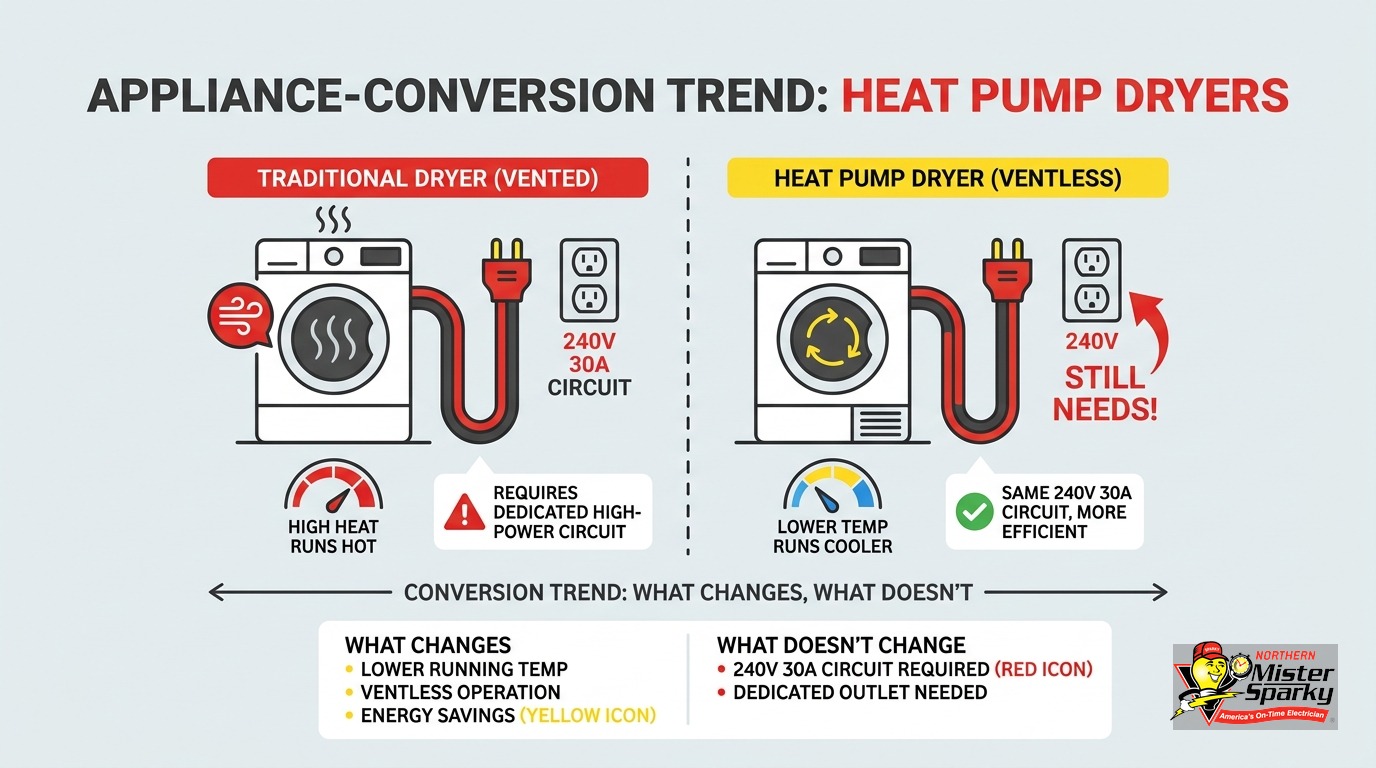
- Circuit specs are unchanged from a standard electric dryer: 240V, 30A, 10 AWG copper conductors, a 30A double-pole breaker, and a NEMA 14-30R (4-prong) receptacle on a dedicated circuit.
- Lower wattage, same circuit: Heat pump dryers operate at roughly 1,500-1,800W, far below a 5,000W resistance dryer. The nameplate still specifies 240V/30A, and that is what the circuit must match.
- GFCI is required on new circuits: Any dryer circuit installed under a new permit in Minnesota must have GFCI protection per NEC 210.8(A)(10).
- Gas conversions are a different job entirely: Gas dryers run on a 120V/15A outlet for controls only. Converting to a heat pump dryer means running an entirely new 240V/30A circuit, pulling a permit, and passing inspection.
- No vent duct, but drainage matters: Heat pump dryers route moisture to a drain or a collection tank you empty periodically. This changes where the dryer can go, not what the circuit needs.
- Minnesota HEAR has not launched: The program includes up to $2,500 for wiring. As of August 2026, it is still waiting on DOE approval. No retroactive rebates are allowed once it launches.
- Minnesota Power offers $300 now: Customers in northern Minnesota can claim a rebate on any ENERGY STAR heat pump dryer through December 31, 2026.
Heat pump dryer wiring requirements come up in two very different conversations. The first is a homeowner swapping one electric dryer for another. The second is a homeowner switching from gas to electric. The circuit specs are identical in both cases. The scope of work is not.
Here is the short version: a heat pump dryer needs the same 240V/30A circuit as a standard resistance dryer. Its operating wattage is much lower, but the circuit requirement does not shrink with it. What changes is where you are starting from, and whether new wiring needs to be run at all.
This post covers the electrical specs, the Minnesota code details in effect right now, and the rebates worth understanding before you schedule the job.
Do Heat Pump Dryers Have Different Wiring Requirements Than Standard Electric Dryers?
No. The circuit is identical: 240V, 30A, 4-wire, NEMA 14-30R. The difference between a heat pump dryer and a resistance dryer is efficiency, not electrical requirements. If you already have a working dryer outlet, a heat pump dryer typically plugs right in.
Where things diverge is the starting point. Replacing one electric dryer with another is usually straightforward from an electrical standpoint. Starting from a gas dryer, or a laundry space with no dryer circuit at all, means new electrical work from the panel out.
NYSERDA’s heat pump clothes dryer buyers guide states it directly: “swapping [a conventional electric dryer] for a heat pump clothes dryer is usually a straightforward process since they have comparable electrical requirements.” That holds true when the circuit exists and is correctly wired. It does not hold when the starting point is a 120V gas dryer outlet or an empty wall.
What Circuit Does a Heat Pump Dryer Actually Need?
A dedicated 240V/30A circuit: 10 AWG copper conductors, a 30A double-pole breaker, and a NEMA 14-30R (4-prong) receptacle. Dedicated means the dryer is the only load on that circuit. Nothing else shares the breaker.
Here is what each component means in plain terms:
- Wire gauge: 10 AWG copper. This is the code-specified wire size for a 30A circuit.
- Breaker: 30A double-pole. It occupies two slots in the panel. Both poles together deliver 240V. A single-pole breaker cannot run 240V.
- Outlet: NEMA 14-30R. The 4-prong outlet you see on modern electric dryers. It carries two hot legs, a neutral, and a ground. Four conductors, four prongs.
- Circuit type: Dedicated. One breaker, one dryer. No outlets, lights, or other appliances on the same circuit.
WireRef’s dryer circuit guide confirms these specs: 10 AWG copper, 30A double-pole breaker, a 4-wire run with two 120V hot conductors, a neutral, and an equipment ground.
Older homes sometimes have 3-prong NEMA 10-30 dryer outlets. Those circuits predate the grounding requirements in modern code. A heat pump dryer should not be connected to a 3-prong outlet. Our post on upgrading a dryer outlet from 3-prong to 4-prong explains what that upgrade involves and when it applies.
Why Doesn’t the Lower Wattage Change the Circuit Requirement?
Because the circuit is sized to the nameplate rating and peak demand, not average operating efficiency. Heat pump dryer nameplates still specify 240V/30A. Code requires the circuit to match. Running at lower wattage during normal cycles does not allow a smaller circuit.
A standard resistance dryer heats clothes by energizing a nichrome element at roughly 5,000W. That load is where the 30A requirement originates: 5,000W divided by 240V is approximately 20.8A, and the circuit is sized above that to handle startup current and code minimums.
A heat pump dryer replaces the heating element with a refrigerant-cycle compressor. The compressor extracts heat from the drum air, concentrates it, and recirculates it. The result is a typical operating draw of 1,500-1,800W, far less than a resistance element. That efficiency is real. ENERGY STAR-certified models save an average of $330 per year compared to standard electric dryers, per data cited in NYSERDA’s buyers guide.
But the nameplate still calls for 240V/30A. The circuit must match the nameplate. Code does not allow downsizing to a 20A circuit because the dryer runs efficiently under normal conditions. Startup loads and safety margins are the reason the circuit is rated above the typical operating draw.
The NEC 220.54 wrinkle
There is a code detail that matters specifically when you are also doing a panel upgrade. NEC 220.54 requires electricians to calculate dryer loads at a minimum of 5,000W (5 kVA) per dryer when sizing a panel, regardless of the dryer’s actual draw. Discussion among licensed electricians on the Mike Holt Forums confirms this minimum applies to heat pump dryers.
This means that even if your heat pump dryer only draws 1,800W at the wall, the panel load calculation must reserve 5,000W for it. If your panel is near capacity, combining the dryer circuit and a panel upgrade in one job is often the most efficient path. Our team assesses panel capacity as part of every dryer circuit consultation.
Does a New Dryer Circuit Require GFCI Protection?
Yes. NEC 210.8(A)(10), in effect in Minnesota under NEC 2023, requires GFCI protection for receptacles in laundry areas. Any new dryer circuit installed under a permit must comply. That typically means a 30A GFCI breaker at the panel.
This requirement surprises some homeowners whose existing dryer circuit has never had GFCI protection. The existing circuit is not retroactively required to change. But the moment you pull a permit for new circuit work, the new circuit must meet current code.
For a 30A dryer circuit, GFCI protection is usually provided by a 30A GFCI breaker installed at the panel. Standard GFCI receptacles are rated for 15A or 20A; the 30A breaker approach is the standard solution for dryer circuits. WireRef notes this GFCI requirement explicitly for circuits installed under new permits.
Minnesota’s code transition timeline is also relevant right now. NEC 2023 is the governing code today. Per the Minnesota Department of Labor and Industry, NEC 2026 takes effect August 17, 2026. Permits filed before that date use NEC 2023. Permits filed on or after use NEC 2026. If your project is scheduled close to that date, confirm with your electrician which code cycle applies to your permit.
Do I Need a Permit to Add a Dryer Circuit in Minnesota?
Yes. Adding a dedicated 240V circuit requires an electrical permit in Minnesota. This applies to every new dryer circuit, including a gas-to-electric conversion. The permit triggers a required inspection before the work is covered by drywall or flooring.
A permit is not administrative overhead. It is the process that assigns a licensed electrician’s accountability to the work and puts a state inspector’s eyes on it before walls close. For 240V circuits, that inspection catches wiring errors before they become fire or shock hazards. It also creates a permanent record of the work.
The permit process typically involves:
- An application filed by a licensed Minnesota electrician before work begins.
- A rough-in inspection after the cable is run but before the wall is closed up.
- A final inspection after the breaker and receptacle are installed and connected.
Skipping a permit creates problems at resale. Home inspectors flag unpermitted electrical work. Buyers’ agents use it as a negotiating point. Insurance companies sometimes deny claims tied to unpermitted work. The permit cost is small relative to those risks.
Our post on electrical permits in Minnesota covers the process in detail, including what to expect at each inspection stage.
What Changes When You Convert From a Gas Dryer to a Heat Pump Dryer?
Almost everything electrically. Gas dryers use a standard 120V/15A outlet for controls only. A heat pump dryer requires a dedicated 240V/30A circuit. That means new wire, a new breaker, a permit, and an inspection. It is not a plug-and-play swap.
This is the scenario that catches the most homeowners off guard. A gas dryer has a gas supply line for heat and a standard 120V outlet for the motor and electronic controls. That 120V outlet looks like any outlet in the house. Swapping the gas dryer for a heat pump dryer does not mean plugging into a different outlet. It means running entirely new wiring.
Here is what the job typically involves:
- An electrician evaluates panel capacity and the best routing path for the new circuit.
- An electrical permit is filed before work begins.
- A 4-wire 10 AWG cable runs from the panel to the dryer location.
- A 30A double-pole breaker is installed in the panel.
- A NEMA 14-30R receptacle with GFCI protection is installed at the dryer location.
- The 120V outlet can stay for other uses or be removed.
- Rough-in and final inspections are completed and signed off.
The 120V outlet and the gas line are separate scopes. A licensed plumber handles the gas disconnect. Northern Mister Sparky handles the electrical side only. For gas line work, our sister brand Northern One Hour Heating and Air Conditioning can assist.
Our dedicated post on gas dryer to electric conversion wiring walks through the full job in detail.
Where Can a Heat Pump Dryer Go Without a Vent Duct?
More places than a vented dryer can go. But the location still needs either a nearby drain or a homeowner willing to empty a water tank every 2-3 loads. The 240V/30A circuit must also reach wherever the dryer lands.
Standard dryers push humid drum air through a rigid or flexible duct to the outside. The duct routing limits where the dryer can go: it needs a path to an exterior wall, typically through a short, relatively straight run. That constraint rules out many interior rooms and upper floors.
Heat pump dryers do not vent to the outside. They extract moisture from the drum air through the refrigerant cycle and handle it one of two ways:
- Condensate drain: A drain hose routes collected water to a floor drain or laundry sink. Low maintenance once installed.
- Collection tank: The dryer holds water internally. You empty the tank approximately every 2-3 loads, per NYSERDA’s heat pump clothes dryer buyers guide.
Removing the vent constraint opens up spaces: basement corners, interior closets, hallway nooks, and first-floor utility rooms that never had access to an exterior vent path. But wherever the dryer goes, the 240V/30A circuit must follow. If the new location is far from the existing panel route, that means new wiring, new conduit, and a permit.
Our post on laundry room electrical requirements covers what the NEC requires for laundry spaces, including receptacle placement and the dedicated circuit rule.
What Minnesota Rebates Are Available for Heat Pump Dryers?
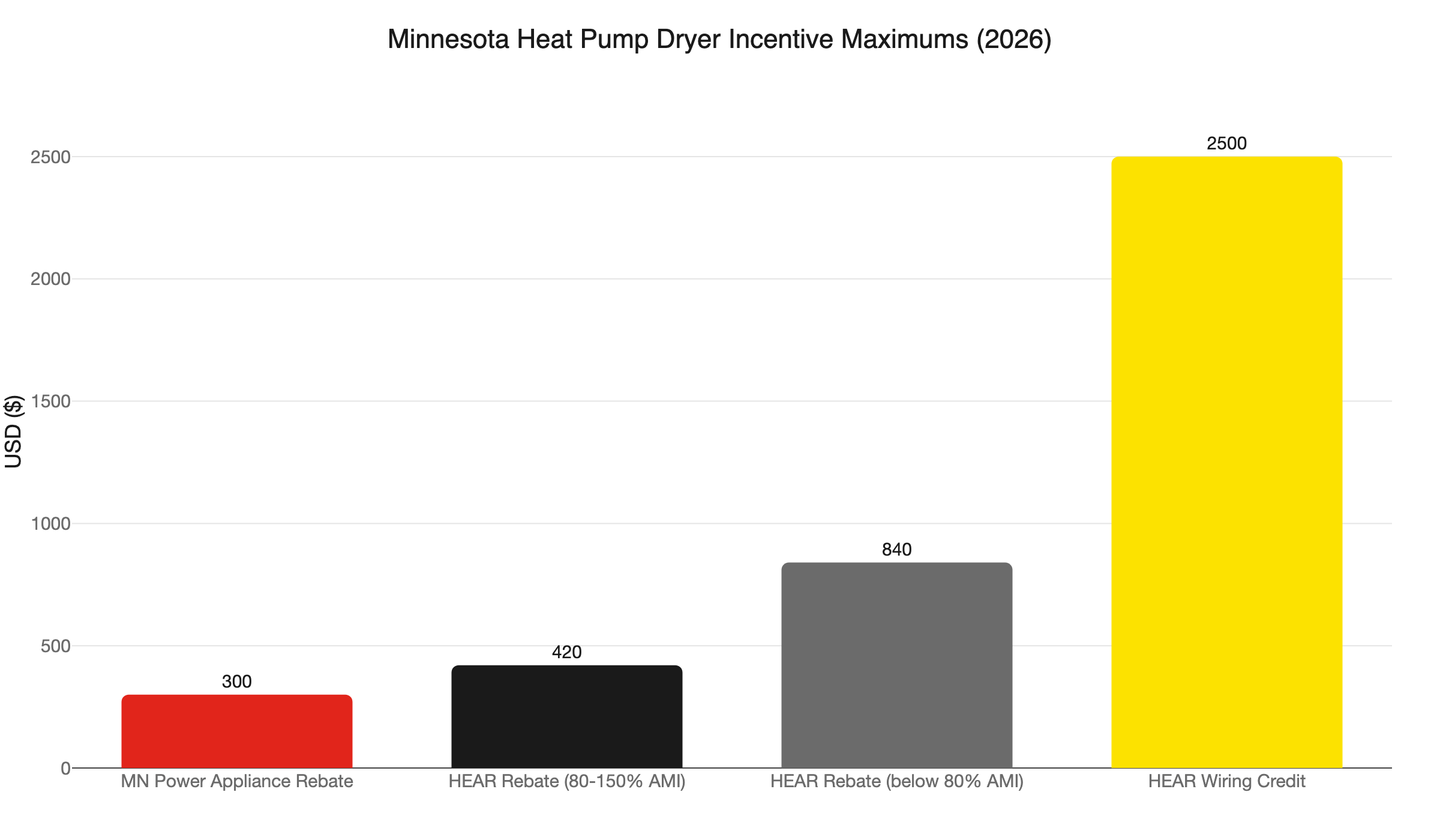
Minnesota Power offers a $300 appliance rebate available now through December 31, 2026. The state HEAR program offers larger incentives, including a $2,500 wiring credit, but it has not launched as of August 2026.
Here is the current picture for Twin Cities and Minnesota homeowners.
Minnesota Power: $300 appliance rebate (available now)
Minnesota Power customers in northern Minnesota can claim a $300 rebate on any ENERGY STAR-certified heat pump dryer, valid January 1 through December 31, 2026. The rebate cannot be combined with other Minnesota Power offers. Applications are submitted through the Minnesota Power website after purchase.
Minnesota HEAR Program (not yet launched)
HEAR stands for Home Energy Appliance Rebate, the state-administered version of the federal HEEHRA program. Minnesota is waiting on DOE approval. As of August 2026, HEAR has not launched and no launch date has been announced.
When HEAR launches, it will offer the following, per MN Commerce’s HEAR program page:
- Up to $840 for the appliance for households below 80% of area median income
- Up to $420 for the appliance for households between 80-150% of area median income
- Up to $2,500 for electrical wiring when bundled with a qualifying appliance
No malarky: that $2,500 wiring credit is the number that matters most for a gas-to-electric conversion. Running a new 240V/30A circuit is exactly the scope of work HEAR is designed to offset. Federal rules prohibit retroactive rebates, meaning work completed before the launch date does not qualify. Timing matters.
Xcel Energy (Twin Cities)
Xcel does not offer a dedicated heat pump dryer rebate in 2026. Xcel’s Conservation Improvement Program covers HVAC equipment but not appliances. When HEAR launches, Xcel customers access it through the state program.
What to do now
If you are a Twin Cities homeowner planning a gas-to-electric conversion, there is a real case for timing the electrical work after HEAR launches. The $2,500 wiring credit could offset a significant portion of the circuit installation cost. Call us now and we will assess your panel, map the circuit routing, and give you a quote. You will have a firm number ready when the program opens, without doing the work twice.
Ready to Wire Your Laundry Room for a Heat Pump Dryer?
Northern Mister Sparky is locally owned and operated in the Twin Cities. We serve Minneapolis, St. Paul, Bloomington, Brooklyn Park, Woodbury, Blaine, Maple Grove, Plymouth, and the surrounding metro.
As America’s On-Time Electrician(R), we show up when we say we will. Whether you need a circuit verification before the dryer arrives, a new 240V/30A circuit for a gas conversion, or a panel assessment to see if your existing service can carry the new load, our team handles the electrical side from consultation through permit sign-off.
Every job is backed by our UWIN(R) 100% satisfaction guarantee. If you are not satisfied, we make it right.
Call 763-200-5956 or book online to schedule an assessment. We will look at your existing setup, tell you exactly what the job requires, and make sure your laundry room is ready before the dryer shows up on the truck.
Frequently Asked Questions
Do heat pump dryers need a 240V outlet? +
What electrical work is needed to convert from a gas dryer to a heat pump dryer? +
Is there a Minnesota rebate for heat pump dryer wiring? +
Need an electrician now?