
Stacked Washer Dryer Electrical Requirements (2026)
Key Takeaways
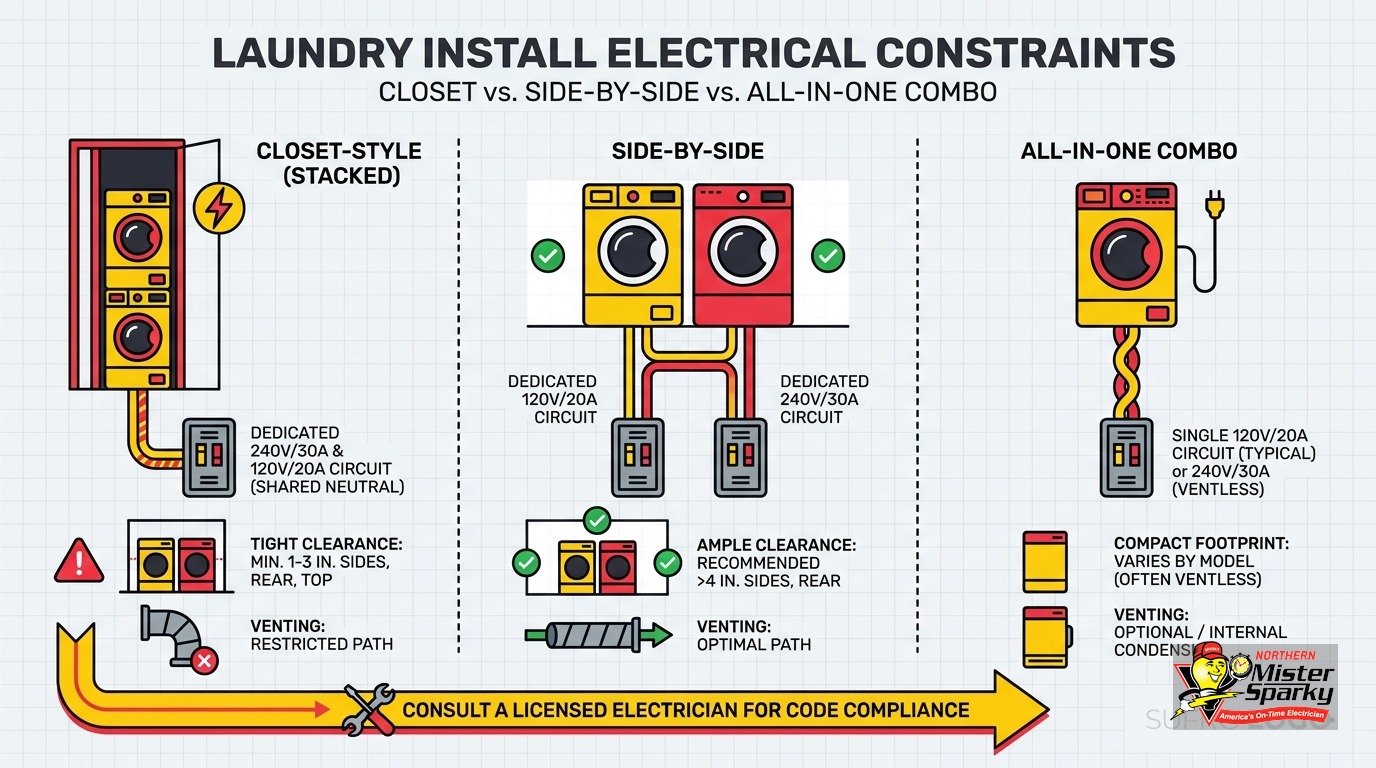
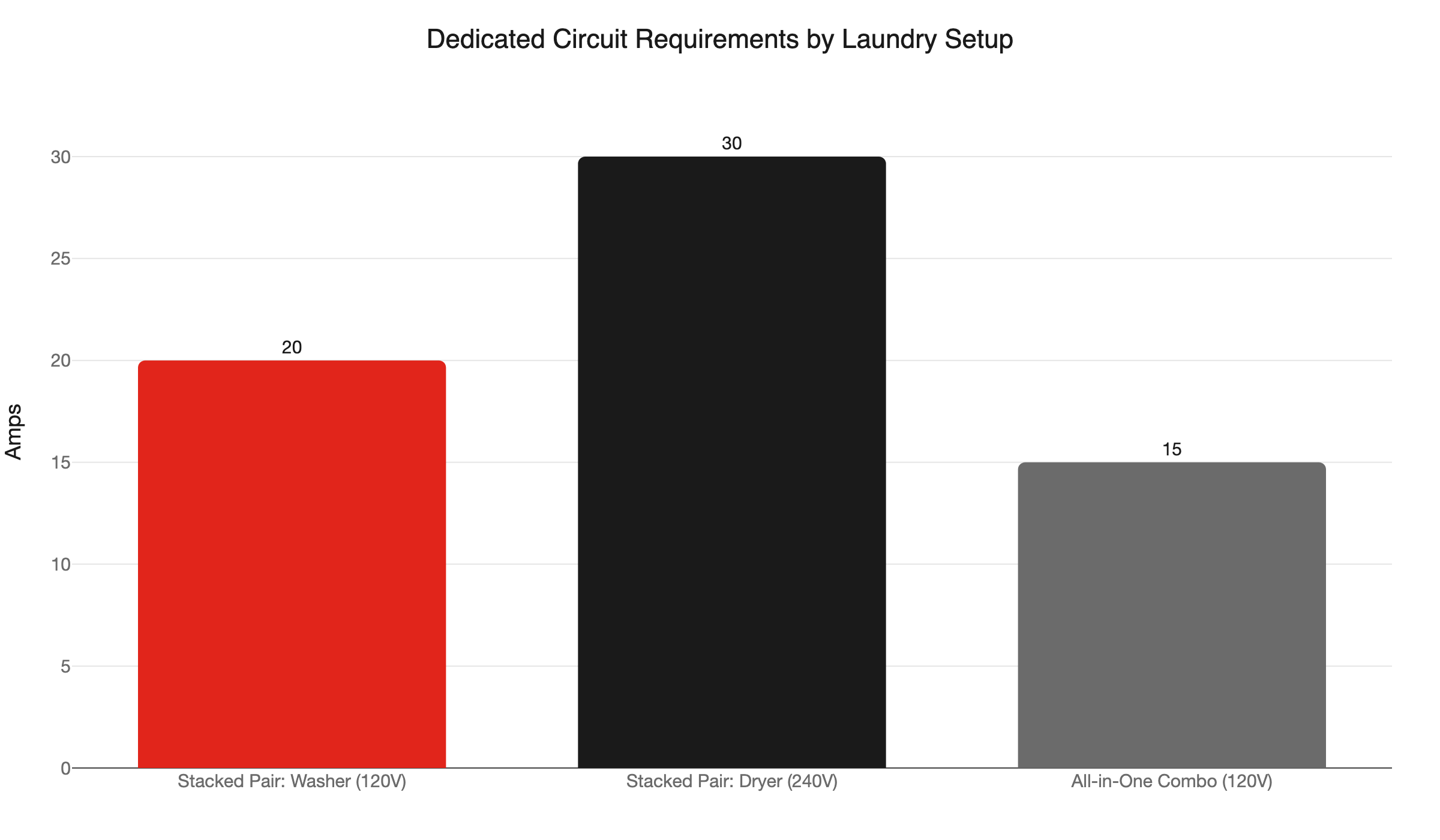
- A stacked pair of separate machines requires two dedicated circuits: 20A/120V for the washer and 30A/240V for the electric dryer.
- An all-in-one ventless combo unit runs on a single dedicated 15A/120V circuit and needs no dryer duct at all.
- Minnesota moved to the 2026 NEC on August 17, 2026. Any permit pulled today falls under that code.
- NEC 210.8(D) now requires GFCI protection on the 240V dryer circuit itself. Many Twin Cities homes wired before 2020 do not yet meet this rule.
- A laundry closet with a vented dryer must have makeup air. IRC M1502 makes a completely sealed closet a code violation.
- Basement laundry rooms trigger two independent GFCI requirements simultaneously, a detail that catches most homeowners off guard.
- Minnesota requires a licensed electrician and a permit for any new circuit or circuit modification. DIY circuit work is not legal in this state.
What Are the Electrical Requirements for a Stacked Washer and Dryer?
A stacked pair needs a dedicated 20A/120V circuit for the washer and a dedicated 30A/240V circuit for the electric dryer. An all-in-one ventless combo unit needs only one dedicated 15A/120V circuit. Which type of machine you have determines everything about the rough-in.
Getting this wrong is common. A homeowner buys a stacked pair thinking they have a single laundry outlet covered, and the installer discovers the closet needs a second 240V circuit run from the panel. Or a homeowner replaces a dryer and discovers the 20-year-old circuit has no GFCI protection, which triggers a required upgrade before the inspector will sign off. Knowing what code requires before you buy the appliance or call the electrician saves you from both scenarios.
Stacked Pair vs. All-in-One Combo: Why the Distinction Matters
A stacked pair means a full-size washing machine with a full-size electric dryer sitting on top using a stacking kit. These are two completely separate appliances sharing a vertical footprint. Each machine draws its own power. Each machine needs its own dedicated circuit.
An all-in-one combo unit, such as the Samsung Bespoke WD53 series or comparable LG combo models, is a single machine that washes and dries in the same drum. Most current combo units use ventless heat pump technology. They draw dramatically less power than a conventional electric dryer. The Samsung Bespoke all-in-one spec sheet confirms the machine is rated at 15A/120V/60Hz. That is the same voltage class as a toaster.
A breakdown of both setups confirms the circuit split: all-in-one combo units need a single 120V outlet on a dedicated circuit, while a stacked pair requires both a 120V washer circuit and a separate 240V dryer circuit. These are not interchangeable.
This distinction matters most in a laundry closet. A closet roughed in for a single washer outlet may have exactly what a combo unit needs. That same closet is missing the 240V dryer circuit a stacked pair requires. Know before you frame in the walls.
What Circuits Does a Stacked Washer-Dryer Pair Need?
A stacked pair requires two dedicated circuits: a 20A/120V circuit for the washer and a 30A/240V circuit for the electric dryer. The dryer circuit uses 10 AWG copper wire and terminates at a NEMA 14-30 four-prong outlet. Neither circuit can share a breaker with any other load in the home.
The NEC 210.11(C)(2) laundry branch circuit rule requires at least one dedicated 20A branch circuit for laundry area receptacles. This circuit is reserved for the washer. It cannot serve other outlets in the space, even in a compact laundry closet with no room for anything else. The rule is unconditional.
The dryer circuit is a completely separate run. A standard residential electric dryer uses a 30A/240V circuit with 10 AWG copper wire and a NEMA 14-30 four-prong outlet. Three-prong NEMA 10-30 outlets are still present in many pre-2000 Twin Cities homes. If a new dryer is driving the project, that outlet will need to be updated. Our post on converting a 3-prong to 4-prong dryer outlet walks through what that conversion involves and when it triggers a GFCI upgrade on the full circuit.
Gas dryers require a 120V outlet for the motor and controls, so the 20A laundry circuit still applies. Gas dryers do not need a 240V circuit.
What Circuits Does an All-in-One Combo Unit Need?
A ventless all-in-one combo unit needs one dedicated 15A/120V circuit. No 240V circuit, no duct run, no new panel capacity. The machine plugs into a standard outlet, but that outlet must serve no other device.
If a laundry closet already has a 20A washer circuit and nothing else shares it, a combo unit can run on that circuit. You do not need to open the wall or pull new wire. That is a real cost savings in a finished closet or hallway installation.
“It already has an outlet” is not the same as “the outlet is compliant with today’s code.” An existing outlet must still meet current GFCI and AFCI requirements. If the closet was wired before 2020, those requirements likely did not apply when the work was done. Those rules are covered in the sections below, and they apply whether you are adding a new circuit or using an existing one.
Does My Dryer Circuit Need GFCI Protection?
Yes. NEC 210.8(D) requires GFCI protection on all clothes dryer branch circuits rated up to 60A. This applies to the 30A/240V circuit for a conventional electric dryer and to the 15A/120V circuit for an all-in-one combo. It applies whether the dryer is plug-connected or hardwired into the wall.
This is the rule that surprises most homeowners and some contractors. Before the 2020 NEC, a hardwired 240V electric dryer was exempt from GFCI. The reasoning was that a dryer is not a portable appliance. That exemption is gone. The 2026 NEC laundry circuit requirements list NEC 210.8(D) explicitly as applying to the dryer circuit itself, not just to nearby receptacles.
In Minnesota, the 2026 NEC became effective on August 17, 2026. Any permit pulled on or after that date requires GFCI on the dryer circuit. An inspector will check it.
For older Twin Cities homes, this is the most common upgrade we see when a dryer replacement or closet conversion brings an electrician to the house. The existing 240V circuit has no GFCI protection because it was installed under an older code edition. That circuit must be brought into compliance before inspection closes. On a 240V circuit, the standard solution is a GFCI breaker at the panel. A 240V GFCI outlet at the point of use is not a standard available product.
The practical rule: any time you touch a dryer circuit, including replacing the receptacle, rerouting wire, or swapping the breaker, you have triggered a code upgrade requirement on the full circuit.
What GFCI Rules Apply to the Washer Outlet?
The washer outlet is covered by two NEC rules. NEC 210.8(A)(10) requires GFCI on all receptacles in laundry areas. If the laundry area is also in an unfinished basement, NEC 210.8(A)(5) adds a second independent GFCI requirement. Both rules apply simultaneously, and missing either one fails inspection.
This double-coverage situation is described in NEC laundry area circuit guidance as the most commonly missed item during laundry installation inspections. Most Twin Cities inspectors checking a basement laundry area will verify compliance with both NEC 210.8(A)(5) and NEC 210.8(A)(10) as separate line items.
Both rules also apply to every other receptacle in the laundry area: the 120V outlet for a gas dryer’s controls and ignition, any general-purpose outlet added to the space, and any outlet within the laundry zone even if installed for a different purpose. All of them need GFCI protection.
The majority of Twin Cities homes have laundry in the basement. If yours does, both rules apply to your washer outlet. If you bought an older home in Minneapolis, St. Paul, or the suburbs and the washer outlet was never inspected under post-2020 code, do not assume it is compliant.
For a full breakdown of where GFCI protection is required throughout a home, see our guide to GFCI outlet requirements.
What About AFCI Protection?
AFCI (arc-fault circuit interrupter) protection is required on the 20A washer circuit and any laundry lighting circuit under NEC 210.12(A). The 30A/240V dryer circuit is exempt from AFCI but not from GFCI. These two protection types guard against different hazards and operate independently.
AFCI protection detects dangerous arcing before it ignites a fire. Arcing can happen inside the wiring from insulation that has been damaged by age, rodents, or the vibration that a washing machine produces over years of operation. Standard breakers do not catch this type of fault. An AFCI breaker does.
NEC 210.12(A) AFCI requirements for the 2026 code cycle confirm the washer circuit is on the required list. The most efficient solution for a 120V laundry circuit is a dual-function AFCI/GFCI breaker. It satisfies the NEC 210.8(A)(10) GFCI requirement and the NEC 210.12(A) AFCI requirement in a single device at the panel. Our post on combination AFCI/GFCI breakers explains how they work and when they are the right choice.
Laundry Closet Installations: What Extra Rules Apply?
A laundry closet with a vented dryer must meet IRC M1502 makeup air requirements in addition to all the electrical requirements above. The closet must also meet manufacturer clearance minimums for airflow and connections. Nothing about a small closet exempts it from any of these rules.
The electrical code does not relax because the space is small. What changes in a closet is the physical environment. Heat concentrates, airflow is restricted, and lint has fewer places to go. Those conditions make compliance more critical, not less.
Manufacturer clearance specifications confirm the standard minimums: 1-3 inches on all sides for air circulation, plus 2-6 additional inches of depth behind the unit to accommodate the dryer hose, water supply lines, and electrical connections. These are manufacturer requirements, not NEC. Skipping them voids the appliance warranty and can restrict dryer exhaust airflow enough to cause lint buildup inside the duct, which is a documented fire risk in a closet installation.
Measure the rough opening before you purchase a stacked pair. A unit measuring 27 inches wide and 75-76 inches tall will not fit a 26-inch closet opening, and a tight closet that restricts airflow on all sides is a problem before a single load of laundry runs.
Does a Laundry Closet Need Makeup Air?
Yes. IRC M1502 requires makeup air wherever a closet is designed to house a clothes dryer. If the dryer manufacturer does not specify makeup air requirements, code requires permanent openings in the closet totaling at least 100 square inches. A completely sealed closet with a vented dryer is a code violation.
This rule exists because a vented dryer exhausts air to the outside. That exhausted air must be replaced from somewhere. In a sealed closet, the dryer pulls replacement air backward through its own duct. That reduces exhaust velocity, traps lint inside the duct, and creates a fire hazard that builds over time. IRC M1502 and Chapter 15 of the International Residential Code exist specifically to prevent this.
The practical fix is a louvered closet door or permanent grille openings in the closet wall totaling at least 100 square inches. A standard louvered bifold door from any home improvement center typically exceeds that minimum. A solid door with a gap at the bottom does not qualify. The opening must be permanent and cannot be blocked off during operation.
An all-in-one ventless combo unit is not subject to the IRC M1502 makeup air requirement. It does not exhaust air outside the home. That is one of the strongest practical arguments for a combo unit in a laundry closet build.
Dryer Duct Requirements in a Closet
The dryer exhaust duct must be 4-inch diameter rigid smooth-interior metal, either galvanized steel or aluminum at minimum 28-gauge. Maximum equivalent run length is 35 feet, reduced by 5 feet per 90-degree elbow and 2.5 feet per 45-degree elbow. The duct must terminate at the exterior with a backdraft damper, and screens at the exterior cap are prohibited.
These requirements apply in a laundry closet the same as anywhere else. IRC 2024 dryer duct code does not offer a closet exception. Flexible vinyl duct is not code-compliant on dryer exhaust runs. The short foil flex connector sold next to dryer accessories is a transition connector between the dryer and the rigid duct. It is not a substitute for rigid duct on the run itself.
Closet installations often require multiple elbows to work around framing. Account for elbow deductions before you finalize the layout. Two 90-degree elbows reduce your 35-foot allowance to 25 equivalent feet. Three elbows take 15 feet off the total. If the layout forces enough turns, a secondary duct route through a different wall may be necessary.
In a Twin Cities winter, the exterior termination needs a properly functioning backdraft damper. Cold air flowing back through an idle dryer duct will freeze moisture inside the duct. A screen on the exterior cap is never permitted because lint clogs it quickly, and a clogged cap creates exhaust backpressure that is a fire hazard.
What Minnesota Electrical Code Is in Effect Right Now?
Minnesota adopted the 2026 NEC on August 17, 2026. Any permit pulled on or after that date requires 2026 NEC compliance. Permits pulled before August 17, 2026 were under the 2023 NEC. If you are planning laundry circuit work and pulling a permit today, you are under the 2026 code.
This matters because several rules covered in this post were introduced in the 2020 NEC and clarified in the 2023 and 2026 editions. A contractor who learned code before 2020 and has not kept current may quote you for work that skips dryer-circuit GFCI or washer-circuit AFCI. That work will fail inspection.
Minnesota’s Department of Labor and Industry electrical codes page confirms the August 17, 2026 effective date. The state follows the NEC without major laundry-area amendments, so national NEC guidance applies in Minnesota without local carve-outs. Electrical licensing exams also transitioned to the 2026 NEC on September 8, 2026.
Most competing guides online cite the 2020 or 2023 NEC. If a contractor references a code edition and you are not sure whether it is current in Minnesota, ask them to confirm against the DLI page. The answer for any permit pulled today should be the 2026 NEC.
Do I Need a Permit for Laundry Circuit Work in Minnesota?
Yes. Minnesota Statute Chapter 326B requires a licensed electrician and a permit for any new electrical circuit or circuit modification. Residential DIY installation of new circuits is not permitted under Minnesota law. This applies regardless of whether the work is in a finished room, a closet, or an unfinished basement.
This covers all the common scenarios in a laundry project: adding a 20A washer circuit, replacing a 30A/240V dryer circuit, converting a 3-prong outlet to a 4-prong, adding GFCI protection to an existing dryer circuit, and running a new circuit into a laundry closet. All of these are circuit work. All require a permit and a licensed contractor.
An unpermitted circuit creates real exposure. It can affect your homeowner’s insurance coverage for a related claim. It will be flagged during a home inspection when you sell, and a buyer’s lender may require remediation before closing. The DLI electrical licensing page is the authoritative source on Minnesota permit requirements.
A permit is also documentation. An inspected and approved circuit is a verifiable asset at resale. For more on what the permit process looks like and what happens at the inspection, see our post on electrical permits in Minnesota.
When to Call Northern Mister Sparky
Laundry room wiring spans four NEC sections, an IRC closet ventilation rule that most electricians overlook, and a Minnesota code transition that changed which requirements apply depending on your permit date. Getting all of it right the first time means no failed inspection, no circuit redo, and no surprises at resale.
Call us before you start in any of these situations:
- You are moving laundry into a closet and do not know whether the space has the circuits code requires.
- You are buying a new appliance and are not sure whether your current outlet meets today’s 2026 NEC requirements.
- You want to switch from a stacked pair to an all-in-one combo, or the reverse, and need to know what wiring stays and what needs to change.
- You are finishing a basement and planning a new laundry area from scratch.
- Your home is older and the dryer circuit has never had GFCI protection.
- You are selling your home and want to confirm the laundry circuits will not be flagged at inspection.
We are locally owned and operated in the Twin Cities. Our electricians pull their own permits and work in Minneapolis, St. Paul, Bloomington, Brooklyn Park, Woodbury, Blaine, Maple Grove, Plymouth, and the surrounding communities. We know what Hennepin and Ramsey County inspectors are looking for under the 2026 NEC.
Call 763-200-5956 or schedule an appointment online. As America’s On-Time Electrician(R), we show up when we say we will. All work is backed by the UWIN(R) 100% satisfaction guarantee.
Frequently Asked Questions
How many circuits does a stacked washer and dryer need? +
Does a dryer circuit need GFCI protection in Minnesota? +
Can I install a washer and dryer in a laundry closet? +
Do I need a permit for laundry circuit work in Minnesota? +
Need an electrician now?