
Induction Stove Electrical Requirements: A Minnesota Guide
Key Takeaways
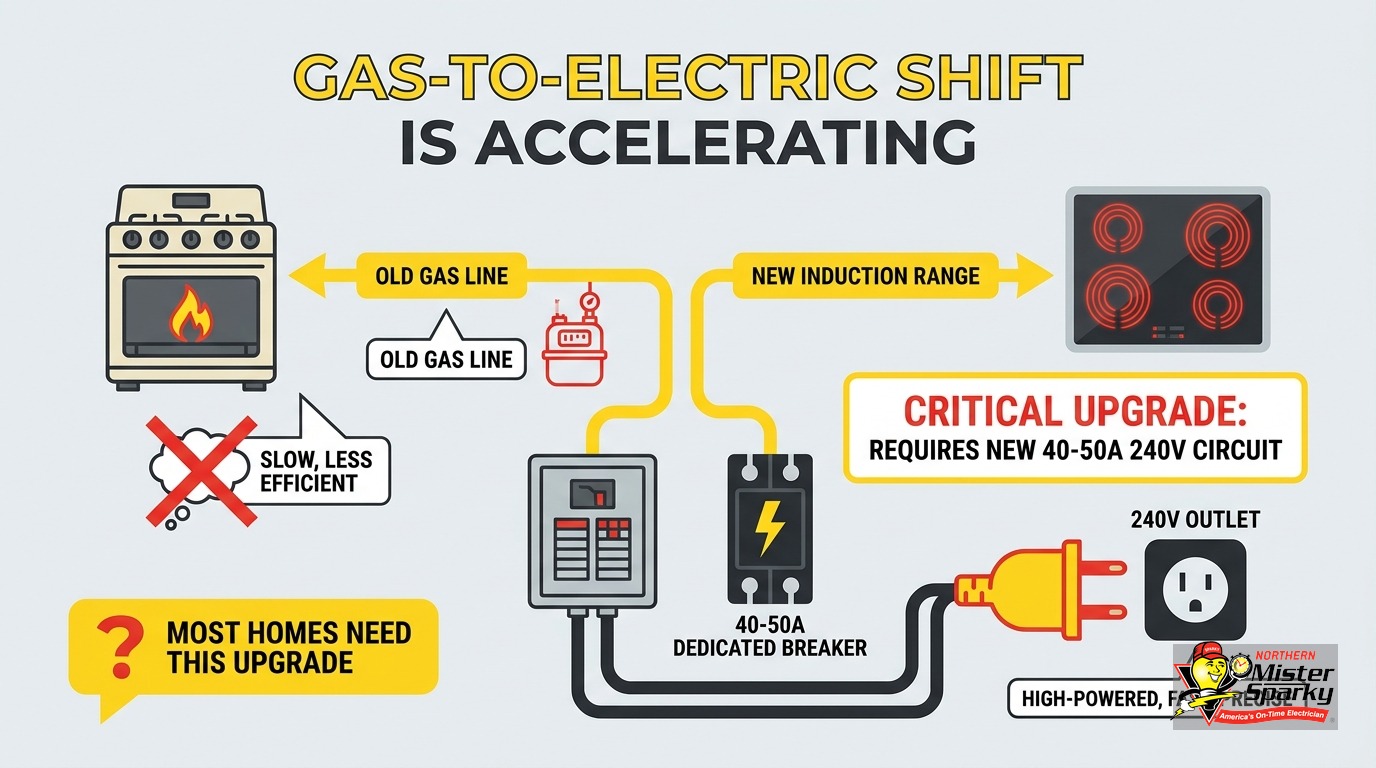
- Most induction ranges require a dedicated 240V, 40-50 amp circuit with the correct wire gauge, a double-pole breaker, GFCI protection, and a permit.
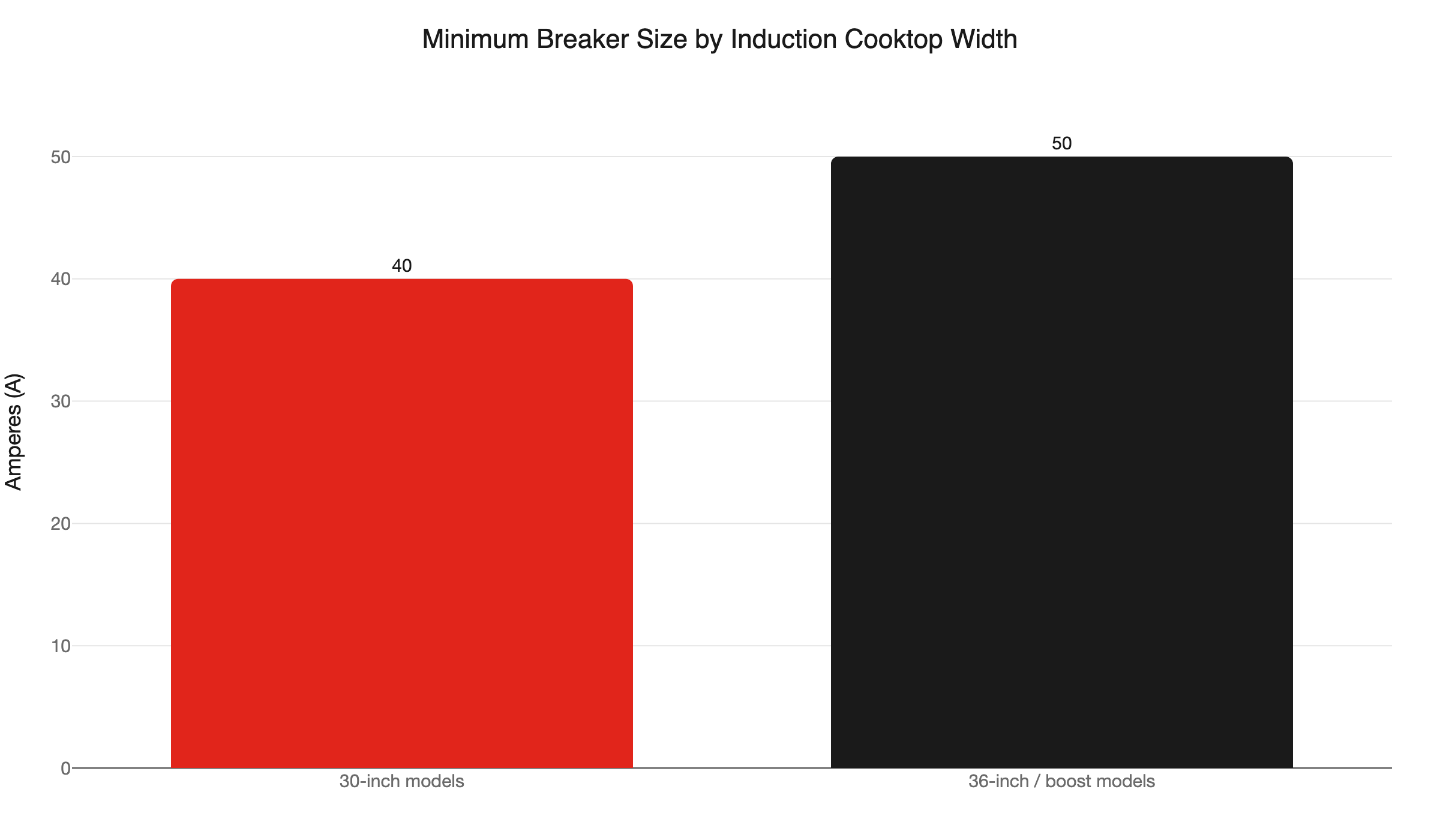
- 30-inch models typically need a 40-amp circuit with 8 AWG copper wire. 36-inch and boost models typically need 50 amps with 6 AWG copper wire.
- Homes built before 1980 with 100-amp service and multiple electric appliances often need a panel upgrade before the induction circuit can land.
- Minnesota adopted the 2026 NEC with an effective date of August 17, 2026. Permits pulled on or after that date fall under the new code edition.
- A permit is required for any new circuit in Minnesota. Minimum fee: $55. Standard fee: $110, filed at ims.dli.mn.gov.
- No induction rebates are reliably available in Minnesota right now. The HEAR program has no launch date, the federal 25C credit expired December 31, 2025, and Xcel Energy’s current program does not cover cooking appliances.
- Call 763-200-5956 or book online to schedule a panel assessment before you order the cooktop.
What Are the Induction Stove Electrical Requirements?
An induction range needs a dedicated 240-volt, double-pole circuit sized to the manufacturer’s spec, a GFCI breaker, correctly gauged copper wire, an accessible disconnect, and a permit from the Minnesota Department of Labor and Industry. The exact amperage depends on the cooktop’s size and feature set.
Switching from gas to induction is not just an appliance swap. Gas ranges need a 120-volt outlet for the clock and igniter and a gas line. Induction ranges need none of that gas infrastructure. What they need instead is a substantially heavier electrical circuit.
A standard kitchen countertop receptacle runs on 120 volts and 15 to 20 amps. An induction range runs on 240 volts and 40 to 50 amps. These are completely different classes of circuit. You cannot adapt one to serve the other.
According to CooktopHunter’s technical breakdown of induction circuit requirements, a code-compliant installation requires all of the following:
- A dedicated circuit (shared with no other appliance)
- A double-pole breaker sized to the cooktop’s published minimum
- Wire gauged to match the breaker (8 AWG for 40-amp, 6 AWG for 50-amp)
- A ground conductor
- An accessible disconnect
- A 240-volt-rated junction box or NEMA 14-50R receptacle
- GFCI protection on the circuit (required under 2023 NEC section 210.8)
- Torque-spec terminal connections at every termination point
Each item on that list exists for a reason. The dedicated circuit prevents overloads when the dishwasher, refrigerator, and other kitchen loads run at the same time. GFCI protection detects ground faults and trips the circuit before a fault becomes a shock. Torque-spec connections prevent loose terminals, which are among the leading causes of arc faults in residential panels.
Worth noting: the induction circuit is entirely separate from your kitchen’s countertop circuits. NEC requires at minimum two 20-amp small-appliance branch circuits for kitchen countertop receptacles. The range circuit is its own dedicated line. It does not satisfy that requirement, and those countertop circuits do not satisfy the range requirement.
What Size Circuit Does an Induction Range Actually Need?
Size depends on the cooktop width and feature set. Most 30-inch models need a 40-amp circuit with 8 AWG copper wire. Most 36-inch or boost-featured models need 50 amps with 6 AWG copper wire. Always verify against the manufacturer’s nameplate before any work begins.
Per CooktopHunter’s published specifications, 30-inch induction ranges typically require a 40-amp double-pole breaker and 8 AWG copper conductors. Larger 36-inch models and units with “boost” burner modes step up to 50 amps and 6 AWG copper.
The manufacturer’s nameplate is the definitive reference. It specifies the minimum circuit amperage and the supply connection type. Wiring to a smaller breaker than the nameplate requires is a code violation and a safety hazard. Wiring to a breaker larger than the wire can safely handle is equally dangerous.
The conductors must be copper. They must run as a 4-wire system: two hots, a neutral, and a ground. Pre-1996 homes sometimes have a 3-wire range circuit without a separate equipment ground. Those older circuits cannot be safely reused for a new induction appliance without modifications.
For more on how wire gauge and breaker size work together, see our guide on matching wire gauge to the right breaker size.
Does Your Home’s Panel Have Enough Capacity?
Not always. Homes with 100-amp service running electric heat, an electric water heater, an electric dryer, and central air conditioning often lack headroom for an additional 40- or 50-amp induction circuit. A load calculation by a licensed electrician tells you where you stand before any money is committed.
This is the question most homeowners skip until the cooktop has already arrived. By then, they are looking at an appliance on the floor that cannot be connected.
The Twin Cities metro has a dense stock of postwar ramblers and pre-1960 bungalows. Many were built with 100-amp electrical service, which was adequate for the era. Today, a home with electric baseboard heat, an electric water heater, a central AC unit, an electric dryer, and a full kitchen appliance load is already pressing that service hard.
Adding a 50-amp induction circuit to that picture can trigger a load calculation failure. When the calculated demand exceeds what the existing service can deliver, a service upgrade is required before the new circuit can be installed. That is not a code-interpretation gray area. It is a math problem with a clear answer.
A 200-amp service upgrade means replacing the meter base, the main panel, and sometimes the weatherhead and service entrance conductors. It is a larger project and a larger investment. But it solves a real problem: an undersized service on a loaded home is a genuine risk, not a technicality.
If your home already shows strain, such as breakers tripping under normal load or lights dimming when the AC kicks on, those are signals worth taking seriously before adding a major new circuit. Our post on signs you need an electrical panel upgrade covers the most common indicators.
For a full comparison of what 100-amp and 200-amp service can realistically support, read our guide on 100-amp vs. 200-amp electrical service. Our team runs a load calculation on every induction circuit job so you have a clear answer before committing to any work.
Can You Reuse Your Existing Electric Range Circuit for Induction?
Sometimes. An existing circuit qualifies for reuse only if it was installed after 1996 with 4-wire grounding, uses copper conductors, carries the correct gauge and breaker size for the new cooktop, and is dedicated to the range. A licensed electrician can verify all four conditions in a single visit.
Many Twin Cities homes already have a 240-volt circuit at the range location, left over from a previous electric coil range or a dual-fuel gas range with an electric ignition. The question is whether that circuit meets the induction stove electrical requirements for the specific new unit.
The conditions for legitimately reusing an existing circuit are specific. The system must use 4-wire grounded conductors with a separate equipment ground, required after 1996. The conductors must be copper. The wire gauge must match or exceed what the new breaker requires. And the circuit must be dedicated: no other appliance shares it.
Fail any one of those conditions and a new circuit run is the correct path. Trying to work around it can cause a fire inside the panel or a failed inspection that stalls your kitchen project.
One item applies even to circuits that otherwise pass the reuse test: the breaker. Under 2023 NEC section 210.8, a 240-volt kitchen appliance circuit now requires GFCI protection. A standard double-pole breaker does not provide it. A GFCI double-pole breaker at 40 to 50 amps costs $110 to $160 for the part alone. It is a code requirement on every new induction installation, not an optional upgrade.
Do You Need a Permit to Install a New Circuit in Minnesota?
Yes, always. Any new circuit in Minnesota requires a permit from the Department of Labor and Industry. Minimum fee: $55. Standard fee: $110, covering two inspection visits for up to 20 circuits. An unpermitted install can complicate your homeowner’s insurance and will surface during a home sale inspection.
Minnesota is direct about this. Adding a new 240-volt circuit, even for a single kitchen appliance in your own home, is a permitted electrical project under state law. The DLI permit page specifies the fees and the online filing address: ims.dli.mn.gov. You can reach DLI at dli.electricity@state.mn.us or 651-284-5026.
The permit process exists to protect you. An inspection verifies the work: correct wire gauge, correct breaker size, GFCI protection, proper connections. It also keeps your homeowner’s insurance intact. An unpermitted electrical installation can complicate or void a claim if something goes wrong later.
A common assumption holds that a single new circuit is too minor to require a permit. Minnesota code does not work that way. Every new circuit is a permitted project.
One carve-out applies: Minnesota homeowners may pull their own permit and perform their own electrical work on their owner-occupied single-family home. That exemption does not extend to rental properties. Rental properties require a licensed electrical contractor for all permitted electrical work.
For more detail on how Minnesota’s permit system works, see our full guide on electrical permits in Minnesota.
What Is the NEC Code Change Happening Right Now?
The 2026 NEC takes effect in Minnesota on August 17, 2026. Permits filed before that date must comply with 2023 NEC. Permits filed on or after August 17 must comply with 2026 NEC. The transition affects every Minnesota electrical permit submitted this week and beyond.
Minnesota adopted the 2026 National Electrical Code with an effective date of August 17, 2026. That transition is happening this week.
The Minnesota Department of Labor and Industry confirmed the details: permits filed before August 17 must comply with 2023 NEC. Permits filed on or after that date must comply with 2026 NEC. Electrical licensing exams transition to the 2026 NEC beginning September 8, 2026. Minnesota’s electrical code lives in Chapter 1315 of the State Building Code, which adopts the NEC as published by NFPA.
What does this mean for a homeowner scheduling an induction circuit installation right now?
The code edition governing your permit depends on when your electrician submits it. For a standard induction circuit, the core wiring requirements do not change dramatically between the two editions. But the details matter, and your electrician needs to know which edition applies before the permit is filed.
When you call Northern Mister Sparky, our team tracks the current Minnesota code edition. You do not have to figure out which NEC applies to your project timeline. We already know.
What Rebates Can You Get for an Induction Range in Minnesota?
None that are reliably available right now. Minnesota’s HEAR program has no launch date. The federal IRA 25C credit expired December 31, 2025. Xcel Energy’s current program does not cover induction cooking appliances. Plan the electrical work as a cash expense until the rebate landscape changes.
A lot of content online implies that federal and state rebates are waiting for homeowners who electrify their kitchens. For Minnesota homeowners in August 2026, that picture is inaccurate.
HEAR Program (Minnesota): The Home Electrification and Appliance Rebate Program would cover induction ranges and panel upgrades. Rebates range from $840 to $8,000 per appliance. Income limits apply at 80% and 150% of area median income. That sounds promising. But the HEAR program has no expected launch date as of August 2026. Applications are not open. There is no timeline to offer you.
Federal IRA 25C Credit: The IRA Energy Efficient Home Improvement Credit previously covered panel upgrades. It expired December 31, 2025, under the One Big Beautiful Budget Act signed July 4, 2025. That credit is not available for 2026 projects.
Xcel Energy: Xcel Energy’s 2024-2026 Minnesota residential rebate program covers heating, cooling, water heaters, smart thermostats, and insulation. Induction ranges and cooktops are not in the current program.
The honest answer, no malarky: budget the electrical work as a full cash expense for now. The rebate landscape may shift. We will not tell you it has changed until it actually has.
How Much Does the Electrical Work Cost in the Twin Cities?
Cost depends on whether your panel has capacity, how far the circuit needs to run, and whether GFCI protection requires a new breaker. A site assessment gives you the accurate number for your home. A circuit-only run costs meaningfully less than a circuit plus a panel or service upgrade.
The variables that determine cost for an induction circuit installation:
- Panel capacity. An open double-pole slot with enough load headroom means a straightforward circuit run. No open slot, or insufficient headroom, means a panel upgrade or subpanel addition is in scope.
- Run length and access. An unfinished basement or accessible attic keeps labor time down. A finished wall with no clear path drives it up.
- GFCI breaker. Required by current NEC, a GFCI double-pole breaker at 40 to 50 amps costs $110 to $160 for the part. It is a line item on every new induction circuit.
- Wire gauge. 6 AWG copper for a 50-amp circuit costs more than 8 AWG for a 40-amp circuit, both in material and in the heavier conduit or protection it may require in certain runs.
For a directional frame: pricing for a circuit-only install from a licensed electrical contractor in the Dallas-Fort Worth market varies by job specifics including panel capacity, access, and run length. Twin Cities labor rates will differ from that figure. Those numbers are useful as a general reference, not a local quote.
The right sequence is simple. Get a panel assessment before the cooktop ships. Know what your home needs, get a firm local quote, then buy the appliance with full information. That is a calmer process. Rushing an electrical upgrade after the range is already sitting in your kitchen adds stress and delays to an otherwise straightforward project.
How Northern Mister Sparky Handles the Induction Stove Electrical Requirements
We are locally owned and operated in the Twin Cities. When you call us, you reach electricians who know Minnesota’s code requirements, the DLI permit process, and what the housing stock in Minneapolis, St. Paul, Bloomington, Brooklyn Park, Woodbury, Blaine, Maple Grove, and Plymouth actually looks like. This is not a call center reading from a national script.
Our process for an induction circuit installation:
- Panel assessment first. We verify your service size, run a load calculation, and check for an open double-pole slot. You know exactly what your home needs before any work is committed.
- Permit filing. We handle the DLI permit. We know whether your project falls under 2023 or 2026 NEC based on when we submit it.
- Circuit installation. Dedicated run, correct wire gauge, GFCI double-pole breaker, torque-spec connections. Done to current code, ready for inspection.
- Inspection coordination. We coordinate the DLI inspection. A passed permit closes the project cleanly.
We will not skip the permit. We will not reuse a circuit that fails the code test. We will not tell you a rebate is available when it is not.
As America’s On-Time Electrician(R), we show up when we say we will. With the UWIN(R) 100% satisfaction guarantee, the job is done right or we make it right.
Call 763-200-5956 or book online to schedule your panel assessment. Order the cooktop after we give you the all-clear.
Frequently Asked Questions
What electrical circuit does an induction stove require? +
Do you need a permit to install an induction circuit in Minnesota? +
Are there rebates for induction ranges in Minnesota right now? +
Need an electrician now?