
Dual Fuel Range Electrical Requirements: A Twin Cities Guide
Key Takeaways
- A dual fuel range requires a dedicated 240V circuit. Gas kitchens almost never have one.
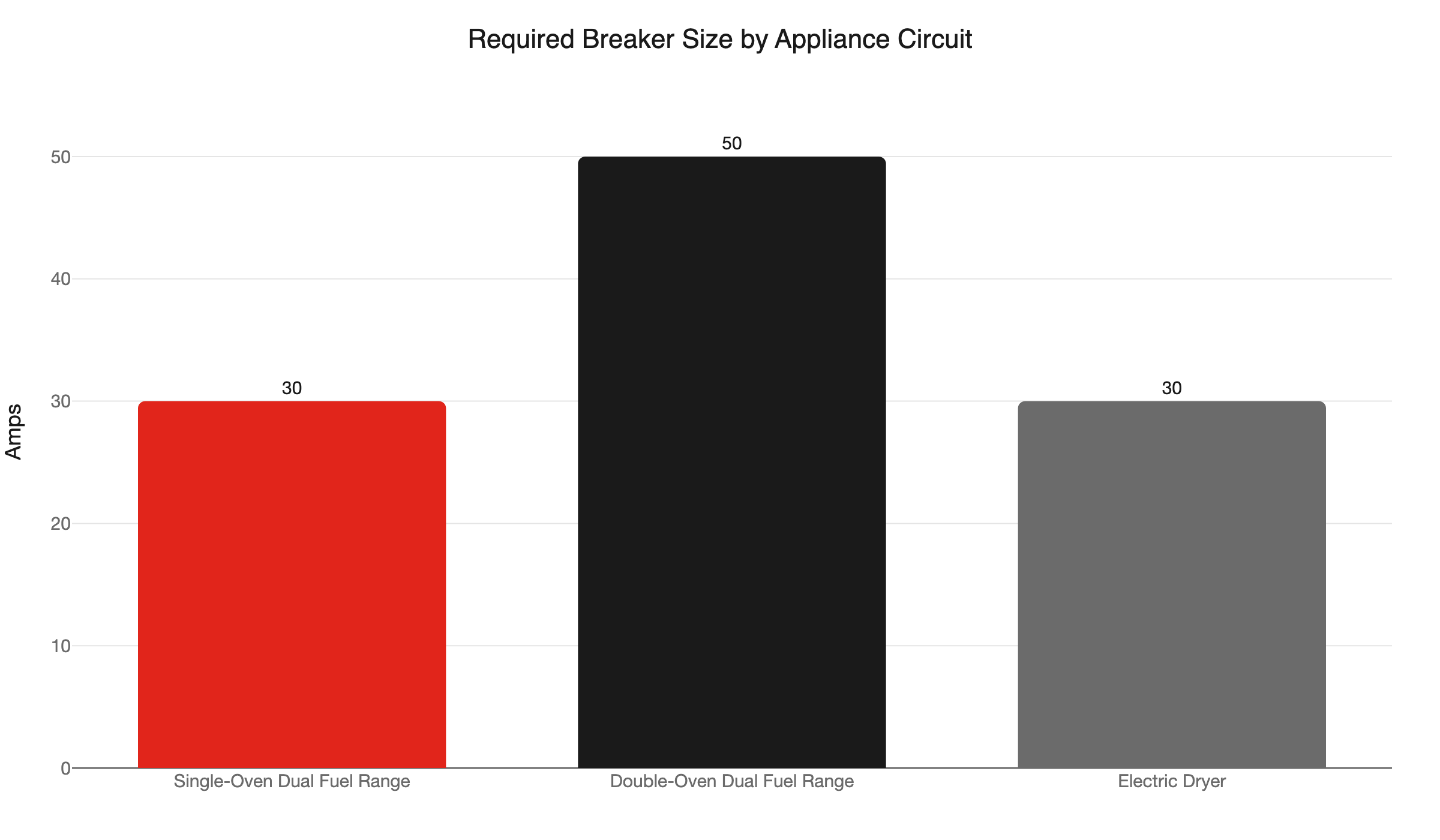
- Single-oven models typically need a 30A circuit; double-oven models need a 50A circuit. Confirm the requirement in your installation guide.
- The correct outlet is a NEMA 14-50R (4-prong, 50A). It is not the same as a dryer outlet (NEMA 14-30R). The pin layouts differ and the plugs cannot be swapped.
- Wire gauge must match the circuit: 8 AWG copper at 40A, 6 AWG copper at 50A. Undersized wire is a fire hazard.
- Plug-in installations require GFCI protection under NEC, in force in Minnesota since April 2021.
- Minnesota requires a permit for any new 240V circuit. A licensed electrician must pull it. Total permit cost typically runs about $110.
- Check your panel’s headroom before ordering the range. A 100-amp service may not have room for a new 50A circuit.
- Xcel Energy offers up to $1,500 toward qualifying panel upgrades from 100A to 200A.
- The federal Section 25C tax credit for panel upgrades expired December 31, 2025. No federal credit is available for 2026 projects.
Why Do Dual Fuel Range Electrical Requirements Catch Homeowners Off Guard?
Because the appliance is marketed primarily as a gas range. Retailers focus on burner performance and BTU output. The 240V electrical requirement for the electric oven is buried in the installation guide, not on the spec tag. Most buyers never see it until delivery day arrives.
A dual fuel range uses gas burners for stovetop cooking. That part works exactly like your current gas range. The oven, though, runs on electricity. It needs a dedicated 240V circuit, the same type that powers an electric dryer or a full electric range. Without that circuit, the appliance will not operate.
The problem compounds on delivery day. The crew arrives, checks for the outlet, finds nothing, and reschedules. The homeowner scrambles to find an electrician while a new appliance sits in a warehouse. A project that could have closed in two weeks stretches to six.
Start the electrical conversation before you order the range. Our team in the Twin Cities runs this sequence regularly. We assess the kitchen, check the panel, pull the permit, and coordinate the install around the delivery window. The whole process is smoother when the electrical piece comes first.
Does Your Kitchen Have a 240V Circuit?
Probably not. If your current range is gas-only, a 240V circuit was never needed. The gas range required only a small 120V outlet for the clock, display, and igniter. No 240V wiring was ever run to that kitchen wall.
Check behind the current range. A 240V outlet is physically larger than a standard household outlet. It has four flat or angled prongs in a specific NEMA configuration. If you see a standard 15A or 20A outlet back there, or nothing at all, the 240V circuit does not exist.
If you do see a larger outlet, do not assume it is the right type for your new range. A previous homeowner may have installed a 30A circuit for an older electric range. A dual fuel model requiring 50A cannot safely run on a 30A circuit, even if the outlet looks similar.
Have an electrician verify the circuit before you commit to a delivery date. The check takes minutes and changes your entire project timeline.
What Breaker Size Does a Dual Fuel Range Need?
Most single-oven dual fuel ranges require a 30A dedicated circuit. Double-oven models typically require 50A. Breaker size varies by manufacturer and model, so confirm the requirement in your specific installation guide before your electrician orders materials.
The breaker size determines everything downstream: the wire gauge, the outlet type, and whether your panel has an open slot available. Those three items are a matched system. Mixing them creates hazards or code violations.
A note on upsizing: many electricians recommend running a 50A circuit even when the range only requires 30A. The extra capacity gives you flexibility if you later upgrade to a double-oven model. The material cost difference is modest, and you avoid pulling new wire later. Ask your electrician whether your panel can accommodate the larger breaker before deciding.
The circuit must also be dedicated. No other outlets, lights, or appliances share the same breaker. Kitchen circuits carry heavy loads. Sharing the range circuit with anything else invites tripped breakers and voltage fluctuations that affect oven performance.
Which Outlet Does a Dual Fuel Range Use?
A 50A circuit uses a NEMA 14-50R outlet (4-prong, 50A rated). A 30A circuit uses a NEMA 14-30R. These outlet types are not interchangeable. The pin layouts differ, and a plug designed for one will not fit the receptacle of the other.
This distinction is the source of most dual fuel installation confusion. Homeowners see a 4-prong outlet and assume the dryer outlet in the laundry room would work for the range. It will not. Our 240V outlet installation guide covers the difference in full, but the short version is this: the dryer outlet is rated at 30A and the range outlet is rated at 50A. The numbers matter.
Do not adapt one plug type to another with a converter or a swapped plug cap. The underlying amperage mismatch creates a fire hazard regardless of whether the plug physically fits. The outlet must match the circuit, and the circuit must match the appliance’s installation requirement.
If your kitchen already has a 240V outlet from a previous electric range, confirm the outlet type and the breaker rating before assuming it fits the new dual fuel model. A 30A circuit left by a previous homeowner cannot safely serve a 50A appliance.
What Wire Gauge Does a Dual Fuel Range Circuit Require?
A 40A circuit requires 8 AWG copper wire. A 50A circuit requires 6 AWG copper. Running either circuit on 10 AWG wire is a fire hazard. The wire heats past safe limits under normal load before the breaker ever trips. Wire gauge must match the circuit amperage exactly.
Here is why the gauge matters so much. The circuit breaker is sized to protect the outlet and the panel connection. It does not protect the wire running between them from overheating. If undersized wire is used, it will heat past safe limits long before the breaker responds. The insulation around the wire can ignite, typically inside a wall cavity where no one can see it.
This shortcut is common with unlicensed work. Thinner wire is cheaper and easier to pull through tight spaces. A licensed electrician matches gauge to amperage. An inspector confirms it. A permit makes an inspection happen.
Our guide on 240V outlet wiring also covers the four-wire circuit requirement: two hot legs, one neutral, and one ground. Three-wire connections, which carry two hot legs and a neutral but no separate ground, are not permitted on new circuits under current NEC. Some older Twin Cities homes still have three-wire connections to ranges or dryers. New work must meet current code regardless of what the previous installation used.
Does a Plug-In Dual Fuel Range Need GFCI Protection?
Yes. NEC 210.8(A), adopted in Minnesota in April 2021, requires GFCI protection for 240V receptacles used by cord-and-plug connected ranges. If the range plugs into a wall outlet, that outlet needs GFCI. Hardwired ovens, which connect directly to the wiring with no cord or plug, are exempt from this requirement.
This is a newer code provision. Many existing 240V kitchen outlets installed before April 2021 do not have GFCI protection. If your kitchen has a 240V outlet left over from a previous electric range, it likely does not meet current code for a new plug-in installation.
Bringing the circuit up to current code at permit time is the right call. An inspector will flag a non-GFCI receptacle on a new install. Correcting it after drywall is closed costs more than specifying it correctly the first time.
The practical implication: a GFCI-protected 240V circuit requires a specific breaker type. Not every panel accommodates these cleanly. Older panels with limited space or outdated bus designs can present real challenges. Your electrician needs to know whether the range will be cord-and-plug or hardwired before specifying materials and pulling the permit.
Minnesota Permits: What the Process Actually Looks Like
Every new 240V circuit in Minnesota requires an electrical permit. No exceptions.
Under MN Stat. 326B.33, homeowners cannot self-permit this work. A licensed electrical contractor must apply for the permit before any work begins. The minimum fee is $55. A typical project that includes a rough-in inspection and a final inspection runs about $110 total.
The sequence works like this. The electrician files the permit application. Work begins once the permit is issued. After the circuit rough-in is complete, an inspector from the Minnesota Department of Labor and Industry visits to verify wire gauge, circuit configuration, outlet type, and GFCI compliance. That inspection happens before walls are closed. After final work is done, the inspector returns for sign-off and the permit closes.
That closed permit is a document worth keeping. When you sell your home, buyers and their inspectors check for permit history on major electrical work. Unpermitted circuits can delay or kill a sale. An unpermitted circuit that causes a fire can affect an insurance claim. Neither scenario is one you want to navigate.
See our Minnesota electrical permit guide for a full walkthrough of fees, scheduling, and what inspectors look for on kitchen circuit work.
One date matters for any project starting now: Minnesota adopted the 2026 National Electrical Code effective August 3, 2026. Permits filed on or after that date are reviewed under 2026 NEC. Permits filed before that date run under 2023 NEC. The 2026 code includes updates to circuit protection requirements. Our team is current on both versions and will confirm which applies to your project at the time of permit.
Will Your Panel Handle the New Circuit?
Not always. Many older Twin Cities homes run 100-amp service, and adding a 50A range circuit can consume most of the available headroom. Check your panel’s capacity before you order the range, not after it arrives on your doorstep.
Here is the load picture in plain terms. A 100-amp panel has roughly 80A of practical capacity, using the standard 80% sizing rule. A dryer pulls 30A. A new 50A range circuit adds another 50A. Those two appliances alone account for 80A, with little margin left for the rest of the house.
In practice, electricians use demand-factor calculations that account for simultaneous load patterns rather than simple addition. But in older 100-amp panels, the more immediate issue is often physical: no open slots for a new double-pole breaker.
Our 100-amp vs. 200-amp electrical service guide explains when a panel upgrade is required versus when targeted circuit work alone is sufficient.
Our team starts every range-circuit inquiry with a panel assessment. If your panel is full, at capacity, or running outdated breaker technology, we will tell you at the quote stage. A panel upgrade scoped upfront is a manageable part of a kitchen project. The same upgrade discovered after the range is already plumbed in is a significant disruption. We will not spring it on you mid-job.
If a panel upgrade is part of the scope, ask about financing. We offer options for larger jobs.
Does Xcel Energy Help Cover the Cost of a Panel Upgrade?
Yes. Xcel Energy offers up to $1,500 toward qualifying residential panel upgrades from 100A to 200A. Complete the work with a licensed electrician, obtain permit approval from the inspector, then submit the closed permit and invoice to Xcel for the rebate.
Most homeowners who qualify for this rebate do not know it exists. The rebate targets the 100A to 200A upgrade specifically. It does not cover partial panel work or service additions short of that full step. Timing matters: the permit must close before you can submit, so plan that sequence with your electrician at the start of the project.
One thing to know for any project permitted in 2026: the federal Section 25C tax credit for electrical panel upgrades expired December 31, 2025. No federal credit is currently available for panel work this year. The Xcel rebate is the primary financial offset available to most Twin Cities homeowners right now.
If the panel upgrade pushes the project cost higher than your initial estimate, ask us about financing options when you call.
Book the Circuit Before You Book Delivery
The dual fuel range electrical requirements follow a clear path: assess the panel, size the circuit correctly, use the right outlet and wire gauge, add GFCI if the range is cord-and-plug, pull the permit, pass both inspections. None of those steps are complicated when they are done in order.
What creates delays is starting that path on delivery day. Permits take a few business days to file. Inspectors need to be scheduled. Wire must be ordered at the correct gauge. None of those pieces move fast when a delivery truck is already en route.
Call us at 763-200-5956 or book online before you finalize the range order. Our team is locally owned and operated, and we serve Minneapolis, St. Paul, Bloomington, Brooklyn Park, Woodbury, Blaine, Maple Grove, Plymouth, and the surrounding Twin Cities area. We will assess your panel, quote the circuit, and get the permit started so your delivery date actually works.
As America’s On-Time Electrician(R), we will be there when we say we will. The UWIN(R) guarantee backs every job we complete.
Frequently Asked Questions
What electrical circuit does a dual fuel range need? +
What outlet does a dual fuel range use? +
Do I need a permit to install a 240V circuit for a range in Minnesota? +
Does a plug-in dual fuel range need GFCI protection in Minnesota? +
Does Xcel Energy offer rebates for panel upgrades in Minnesota? +
Need an electrician now?