
Electric Range Power Cord Installation: A Minnesota Guide
Key Takeaways
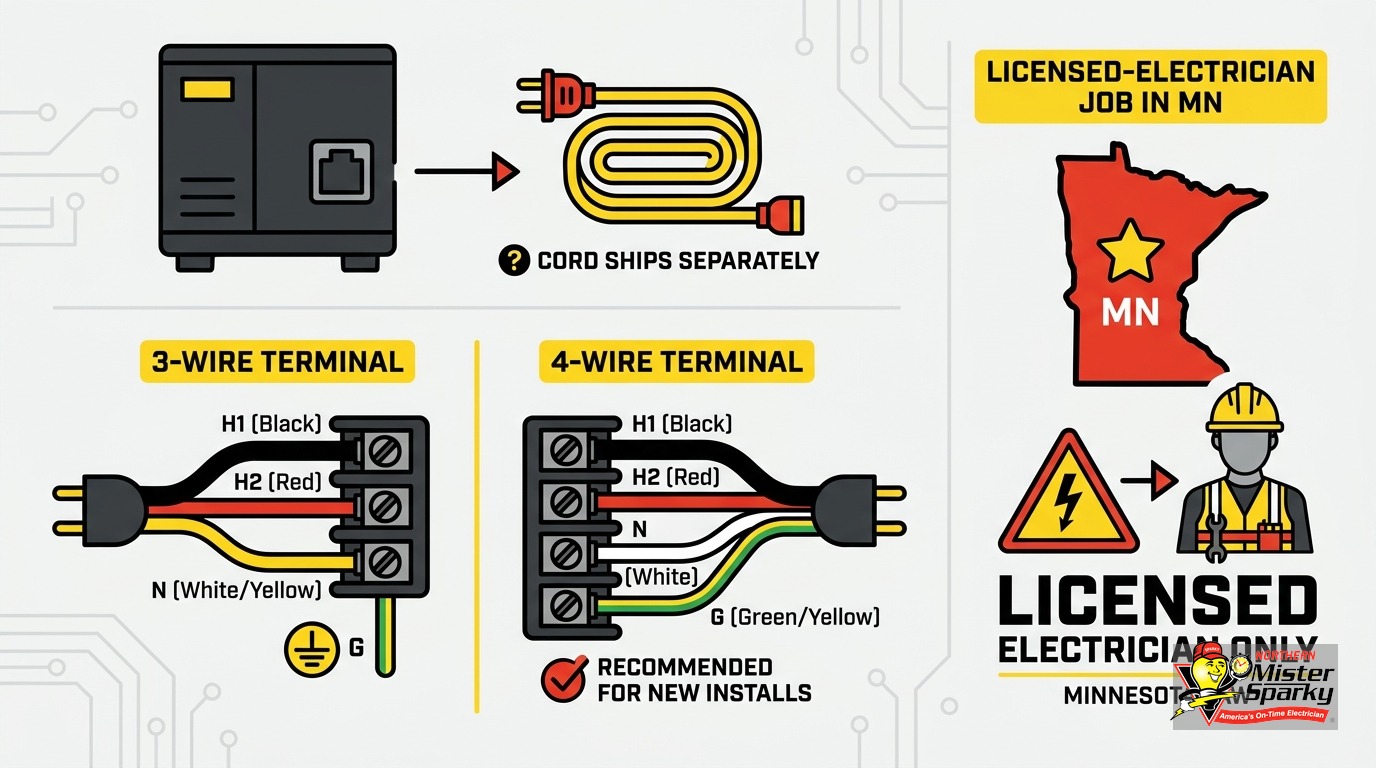
- New ranges do not include a power cord because manufacturers cannot predict your outlet type.
- Homes wired before 1996 typically have a NEMA 10-50 (3-wire) outlet. Homes wired after 1996 have a NEMA 14-50 (4-wire) outlet.
- The cord must be rated for at least 250V/40A and must match your outlet configuration.
- Switching from 3-wire to 4-wire requires removing the factory ground strap inside the terminal block. Leaving it in can energize the range chassis and create a shock hazard.
- Loose terminal block screws cause resistance heating. At 40-50 amps, that heat can melt insulation or damage the range before a breaker trips.
- In Minnesota, electric range power cord installation is electrical work. It requires a permit and a final inspection.
- The homeowner exemption applies only to owner-occupants of single-family homes. Rental property owners must hire a licensed electrician, even for a simple cord swap.
- Minnesota adopted the 2026 NEC on August 17, 2026. New circuit runs must comply with the 2026 NEC standard.
- Call Northern Mister Sparky at 763-200-5956 or book online for a correct, permitted installation.
Why Didn’t My New Range Come With a Power Cord?
Short answer: Manufacturers cannot know whether your home has a 3-wire or 4-wire outlet. Installing the wrong cord type violates the NEC and creates a shock hazard. So no cord ships in the box. You buy the correct one after identifying your specific outlet.
It feels like a cost-cutting move when you first see it. You spend over a thousand dollars on a new range. You open the box. No power cord. The installation manual says to buy one separately.
The reason is not cost savings. It is a genuine compatibility problem across the national housing stock.
Your home’s outlet type depends on when the kitchen circuit was installed. Homes wired before 1996 almost always have a 3-wire outlet, designated NEMA 10-50. Homes wired after 1996 have a 4-wire outlet, designated NEMA 14-50. The two plugs are physically different and not interchangeable.
A manufacturer could guess one type and ship that cord. A wrong guess means you either have a cord that will not fit, or one that fits but is wired incorrectly for your outlet. Whirlpool’s range installation instructions specify that the cord must be UL-listed and rated for at least 250V/40A. It must also match the outlet configuration in your specific home.
Shipping no cord puts the identification step where it belongs. Someone who can see your actual outlet makes the call. That is the correct sequence, not a workaround.
What Is the Difference Between 3-Wire and 4-Wire Range Cords?
Short answer: A 3-wire cord uses the neutral as both the current return path and the chassis ground. A 4-wire cord adds a dedicated equipment ground wire. The 4-wire setup keeps the chassis at true ground potential. If the neutral develops a fault, the chassis stays safe instead of becoming energized.
Here is what each outlet type means physically:
NEMA 10-50 (3-wire):
- Two hot legs, each carrying 120V (240V between them for heating elements)
- One neutral conductor that doubles as the chassis ground
- The appliance chassis is bonded to the neutral inside the terminal block
NEMA 14-50 (4-wire):
- Two hot legs, each carrying 120V
- One neutral conductor for control circuits
- One dedicated equipment ground wire bonded to the chassis separately
The safety difference is direct. In a 3-wire setup, the chassis is tied to neutral. Neutral is not always at zero volts. It carries return current under load. If a fault develops on the neutral, the chassis carries stray voltage. You touch the range, stand on a grounded floor, and you complete the circuit.
In a 4-wire setup, the chassis connects to the dedicated ground wire. That wire stays at zero volts even when neutral carries load current. Fault current has a clean path back to the panel. The chassis stays safe.
The 2026 NEC (NFPA 70) requires 4-wire circuits for all new range circuit installations. It took effect in Minnesota on August 17, 2026. Existing 3-wire circuits are grandfathered. You match the cord to your existing outlet. You do not need to rewire the kitchen just to install a new range.
One more detail worth noting: range cords and dryer cords are not interchangeable. A range cord is rated 40A with flat prongs. A dryer cord is rated 30A and uses a different prong shape for the neutral. Always buy a cord sold specifically for ranges.
Our post on 240V outlet installation for dryers and ranges covers outlet types and circuit requirements for both appliances in more detail.
The Code History Behind the 3-Wire and 4-Wire Split
Before 1996, using the neutral as the chassis ground was accepted practice for large appliances. Ranges, dryers, and other 240V appliances had been wired that way for decades. It was code-compliant at the time of installation.
The 1996 NEC revision changed the standard for new work. NEC Section 250.140 required new appliance circuits to include a separate equipment ground. Any circuit run after 1996 must be 4-wire. Later editions of the NEC carry this requirement forward as Section 250.142.
In real homes across the Twin Cities, the year of installation determines what is behind your outlet. A home built in 1980 almost certainly has a NEMA 10-50 at the range location. A home built in 2003 has a NEMA 14-50. A home built in 1958 but rewired in 2014 has a NEMA 14-50 wherever the rewire reached.
Grandfathering is legal. A 3-wire circuit installed before 1996 does not need to be upgraded just because you bought a new range. The existing circuit can stay. But any new circuit work - whether for a remodel, a new range location, or a gas-to-electric conversion - must meet current code. In Minnesota, that means the 2026 NEC: 4-wire circuit, NEMA 14-50 outlet.
If you cannot identify your outlet type by looking, a licensed electrician can confirm it in a few minutes. A NEMA 10-50 has two angled flat slots and one L-shaped slot. A NEMA 14-50 has two angled flat slots, one vertical slot, and one rounded D-shaped ground opening. When in doubt, verify before buying a cord.
What Is the Ground Strap, and Why Does It Create a Hazard?
Short answer: The ground strap is a small metal connector inside the range terminal block that bonds the neutral terminal to the chassis. On 3-wire installs, it stays. On 4-wire installs, it must be removed before attaching the cord. Leaving it in creates two simultaneous ground paths through the neutral, which can put stray voltage on the chassis.
This is the step that DIY guides tend to bury halfway through a numbered list without explaining the consequence. It is the step most likely to result in injury when it is missed.
Here is the mechanism. A new range ships from the factory with the ground strap installed. The factory cannot know which cord type you will use. On a 3-wire hookup, the strap belongs there. The neutral-to-chassis bond is intentional and correct for that configuration.
When you switch to a 4-wire cord, the new cord brings a dedicated ground wire. That wire bonds the chassis to the panel’s grounding system through a separate conductor. But the factory strap is still inside the terminal block. It still bonds neutral to chassis.
Now the chassis has two ground paths. One is the dedicated ground wire from the cord. The other runs through the neutral and the ground strap. Neutral is not a fixed zero-volt reference. It carries return current under load. A chassis bonded to neutral through the strap can carry that return current.
Fred’s Appliance Academy describes the failure mode directly. When the ground strap is left in during a 4-wire install, “what we could end up having is a customer complaint of when they rub up against [the range].” The customer receives a shock from the chassis.
The fix is one step: remove the ground strap before terminating the 4-wire cord. On 3-wire installs, the strap stays in place. The catch is that you must know this step exists before you can execute it. It requires opening the terminal block cover and removing the strap before connecting any wire. Most appliance packaging lists it as a numbered item without explaining the consequence of skipping it. Knowing the mechanism is what makes the installation safe.
Why Are Loose Terminal Block Connections Dangerous?
Short answer: A loose screw creates electrical resistance at the connection point. Current through that resistance generates heat. At 40-50 amps, that heat can melt wire insulation, char the terminal block, and damage the range before a breaker ever trips. The failure builds slowly and silently.
The terminal block on your range has three or four screw terminals that clamp each conductor from the power cord. Getting the torque right matters in both directions.
Undertightening causes resistance heating. A loose connection is not a clean conductor. Current flows through the gap between the conductor and the terminal seat, which generates heat proportional to the resistance at that gap. That heat damages insulation, chars the plastic block, and can cause a fire inside the range’s back panel.
Fred’s Appliance Academy documented a service call on a cord that “started warming up, and it started melting” because a terminal screw was not properly seated. On a circuit running 40-50 amps, an undertightened connection generates enough heat to cause real damage without tripping the breaker. The failure does not announce itself. It builds until something burns.
Overtightening cracks the terminal block. The block is molded plastic. Driving a screw with a power tool or applying too much hand pressure cracks the plastic around the terminal seat. A cracked block cannot properly clamp the conductor. Fixing it means replacing the terminal block, which requires opening more of the appliance.
The correct approach is firm hand-tightening. Each conductor fully seated in the terminal, screw snug but not driven hard. No impact drivers or ratchet wrenches at the terminal block. This is not complicated to understand, but it requires knowing what a properly made connection feels like.
Does Electric Range Power Cord Installation Require a Permit in Minnesota?
Short answer: Yes. Connecting a cord to an electric range is electrical work in Minnesota. It requires a permit and a final inspection. Owner-occupants of single-family homes may apply for the homeowner exemption. Rental property owners and condo owners cannot.
This is the piece that every appliance guide, how-to video, and online tutorial skips. Minnesota is specific about what constitutes electrical work.
Under Minnesota’s homeowner electrical permit rules (DLI) and MN Statute 326B, connecting a cord to a 240V appliance terminal block is electrical work subject to state licensing and permit requirements. The work requires a permit filed before you start, and a final inspection once it is complete.
Minnesota adopted the 2026 NEC effective August 17, 2026. Permits filed on or after that date must comply with the 2026 NEC. That includes grounding and bonding requirements that govern the ground strap step described above.
There is also a local jurisdiction layer. Approximately 66 cities in the Twin Cities metro have adopted local electrical inspection authority separate from the state DLI. Minneapolis, St. Paul, and Bloomington each operate their own inspection programs. Before filing a permit, you need to confirm whether state DLI or your city’s inspection office governs your address.
Our post on electrical permits in Minnesota walks through how to identify the right jurisdiction and what the permit process looks like from start to final approval.
Who Can Legally Do This Work in Minnesota?
Short answer: A licensed electrician can perform this work on any property. An owner-occupant of a single-family home may qualify for the homeowner exemption but must pull a permit and pass inspection. Any rental property, condo, duplex, or tenant-occupied home requires a licensed electrician, period.
The homeowner exemption is real and legal. It also has firm limits that catch Twin Cities landlords off guard.
Under Minnesota’s homeowner exemption rules, an owner-occupant of a single-family home can perform their own electrical work. The requirements are:
- Pull an electrical permit before the work starts
- Perform the work yourself (not through an unlicensed friend, family member, or handyman)
- Pass a final inspection
The exemption does not apply to:
- Rental properties, including single-family rentals
- Duplexes and two-family homes
- Condominiums and apartments
- Any property where a non-owner occupant is living
This is one of the most common mistakes we see in the Twin Cities. A landlord buys a range for a rental unit. They install the cord themselves. They assume the homeowner exemption covers it. It does not. The property is occupied by a tenant. MN Statute 326B requires a licensed electrician for that job, regardless of how simple the work appears.
If you are unsure whether your situation qualifies, hire a licensed electrician. Our post on how to verify a licensed electrician in Minnesota covers what to look for when selecting a contractor in the Twin Cities.
When you hire Northern Mister Sparky, we pull the permit, identify the correct inspection authority for your city, and handle the inspection. You do not have to figure out whether Minneapolis or the state DLI governs your address.
What Does the 2026 NEC Change for Range Cord Work in Minnesota?
Short answer: For cord replacement on an existing grandfathered 3-wire circuit, nothing changes. Match the cord to the existing outlet. For any new circuit run - a gas-to-electric conversion, a new range location, or any circuit extension - the 2026 NEC requires a 4-wire circuit with a NEMA 14-50 outlet.
Minnesota moved to the 2026 NEC on August 17, 2026. For most Twin Cities homeowners replacing a cord on a range connected to a grandfathered 3-wire circuit, the transition does not change the cord selection. The grandfathered circuit remains legal. You match the cord to the existing outlet and follow the ground strap rule.
The 2026 NEC matters directly in three situations:
New circuit for a gas-to-electric conversion. If you are converting a kitchen from gas to electric, you need a new dedicated circuit. That circuit must be 4-wire with a NEMA 14-50 outlet. No grandfathering applies to new circuit work.
Moving the range to a new location. If the circuit must be extended or repositioned, the new work must meet 2026 NEC. That means 4-wire from the panel to the new outlet location.
Corrective work on a failing circuit. If the existing circuit has wiring damage, a breaker that will not hold, or other problems found during the cord installation, the corrective work must also comply with 2026 NEC.
If you are converting from a gas range to electric, the project involves more than a cord. A new dedicated 240V circuit, a 40-50A double-pole breaker, and a NEMA 14-50 outlet are all required. Our post on the electrical requirements for converting a gas range to electric covers the full scope of that project and what to expect from the permit process.
Schedule Your Electric Range Power Cord Installation With Northern Mister Sparky
Northern Mister Sparky is locally owned and operated in the Twin Cities. We are backed by the national Mister Sparky franchise and the America’s On-Time Electrician(R) commitment. We show up when we say we will. We do the job correctly the first time.
Electric range power cord installation is a focused job. But it has two steps that most guides do not explain fully: the ground strap and the terminal torque. We identify your outlet type, source the correct cord, handle the ground strap for your specific configuration, and seat each conductor with proper technique. We inspect the full connection before the range goes back against the wall.
When a permit is required, we pull it. We know which cities in the Twin Cities metro operate local inspection programs and which fall under state DLI. We coordinate the inspection. You do not have to research any of that on your own.
If we find other issues at the same visit - a breaker that will not hold, a circuit that cannot support the new range’s load, or wiring damage behind the outlet - we give you a clear diagnosis and next steps.
We serve Minneapolis, St. Paul, Bloomington, Brooklyn Park, Woodbury, Blaine, Maple Grove, Plymouth, and the surrounding Twin Cities area. Call us at 763-200-5956 or book online. Every job we take comes with the UWIN(R) 100% satisfaction guarantee.
Frequently Asked Questions
Can I install an electric range power cord myself in Minnesota? +
What kind of power cord does my electric range need? +
What is the ground strap on an electric range, and why does it matter? +
Need an electrician now?