
Gas Stove Electrical Outlet Requirements: MN Homeowner Guide
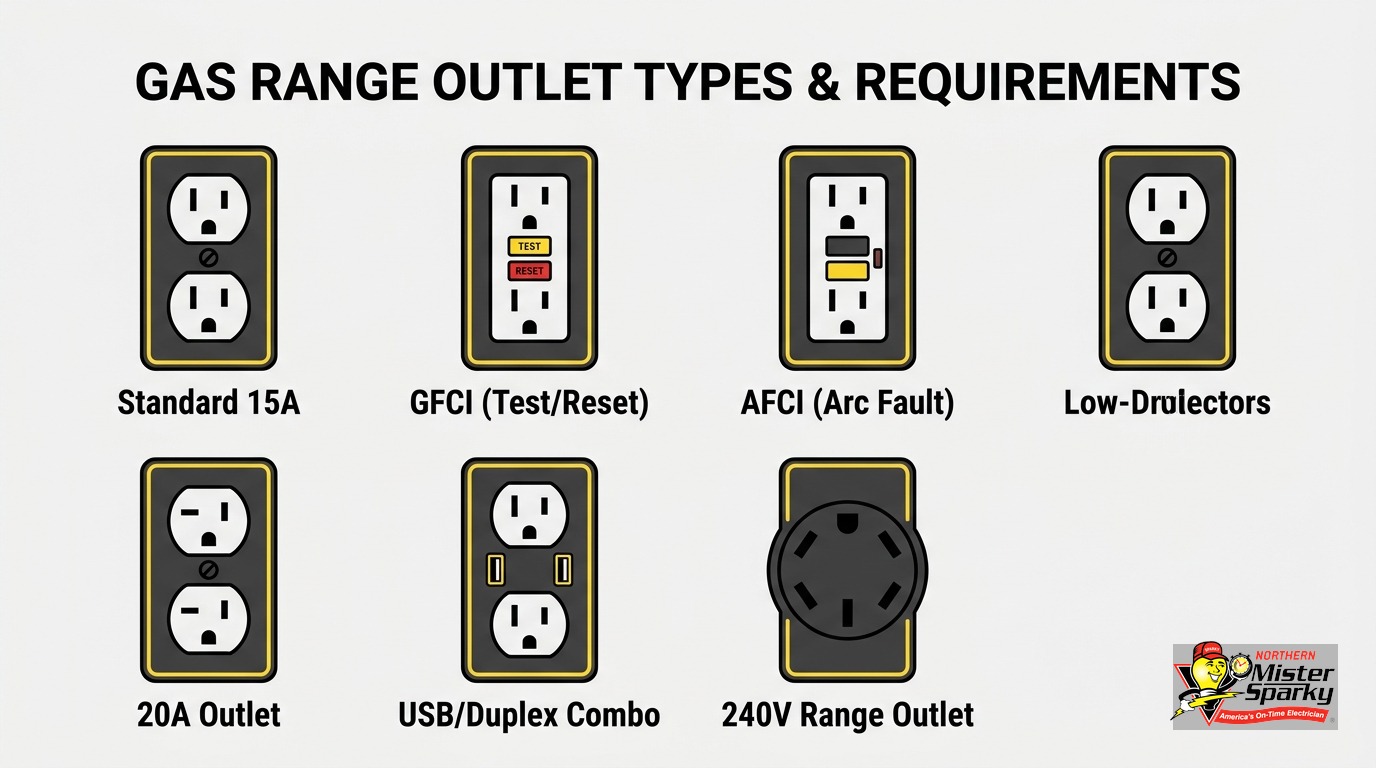
Key Takeaways
- Every modern gas range needs a 120V, grounded electrical outlet - it powers the igniter, clock, oven light, and digital controls.
- Most manufacturers specify a 15A or 20A outlet within cord reach (roughly 4 feet) of the range position.
- Adding a new outlet where none exists requires a permit and inspection in Minnesota - it is not a handyman task.
- If the outlet is within 6 feet of the kitchen sink, it must be GFCI-protected under NEC 210.8(A)(6).
- The outlet must be accessible behind the range, not buried under cabinetry, per NEC Article 422.16(B)(1).
- Homes built before the 1960s in older Twin Cities neighborhoods often lack this outlet entirely.
- Minnesota adopted the 2026 NEC effective August 17, 2026 - permits filed after that date follow the new code cycle.
- A missing or non-compliant range outlet is a common home inspection flag that can delay a real estate closing.
Does a Gas Stove Need an Electrical Outlet?
Yes. Every modern gas range requires a standard 120V grounded outlet within reach of its power cord. The outlet powers the electronic igniter, oven light, clock, digital controls, and convection fan. Without it the range is not fully functional and is not code-compliant as installed, even if a burner can still be lit manually with a match.
A gas range uses gas for heat and electricity for everything else. Those are two separate utility requirements, and both need to be in place before the appliance is ready for use. If your kitchen has the gas line but not the outlet, the electrical side of the installation is incomplete - and you will need a licensed electrician to finish it.
The confusion usually comes from older homes where a previous range ran on a standing pilot light, which required no electricity at all. That era is over for current-production appliances. Every range sold today uses electronic ignition and draws power continuously when plugged in. The outlet is not optional equipment.
What Does the Outlet Actually Power?
The gas line handles combustion. The outlet handles everything the homeowner interacts with day to day on a modern range: the electronic spark igniters that click when you turn a burner knob, the timed oven cycles, the interior oven light, the digital temperature display, and on newer models the convection fan and Wi-Fi connectivity.
Some ranges also draw power through the outlet for the clock and timer functions the oven relies on for timed-bake and delayed-start modes. If the outlet is missing or unplugged, these features simply do not work. On models where the igniter circuit runs through the control board, even lighting a burner may require the unit to be powered.
Modern ranges draw more continuously than their predecessors. A basic 1990s gas range with a simple clock and pilot-style ignition drew very little. A current model with a convection fan running, a digital control board active, and Wi-Fi polling the network draws more - which is why the 20A circuit spec appears more frequently in today’s manufacturer installation guides than it did a decade ago. When in doubt, check the guide for your specific model before assuming a 15A outlet is sufficient.
Gas Stove Electrical Outlet Requirements: What the Code Says
The gas stove electrical outlet requirements come from two sources: the National Electrical Code and the appliance manufacturer’s installation guide. Both matter, and they have to be read together.
From the NEC:
NEC Article 422.16(B)(1) governs cord-and-plug connections for ranges and built-in ovens. It requires the receptacle to be in an accessible location - one that can be reached without removing a built-in or permanently mounted fixture. A receptacle buried under the range floor cavity, hidden under a cabinet panel, or tucked into a space that requires disassembly to reach does not qualify. The outlet must be reachable.
From the manufacturer:
Most gas range manufacturers specify a 120V, 15A or 20A grounded outlet within roughly 4 feet of the range - close enough for the power cord to reach without extension cords. Models with convection, digital controls, or Wi-Fi increasingly call for a 20A circuit. The specific requirement is in the installation guide that ships with the range. If you no longer have the paper guide, the manufacturer’s website will have the PDF.
In Minnesota:
Minnesota’s electrical code is the NEC as adopted under Chapter 1315 of the Minnesota State Building Code, administered by the MN Department of Labor and Industry Board of Electricity. When the NEC specifies that the outlet must be grounded, accessible, and correctly rated, Minnesota inspectors enforce that standard. There is no local carve-out that makes the range outlet optional.
Do I Need a Permit to Add an Outlet for My Gas Range in Minnesota?
Yes - if the outlet does not already exist. Adding new wiring, whether that means running a new circuit from the panel or extending an existing circuit to a new location, is new electrical work in Minnesota and requires a permit and inspection. This is not a gray area.
The permit triggers an inspection through the MN Department of Labor and Industry or your local authority having jurisdiction, depending on the municipality. A handyman adding an outlet without a permit does not satisfy the code requirement. The work still needs to be inspected, and unpermitted electrical work can surface as its own flag when you sell the home.
Homeowners in Minnesota can pull their own electrical permits for work on their primary residence. If you hire a licensed electrician - which is the right call for any new circuit - they pull the permit as part of the job.
One thing that makes the process faster than it used to be: Minnesota now offers Electrical Remote Virtual Inspections (ERVI), which allow the inspection to happen over video rather than waiting for an in-person visit. For a straightforward outlet addition, this can shorten the timeline significantly. The permit still has to be pulled and the inspection still has to happen - it just does not have to mean scheduling around an inspector’s in-person availability.
Does the Outlet Need GFCI Protection?
It depends on your kitchen layout, but in many Twin Cities kitchens, the answer is yes.
Under NEC 210.8(A)(6), receptacles within 6 feet of a kitchen sink must be GFCI-protected. Whether the gas range outlet falls within that zone depends on how your kitchen is configured. In a galley-style kitchen - the long, narrow layout common in South Minneapolis bungalows, Northeast Minneapolis two-stories, and St. Paul shotgun houses - the range and sink are often closer than 6 feet. In that case, the range outlet is inside the GFCI zone and must be protected accordingly.
This catches homeowners and contractors off guard because the assumption is that a dedicated outlet behind an appliance is automatically exempt. It is not. Distance from the sink is the determining factor, and many Twin Cities kitchen layouts do not give you much distance to work with.
If you are adding a new outlet for a gas range, the electrician running the circuit needs to measure that distance and specify GFCI protection where required. If that step gets skipped, the inspector will flag it. Or the home inspector at point of sale will flag it. Either way, you end up doing the work twice.
For a full breakdown of where GFCI protection is required throughout your home, see our guide to GFCI outlet requirements explained.
The Accessibility Rule Most Installers Overlook
The NEC accessibility requirement sounds like a code technicality, but it has a concrete practical meaning: the outlet must be reachable without removing a permanently installed fixture or built-in cabinet panel.
In a typical range installation, this means the outlet should be set into the wall in the open cavity behind where the range slides, roughly 6 to 12 inches above the floor. It should not be in the floor of the range cavity, not hidden behind fixed cabinetry, and not in a location that requires the range itself to be moved to reach the plug. The outlet has to be accessible for plugging in and, if needed, unplugging.
This matters for two reasons. First, a non-accessible outlet fails inspection. Second, the range’s power cord has to reach it. Most cords are 4 feet or shorter, and they route cleanly when the outlet is in the right wall location. If the outlet is in an awkward position, the cord ends up running in a way that creates pinch points or heat exposure, neither of which belongs behind a working range.
If you are doing a kitchen remodel that repositions the range or adds cabinetry, flag the outlet location with your electrician before the cabinets go in. Retrofitting an accessible location after the cabinetry is installed is significantly more expensive and disruptive than getting it right the first time.
What Changed with Minnesota’s 2026 NEC, and Why Does It Matter Right Now?
Minnesota adopted the 2026 NEC effective August 17, 2026. Any permit filed on or after that date - including a permit for a new kitchen outlet - is reviewed and inspected under the 2026 code. Permits filed before August 17 follow the 2023 NEC.
Right now, in September 2026, a freshly adopted code cycle is in effect. Inspectors are applying the 2026 standards to everything that comes across their desk. If you have not updated your kitchen wiring in several years and you are pulling a permit for a new range outlet, the inspector is looking at the full picture through a current lens - not just the outlet itself, but everything visible in the installation area.
The 2026 NEC Residential Inspection Checklist from MN DLI is publicly available if you want to see exactly what an inspector is evaluating item by item. It is worth a look before you schedule work.
The practical point: if you know you need this outlet, now is a good time to handle it. The code is freshly defined, electricians who are current on the 2026 cycle know exactly what an inspection requires, and there is no advantage to waiting. Kicking it to next year just means the job happens under the same code with less runway before the next adoption cycle.
Why Do Older Twin Cities Homes Often Lack This Outlet?
Because when those homes were built, gas ranges did not need electricity. The answer is that simple, and it explains why this is such a common call in older Minneapolis and St. Paul neighborhoods.
Homes built before the 1960s were wired for the appliances of their era. Gas ranges used standing pilot lights - a continuous small flame that ignited burners without any electrical involvement. There was no igniter circuit, no clock, no digital controls. The gas line was the only utility the range needed. Electricians wiring those kitchens in 1925 or 1948 had no reason to run an outlet to the range location.
The shift to electronic ignition happened gradually through the 1970s and 1980s as manufacturers phased out standing pilots. But the wiring in many older homes never caught up. If your home is a pre-1960 build and you have never had an electrician specifically add a range outlet, there is a real chance it is not there.
This is a pattern that shows up regularly in Longfellow, Northeast Minneapolis, Macalester-Groveland, Highland Park, Prospect Park, and older sections of South Minneapolis and St. Paul. The homes are solid, well-built, and often well-maintained - but the kitchen wiring reflects what was needed in the year they were constructed, not what a modern appliance requires.
What Happens When the Delivery Crew Shows Up and There’s No Outlet?
The delivery crew leaves - or more accurately, they leave the range in your kitchen and cannot finish the installation. Delivery and appliance installation teams are not electricians. They will hook up a range when all the utilities are ready. They will not run electrical work, and they should not. If there is no outlet where the range needs to go, the job stops there.
That puts you in a frustrating position: a new range sitting in the middle of your kitchen, a gap in the wall where the old one was, and a call to make to a licensed electrician to schedule work before the install can be completed. Depending on how quickly you can get on an electrician’s schedule, that gap can stretch into days.
The sequence that avoids this: electrician first, delivery second. Before you schedule the delivery, confirm an outlet is present and accessible behind the existing range. Pull the range out a few inches and look. If you see a grounded three-prong outlet at the right height behind the unit, you are likely in good shape. If you see nothing, or you see a two-prong ungrounded outlet, call us before you call the appliance store.
If you are upgrading from an older basic range to a newer model with convection and digital controls, also confirm the outlet’s amperage rating matches the new range’s installation guide. A 15A outlet that served a 1990s range may not be adequate for a current convection model specifying 20A. That is not a swap you can skip.
What Do Home Inspectors Flag About Gas Stove Electrical Outlet Requirements?
A missing or non-compliant range outlet is one of the more consistent items on a Twin Cities home inspection report when it surfaces. Inspectors flag it because it is a clear, documentable deficiency with a specific code reference attached to it.
The common items: no outlet present at the range location, a two-prong ungrounded outlet (range installation requires a grounded three-prong), an outlet in an inaccessible location that does not meet NEC 422.16(B)(1), a missing GFCI where the layout requires one, or an undersized circuit relative to the range’s manufacturer specification.
Any of these can appear on a seller’s disclosure and hand the buyer negotiating leverage. And any of them require a licensed electrician and a permit to correct properly. A handyman adding an outlet after the inspection - without pulling a permit - does not fix the code deficiency. It creates a separate problem: an open or unpermitted electrical item, which is its own red flag on the next inspection.
If you are preparing to sell a Twin Cities home and you are uncertain about the range outlet situation, an electrical inspection before listing is a straightforward way to surface any issues before they become the buyer’s bargaining chip. It is much cleaner to fix it on your schedule than to negotiate a credit under contract deadline pressure.
For a broader look at what kitchen electrical code requires - circuits, outlets, and GFCI placement - see our guide to kitchen electrical circuits and code requirements.
What It Takes to Add a Gas Range Outlet: What to Expect When You Call Us
Adding a gas range outlet is a focused job. The work is: assess the existing panel capacity, run a new circuit from the panel to the range location at the correct gauge and amperage, confirm GFCI requirement based on sink distance, install the outlet in an accessible wall location, pull the permit, and schedule the inspection. For most Twin Cities homes, this is a half-day job.
If the panel is already at capacity - no open slots and no room to add a breaker - that becomes part of the conversation before any outlet work starts. We will tell you what you are looking at before we start the job, not after. You can also read our overview of what it costs to run a new electrical circuit to get a sense of scope before you call.
We are locally owned and operated in the Twin Cities, and we back every job with the UWIN(R) 100% satisfaction guarantee. No malarky on pricing, no surprises on scope. We are also America’s On-Time Electrician(R), which means when we tell you we will be there at 9 a.m., we are there at 9 a.m.
Call 763-200-5956 or book online and we will confirm whether your kitchen is ready for the new range before the delivery truck shows up.
Frequently Asked Questions
Does a gas stove need an electrical outlet? +
What size outlet does a gas range need? +
Does the outlet behind a gas range need GFCI protection? +
Do I need a permit to add an outlet for my gas stove in Minnesota? +
Need an electrician now?