
Cost to Add a New Circuit: Your Twin Cities Price Guide
Key Takeaways
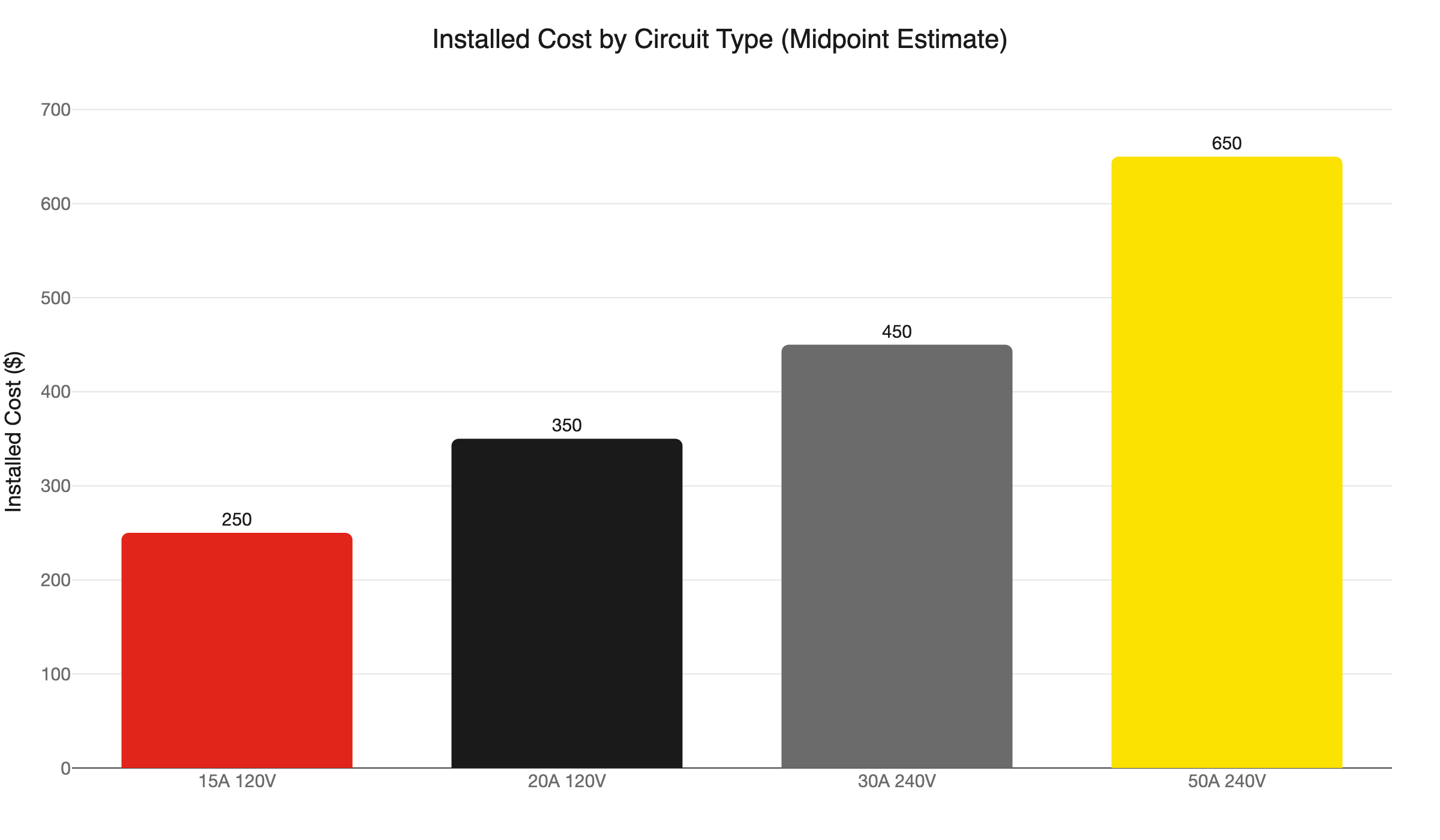
- Most new dedicated circuits cost $150 to $900 installed, depending on amperage, wire run length, and panel availability.
- A 15A or 20A 120V circuit for a refrigerator, chest freezer, or home appliance runs $150 to $500.
- A 50A 240V circuit for an EV charger, large sauna, or electric range runs $400 to $900 or more.
- Minnesota adopted NEC 2026 on August 17, 2026. Every new 120V 15A/20A circuit permitted today requires an AFCI breaker ($35 to $55 each versus $8 to $12 for a standard breaker).
- Xcel Energy income-qualified homeowners can receive up to $1,200 toward an EV charger circuit, including the dedicated wiring.
- A detached garage or workshop is a separate project scope entirely. Expect $2,500 to $6,500 or more for underground feeder and a subpanel.
- A full panel adds a step before any new circuit work: tandem breakers, a subpanel, or a service upgrade.
What Kind of Circuit Are You Adding?
Short answer: Start with what you are powering and where it is going. A refrigerator or chest freezer needs a 15A or 20A 120V circuit. An EV charger or sauna heater needs 30A to 50A at 240V. A detached garage or workshop needs a subpanel - not just a single circuit run.
The cost to add a new circuit depends less on amperage than on what you are running and where it needs to go.
A 20A circuit for a chest freezer in your attached garage is a two- to three-hour job. A 50A circuit for an EV charger in a detached garage may require trenching, a subpanel, and an underground feeder run. Both are “new circuits.” The scope is completely different.
This guide breaks costs down by use case: light-duty 120V appliances, EV chargers, saunas, and detached garage or workshop setups. We also cover Minnesota’s 2026 electrical code update and what it means for your project cost. The quick answer: most dedicated circuits run $150 to $900 installed.
When Do You Actually Need a Dedicated Circuit?
Short answer: You need a dedicated circuit when an appliance draws more power than a shared circuit can handle, or when code requires it. Common triggers include a breaker that trips when two appliances run together, or adding a major new load like an EV charger, sauna, or electric range.
Common reasons Twin Cities homeowners add circuits:
- A breaker trips on a shared circuit when the microwave and toaster run at the same time.
- A new major appliance - EV charger, sauna, induction range, or electric water heater - requires its own circuit. These loads cannot share.
- A basement, garage, or sunroom addition requires new circuits for outlets, lighting, and any appliances going in that space.
- A home workshop needs dedicated 20A or 30A circuits for a table saw, dust collector, or air compressor.
- A kitchen or bathroom remodel triggers code requirements for dedicated countertop and appliance circuits.
How Much Does It Cost to Add a 15A or 20A Circuit?
Short answer: A 15A 120V dedicated circuit runs $150 to $350 installed. A 20A 120V circuit, the standard size for a refrigerator, microwave, or chest freezer, runs $200 to $500. Wire gauge, run length, and whether the wall is finished or open are the main variables.
These are the most common new-circuit jobs. Most homeowners add them for a refrigerator in the garage, a chest freezer in the basement, or a home office that keeps tripping a shared circuit.
A 15A circuit uses 14 AWG wire. A 20A circuit requires 12 AWG, which is heavier and slightly more expensive per foot. Both are the standard spec for dedicated appliance circuits.
What drives cost within that range:
- Wire run length. A 10-foot run from the panel in an adjacent utility room is a quick job. A 60-foot run to a finished bedroom or workshop is a different day’s work.
- Finished walls. Fishing wire through drywall adds labor. An open basement ceiling is the simplest, lowest-cost scenario.
- Breaker type. Minnesota adopted NEC 2026 on August 17, 2026. Every new 120V 15A/20A circuit permit now requires an AFCI breaker ($35 to $55 each versus $8 to $12 for a standard breaker).
- Number of circuits on the same visit. Adding two or three circuits on one call costs less per circuit than scheduling each one separately.
How Much Does an EV Charger Circuit Cost in the Twin Cities?
Short answer: A 50A 240V circuit for an EV charger runs $400 to $900 or more installed, before the charger hardware itself. Income-qualified Xcel Energy customers can receive up to $1,200 toward the circuit and the charger combined - covering the electrical work, not just the device.
Most Level 2 home chargers, the ones that add 20 to 30 miles of range per hour of charging, require a 50A 240V dedicated circuit. The wire gauge is the single biggest cost driver. A 50A circuit uses 6 AWG wire. That is significantly thicker, heavier, and more expensive per foot than the 12 AWG on a standard 20A circuit. Pulling heavy-gauge wire through a long, finished wall is real labor.
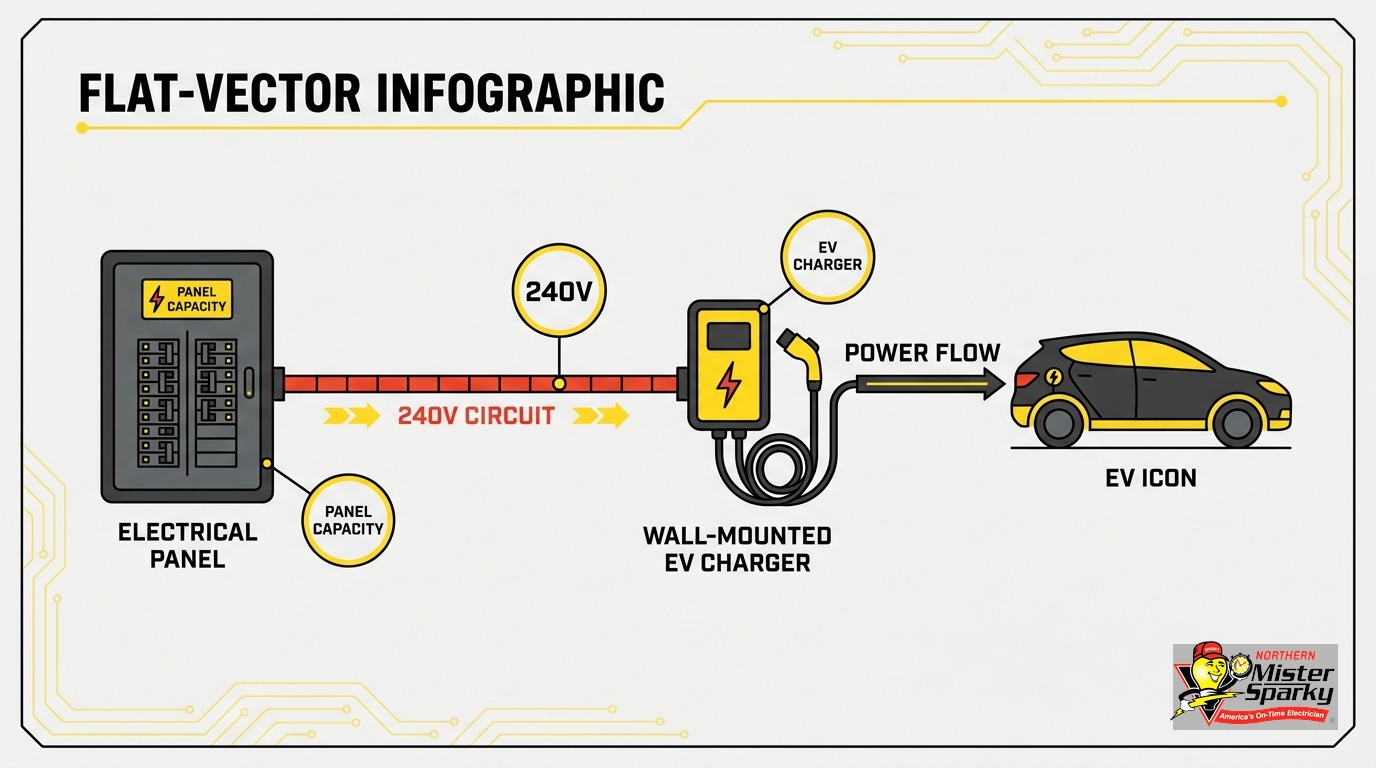
The Xcel rebate covers the circuit, not just the charger hardware. Xcel uses the term “premises wiring” for the dedicated 240V circuit run from your panel to the charger location. If your household income is at or below 80% of area median income, you may qualify for up to $1,200 toward the charger and that circuit. Many homeowners do not realize the rebate covers the electrical work. Ask about it when you schedule.
Xcel also offers the EV Accelerate at Home program, with charging rates as low as 3.8 cents per kWh during off-peak hours (midnight to 6 a.m.). Enrollment requires a 240V circuit and a Wi-Fi-connected Level 2 charger.
Panel capacity is part of every EV conversation. A 50A 240V circuit consumes 25% of a standard 200A panel’s total capacity. Before quoting the circuit, your electrician should verify available ampacity. A panel that is already close to full changes the project scope.
For charger hardware options and what to expect on install day, see EV charger installation in the Twin Cities.
How Much Does a Sauna Circuit Cost?
Short answer: A sauna circuit typically runs $300 to $900 installed, depending on heater wattage. The NEC 210.20 continuous-load rule pushes larger saunas to 40A or 50A circuits - not the 30A many homeowners expect. GFCI protection is always required. Small infrared saunas may not need a new circuit at all.
The sizing rule that surprises most homeowners: sauna heaters run for extended periods, which makes them a “continuous load” under NEC 210.20. The breaker must be sized at 125% of the heater’s maximum draw, not 100%. Here is what that means in practice:
| Heater wattage | Draw at 240V | 125% continuous load | Required breaker |
|---|---|---|---|
| 4.5 kW | ~19A | ~24A | 30A |
| 6 kW | ~25A | ~31A | 40A |
| 8 kW | ~33A | ~42A | 50A |
A 1 to 2 person infrared sauna often runs on 120V/15A. It may not need a new circuit at all. Larger infrared units (3 to 4 person or more) and all traditional Finnish-style saunas need a 240V circuit in the 30A to 50A range.
GFCI protection is required on every sauna circuit. The wet, high-heat environment triggers the requirement per NEC sauna wiring rules. Traditional saunas also require high-temperature-rated wiring inside the unit itself. Your electrician will confirm the spec when they assess the heater.
For the full Minnesota-specific sauna circuit requirements, see sauna electrical wiring requirements in Minnesota.
What About a Detached Garage or Workshop?
Short answer: A detached garage is not a single-circuit project. Getting power underground to a detached structure and setting up a subpanel typically costs $2,500 to $6,500 or more. Distance, soil conditions, and the size of the subpanel all affect the total.
Here is what makes a detached structure different from adding a circuit inside your home:
- Underground feeder. The wire has to go underground from your main panel to the garage. That means trenching. Underground feeder runs to a detached garage or shop cost $10 to $25 per linear foot, including conduit, wire, and installation.
- Subpanel. A detached structure requires its own disconnect and distribution panel. A 60A subpanel for a detached garage with an underground run typically costs $1,500 to $4,000 or more.
- Grounding electrode system. The NEC requires a separate grounding electrode at each detached structure. That adds $200 to $500.
- Interior circuits. Once the subpanel is in, the individual circuits for outlets, lighting, and high-draw equipment are quoted separately on top of that.
If you plan to run a table saw, a dust collector, and an air compressor at the same time, plan for a 100A or 200A subpanel - not a 60A. A 60A panel looks affordable until you add a welder or a second machine tool and realize it cannot keep up.
For the full scope breakdown, see detached garage subpanel installation.
What Changed Under Minnesota’s New Electrical Code?
Short answer: Minnesota adopted the 2026 National Electrical Code effective August 17, 2026. The biggest change for new circuits: AFCI protection now applies to every 120V 15A/20A branch circuit in a home, with no room exemptions remaining. Any permit pulled today follows these rules.
Under the previous code, AFCI breakers were required in specific rooms: bedrooms, living rooms, kitchens, and a few others. The 2026 NEC removes all room exemptions. If you pull a permit for a new circuit in a laundry room, utility room, or garage, the Minnesota Board of Electricity’s NEC 2026 FAQ now requires an AFCI breaker. No exceptions remain.
What this adds to your project cost:
- Standard breakers: $8 to $12 each
- AFCI breakers: $35 to $55 each
- Five new circuits with AFCI breakers: adds $135 to $215 in materials alone, compared to standard breakers
The 2026 NEC also expanded GFCI protection to within 6 feet of all indoor sinks in a dwelling - not just bathroom and kitchen sinks. Bathroom circuits now require both AFCI and GFCI protection on the same circuit. A dual-function AFCI/GFCI breaker ($55 to $75 each) satisfies both requirements in one slot.
If you received a quote before August 17, 2026, and are scheduling work now, ask your electrician whether the quote accounts for AFCI requirements. A quote written under the old code may not pass inspection today.
What Does an Electrician Charge Per Hour in the Twin Cities?
Short answer: Electricians in the Minneapolis metro bill $85 to $150 per hour for residential work. That rate covers wages, overhead, tools, insurance, and licensing. Most circuit jobs are quoted as flat-rate projects, not hourly.
Journeyman electrician wages in the Minneapolis metro run $35 to $45 per hour. The rate on your invoice is higher - it includes overhead, equipment, and the shop’s margin. That is standard across the trades and expected.
When you receive a quote, check whether it includes the permit, the breaker, and wire materials, or whether those are separate line items. A quote that lists only labor can look cheaper than it is. Most reputable shops quote all-in. If yours does not, ask for a full itemization before you sign.
Do You Need a Permit to Add a Circuit in Minnesota?
Short answer: Yes. Every new circuit requires a permit and electrical inspection in Minnesota. The permit confirms code compliance, protects you if something goes wrong, and matters when you sell the home. Your electrician handles the filing.
Permit fees vary by city:
- State minimum: $55 per inspection; 15 to 30 circuits in a dwelling run $165 for the group
- Saint Paul: $15 per circuit, $85 minimum
- Minneapolis: $75 to $400 depending on scope
Owner-occupants of a single-family home in Minnesota can legally pull their own permit and do the electrical work themselves. Minnesota residential electrical permits allow this statewide. An inspection is still required, and the inspector will check code compliance. If the work fails, you pay for a re-inspection.
Most homeowners hire a licensed electrician and hand off the permit process entirely. For any job involving the 2026 NEC AFCI requirements, that is almost always the right call.
What Happens If Your Panel Is Already Full?
Short answer: A full panel - no open breaker slots - means a new circuit cannot go in without first creating room. Options include tandem breakers (where the panel allows them), a new subpanel, or a service upgrade. Your electrician will tell you which fits your panel and your actual load.
The basic decision tree:
- Tandem breakers. Some panels accept two single-pole breakers in one slot. This frees up a position without major work. It is the cheapest option when the panel supports it: roughly $75 to $200 in materials.
- Subpanel. A small breaker subpanel fed from the main panel gives you additional slots. Cost: $500 to $2,000 depending on size and location.
- Service upgrade. If your 100A service is near capacity, a 200A service upgrade may be the right move. That is a $5,000 to $15,000 project and a separate scoping conversation.
Northern Mister Sparky checks panel capacity before quoting any circuit work. You will know the full scope before anything begins.
What Factors Drive the Cost the Most?
Short answer: Wire run length and wall accessibility move the number more than almost anything else. A circuit through a finished wall can cost twice as much as the identical circuit in an open basement. Wire gauge, breaker type, panel capacity, and the number of circuits on a single visit all shift the total as well.
Several variables matter beyond amperage alone:
- Wire run length. A 10-foot open-basement run is quick. A 60-foot run through finished walls is not.
- Wire gauge. A 50A circuit requires 6 AWG wire, which is significantly more expensive per foot and harder to pull through finished walls than the 12 AWG used on a 20A circuit.
- Breaker type. AFCI and dual-function AFCI/GFCI breakers run $35 to $75 each versus $8 to $12 for a standard breaker. Minnesota’s 2026 code requires AFCI on all new 120V 15A/20A circuits.
- Panel capacity. No open slots means extra work before the circuit can be installed.
- Permits. Required for every new circuit in Minnesota. Fees vary by city.
- Underground runs. A detached garage or outbuilding adds trenching, conduit, a subpanel, and a grounding electrode to the project.
- Number of circuits added. Three circuits on one visit costs less per circuit than three separate calls.
Ready to Schedule?
The cost to add a new circuit in the Twin Cities depends on what you are running, where it goes, and what your panel has room for. Most homeowners find the estimate sharpens considerably after a quick on-site look from a licensed electrician.
Northern Mister Sparky is locally owned and operated, serving Minneapolis, St. Paul, Bloomington, Brooklyn Park, Woodbury, Blaine, Maple Grove, Plymouth, and the surrounding metro. As Minnesota’s America’s On-Time Electrician(R), we give you a straight cost estimate before any work starts. Every job is backed by our UWIN(R) 100% satisfaction guarantee. No malarky. If something is not right, we make it right.
For larger jobs - EV chargers, saunas, and garage subpanels - ask about financing options when you call.
Call 763-200-5956 or book online. We show up on time.
Frequently Asked Questions
How much does it cost to add a new circuit? +
Do I need a permit to add a circuit in Minnesota? +
Does the Xcel Energy rebate cover the electrical circuit for an EV charger? +
Need an electrician now?