
Sauna Electrical Wiring Requirements: Twin Cities Guide
Key Takeaways
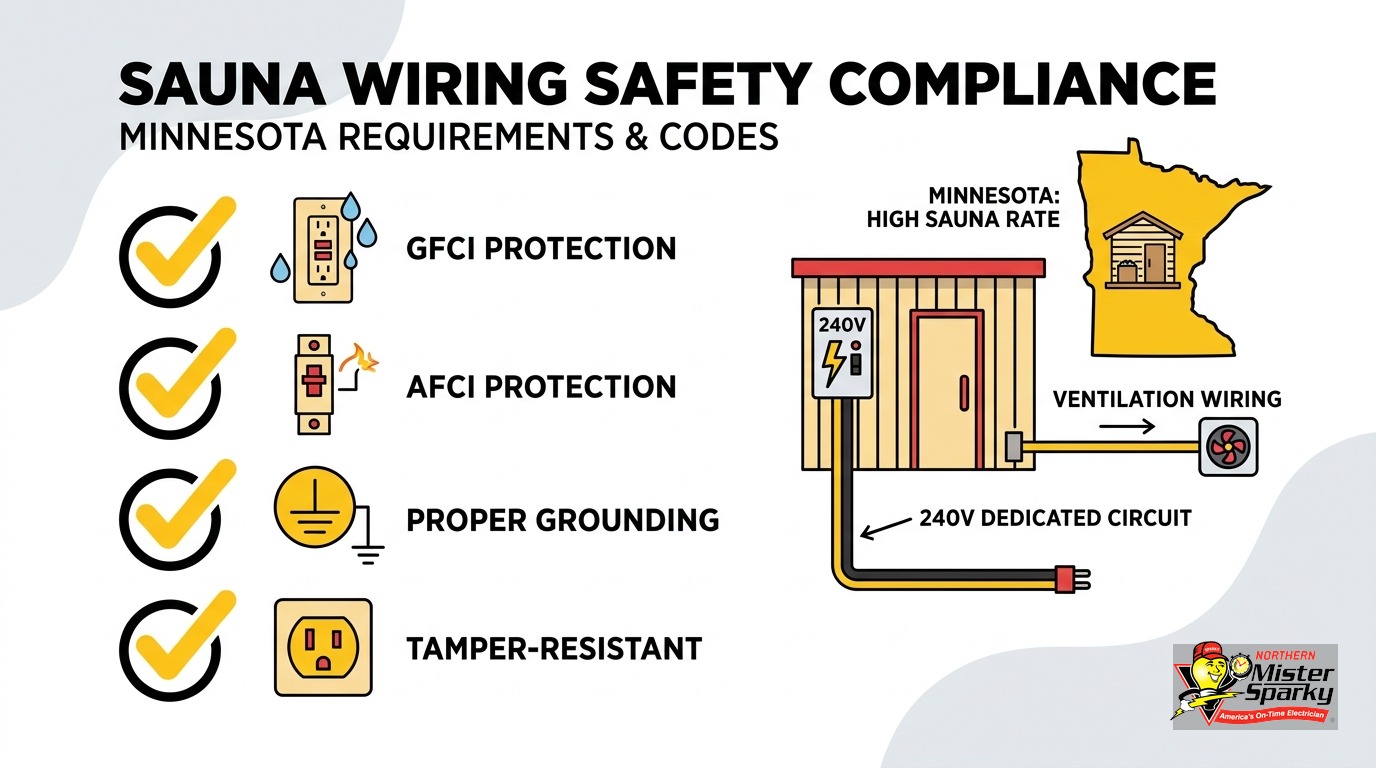
- Electric sauna heaters require a dedicated 240V circuit. Sharing a circuit with anything else is not allowed.
- NEC Article 424 governs fixed electric space-heating equipment, including most sauna heaters. Articles 210 and 422 may also apply.
- A hardwired disconnect switch must be readily accessible and within sight of the heater unit.
- GFCI on the 240V heater circuit can cause nuisance tripping. Many manufacturers prohibit it. Verify with your local inspector before installation begins.
- Traditional sauna interior wiring must be rated for 180-200°F. Infrared saunas run cooler and have different wire specifications.
- The control panel belongs in a dry location outside the sauna room, typically 48-52 inches above the floor.
- The ventilation fan circuit is separate from the heater circuit. This step is consistently overlooked.
- In Minneapolis, a 240V sauna circuit always requires an electrical permit, even if the structure does not need a building permit.
- Minnesota adopted the 2026 NEC effective August 17, 2026. Permits filed on or after that date fall under the new code.
What Are the Sauna Electrical Wiring Requirements?
Short answer: A traditional electric sauna needs a dedicated 240V circuit, heat-rated interior wiring, a readily accessible disconnect switch, and a control panel in a dry exterior location. A wood-burning sauna still requires a 120V circuit for lighting and ventilation. Infrared saunas vary by unit size and may run on 120V or 240V.
That is the foundation. The full scope of sauna electrical wiring requirements builds from there: wire gauge matched to heater wattage, low-voltage control wiring routed separately from line voltage, Minnesota-specific permit requirements, and installation standards that just changed when the state adopted the 2026 NEC.
NEC Article 424 covers fixed electric space-heating equipment, which includes most hardwired sauna heaters. Articles 210 and 422 may apply depending on how the heater is classified. A licensed electrician knows which articles govern your specific installation type.
The stakes are not abstract. A sauna operates at high temperatures. It is often an enclosed space. A wiring failure in that environment is serious. Permitted, inspected work by a licensed electrician is not a formality. It is the baseline.
Why Minnesota Leads the Country in Residential Saunas
Saunas are not a novelty in Minnesota. Finnish and Scandinavian immigrants built them here for over a century. In many early communities, the sauna went up before the house. The oldest surviving smoke sauna in the United States was built in 1868 in Cokato Township, Minnesota. Today, Minnesota has the highest absolute volume of mobile sauna operators in the country.
That cultural density has a practical consequence for homeowners planning an installation. Twin Cities inspectors review sauna electrical permits regularly. They know what a compliant installation looks like. They also know what a close-but-not-quite installation looks like, and they will call it out.
It also means licensed electricians here wire saunas all the time. That frequency builds specific knowledge. An electrician who has pulled a dozen sauna permits in Hennepin County knows what the local inspector expects. That local familiarity does not exist in a national guide written for a general audience.
Northern Mister Sparky is locally owned and operated. We pull permits in Hennepin, Ramsey, Anoka, Dakota, and Washington counties, and we know what those inspectors look for. That is part of what it means to be America’s On-Time Electrician(R) serving the Twin Cities.
Which Type of Sauna Needs Which Electrical Setup?
Short answer: Traditional electric saunas need a dedicated 240V circuit and high-temperature-rated internal wiring. Infrared saunas may run on 120V or 240V, depending on unit size. Wood-burning saunas need at least a 120V circuit for lighting and ventilation, plus underground cable to the structure if it is a detached building.
Here is how the three main types compare:
Traditional electric saunas operate at 180-200°F. All internal wiring must be rated for those temperatures. The heater draws enough load to require a dedicated 240V circuit. Breaker size and wire gauge depend on the heater’s wattage.
Infrared saunas run at 120-150°F and do not require the same high-temperature wire specifications. Smaller single-person units often run on a standard 120V outlet. Larger multi-person units may require 240V. Confirm with the manufacturer before purchasing and before the electrician begins the layout.
Wood-burning saunas have no electric heater, but they are not off the hook. Even a wood-burning sauna needs at least a 120V circuit for interior lighting and a ventilation fan. If the sauna is a detached structure, you need to trench cable from the house. That cable run must meet Minnesota burial depth requirements.
Knowing your sauna type before calling an electrician saves time. It determines whether you need a 120V or 240V circuit, whether high-temperature wire is required, and how complex the installation will be.
Do I Need a Dedicated Circuit for My Sauna Heater?
Short answer: Yes, without exception. A sauna heater draws enough load that the NEC requires its own dedicated circuit from the electrical panel. No other appliance or outlet can share that circuit.
A dedicated circuit runs directly from your panel to the heater. Nothing else taps into it. This is not a guideline. It is a code requirement. The reason is simple: sauna heaters are high-draw appliances. Running one on a shared circuit creates overloaded wiring, nuisance tripping, and heat buildup at connections. Any of those outcomes is a problem in a room designed to operate at 180-200°F.
For a deeper look at why high-draw appliances need their own circuits, our overview of dedicated circuits for appliances walks through the reasoning.
If your current panel does not have an available slot for the new circuit, that problem must be solved before any sauna wiring begins. Your electrician will assess panel capacity as part of the initial scope. Running out of slots is not a reason to skip the dedicated circuit. It is a reason to address the panel first.
What About GFCI Protection on a Sauna Heater Circuit?
Short answer: GFCI on the 240V heater circuit is complicated. The NEC generally requires GFCI in wet locations, but many sauna heater manufacturers specifically prohibit it on the heater circuit because of nuisance tripping. Bring the manufacturer’s documentation to your local inspector before the installation starts.
This question does not have one clean universal answer. NEC 110.3(B) requires listed equipment to be installed per the manufacturer’s instructions. If the heater manufacturer prohibits GFCI on the 240V heater circuit, that instruction carries weight with a code inspector. The path forward is always the same: bring the documentation and coordinate with the inspector before work begins.
Walking in without the manufacturer’s spec sheet and hoping the inspector waves it through is not a strategy that holds up in Hennepin County.
GFCI protection still applies elsewhere around the sauna. Wet-area outlets near the changing room, exterior outlets serving the structure, and other locations specified by the NEC all require GFCI protection. Those rules are clear. The heater circuit is the complicated exception. For a plain-language explanation of where GFCI is and is not required in residential settings, see our guide to GFCI outlet requirements.
The Control Panel, Disconnect Switch, and Low-Voltage Wiring
Two components that homeowners consistently underestimate: the control panel and the disconnect switch. Getting either one wrong means a failed inspection.
The control panel (the thermostat and timer unit) must be installed in a dry location outside the sauna room, typically 48-52 inches above the floor. It connects to the heater via low-voltage communication cables. Those cables must be routed separately from the main power wiring. Running low-voltage and line-voltage cables in the same conduit or bundle is a code violation. This is one of the most common errors in DIY sauna installations, and inspectors know to look for it.
The disconnect switch must be a dedicated, readily accessible switch located within sight of the heater unit. The NEC requires this for hardwired sauna heater installations. The purpose is emergency response. Anyone dealing with a problem inside the sauna room should be able to cut power to the heater without locating the main panel. The switch must be visible from the heater’s location. A switch tucked around a corner or in an adjacent room does not meet the “within sight” requirement.
Both components need to be positioned before the rough-in begins. Moving them after drywall is expensive. The control panel height, the disconnect switch location, and the separate routing paths for the low-voltage cables all need to be planned at the design stage, not corrected during the inspection.
Do I Need a Permit to Wire a Sauna in Minneapolis?
Short answer: Yes. The electrical permit is always required for a sauna circuit in Minneapolis and most Twin Cities suburbs, even if the sauna structure itself is exempt from a building permit.
Here is the specific Minneapolis rule: structures under 200 square feet may be exempt from a building permit, but the 240V electrical circuit always requires an electrical permit, regardless of structure size. The structure and the electrical work are governed by separate permit tracks. The building permit threshold creates confusion, but it does not change the electrical permit requirement.
Most Hennepin and Ramsey County suburbs follow similar logic. The square footage threshold for building permits varies by municipality. The requirement for an electrical permit on a 240V circuit does not vary.
For permit questions specific to Minneapolis, Minneapolis Development Review is at 505 Fourth Ave. S., Room 220, Minneapolis, MN 55415. You can also reach them at 612-673-3000. Our team handles Minnesota electrical permits as part of every permitted installation. You do not need to manage that process on your own.
What Changed with Minnesota’s 2026 NEC Update?
Short answer: Minnesota adopted the 2026 National Electrical Code, effective August 17, 2026. Any permit filed on or after that date is governed by the 2026 NEC. Permits filed before that date comply with the 2023 NEC.
This transition is live right now. If you have not yet filed a permit for your sauna installation, your job will be inspected under the 2026 code. Minnesota’s Department of Labor and Industry publishes the adoption timeline. Homeowners in Hennepin or Ramsey County pulling permits this week are the first cohort inspected under the new standard.
The practical impact depends on your project scope. The core sauna wiring requirements do not change dramatically between code cycles. But updated language around wiring methods, equipment clearances, and GFCI applicability can affect specific decisions in a real project.
A licensed Twin Cities electrician working in 2026 already knows what the 2026 NEC requires for sauna installations. If someone you are considering hiring cites only 2023 NEC requirements without acknowledging the August 17 transition, that is worth asking about. Inspectors in Hennepin and Ramsey counties are enforcing the 2026 code on permits filed today.
Sauna Electrical Wiring Requirements: Breaker Size and Wire Gauge
Getting the circuit size right is not optional. Undersized wire is a fire hazard. An undersized breaker trips under normal heater load. An oversized breaker defeats the circuit’s protection and violates code.
The calculation starts with the heater’s wattage. Divide that by 240V to get the amperage draw. The NEC’s continuous-load rule then requires the circuit’s overcurrent protection to be rated at 125% of that amperage. Wire gauge must match the breaker rating. The governing document for all of this is the manufacturer’s spec sheet. Your electrician will size the circuit to that sheet, not to a general estimate.
In a traditional sauna, undersized wire faces a compounded risk. Ambient heat from the sauna environment stacks on top of resistive heat from a too-small conductor. The combination is more dangerous here than the same wiring mistake anywhere else in the house. Size the wire correctly from the start.
If your panel capacity is a question before you pick a heater, discuss it with your electrician first. Knowing the panel’s available amperage helps you choose a heater that fits without requiring a panel upgrade. If a panel upgrade is needed regardless, it is far better to know that before the rough-in than after.
Outdoor Saunas: Cold-Climate Wiring and Burial Depth
An outdoor sauna in Minnesota adds complexity that no national sauna retailer covers. The cable run from the house to the structure must be buried. Burial depth varies by wiring method, and Minnesota’s climate makes those choices matter more than they do in warmer states.
Direct-bury cable has a different minimum depth than PVC conduit or rigid metal conduit. The freeze-thaw cycle in the Twin Cities shifts soil every year, placing mechanical stress on buried conductors over time. Conduit is the preferred approach for longer outdoor runs. It protects the conductors from that mechanical stress and allows wire replacement without redigging. Our guide to underground electrical wire depth in Minnesota covers the specific depth requirements by wiring method.
For larger or more permanent outdoor sauna structures, a small subpanel at the building is often the right solution. A subpanel at the point of use eliminates voltage drop on long runs. It provides dedicated breaker slots for the heater circuit, the ventilation circuit, and the lighting circuit. It also leaves room for a convenience outlet without requiring additional trenching later.
Cold-weather conduit runs require weatherproof fittings at all entry and exit points, conduit material rated for frost exposure, and careful attention to penetrations through the house foundation. These details are routine for a licensed Minnesota electrician. They are easy to miss for anyone who has not pulled outdoor permits in this climate before.
Why Does My Sauna Need a Separate Ventilation Fan Circuit?
Short answer: The ventilation fan and the heater have different load characteristics and different operating patterns. Combining them on one circuit creates code violations and reliability problems. The fan must have its own dedicated circuit, separate from the heater.
Homeowners spend most of their attention on the heater circuit. The ventilation fan becomes an afterthought. That is a mistake.
The ventilation fan runs during heat-up to bring fresh air into the room. It runs after the session to exhaust moisture and begin cooling the space. Its operating schedule is not the same as the heater’s schedule. Tapping the fan off the heater circuit is not code-compliant. Both circuits must originate separately at the panel.
If your panel is already short on breaker slots, address that before the sauna project begins. Adding a sauna with all of its required circuits, including the heater, the ventilation fan, and the lighting, may tip you into a panel upgrade conversation. That is better to surface early than to discover mid-project.
Schedule Your Sauna Wiring with Northern Mister Sparky
Sauna electrical wiring requirements pull together multiple NEC articles, a fresh Minnesota code adoption, local permit requirements, cold-climate burial standards, and a GFCI question that requires manufacturer documentation and inspector coordination. This is not a job for a general contractor with a sub on call. It is a job for a licensed Twin Cities electrician who wires saunas in this market regularly.
Northern Mister Sparky is locally owned and operated. Our team knows what Hennepin and Ramsey county inspectors look for at every stage, from rough-in to final. We handle the permit. We size the circuit to the spec sheet. We route the low-voltage control wiring correctly. We position the disconnect switch so it passes inspection the first time. And with the UWIN(R) 100% satisfaction guarantee behind every job, you have recourse if anything falls short.
Call us at 763-200-5956 or book online. We serve Minneapolis, St. Paul, Bloomington, Brooklyn Park, Woodbury, Blaine, Maple Grove, Plymouth, and the surrounding Twin Cities communities. If your panel needs attention before the sauna work can begin, we will tell you upfront. No malarky, just a clear scope and a scheduled appointment.
Frequently Asked Questions
Do I need a permit to wire a sauna in Minneapolis? +
Can I use a GFCI breaker on my sauna heater circuit? +
What size breaker does a sauna heater need? +
Need an electrician now?