Bonding Gas Line Electrical Code: MN Homeowner Guide
Key Takeaways
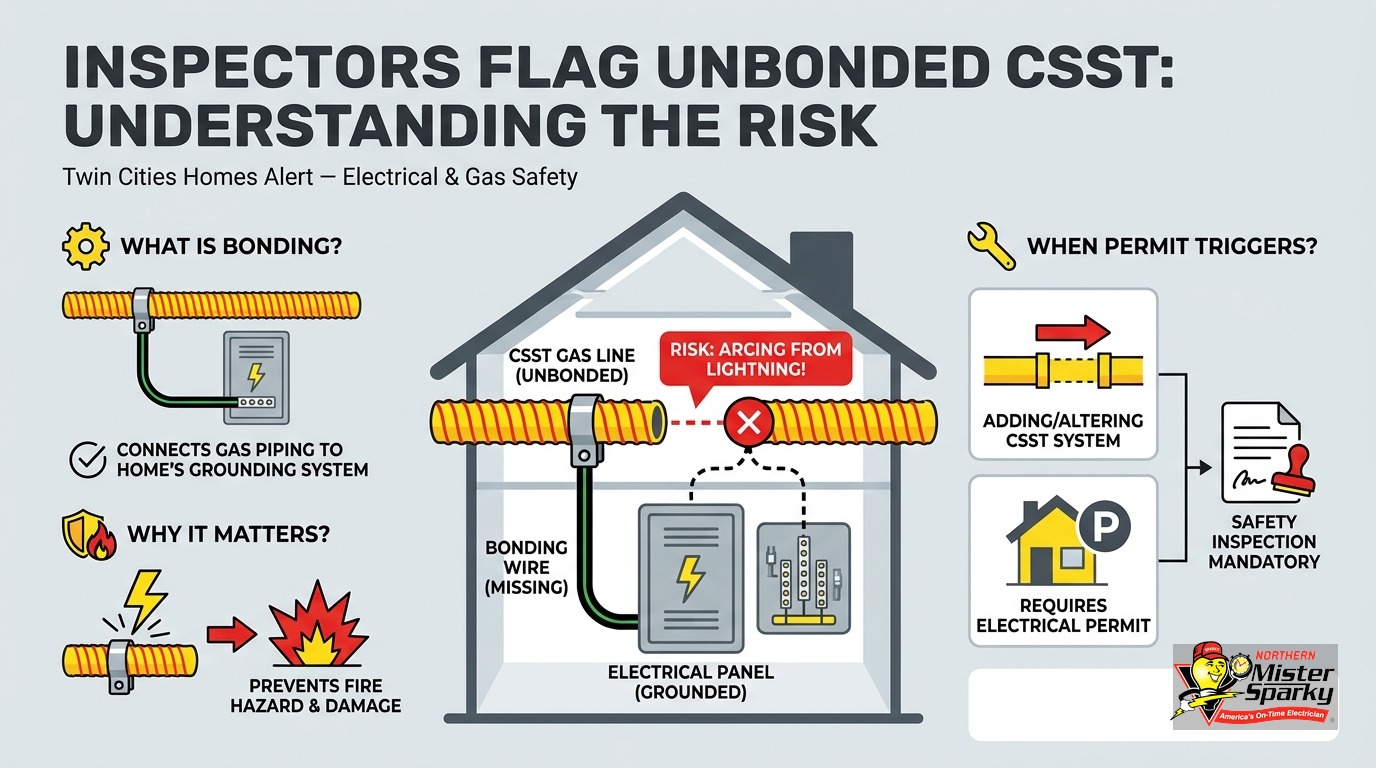
- Minnesota’s bonding gas line electrical code, Section 310.2 of the 2020 Fuel Gas Code, requires all CSST to be bonded with a minimum 6 AWG copper wire connected to the grounding electrode system.
- Yellow CSST (corrugated stainless steel tubing) is the flexible gas piping found in millions of homes built during the 1990s and early 2000s. Most Twin Cities homes from that era have it.
- A nearby lightning strike can create a voltage arc through unbonded CSST, burn a pinhole in the tubing, and start a fire or explosion.
- The ATF documented two firefighter line-of-duty deaths caused directly by lightning-induced CSST arc failure.
- Minnesota does not follow the national code exception for arc-resistant (black-jacket) CSST. All CSST in Minnesota must be bonded, regardless of jacket type.
- Maple Grove bans standard yellow CSST entirely for new work.
- Bonding is electrical work. A licensed electrician pulls the permit and does the job, not a plumber or gas contractor.
- Grandfathering applies to code status, not safety. An inspector who flags it is right to do so.
What Is CSST, and Why Is It in So Many Twin Cities Homes?
CSST is flexible corrugated stainless steel gas piping, widely installed in homes built between the late 1980s and mid-2000s. Builders adopted it quickly because it is faster to install than rigid black iron pipe. The Twin Cities housing boom of those decades means a large share of local homes have it, often without bonding in place.
The product arrived in the U.S. around 1988. Standard CSST has a yellow plastic jacket. Arc-resistant CSST has a black jacket. Both types are still in service across the metro.
Manufacturers did not require bonding as a standard installation condition until roughly 2006-2007, according to Structure Tech’s CSST bonding analysis. That window maps almost exactly onto the Twin Cities construction era. Homes in Bloomington, Maple Grove, Plymouth, Brooklyn Park, and Woodbury built during those years may have yellow CSST with no bonding wire in place.
Home inspectors flag it constantly. If yours did, you are not alone, and the fix is manageable.
What Happens When Lightning Hits Unbonded CSST?
A nearby lightning strike induces a high electrical potential on the metal systems inside your home. Unbonded CSST sits at a different potential than adjacent wiring, ducts, and pipes. That voltage difference creates an arc energetic enough to burn a pinhole through the thin stainless wall. Gas leaks. Fire or explosion follows.
The lightning does not have to hit your house directly. A nearby ground strike is enough to induce the voltage differential that causes the problem.
This is not a theoretical worst case. The ATF investigated and confirmed two firefighter line-of-duty deaths caused directly by lightning-induced CSST arc failure. The cause-and-origin finding was definitive, not speculative.
The National Association of State Fire Marshals estimated that 5 million U.S. homes contain yellow CSST that may not meet current bonding standards. Their outreach campaign reached 35 million homeowners.
Bonding solves the problem. It ties the CSST to the same electrical potential as every other metal system in the house. Same potential, no voltage difference, no arc, no pinhole.
What Does Bonding Gas Line Electrical Code Require in Minnesota?
Minnesota’s 2020 Fuel Gas Code, Section 310.2, requires CSST to be bonded with a minimum 6 AWG copper wire on a maximum 75-foot run, connected to the grounding electrode system. The bonding clamp must attach to rigid pipe or a fitting, not to the corrugated tubing itself.
Minnesota adopted the 2020 Fuel Gas Code on April 6, 2020, based on the 2018 International Fuel Gas Code. The state’s official adoption document is available through the Minnesota Department of Labor and Industry.
Key specifics for Twin Cities homeowners:
- Wire size: 6 AWG copper, minimum. Larger is acceptable. Smaller is not.
- Maximum run: 75 feet from the CSST to the bonding connection point.
- Where the wire terminates: Anywhere on the grounding electrode system. That includes the ground rod, the metallic water service entry, or the ufer ground (a concrete-encased electrode). The old rule required the wire to run back to the main panel. The current rule does not.
- Where the clamp goes: On rigid pipe or a fitting adjacent to the CSST, not on the corrugated section itself.
- What does not count: The intersystem bonding terminal, a small lug block sometimes mounted on the exterior of newer homes, is not an acceptable connection point for CSST bonding. HomeMSP’s 2016 CSST bonding update identifies this as one of the most common mistakes made by homeowners and contractors alike.
The bonding requirement comes from the fuel gas code, specifically NFPA 54 and the IFGC. It is enforced by the building department, not the electrical inspector directly. But it is still electrical work and still requires an electrical permit.
For a broader look at how bonding and grounding work together in a home’s electrical system, our post on electrical bonding and grounding explained covers the fundamentals.
How Do I Know If My CSST Is Bonded?
Look for a bare or green copper wire, at least as thick as a pencil, clamped to a rigid section of gas pipe near the meter or appliances. That wire should run to a ground rod, metallic water service entry, or the main panel’s grounding electrode connection. No wire visible near the gas piping is a red flag.
You likely have CSST if your home was built or had gas work done between the late 1980s and mid-2000s. The tubing looks like a flexible metal hose with a corrugated surface. Standard CSST has a yellow jacket. Arc-resistant CSST has a black jacket.
Signs your CSST may not be properly bonded:
- A home inspection report flagging “unbonded corrugated stainless steel gas piping.”
- Flexible yellow or black tubing running to a furnace, water heater, or dryer with no bonding wire attached nearby.
- A house built between 1988 and 2006 with no electrical work done to the gas system since.
- A wire attached only to the small intersystem bonding terminal on the exterior of the house.
A home inspector’s flag is not a code enforcement order. An installation from 2004 that met code then is still technically code-compliant today through grandfathering. But it is still a real safety deficiency. The inspector is right to flag it, and it should be corrected. If you are not sure what you are looking at, have a licensed electrician assess it. The visual check typically takes less than an hour.
Do You Need a Permit to Bond a Gas Line in Minnesota?
Yes, in most jurisdictions. CSST bonding is electrical work. A licensed electrician pulls a standard or special electrical permit. You do not need a separate gas permit for the bonding wire. The permit triggers an inspection that confirms the wire size, run length, and connection point all meet code.
A permit protects you at resale. An unpermitted repair can create the same complication at closing as no repair at all. Our post on electrical permits in Minnesota explains the permit and inspection process and what happens when a permit is left open before a home sale.
Who Does the Work: Electrician or Plumber?
A licensed electrician does the CSST bonding. The fuel gas code governs the requirement, but the work is electrical: a bonding wire connected to the grounding electrode system. The gas contractor installs the tubing. The electrician installs the bonding wire and pulls the permit.
This distinction trips people up. The gas line itself is the plumber’s or gas contractor’s territory. But the bonding connection is to the electrical grounding electrode system. That makes it electrical work.
If a gas contractor offers to add the bonding wire during another job, ask directly whether they hold a Minnesota electrical license. If they do not, they cannot legally pull the permit, and the installation will not pass inspection.
Our team at Northern Mister Sparky handles CSST bonding routinely. We are locally owned and operated in the Twin Cities. We pull the permit, do the work, and schedule the inspection. No malarky.
What About Arc-Resistant CSST - Do I Still Need Bonding in Minnesota?
Yes. Minnesota’s Fuel Gas Code Section 310.1.1 requires bonding for all CSST, including arc-resistant products with black jackets. The national IFGC 2018 code allows an exception for arc-resistant CSST. Minnesota adopted that code base but did not carry the exception forward.
Arc-resistant CSST, sold as CounterStrike (TracPipe) and FlashShield (Gastite), uses a thicker jacket engineered to survive an arc event without burning through. The national IFGC allows this product to substitute the bonding wire requirement. Minnesota explicitly does not.
If someone tells you your black-jacket CSST does not need bonding in Minnesota, get a second opinion from a licensed Twin Cities electrician familiar with the state’s fuel gas code amendments. Structure Tech’s CSST analysis confirms this distinction clearly for Minnesota homeowners: both yellow and black-jacket CSST require bonding under state code.
Minnesota’s Rule Is Stricter Than the National Code
This is worth stating plainly because it catches contractors off guard regularly.
The national code, IFGC 2018, allows arc-resistant CSST to substitute the bonding wire with its arc-resistant jacket. Minnesota adopted IFGC 2018 as the foundation for its 2020 Fuel Gas Code, then explicitly declined to include that exception. Section 310.1.1 of the Minnesota code closes the gap.
Similarly, the national code gives some flexibility around the intersystem bonding terminal. Minnesota’s code explicitly prohibits it as a CSST bonding connection point.
A contractor who learned the national code but not the Minnesota amendments may install a system that looks correct but fails local inspection. Know which code applies to your jurisdiction before the work starts.
Maple Grove Has the Strictest Rule of All
If you live in Maple Grove, standard yellow CSST is prohibited entirely for new gas piping work. Only arc-resistant CSST is permitted.
The city’s position came from a specific exchange. Maple Grove asked a CSST manufacturer to specify a minimum separation distance between yellow CSST and adjacent conductive systems. The manufacturer declined to provide a number. Maple Grove responded by banning the product for new installation.
If you have existing yellow CSST in a Maple Grove home, bonding is still the required fix for the safety deficiency. The tubing was installed before the prohibition, and bonding addresses the hazard. But any new gas work in Maple Grove must use arc-resistant product, and that product still requires bonding under Minnesota code.
Bonding Gas Line Electrical Code: Old Rule vs. Current Rule
The most significant practical change between the old rule and the current Minnesota requirement is where the bonding wire can terminate.
Under the older rule, the 6 AWG copper wire had to run all the way back to the main electrical panel. In homes where the gas line enters through a utility room far from the panel, that was a long, expensive run. It made retrofit jobs more disruptive and often cost more than homeowners expected.
The current Minnesota code allows the wire to connect anywhere on the grounding electrode system. If a ground rod is closer to where the gas line enters the house, the bonding wire can terminate there. If the metallic water service entry is closer, that works too.
This change makes most CSST bonding retrofits faster and less expensive than they used to be. It also reduces how much finished wall or ceiling needs to be opened up.
If a contractor quotes a CSST bonding job and insists the wire must go all the way to the main panel, ask whether they are working from the current Minnesota Fuel Gas Code. That specific routing requirement no longer applies.
Does Unbonded CSST Affect Home Insurance or Resale Value?
It can, on both counts. Some insurers decline to write policies or charge higher premiums for homes with unbonded CSST. At resale, inspectors flag it, and buyers or their lenders sometimes require the correction as a closing condition. Getting the work done before you list removes the item from the inspection report entirely.
Lightning protection more broadly is worth thinking about alongside CSST bonding. A whole-home surge protector does not substitute for bonding, but it does address the same class of events: induced voltage from nearby lightning strikes. Our post on whole-home surge protection covers that layer separately.
How Much Does CSST Bonding Cost?
Cost depends on home size, how far the CSST sits from the nearest grounding electrode, and how many connection points the system needs. Most straightforward single-family retrofits run a few hundred dollars for labor and materials, plus the local permit fee.
Because the current code lets the bonding wire terminate at the nearest grounding electrode rather than the main panel, many jobs take less time and cost less than homeowners expect. Our team will assess the layout, give you a straight number before the work begins, and explain what the permit process looks like in your specific city.
If the inspection report also flagged grounding deficiencies alongside the CSST bonding issue, our electrical grounding service can address both in a single visit.
Call 763-200-5956 or book online to schedule a CSST bonding assessment.
What to Do If Your Inspector Flagged Unbonded CSST
Call a licensed electrician. Not a handyman. Not a gas contractor without an electrical license. A licensed electrician who works in the Twin Cities, knows the Minnesota Fuel Gas Code, and can pull the permit.
The fix is straightforward when done by someone who does it regularly. The risk of leaving it undone is real and documented. Two firefighters died from this specific failure mode. The ATF cause-and-origin finding was unambiguous.
We are Northern Mister Sparky, America’s On-Time Electrician(R), locally owned and operated in the Twin Cities. Our UWIN(R) 100% satisfaction guarantee backs every job. We serve Minneapolis, St. Paul, Bloomington, Brooklyn Park, Woodbury, Blaine, Maple Grove, Plymouth, and the surrounding metro.
Call 763-200-5956 or book online. If you have questions about what the inspection report means, how the permit works in your city, or what the job involves for your home’s specific layout, our team is glad to talk it through before you commit.
Frequently Asked Questions
Is unbonded CSST still code-compliant if it was installed before bonding rules changed? +
Can I connect the CSST bonding wire to the intersystem bonding terminal on the outside of my house? +
Does arc-resistant (black-jacket) CSST need bonding in Minnesota? +
Need an electrician now?