
Lightning Struck House Electrical Damage: What to Do Next
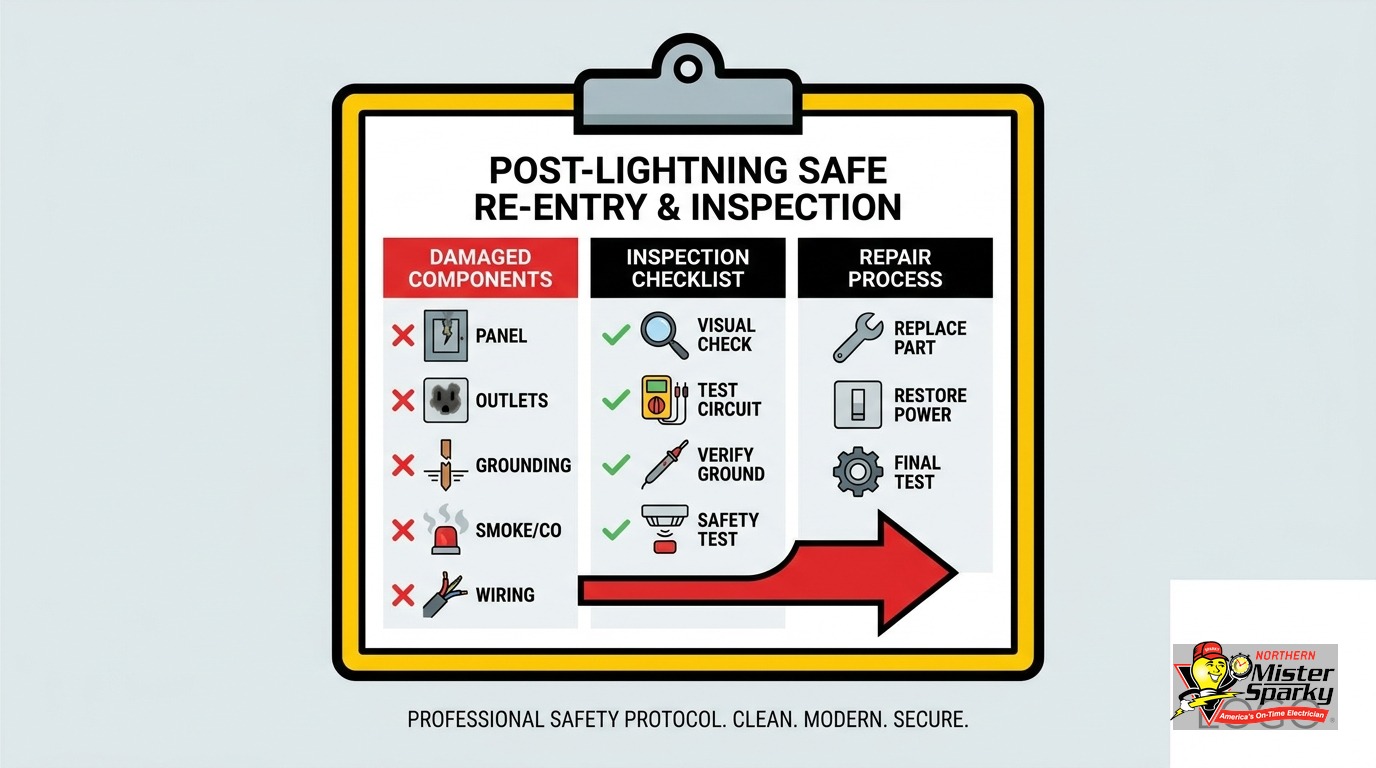
Key Takeaways
- Do not re-enter a lightning-struck home until the fire department clears it. Wiring fires smolder inside walls for 30 minutes or more before they become visible.
- Lightning does not need to hit your roof. A nearby strike to a power line or transformer sends a surge through your service entrance and into every circuit at once.
- The inspection runs from the outside in: meter base and service entrance conductors first, then the main panel, then branch circuits, then individual loads.
- Any electrical repair after a lightning strike requires a Minnesota permit. Skipping it can void your homeowners insurance payout.
- If your service mast is damaged, Xcel Energy will not restore power until a licensed electrician repairs it and it passes inspection.
- A whole-home surge protection system installed before storm season is the most effective way to limit damage on the next strike.
- Call Northern Mister Sparky at 763-200-5956 or book online to schedule your post-storm inspection.
Is It Safe to Go Back Inside After Lightning Strikes My House?
Not yet. Wait for a fire department all-clear before re-entering. Wiring fires smolder inside walls for 30 minutes or more before becoming visible. The house can look completely normal from the outside while actively burning inside.
Once the storm passes, the instinct is to check the damage. That instinct can get you hurt. A lightning strike superheats wiring and insulation inside wall cavities. The material smolders for a long time before it breaks into open flame. By the time you smell smoke, the fire has already spread.
Here is the re-entry protocol we recommend:
- Call 911 first. Let the fire department do a walkthrough or thermal scan. They have tools to find hot spots inside walls that you cannot detect.
- Do not flip breakers, restore power, or plug anything in until an electrician has inspected the system.
- Check the attic before sleeping. Roof strikes travel down through structural members. The attic is where insulation and framing meet wiring, and it is often the last place a smoldering fire surfaces.
- Use your nose. Burning plastic insulation has a distinctive smell. If you detect it anywhere in the house, get everyone out and call 911.
- Do not trust appliances that seem fine. A voltage spike can destroy the control board inside a refrigerator or smart thermostat while the device still powers on.
According to electricalconnection.org, wiring fires from a lightning strike are among the most costly damage scenarios because locating a hidden fire requires opening finished walls - work that adds significant cost and time on top of an already stressful situation.
How Does Lightning Enter a Home’s Electrical System?
A direct roof strike is not required for serious electrical damage. A nearby strike to a power line or transformer sends a surge through your utility connection and into every circuit simultaneously. The main panel absorbs the worst of it, but the damage spreads throughout the house.
There are two entry paths for a lightning surge:
Direct strike. The bolt hits the structure - the roof, a chimney, a tree close to the house. Current follows the path of least resistance, which is often the wiring inside the walls, the plumbing, or the metal flashing. The service entrance conductors take the hit before the panel ever sees it.
Indirect strike (line surge). The bolt hits a utility line, a nearby transformer, or the ground close to the house. A massive voltage spike travels in through the meter base and service entrance. As staleyelectric.com explains, every circuit in the house gets hit at once, because the surge enters at the service entrance and fans out through the panel into every branch circuit.
Both paths cause serious damage. The indirect strike is actually more common, and homeowners often underestimate it because there is no visible hole in the roof and no obvious point of impact.
What Components Get Damaged by a Lightning Strike?
Lightning doesn’t play favorites. A surge enters at the meter base and travels inward through the service entrance conductors, the main panel, and every branch circuit - reaching outlets, switches, and connected appliances throughout the house. Damage at each stage can be invisible to the eye.
Here is what our team looks for, from the outside in:
Meter base and service entrance conductors. This is the first point of contact for a line surge or a strike to the weatherhead. The conductors can be burned, the meter socket can be melted or cracked, and the enclosure can show internal arcing. Damage here is sometimes obvious - a blackened weatherhead or a distorted meter socket - and sometimes subtle enough to require close inspection.
Main panel. Bus bars are the copper or aluminum conductors inside the panel that every breaker clips onto. A surge can pit and burn the surface of the bus bars, degrade neutral bar connections, and destroy individual breakers. AFCI and GFCI breakers are especially vulnerable because their internal electronics are sensitive to transient voltage. A breaker that trips and resets normally after the storm is not necessarily undamaged - internal arcing damage can cause nuisance trips or outright failure weeks later.
Branch circuits and wiring. The surge travels out from the panel through every branch circuit at once. Wiring insulation can char at connection points, in junction boxes, and at outlet and switch locations throughout the house. This is the damage that hides inside walls and shows up later as a fire.
Appliances and electronics. Staleyelectric.com notes that modern appliances with electronic control boards - HVAC systems, refrigerators, ranges, and smart home hubs - are particularly vulnerable. A brief voltage spike can destroy the circuit board while leaving the appliance physically intact. The device powers on but behaves erratically or fails entirely days later.
Surge protectors and protection devices. These are designed to absorb transient voltage - which means they may have sacrificed themselves protecting downstream equipment. Any surge protection device in the house needs to be tested or replaced after a major strike, because a depleted device is no longer protecting anything.
What Does a Post-Strike Electrical Inspection Cover?
A licensed electrician inspects from the outside in: meter base and service entrance first, then the main panel, then branch circuits, then individual loads. The goal is to find invisible damage that would cause a fire or failure later, and to document everything for the permit and insurance claim.
Here is what our team covers at each stage:
Service entrance and meter base. We check the weatherhead, drip loops, service entrance conductors, and meter socket for burn marks, melted insulation, and arcing. If the service mast is damaged, Xcel Energy will not restore power until a licensed electrician repairs it and it passes inspection. Our service mast repair team handles this coordination regularly after severe Twin Cities storms.
Main panel. We open the panel and inspect bus bars for pitting and burn marks, check neutral bar connections for looseness or corrosion, test every breaker, and look for signs of internal arcing. AFCI and GFCI breakers get individual attention. We do not assume a breaker is fine just because it resets.
Branch circuits. Using a combination of visual inspection and electrical testing, we assess wiring throughout the house. Where we find charring at boxes, burned insulation, or abnormal resistance readings, we document the location for the permit file and the insurance adjuster.
Loads and appliances. We check outlets, switches, and hardwired appliances. We advise on plug-in electronics and major appliances, though those typically go through a separate insurance adjuster process.
Throughout the inspection, we photograph everything and produce a written report. That documentation supports your homeowners insurance claim and is required for the permit file. No documentation, no claim. It is that straightforward.
Do Minnesota Homeowners Need a Permit for Lightning Damage Repairs?
Yes, without exception. Any electrical repair or replacement after a lightning strike requires an electrical permit in Minnesota. This includes wiring, panels, apparatus, and equipment. Skipping the permit can void your homeowners insurance coverage on the repair.
This is the detail that most generic online posts never mention, and it matters more than most homeowners realize. The Minnesota Department of Labor and Industry requires an electrical permit for work that covers replacing wiring, panels, or electrical equipment. That captures virtually everything a post-strike inspection might uncover.
All permitted work must comply with the current electrical code. As of August 17, 2026, Minnesota requires all permitted electrical work to comply with the 2026 NEC. If a contractor tells you the work can be done without a permit because it is “insurance work” or a “repair,” that is incorrect. The permit requirement applies regardless of how the job is funded.
In practice, your electrician pulls the permit, the work is inspected by the state, and the signed-off permit record goes to your insurer as part of the claim documentation. A repair done without a permit leaves you with unpermitted work that can complicate a future home sale and potentially invalidate the insurance payout entirely. Our electrical permit guide explains how the Minnesota process works for homeowners.
How Much Does Lightning Strike Electrical Damage Cost?
The numbers are significant. The national average homeowners insurance claim for lightning damage was $17,513 in 2023, up 14.6% from 2022. Twin Cities repair costs vary by what was hit - a damaged panel is a different scope than burned wiring throughout finished walls.
The Insurance Information Institute reported 70,787 lightning claims were filed nationally in 2023, totaling $1.24 billion in losses. Those averages reflect real damage, not worst-case numbers.
What drives costs up:
- Panel replacement. If bus bars are pitted or the enclosure shows arcing damage, the panel is replaced, not repaired. A panel replacement in the Twin Cities runs from $2,500 to $5,000 or more depending on size and service entrance condition.
- Service entrance work. Replacing the weatherhead, service entrance conductors, and meter base adds cost and requires coordination with Xcel Energy for reconnection and inspection.
- In-wall wiring damage. Finding and replacing burned wiring inside finished walls requires opening drywall. That drives up both the electrical cost and the general contractor cost for patching and repainting.
- Appliance and electronics replacement. The insurance claim often covers electronics and appliances separately from the structural electrical work. Document every affected device before cleanup begins.
Minnesota ranks 22nd nationally in total cloud-to-ground lightning pulses. Southwestern Minnesota sees particularly high concentrations of positive-polarity strikes. This is not a rare scenario for local homeowners - the Twin Cities metro gets hit hard during storm season.
When Is Lightning Season in the Twin Cities?
Minnesota’s peak lightning season runs June through August. Severe thunderstorms producing damaging winds and significant ground strikes are common throughout the metro during that window.
That three-month window is the highest-risk period for Twin Cities homes. It is also the right time to act on prevention. A whole-home surge protection system installed before the season starts is the most effective step a homeowner can take to limit electrical damage when the next storm rolls through.
If your home has never had a whole-home surge protector installed, the period before June is the ideal time to schedule it. If it has one but it absorbed a surge during a previous storm, it needs to be replaced - a depleted unit offers no protection.
How Do You Protect Your Home Against the Next Strike?
A whole-home surge protection system with a Type 1 device at the service entrance and a Type 2 device at the main panel blocks the surge before it reaches your wiring and appliances. A power strip protects one outlet. A whole-home system protects every circuit at once.
NFPA 780 requires Type 1 SPDs at the service entrance and Type 2 SPDs at distribution panels as part of a complete lightning protection system. A properly installed system can be up to 99% effective at preventing damage. That investment looks very different when measured against the average $17,513 claim.
Our surge protector installation service covers whole-home SPD installation from the service entrance down to panel-mounted units. It is one of the most straightforward upgrades we install, and one of the most impactful for storm-exposed homes.
One important note: if your home already has a whole-home surge protector, it may need to be replaced after a major strike. The device may have absorbed the surge - which is exactly what it is designed to do. But a depleted SPD is no longer protecting your home, and many homeowners do not realize they are running without protection until the next storm proves it.
Signs Your Home Was Hit (Even If You Didn’t See It)
You may not always know a strike hit your home directly. Here are the indicators that warrant a call:
- Breakers tripped across multiple circuits at the same time, not just one
- A burning smell anywhere in the house, even faint or intermittent
- Outlets or switches that are warm to the touch, discolored, or show scorch marks
- Appliances that stopped working after the storm, especially electronics
- Internet router, cable box, or smart home hub that will not power on
- GFCI or AFCI outlets that trip immediately or will not reset
- Lights that flicker or dim unexpectedly in the days following the storm
- The main breaker tripped with no obvious cause
Any one of these signals after a storm warrants an electrician inspection. For a broader list of electrical warning signs in your home, see warning signs you need an electrician.
What to Tell Your Insurance Company
Call your insurer as soon as the fire department clears the house. Before any cleanup or repair work:
- Photograph the meter base, weatherhead, and exterior of the panel enclosure
- Photograph any visible burn marks, discoloration, or damage to outlets, switches, or appliances
- Note the date and time of the storm and the approximate time you noticed damage
- List every appliance or electronic device that stopped working after the storm
- Ask your insurer whether they want an adjuster on-site before or after the electrician inspection - some carriers want first look; others prefer the licensed inspection report first
Most insurers require the licensed electrician’s inspection report and the permit documentation before closing the claim. We provide both. If you have questions about how the permit and inspection process supports your claim, our team can walk you through it.
Schedule Your Inspection Today
Lightning strike electrical damage moves fast - and silently. The wiring fire that starts inside a wall tonight can be a total loss by morning. The burned neutral bar that looks minor today can fail under load next week. The stakes are high, and the inspection is how you find out exactly what you are dealing with.
Northern Mister Sparky is locally owned and operated in the Twin Cities. We are America’s On-Time Electrician(R), which means we show up when we say we will, every time. Every job is backed by the UWIN(R) 100% satisfaction guarantee.
Call 763-200-5956 or book online. We will inspect your system, pull the required Minnesota permit, coordinate with Xcel Energy if the service entrance is involved, and get your home back to safe.
Frequently Asked Questions
Is it safe to go back inside after lightning strikes my house? +
Do I need an electrical permit for lightning damage repairs in Minnesota? +
How do I know if lightning damaged my home's electrical system? +
How much does lightning strike electrical damage cost to repair? +
Need an electrician now?