
Whole House Surge Protector Installation Cost: MN Guide
Key Takeaways
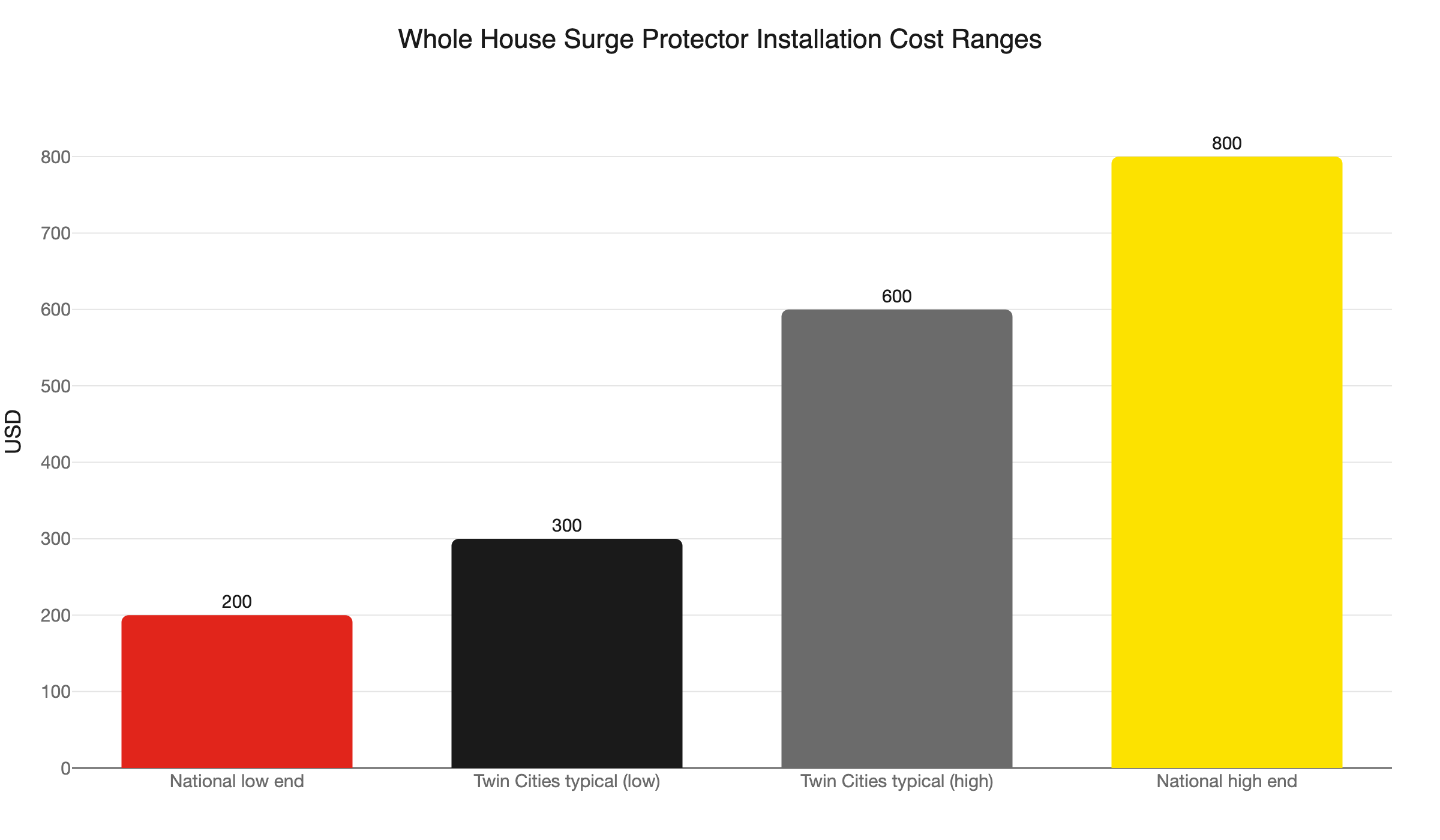
- Whole house surge protector installation costs $300-$600 in the Twin Cities for a standalone service call. The national range is $200-$800.
- Minnesota adopted NEC 2023 on July 1, 2023. Any permitted service or panel replacement now requires a Type 1 or Type 2 surge protector under Article 230.67.
- Bundling the install with a panel upgrade cuts cost by 30-50% because the electrician is already on-site with the panel open.
- About 80% of damaging surges start inside your own home, from large motors cycling on and off. This is not primarily a lightning problem.
- The device can silently fail after absorbing a major surge event. Plan to replace it every 5-10 years or after any significant nearby strike.
- Xcel Energy’s $1,500 panel upgrade rebate includes the required surge protector as a mandatory line item on qualifying jobs. That partially subsidizes the cost.
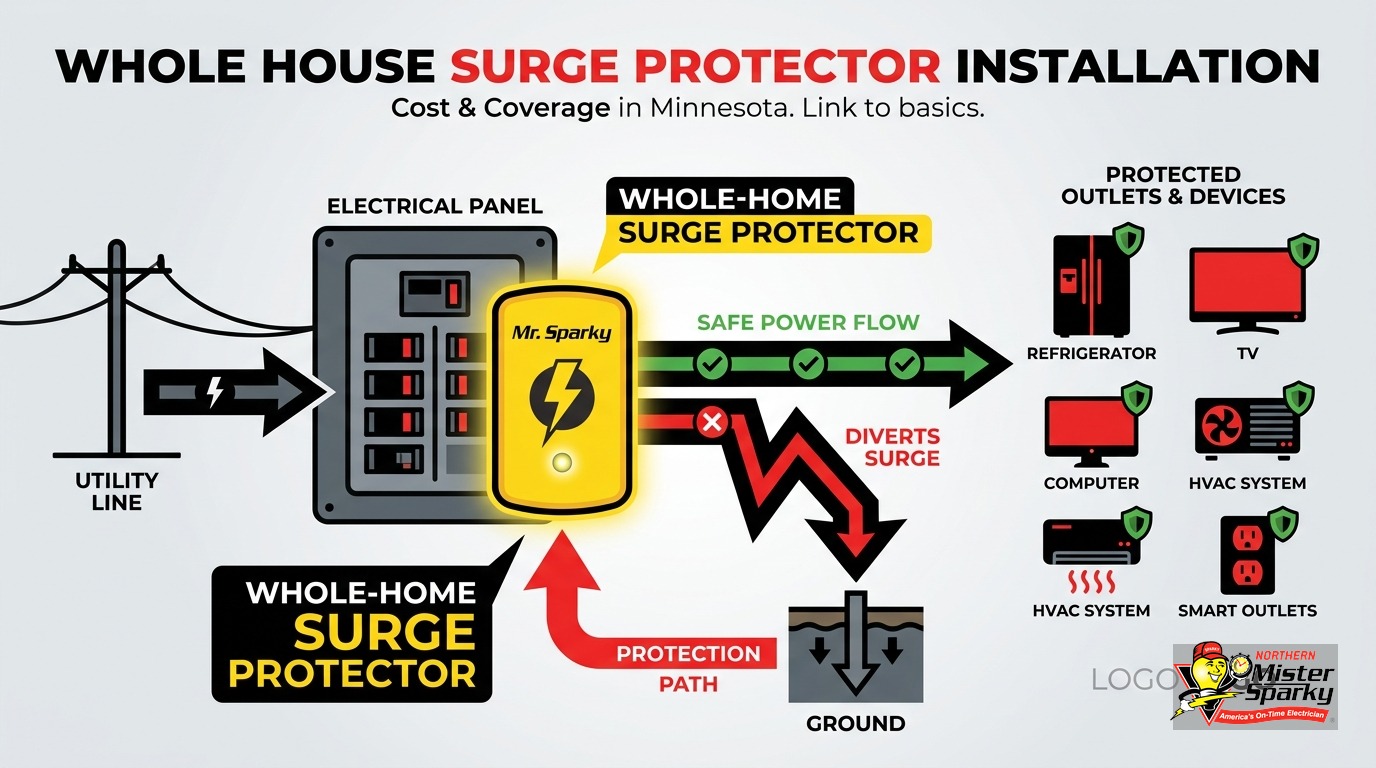
- A panel-mounted device covers your HVAC, EV charger, electric water heater, and every hardwired appliance. A plug-in power strip never reaches those.
What Does Whole House Surge Protector Installation Cost in the Twin Cities?
The short answer: Most Twin Cities homeowners pay $300-$600 for a standalone installation. The device runs $60-$500 and labor adds $100-$350 for roughly two hours of work.
National cost data from HomeAdvisor puts the full installed range at $200-$800. Twin Cities pricing lands in the middle of that for most standard jobs on a modern, accessible panel. Budget $400-$500 as a reasonable midpoint estimate if your panel is in good shape and easy to reach.
Three things push the price higher:
- A crowded or older panel. If the electrician needs extra time to work safely around a packed breaker box, labor climbs.
- A detached garage or workshop subpanel. Protecting a subpanel is a separate device and a separate job. Each panel needs its own surge protector under NEC 2023.
- Premium devices. Higher joule ratings, LED status indicators, and thermal fusing cost more upfront. Those features matter, though, especially the status LED, which tells you when the device has stopped offering protection.
Three things bring the price down:
- Bundling with another job. Adding a surge protector during a panel upgrade, EV charger installation, or service entrance replacement cuts 30-50% off the cost. The panel is already open. There is no second service call and no panel re-opening fee.
- Qualifying for the Xcel Energy rebate. If your panel job qualifies, the rebate offsets the whole project cost, surge protector included. More on that below.
- Simple panel access. A modern, well-organized panel in a dry basement is a quick, clean install.
If you are not planning any other electrical work and want protection added today, $400-$500 is a realistic number to work from when getting quotes in the metro area.
When Is Whole House Surge Protector Installation Required by Minnesota Code?
The short answer: Minnesota adopted NEC 2023 on July 1, 2023. Any permitted electrical service or panel replacement after that date requires a Type 1 or Type 2 surge protection device.
The legal basis is NEC Article 230.67, which mandates surge protection on all services supplying dwelling units. Ditek’s breakdown of the NEC 2023 rules confirms that NEC 2023 also expanded coverage to feeder panels under Article 215.18. In plain terms: subpanels now require surge protection on code-compliant replacements, not just the main service entrance.
What this code requirement does not mean:
- It does not require you to retrofit a surge protector onto an existing panel you are not replacing or permitting. The trigger is a permitted service or panel replacement.
- It does not apply retroactively to work completed before July 1, 2023.
- It does not give any inspector reason to overlook a missing SPD on a post-July 2023 permitted panel job.
What this means practically: if your panel replacement is coming in the next year or two, the surge protector is a mandatory line item, not an optional add-on. Budget for it as part of the job. As covered in our whole home surge protection guide, the requirement is also genuinely protective, not just a compliance checkbox.
Minnesota is currently on NEC 2023. NEC 2026 rulemaking is in progress with a tentative July 1, 2026 effective date. Future code revisions may bring additional requirements for existing homes.
What Does a Whole House Surge Protector Actually Cover?
The short answer: Everything connected to your electrical panel. That includes your HVAC system, EV charger, electric water heater, hardwired appliances, and every outlet in the house.
That scope is the core advantage over plug-in strip protectors. A $30 power strip covers only the devices plugged into it. A panel-mounted device covers your entire electrical system, including the equipment a strip never reaches.
ABB’s overview of whole home surge protection highlights the categories where this coverage matters most:
- HVAC systems. Your furnace, air conditioner, and heat pump all have sensitive control boards. Surge damage to a control board can cost as much as replacing the unit. A new HVAC system is one of the strongest arguments for adding a panel SPD now.
- Smart appliances. Modern refrigerators, dishwashers, and washing machines carry electronics that older models never had. They are surge-vulnerable in ways your parents’ appliances were not.
- EV chargers and solar inverters. Both are high-value, surge-sensitive electrical assets. Damage to a Level 2 charger or a solar inverter is a costly repair that a panel SPD helps prevent.
- Home automation and security systems. Anything hardwired to a circuit is on the panel and covered by a properly installed device.
For homes with a detached garage that has its own subpanel, that subpanel may need a separate device to meet NEC 2023 code on any future replacement work.
What Doesn’t a Whole House Surge Protector Cover?
The short answer: A direct lightning strike to your home’s structure. That requires a separate lightning protection system. The panel SPD handles the spikes that travel along utility lines, not a direct hit.
A panel-mounted device clamps the voltage spikes that enter through your utility connection. When lightning strikes a transformer or power line within roughly 10 miles, it can send a damaging spike down the wire into your home. The SPD catches that spike before it reaches your devices.
What it does not stop:
- A direct strike to your roof or structure. The energy from a direct hit overwhelms any SPD. Ask a Prepper’s breakdown of what surge protectors actually do explains the distinction clearly. Direct strike protection requires a separate system with lightning rods, down conductors, and bonded ground terminations.
- Sustained overvoltage. If your utility delivers elevated voltage for an extended period, that is a utility delivery issue, not a transient spike. An SPD was not designed for that scenario.
- Protection after the device has silently failed. The internal components degrade with each absorbed event. More on this in the replacement section below.
One figure worth knowing: the national average lightning insurance claim runs around $21,000. That covers structural damage, fire, and total electronics loss, well beyond what any SPD handles. A whole house surge protector is one layer of protection, not a complete lightning defense strategy.
Where Do Most Surges Actually Come From?
The short answer: Inside your own home. About 80% of damaging surges are generated by large motors cycling on and off, not by external lightning.
This surprises most homeowners. The mental image is a thunderstorm and a lightning bolt. That is a real risk, but it is not where most surge damage originates.
OPALCO’s surge protection data puts it directly: roughly 80% of damaging surges are created internally, by equipment that starts and stops repeatedly. Your HVAC compressor, refrigerator, washing machine, garage door opener, and other motor-driven devices each produce a small voltage spike every time they switch on or off. Those spikes are smaller than a lightning surge, but they happen dozens of times a day, every day.
Over months and years, that repeated stress degrades electronics: the control boards inside your appliances, smart home devices, computers, and entertainment equipment. A panel-mounted SPD absorbs those internal spikes continuously, protecting your devices from daily wear they would otherwise accumulate invisibly.
External surges from lightning account for roughly 15% of total surge events. The remainder comes from utility switching, downed lines, and line faults during storms.
Twin Cities homeowners face a genuine external risk: the metro averages 30-40 thunderstorm days per year, peaking May through August. A lightning strike up to 10 miles away can send a damaging spike down your utility line. That seasonal exposure is real. But the daily grind of internal motor surges is the quieter, year-round threat that a panel SPD handles every single day, not just during storm season.
Should You Add Whole House Surge Protector Installation Now or Wait for Your Panel Job?
The short answer: Add it now if you have an EV charger, new HVAC, or a home full of modern electronics. Wait and bundle it if a panel upgrade is coming within the next 6-12 months.
The decision comes down to two questions: how much do you have to protect right now, and is your panel staying put?
Add it now if any of these apply:
- Your home has an EV charger, solar inverter, or a recently replaced HVAC system. These are high-value, surge-sensitive assets. A $400-$500 install is inexpensive insurance against a $2,000-$5,000 repair.
- Your panel is modern, properly sized, and not scheduled for replacement. If the panel is healthy, adding an SPD now locks in protection without waiting.
- You have had a recent nearby lightning event or storm and your current setup is unprotected. The risk window is open until you close it.
Wait and bundle if any of these apply:
- Your panel upgrade is already scheduled or clearly coming within 6-12 months. The SPD is a mandatory line item on that permitted job under Minnesota code. Adding it on the same visit costs 30-50% less than a standalone call.
- You are planning a major addition, a service upgrade, or a detached garage subpanel. Pulling a permit for any of those triggers the code requirement, so the SPD is on the job regardless.
- Your Xcel Energy rebate window is open. If you qualify for the $1,500 panel rebate, bundling the SPD with that job makes the most financial sense.
Our post on electrical panel upgrade timeline and what to expect walks through what a panel replacement project looks like from permit to final inspection. That is the right context for timing a bundled install.
One scenario where you should not wait: if your panel has known problems. Breakers that trip frequently, double-tapped wiring, or a flagged panel brand are reasons to act on the panel first. A surge protector on a compromised panel is not a substitute for fixing the panel itself.
How the Xcel Energy Rebate Changes the Math
Xcel Energy offers a $1,500 rebate on qualifying panel upgrades in Minnesota. The requirements: upgrading from 100A to 200A service, using a licensed electrician, and a Minnesota residential property of 1-4 units.
Because the surge protector is a mandatory line item on any post-July 2023 permitted panel replacement, the SPD cost is built into a qualifying Xcel rebate job. You are not paying for the surge protector and the panel upgrade as separate budget items. The $1,500 rebate offsets the full project, surge protector included.
The Xcel Energy MN Rebate Summary covers the eligibility details. Rebate payment arrives 6-8 weeks after invoice and permit submission.
This is a meaningful offset. A 200A panel upgrade with a surge protector, permit, and licensed labor runs $3,000-$5,000 in the Twin Cities. A $1,500 rebate cuts that substantially. If you are on the fence about timing a panel upgrade, the rebate availability is a genuine financial reason to move sooner.
Our post on Xcel Energy electrical rebates in Minnesota covers the full rebate picture for homeowners considering a panel or service upgrade, including other programs that may apply.
One note on the licensing requirement: no malarky here. An unlicensed installation disqualifies the rebate outright and creates permit and homeowner insurance exposure. A licensed electrician is required, not optional.
Financing is available for larger panel and service work. Ask about it when you book if the upfront cost is a factor.
How Long Does a Whole House Surge Protector Last?
The short answer: Typically 5-10 years, or sooner after any significant surge event. The device can degrade silently and offer zero protection while appearing fully functional.
This is the detail most homeowners and most online articles miss entirely. The MOV (metal oxide varistor) components inside a whole house surge protector absorb energy each time a voltage spike hits. Every absorption degrades the material slightly. After enough cumulative exposure, or one major event, the MOVs can fail completely.
The problem: a failed SPD often shows no external fault indicator. The “protected” LED stays green. The device looks fine. But it is no longer absorbing anything.
What to watch and do:
- Check the status indicator light regularly. Most quality devices have a visible LED that turns off when protection is gone. If the light is off, the device needs replacement.
- After any major nearby lightning event. If you heard a close strike or lost a device despite having protection, have an electrician verify the SPD’s condition before trusting it again.
- At 10 years or older. Replace proactively. Budget $150-$300 for a replacement device on an existing install, plus the service call.
- After the device’s rated joule capacity is spent. Better devices publish a maximum joule absorption rating. Once that is consumed, the device is done regardless of what the indicator shows.
A whole house surge protector is not a set-and-forget installation. It has a service life. Treating it that way is the difference between real protection and the appearance of protection.
Schedule Whole House Surge Protector Installation in the Twin Cities
Northern Mister Sparky is locally owned and operated in the Twin Cities, backed by the national Mister Sparky franchise and the “America’s On-Time Electrician(R)” reputation. We install panel-mounted surge protection as a standalone job or bundled with any panel upgrade, service entrance work, or EV charger installation.
If your panel job qualifies for the Xcel rebate, we handle the permitted work. You submit the rebate paperwork; we make sure everything meets code and inspection.
Visit our surge protector installation service page for details on what we install and how jobs are priced. Or go straight to scheduling.
Call 763-200-5956 or book online to get an electrician to you fast. All work is backed by the UWIN(R) 100% satisfaction guarantee.
Frequently Asked Questions
How much does whole house surge protector installation cost in the Twin Cities? +
Is a whole house surge protector required by Minnesota code? +
Does a whole house surge protector protect against a direct lightning strike? +
Need an electrician now?