
Appliances Not Working After Power Outage Restored
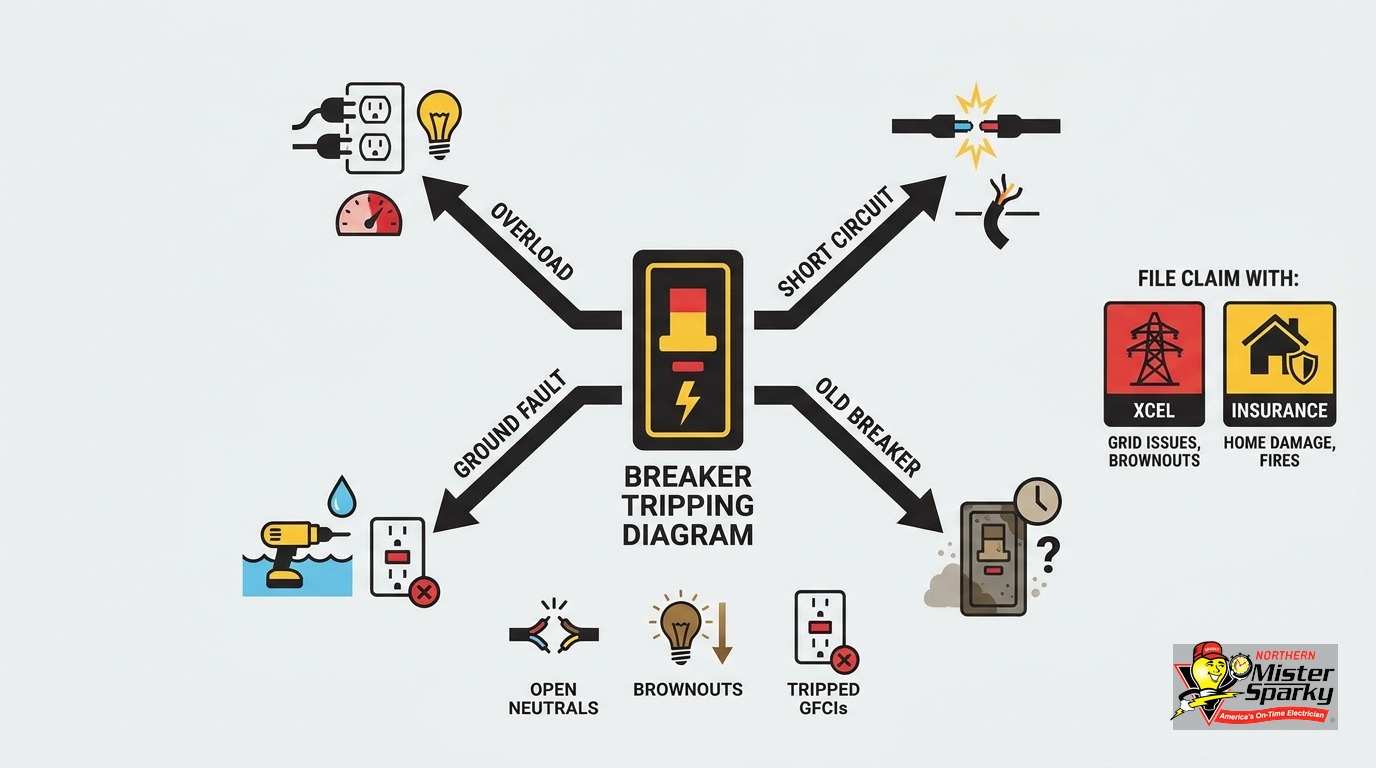
Key Takeaways
- Look at the pattern first. Dead outlets in one area point to a breaker or GFCI. Bright and dim lights point to a service problem.
- If lights run bright or dim, or get worse when a big appliance starts, stop using the house. Call Xcel or an electrician.
- A shock from a metal appliance, a crackling panel, or a burning smell means leave the area and call for help right away.
- Test every GFCI, AFCI, and smoke or CO detector with its Push to Test button. Surge damage does not always show.
- Wait a few minutes after power returns before plugging sensitive electronics back in.
- File an Xcel claim online with photos and receipts. Also call your own insurer to ask what your policy covers.
- A damaged service mast needs an electrician before Xcel can restore service. Ask your city or the state about permits first.
Why Appliances Act Strange After the Lights Come Back
The lights are back on, but the oven stays dark, the fridge hums oddly, or the microwave clock never returns.
Most homeowners blame the appliance. Sometimes that is right. Often the problem sits in the wiring that feeds your house.
We are a locally owned and operated Twin Cities electrician. After big storms and cold snaps, we get the same calls: the power is “back,” but something is off.
For our broader outage checklist, read our guide to electrical safety after a power outage.
How Can I Tell a Bad Appliance From a Bad Service Connection?
Look at the pattern across your whole house. One dead appliance usually means that appliance, its circuit, or its GFCI. Several dead items, plus lights that run bright or dim, point to a problem on the service side.
Most web advice stops at “reset it and wait.” That misses the pattern. These clues help more.
Signs the problem is one appliance or one circuit:
- Only one appliance is dead, and other items nearby work fine.
- A group of outlets in one room or area is dead.
- A breaker or GFCI is tripped.
- The appliance shows an error code.
Signs the problem is at the service connection:
- Some devices are dead while others in different rooms work.
- Some lights are very bright and others are very dim.
- Things get worse when a big load starts, such as a dryer, oven, or furnace blower.
- Electronics act strangely, flicker, or reset on their own.
- The panel crackles or smells like something is burning.
The first list is a repair job. The second is a safety job.
If half your house is dead, our post on losing one leg of power explains what is happening in the panel.
What Is an Open Neutral, and How Do I Spot One?
An open neutral is a break in the wire that completes the circuit back to the utility. Voltage can then swing unevenly inside your home. Some lights burn too bright, others too dim, and appliances can fail or overheat.
Your home gets power on three main wires. Two carry voltage. The third is the neutral, the return path.
When the neutral breaks, the balance is gone. The two sides of your panel no longer share the load evenly. One side can get too much voltage and the other too little.
A Finnish utility’s guide to open neutrals lists the warning signs well. Lights can be “exceptionally bright and some are very dim.” Equipment may be “working strangely.” You may feel a shock from a metal-cased device. You may hear crackling or smell burning at the panel.
That utility serves a different electrical system than ours, so its voltage numbers do not apply in Minnesota. The symptoms and the advice do. If you suspect an open neutral, contact the utility’s emergency line.
Storm damage to the service wires, a loose connection at the meter, or a damaged mast can all cause one. Ice, wind, and falling branches do this in the Twin Cities.
Do not try to find the break yourself. The wires involved are live and can hurt you badly.
What Should I Do Right Away If I Suspect a Service Problem?
Stop using the house’s electricity as much as you can. Turn off big appliances. Do not touch metal-cased devices if you have felt a tingle. Call Xcel’s emergency line or a licensed electrician. If you smell burning or see smoke, call 911.
Here is the order we recommend:
- Turn off large loads. Switch off the dryer, oven, and space heaters. Unplug sensitive electronics.
- Stay away from the panel if it is crackling, hot, or smells burnt.
- Call the utility. Xcel needs to know about a suspected neutral problem on its side of the connection.
- Call an electrician. We can check your side of the connection and make repairs safely.
- Take photos and notes. Write down what you saw, when it started, and which items acted up. You will need this later.
If anyone feels a shock from an appliance, faucet, or metal surface, leave the area. Call 911 if anyone is hurt.
Do not flip the main breaker on and off to “test” things. Do not run extension cords from working outlets to dead ones. Both can make things worse.
Our team handles urgent calls through our emergency electrician service. We are America’s On-Time Electrician(R), and we show up when we say we will.
What Is a Brownout, and Can It Hurt My Appliances?
A brownout is a drop in voltage that lasts longer than a flicker. Motors can overheat, electronics can reset, and some appliances can fail. Brownouts are harder to spot than outages because the lights stay on.
Many appliances run on motors or compressors: your refrigerator, furnace blower, well pump, and sump pump. Low voltage makes a motor draw more current to do the same work. That extra current makes heat.
Signs of a brownout or low-voltage event include:
- Lights that look dim across the house
- A fridge or freezer that clicks on and off repeatedly
- A furnace that tries to start and fails
- Electronics that restart without warning
A single brownout rarely destroys a healthy appliance. Repeated events can wear one out faster. If you see these signs often, the cause may be outside your home or inside your panel.
Our post on lights that dim when appliances turn on covers the in-house causes. Persistent trouble also deserves a closer look at your service connection.
Do I Need to Test My GFCIs and Detectors After an Outage?
Yes. A surge can damage GFCIs, AFCIs, and smoke or CO detectors without any visible mark. Press the Push to Test button on each one. If a device does not respond as it should, replace it. These devices protect your family.
The Electrical Safety Authority in Ontario gives clear advice. After a surge, it says to “check your electrical devices and safety equipment.” That includes GFCIs, AFCIs, and smoke and CO detectors.
Looking at a device will not show internal damage, so use the test button. The same page says, “If not, replace your devices.” That is an Ontario agency, but the test steps work the same way in Minnesota homes.
Here is how to run the check:
- GFCI outlets: Press Test. The power should cut off. Press Reset. The power should return.
- AFCI and GFCI breakers: Press the test button on the breaker. It should trip. Then reset it.
- Smoke and CO detectors: Press the test button on each. Listen for the alarm. Check any battery backup too.
Many of the dead outlets we find after outages are simply tripped GFCIs. One GFCI can protect several outlets down the line. A dead outlet in the garage might trace back to a GFCI in the basement bathroom.
If a GFCI will not reset, see our guide on what to do when a GFCI outlet won’t reset. After a surge, it may be damaged or may be protecting a faulty circuit.
Replace any device that fails its test. Do not tape over a failed alarm or leave a dead GFCI in place. We replace these every day, and the fix is quick.
How Long Should I Wait Before Plugging Things Back In?
Wait a few minutes after power returns so the supply can settle. Plug in sensitive electronics one at a time. This protects them from the swings that often follow a restoration.
Power often comes back messily. It can surge, drop, and surge again. Utilities restore lines in stages, and your block may see several bumps.
Prairie Electric Cooperative, a utility co-op in Texas, advises you to “wait a few minutes for the electricity to stabilize before plugging your things back in.” It gives no exact count, so we will not invent one. Use judgment. If the lights still flicker, keep waiting.
The same co-op says surge protectors “are designed to die in the event of a surge.” A power strip that took a hit may no longer protect anything. Many have a light that shows whether protection is still working. If yours is dark or off, replace it.
Here is a simple restart order:
- Leave your big appliances unplugged or switched off at first.
- Turn the main breaker back on if you shut it off.
- Switch on lights and watch for flicker, buzzing, or uneven brightness.
- Plug in the refrigerator and freezer.
- Add other appliances one at a time.
- Bring back computers, TVs, and chargers last.
If anything seems wrong at any step, stop and unplug it. Odd smells, sparks, or heat mean the item needs inspection.
A whole-home surge protector adds a layer at the panel. It guards every circuit, not just the outlets with a strip. Our whole-home surge protection guide shows how it works. We also offer financing on larger projects.
Who Pays: Do I File With Xcel or My Insurance?
You can pursue both. Xcel reviews the claims it receives, and your insurer decides what your policy covers. File with Xcel online with a detailed description and photos. Then call your insurer and ask about surge and outage coverage.
Most outage articles skip this part. It is a real decision with a paper trail, and here is how we suggest you approach it.
Do not assume who is responsible. Utility liability rules can be strict. We have not confirmed the exact limits in Xcel’s Minnesota terms, so we will not guess. Xcel decides each claim on its facts. The outcome may depend on the cause of the damage.
Start the Xcel claim early. Xcel’s online claim form asks for specific things. It says, “Please ensure that you provide a complete and detailed description of the incident that you believe caused your loss.” It also says, “A valid email is required to submit your claim online.”
After you submit, you will need backup. The form asks you to reply with “invoices, receipts, photographs of the damage, etc.” Gather these as you go:
- Photos of damaged appliances, labels, and model numbers
- The date and time the problem started
- Receipts or invoices for repairs and replacements
- A written report from an electrician, if one inspected your system
- Notes on what you saw, such as flickering or bright and dim lights
Call your insurer too. We could not find reliable Minnesota guidance on whether homeowners policies cover surge damage. Policies differ, so read yours or ask your agent directly. Ask about the deductible. A small loss may cost less than your deductible, so the choice may not be obvious.
Know where to turn for help. The Minnesota Department of Commerce lists consumer contacts. Complaints go to 651-539-1600. Greater Minnesota callers can use 800-657-3602. You can also email consumer.protection@state.mn.us. Its page links to guides on filing a residential claim and on the claims process.
Our electricians can write up what we find. A clear report on a failed neutral or a damaged mast helps any claim. We cannot promise how a claim will turn out, but we can document the facts.
What If My Service Mast Is Damaged?
If your mast is bent, pulled, or cracked, Xcel may not be able to restore power until an electrician repairs it. The mast is the pipe that carries wires from the utility line to your meter. Call an electrician quickly.
Xcel raised this after the April Fools’ Day storm. CBS Minnesota reported that customers still without power “should check for damage to their mast, which is the electric service connection to their home.” If there is damage, they need to consult an electrician before Xcel can restore service.
The article does not mention an inspection, so we will not claim one is always required. Rules vary by city, as covered below.
Signs of a damaged mast include:
- The pipe leans or bends away from the house
- The weatherhead at the top is loose or cracked
- Wires hang low, or pull away from the house
- The meter box looks loose or tilted
- Tree limbs or ice rest on the wires
Never touch a hanging wire. Stay back and call the utility.
Our guide to weatherhead and service mast storm damage repair covers the repair process. Mast repairs can cost more than people expect, and we offer financing to spread out the cost.
Does a Mast Repair Need a Permit in the Twin Cities?
Often, yes, but the rules depend on who inspects electrical work in your city. The state Department of Labor and Industry covers many areas. Some cities run their own programs. Check before work begins, or let your electrician handle it.
Here is what we can say with confidence. The DLI homeowner permit page says homeowners apply through the iMS system and must create an account. It tells you to check the electrical inspector directory to see whether the Authority Having Jurisdiction is “State” or “Local.” For questions, it lists iMS.support.dli@state.mn.us.
The page does not address emergency work or minor repairs. Do not assume a storm repair skips the permit. Confirm with DLI or your city.
Cities in the Twin Cities handle this differently. Some metro cities, including St. Paul, run their own electrical inspections. Our post on Minneapolis and St. Paul permit differences walks through what to expect.
A licensed electrician knows the local process. We pull the permits and schedule the inspections when they are needed. That keeps the repair legal and your insurance file clean.
Your Post-Outage Damage Check, Step by Step
Use this list once the lights are back. Work in order, and stop if you hit a warning sign.
Step 1: Look and listen. Walk through the house. Note any flickering, buzzing, or burning smell. Check the panel without touching it.
Step 2: Check the pattern. Are lights bright in one room and dim in another? Do items fail when a big load starts? If yes, stop and call.
Step 3: Check breakers. Look at your panel. A tripped breaker sits in the middle or off position. Reset it once. If it trips again, leave it off.
Step 4: Test GFCIs, AFCIs, and detectors. Press every Push to Test button. Replace anything that fails.
Step 5: Reconnect slowly. Wait a few minutes. Then add appliances one at a time.
Step 6: Document everything. Take photos. Save receipts. Write down dates and symptoms.
Step 7: Make your calls. Contact Xcel about service problems and file a claim if you have losses. Call your insurer. Call an electrician for any warning sign.
Step 8: Plan ahead. Consider surge protection for the whole home, and fix any weak spots we find.
This list is no substitute for a trained eye, but it catches most problems early. It also builds a record you can use later.
Winter Outages Add Their Own Risks
Cold weather raises the stakes. When a furnace blower or heat source fails, people reach for space heaters and extension cords. That adds load to circuits that may already be stressed.
We do not have Minnesota data on how many winter outages lead to electrical damage, so we will not quote a number. Our field experience is clear, though. Cold snaps push every system harder, and weak connections show up fast.
A few cold-weather tips:
- Plug space heaters straight into wall outlets, not extension cords.
- Do not run a generator inside your garage or home.
- Never connect a generator to your house without proper equipment. Our post on generator backfeed danger explains why this can kill line workers.
- Check outdoor outlets and GFCIs after ice and snow.
If you rely on power for medical equipment, plan ahead. A backup source and a clear contact list matter more than any appliance.
When to Call Northern Mister Sparky
Call us if you see any of the service-side warning signs. Call if a GFCI will not reset, a breaker keeps tripping, or you smell burning. Call if you just want a second opinion on what the outage did to your home.
We are locally owned and operated, and we live and work in the same Twin Cities neighborhoods you do. We know the weather, the older homes, and the local inspection rules. We give you straight answers with no malarky.
Here is what you can expect from us:
- We show up on time. We are America’s On-Time Electrician(R).
- We explain what we find. You get plain language, not jargon.
- We document our work. That helps with Xcel and insurance claims.
- We stand behind it. Our UWIN(R) 100% satisfaction guarantee backs our work.
- We offer financing on larger jobs, such as mast repairs, panel work, and whole-home surge protection.
Do not wait on a problem that could damage your home or hurt your family. Call 763-200-5956 or book online and we will get a licensed electrician to your door.
Frequently Asked Questions
Why are some appliances not working after the power came back on?
Common causes include a tripped breaker or GFCI, a surge-damaged appliance, or a service connection problem. If some items are dead while others run bright or dim, stop using the house. Call your utility or an electrician.
What is an open neutral?
It is a break in the neutral conductor that carries current back to the utility. It can leave some lights too bright and others too dim. Treat it as a hazard and call the utility’s emergency line.
Should I file with Xcel or my insurance company?
You can do both. Xcel reviews each claim, and your insurer decides what your policy covers. Document everything and submit the Xcel claim online with photos and receipts. Then ask your insurer about your coverage.
Do I need to test GFCI outlets after a power surge?
Yes. A surge can damage a GFCI, AFCI, or detector with no visible sign. Press each Push to Test button. Replace any device that does not respond properly.
Frequently Asked Questions
Why are some appliances not working after the power came back on? +
What is an open neutral? +
Should I file with Xcel or my insurance company? +
Do I need to test GFCI outlets after a power surge? +
Need an electrician now?