
Minneapolis vs St Paul Electrical Permit Requirements
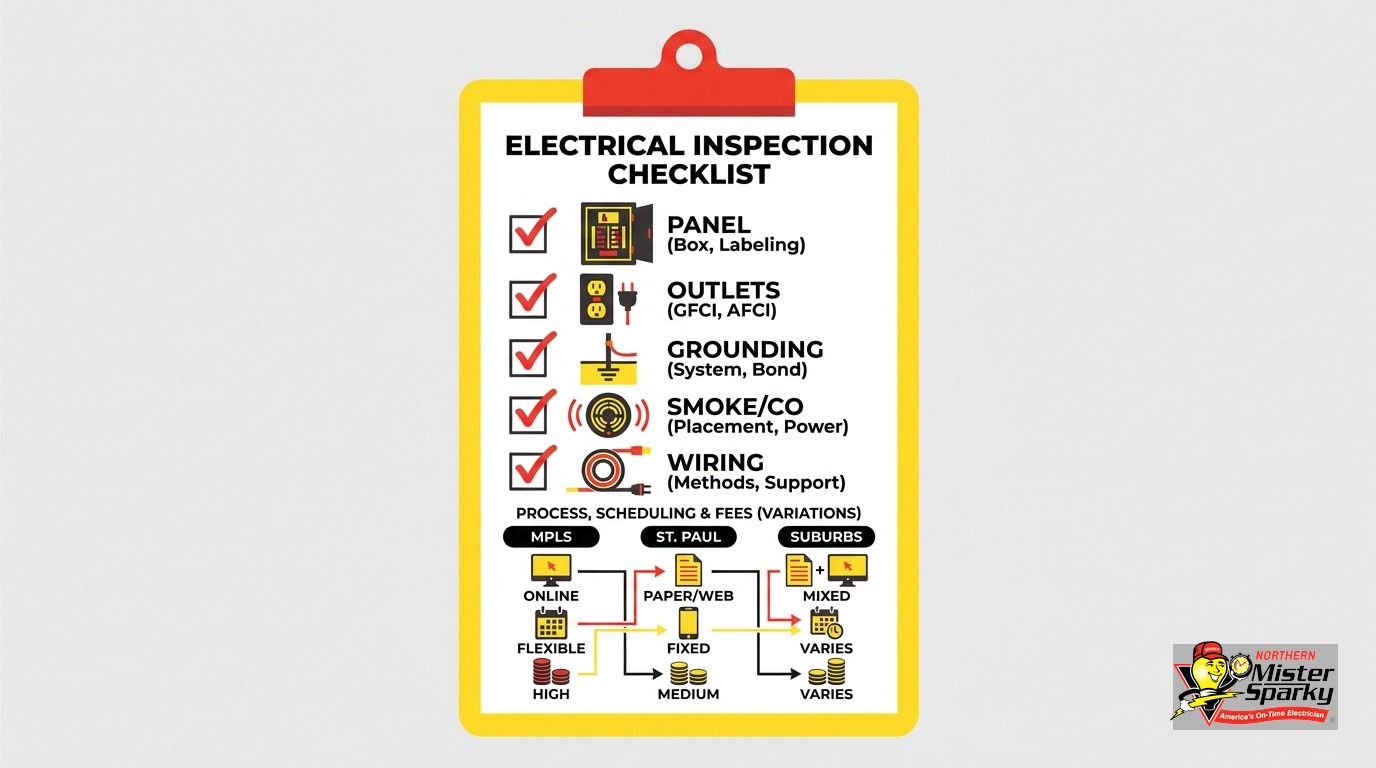
Key Takeaways
- Minneapolis does not run its own electrical inspections. The state does.
- St. Paul issues electrical permits and inspects with its own staff.
- In St. Paul, you call your inspector in a narrow window: 7:30 am to 9:00 am, Monday through Friday.
- In Minneapolis, the person who applied for the permit must set up each inspection.
- Suburbs vary. Some use the state, some run local programs, and some use private inspectors.
- Check the state’s inspector lookup before you file anything.
- St. Paul permits can expire after 180 days of no work.
- On state permits, you have 10 days to pay additional fees once notified.
- A licensed electrician handles all of this for you.
Why Twin Cities Permit Rules Are Not the Same
Many homeowners assume one metro area means one set of rules. For electrical permits, that is wrong.
Minneapolis and St. Paul sit a few miles apart, yet they handle electrical permits and inspections very differently. If you plan a panel upgrade, a new circuit, or an EV charger, the difference affects who you call, when you call, and what you pay.
We are Northern Mister Sparky, a locally owned and operated Twin Cities electrician. We pull permits in both cities and in the suburbs around them. This guide explains the differences in plain terms.
A note first. Permit rules and fees change. Treat this post as a map, not a final answer. Confirm details with your city or the state before you file.
What is the biggest difference between Minneapolis and St. Paul electrical permits?
Minneapolis sends electrical inspections to the state. St. Paul runs them in-house. That one split changes who issues your inspection, how you schedule it, and which fee schedule applies. The rest of the process follows from that choice.
Most online guides miss this. They list fee ranges for each city and stop. Those ranges often conflict with each other.
The conflict comes from the two cities working in different ways, so one range can’t describe both.
- Minneapolis: the city handles other permits, but the state handles electrical inspections.
- St. Paul: the city handles the permit, the fee, and the inspection.
Once you know that, the rest gets easier. Stop asking “what does the city charge?” Ask “which office is in charge of my job?”
Minnesota also sets the electrical code at the state level. Cities cannot adopt their own electrical code. What you build follows the same rules everywhere. How you get approval is what differs.
For a broader look at the state process, see our guide to the electrical permit process in Minnesota.
Who inspects electrical work in Minneapolis?
The state inspects electrical work in Minneapolis. The city’s own page tells you to contact the state for an electrical inspection. The applicant, whether homeowner or contractor, must set up each inspection with the inspector named on the permit.
That wording comes from the city. The City of Minneapolis onsite inspections page says electrical inspections are handled by the state. It also says “the homeowner or contractor who applied for the permit must set up the inspections.”
In practice, that means three things:
- Your permit lists the inspector’s contact information.
- Nobody from the city calls you to book a visit.
- If you do not call, the inspection does not happen.
This is where jobs stall. A homeowner finishes the work, then waits for someone to show up. Nobody does, because nobody was asked.
The city’s Construction Code Services number is 612-673-3000. Use it for questions about the city side of your project. For the inspection itself, call the inspector on your permit.
One caveat: that city page is long, and details about specific project types may sit deeper in it. Ask us or the city if your job is unusual.
Who inspects electrical work in St. Paul?
St. Paul inspects electrical work with its own staff. The city issues the permit, sets the fee, and sends its own inspector. You call that inspector directly, and the call has to land in a short morning window.
St. Paul keeps the whole process under one roof. You deal with one office from permit to final approval, which can feel simpler.
The city’s circuits and service electrical page sets the basic rules. All work must meet the latest edition of the National Electrical Code (NEC) adopted by Minnesota. The permit needs a completed application and the fee.
The St. Paul site also lists a system called PAULIE. Its navigation shows links for online permits and for scheduling an electrical inspection. The page does not explain how PAULIE works, so check the city’s site for current steps before you rely on it.
St. Paul has one clear advantage. The fees are published in one place, so you can estimate the permit cost before you start.
How much does a St. Paul electrical permit cost?
St. Paul charges $85.00 per service and $15.00 per circuit. The minimum fee is $85.00, and a state surcharge of at least $1.00 applies. Furnace and air conditioner installs use a per-unit, per-circuit fee with the same minimums.
Those numbers come from the St. Paul circuits and service page. Here is the breakdown:
- Per service: $85.00
- Per circuit: $15.00
- Minimum fee: $85.00
- State surcharge (minimum): $1.00
For equipment, the city has a separate furnace and air conditioner permit page. It lists $15 per unit installed per circuit, with an $85 minimum and a $1 minimum state surcharge.
A simple example: you add one new circuit. The per-circuit fee alone is less than the minimum, so the minimum applies.
Bigger jobs add up faster. A job with many new circuits will cost more than the minimum. Ask your electrician to count circuits before you file.
What about Minneapolis? We did not find an official Minneapolis fee schedule for state-inspected electrical work. We also could not confirm the state’s homeowner fee amounts, so we will not quote them here.
Be wary of fee ranges on third-party sites. Some quote wide, conflicting ranges for both cities. Without a source, treat them as rough guesses at best. Your electrician can confirm the real number for your job.
How do you schedule an electrical inspection in each city?
In St. Paul, call your permit’s inspector between 7:30 am and 9:00 am, Monday through Friday. In Minneapolis, the applicant contacts the state inspector named on the permit. Neither city sends an inspector unless someone asks.
This part trips people up. Scheduling is a task, and it belongs to you or your contractor.
St. Paul scheduling
The city says to call the inspector listed on your permit between 7:30 am and 9:00 am, Monday through Friday. The Electrical Inspection Department number is 651-266-9003. The window is short. Miss it and you wait for the next morning.
Put a reminder on your phone. Have your permit number in hand before you dial.
Minneapolis scheduling
The Minneapolis page says the applicant must set up the inspections. Inspector contact information is on the permit. Read the permit when it arrives, and save the inspector’s details.
For state-assigned permits, the state’s “issued” email also explains the “Ready for Inspection” process. For contract inspection areas, it gives your inspector’s contact information. Do not delete that email.
A tip for both cities
Book rough-in inspections before anything gets covered. “Rough-in” means the wiring is in the walls, but the drywall is not up yet. If drywall goes up first, the inspector cannot see the work. You may have to open the wall again.
How do Twin Cities suburbs handle electrical permits?
Suburbs vary. Some are state-inspected and some run local programs. Some contract with private inspectors. Fees, scheduling windows, and rules differ from town to town, so never assume your suburb works like Minneapolis or St. Paul.
If you live in Bloomington, Brooklyn Park, Woodbury, Blaine, Maple Grove, or Plymouth, check your own city first.
Hastings shows how different a suburb can be. Its residential electrical permit page says the total fee is the greater of two numbers:
- The fees listed on the application, or
- $75 multiplied by the number of required inspection trips.
That per-trip approach is unusual. It rewards a job that passes on the first visit and punishes one that needs repeat visits.
Hastings also schedules inspections by phone, Monday to Friday, 6:45 to 8:45 a.m. The page says rough-in must be inspected before wiring is covered.
The window differs from St. Paul’s, and so does the fee model. Even the start time is different.
That is why a one-size-fits-all checklist fails. A local electrician who works in your town every week knows the quirks. We work across the metro, so we track these differences for you.
What should you check before you file anything?
Check the state’s electrical inspector lookup first. Look at the AHJ column. AHJ means “authority having jurisdiction,” the office in charge of your inspection. If it says State, file with the state. If it says Local, contact the city or township.
Most guides skip this step. It saves real time.
The Minnesota Department of Labor and Industry (DLI) homeowner electrical permit page tells you to check the inspector lookup before filing or requesting an inspection. Here is how to use it:
- Open the lookup and enter your city or township.
- Find the AHJ column.
- If it says “State,” file through the state’s system.
- If it says “Local,” contact your city or township.
State permits are applied for online through DLI’s iMS system. You must create an account first. The page lists an iMS support email: iMS.support.dli@state.mn.us.
We have not confirmed how Minneapolis appears in the lookup. The city’s page points to the state for inspections. Still, run the lookup yourself. Directories change, and the lookup is the source that counts.
Filing in the wrong place wastes days. It can also leave you with a permit that no office is watching.
Who can pull the permit: a homeowner or a licensed electrician?
It depends on the city and the job. Minnesota has homeowner rules, and each city may set its own limits. Even where homeowners can pull a permit, many choose a licensed electrician for safety, speed, and a warranty on the work.
We could not verify the homeowner-eligibility rules for each city for this post, so we will not guess. Confirm eligibility with your city or the state before you plan a do-it-yourself job.
For the state-level picture, read our guide on the homeowner electrical permit exemption in Minnesota. It covers what homeowners can and cannot do.
Even when you are allowed to do the work, weigh the risk. A wiring mistake is nothing like a crooked shelf. It can cause shocks and fires. It can also fail inspection and cost you twice.
A licensed electrician brings three things:
- Knowledge of the code, so the work passes the first time.
- Experience with each city’s process.
- A permit that is pulled and closed correctly.
At Northern Mister Sparky, we stand behind our work with the UWIN(R) 100% satisfaction guarantee. We also work hard to be America’s On-Time Electrician(R). That matters when an inspection window is only 90 minutes long.
Do electrical permits expire?
Yes. In St. Paul, a permit expires if work does not start within 180 days of issue, or if work stops or is abandoned for 180 days. Exterior work on one- and two-family homes, including garages, must finish within one year.
Those rules come from the St. Paul circuits and service page. They matter more than most people expect.
Here is a common story. A homeowner pulls a permit in spring. Life gets busy and the job sits for months. By fall, the permit has lapsed. Now they need a new one, and a new fee.
Winter makes this worse in Minnesota. Exterior work stalls when the ground freezes. A detached garage circuit or a backyard outlet may sit through January. The one-year limit for exterior work gives you room. The 180-day rule for stalled work does not.
Keep these habits:
- Write down your permit’s issue date.
- Start work soon after you file.
- Keep working, or schedule your inspections, so the job never looks abandoned.
- Call the city before the deadline if plans change.
We did not confirm expiry rules for Minneapolis or for the state. Ask your inspector what applies to your permit.
What are the extra fees and deadlines on state permits?
On state permits, you have 10 days to pay additional fees once notified. You pay through your online account. After that window, the state mails an invoice. Watch your email so a small balance does not become a delay.
The DLI homeowner page states it plainly: “Once notified, you have 10 days to pay additional fees through your online account.” After that, an invoice is mailed.
Why would extra fees come up? A job can grow after you file. You may add circuits. The scope may change as walls open up. The state may bill the difference.
Here is how to stay ahead:
- Use an email address you check daily when you create your account.
- Watch for notices after you add work.
- Pay in the online account as soon as you see the notice.
We did not find a verified list of state fee amounts. The DLI page itself lists none. Before you budget, ask for a written estimate that includes permit costs.
What happens if you skip the permit or fail the inspection?
Skipped permits and failed inspections both cause delays. A failed inspection means you fix the problem and book a new visit. An unpermitted job can surface later, during a home sale, and slow or complicate the deal.
A failed inspection is a to-do list. The inspector tells you what to fix. You fix it and book another visit.
Our guide on what happens after a failed electrical inspection walks through the steps.
Skipping the permit is the bigger gamble. Buyers and their inspectors often look for open or missing permits. Our post on open electrical permits when selling a Minnesota home explains how that can play out.
In a city like St. Paul, an open permit that expires is also a problem. In a state-inspected city like Minneapolis, a permit with no inspection ever scheduled is the same kind of problem. Either way, the paperwork says the work was never approved.
The fix is simple. Pull the permit. Book the inspections. Get the final sign-off. Keep a copy.
How do the cities compare side by side?
Minneapolis uses state inspectors and expects you to schedule them. St. Paul uses city inspectors with a narrow morning call window. Suburbs differ. Always confirm your own jurisdiction before you start.
Here is a quick summary using only what we confirmed:
Minneapolis
- Inspections: handled by the state.
- Scheduling: the applicant sets up each inspection.
- Where to find the inspector: on the permit.
- Contact: Construction Code Services at 612-673-3000.
St. Paul
- Inspections: city staff.
- Scheduling: call the permit’s inspector, 7:30 am to 9:00 am, Monday through Friday, at 651-266-9003.
- Fees: $85.00 per service, $15.00 per circuit, $85.00 minimum, plus a $1.00 minimum state surcharge.
- Expiry: 180 days without work starting or after work stops.
State process (where the AHJ is State)
- Apply online through DLI’s iMS system.
- Create an account first.
- Pay additional fees within 10 days of notice.
Hastings (suburb example)
- Fee: the greater of the application fees or $75 per required inspection trip.
- Scheduling: phone, Monday to Friday, 6:45 to 8:45 a.m.
- Rough-in: inspect before wiring is covered.
Which jobs usually need a permit?
Most jobs that add or change wiring need one. Panel upgrades, new circuits, service changes, and equipment hookups are typical examples. Simple swaps, like replacing a light fixture, may be treated differently, so confirm with your city.
We cannot list every exemption for every city here, and we did not verify each one. The common permit jobs are easy to name:
- Panel upgrades and service changes
- New circuits for kitchens, basements, and garages
- EV charger installs
- Furnace and air conditioner electrical hookups
- Hot tubs, saunas, and generators
For a big project, start with the permit step. For panel work, our panel upgrade service page explains what we handle. We pull the permit, schedule the inspections, and keep the project moving. Financing is available for larger jobs like panels, generators, and EV chargers.
A simple plan for your next permitted project
Confirm your jurisdiction, pull the permit, schedule rough-in, then book the final. Keep your permit number and inspector details close. A clear plan keeps inspections on schedule in any Twin Cities city.
This plan works in Minneapolis, St. Paul, and the suburbs:
- Find your authority. Run the state’s inspector lookup. Note whether it says State or Local.
- Get a written scope. List each circuit, service change, and piece of equipment.
- Pull the permit. File with the right office and pay the fee.
- Save the inspector’s details. They are on your permit or in the “issued” email.
- Schedule rough-in. Do it before any wall is closed.
- Watch your deadlines. Track expiry dates and the 10-day fee window.
- Book the final. Get the sign-off and file a copy with your records.
If any step feels unclear, ask. A five-minute call to the right office beats a week of delay.
Why local ownership matters for permits
Permits are local work. Each city has its own habits, its own phone windows, and its own staff.
We are locally owned and operated. Our team works in Minneapolis, St. Paul, and the suburbs every week. We know which cities call for the state and which run their own programs. We know when to dial and who to ask.
No malarky: we tell you what your project needs, what it costs, and when we will be there. We aim to arrive on time, because inspection windows are short.
If you are planning electrical work, call 763-200-5956 or book online. We will confirm your city’s process, pull the permit, and handle the inspections. You get a safe, code-compliant result and a clean record.
Final Thoughts
Minneapolis and St. Paul share a river and a metro area. They do not share an electrical permit process.
Suburbs like Hastings add their own twists. Check your authority first, watch your deadlines, and book inspections before walls close.
Ready to get started? Call Northern Mister Sparky at 763-200-5956 or book online. We will handle the permit, the schedule, and the work.
Frequently Asked Questions
Does Minneapolis inspect electrical work? +
How do I schedule an electrical inspection in St. Paul? +
How long do I have to pay additional fees on a state electrical permit? +
Do electrical permits expire in St. Paul? +
Do all Twin Cities suburbs follow the same permit process? +
Need an electrician now?