
Can a Homeowner Pull an Electrical Permit in Minnesota?
Key Takeaways
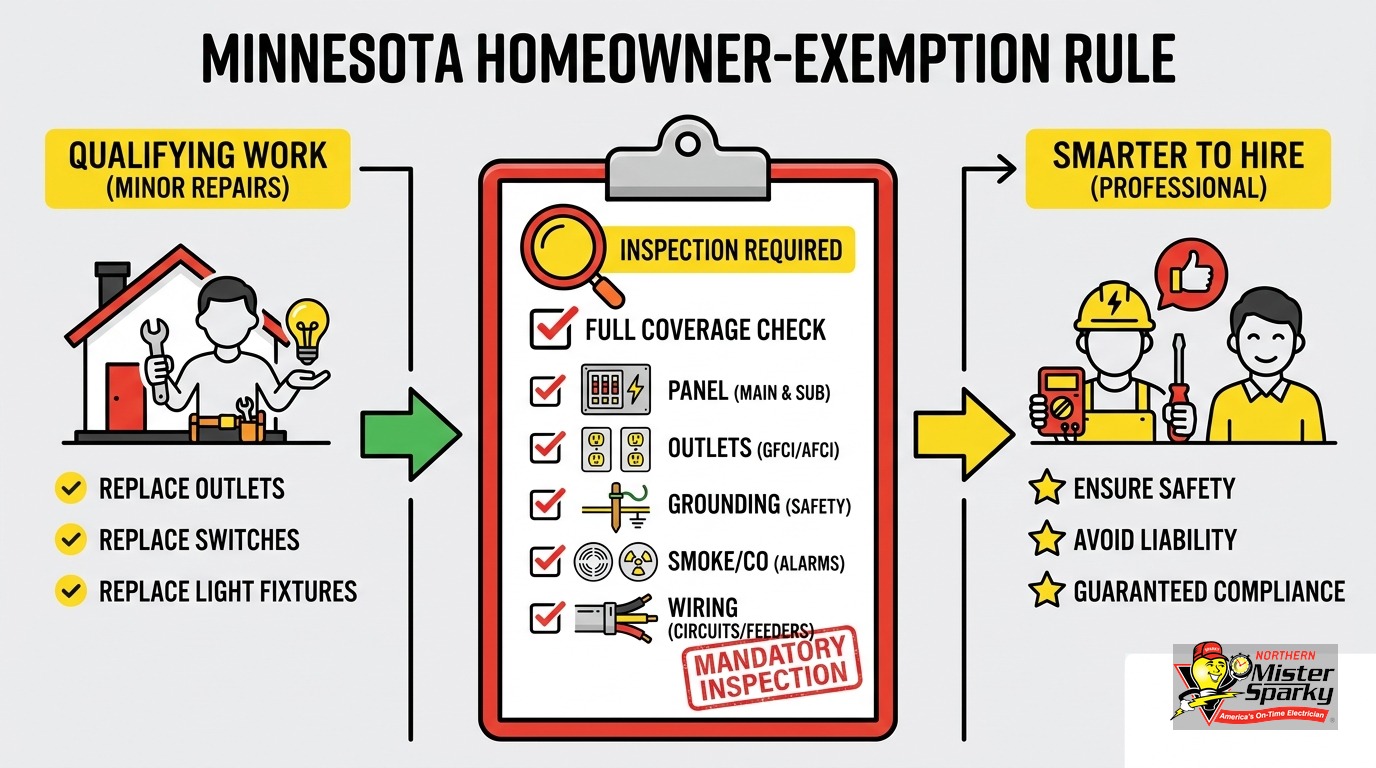
- Can a homeowner pull an electrical permit in Minnesota? Yes - if you own and occupy the property as a single-family home.
- The homeowner exemption waives the licensing requirement, not the permit or inspection requirement. Both are still mandatory.
- You must personally perform all the work. No unlicensed helpers - not family, not friends, not unpaid neighbors.
- Condominiums, duplexes, mobile homes, and properties with any rented portion do not qualify.
- About 66 Minnesota cities run their own permitting offices. Filing with the state DLI when your city is a local authority having jurisdiction (AHJ) stalls your application.
- Panel work, aluminum wiring, 240V circuits, and generator transfer switches should stay with a licensed electrician - even when you technically qualify for the exemption.
- Starting work without a permit triggers an investigation fee on top of standard permit costs.
Can a Homeowner Pull an Electrical Permit in Minnesota?
Yes. Minnesota law allows homeowners to pull their own electrical permits and do the work themselves. No licensed electrician required. But a permit and inspections are still required. The “exemption” removes the licensing hurdle - not the oversight.
That distinction trips up a lot of homeowners. They hear “homeowner exemption” and assume it means permit-free work. It does not. You are exempt from hiring a licensed contractor. You are not exempt from the permitting and inspection process.
The Minnesota Department of Labor and Industry (DLI) outlines two conditions for the exemption:
- You own the property.
- You occupy it now, or you intend to occupy it when the work is done.
Both conditions must be true at the same time. Renovating a home to sell fails test two. A rental property you own but do not live in fails test two. A lake cabin fails test two. We see this trip up Twin Cities homeowners regularly.
Minnesota has been under the 2023 NEC since July 1, 2023. Any permit filed on or after that date must meet 2023 code. The 2023 code expanded GFCI coverage in kitchens and carried forward the 2020 AFCI requirements. For details on the specific changes, see what the 2023 NEC means for Minnesota homeowners.
The Three-Bucket Framework: Where Does Your Project Land?
Before picking up a screwdriver, know which of three buckets your project falls into. Getting this wrong is the most expensive mistake homeowners make.
Bucket 1: No permit needed. A like-for-like swap in the same location - replacing a device or fixture without moving it and without adding circuits - may qualify as minor repair work under Minnesota rule. This bucket is narrower than most homeowners expect. When in doubt, call your local AHJ before you start.
Bucket 2: Permit required, homeowner can pull it. New outlets, new circuits, switch replacements that involve new wiring, and similar work on a qualifying single-family owner-occupied home. You apply for the permit, do the work yourself, and schedule inspections. You close the walls only after the rough-in passes.
Bucket 3: Permit required, licensed contractor only. Any work on a property that fails the owner-occupant test. Also covers specific high-risk work - panel upgrades, 240V circuits, generator transfer switches - discussed later in this post.
Knowing your bucket before you start prevents the worst outcome. That is: completing work without a permit, triggering an investigation fee, then discovering your property never qualified for the exemption in the first place.
Who Qualifies for the Homeowner Exemption?
Short answer: The owner of a single-family, owner-occupied home qualifies. You must own the property and occupy it as your primary residence - or intend to move in when the project is complete. Buying to renovate and sell does not qualify. Neither does any property with a rented portion.
The DLI homeowner permit page is direct on both conditions. “Owner” means your name is on the deed. “Occupy” means it is your primary residence - not a rental, not a vacation cabin, not an investment property you are rehabbing for a future tenant.
Minnesota Statute 326B.31, Subd. 27 defines “residential dwelling” as a single dwelling unit in a one-family dwelling. The definition includes attached garages and accessory buildings used exclusively by the occupants. That statutory language anchors the scope of what counts as a qualifying property.
What about a detached garage on the same lot? If it is used exclusively by you and your household, it generally falls under the homeowner exemption. The same permit application process applies.
What Property Types Are Excluded?
Short answer: Condominiums, apartment buildings, duplexes, mobile homes, recreational vehicles, and any portion of a home occupied by someone other than the owner. If you own a duplex and live in one unit, the exemption still does not apply - the restriction covers the entire structure, not just your unit.
Minnetonka’s electrical permit guidance lists the excluded property types explicitly: condominiums, apartment buildings, mobile homes, recreational vehicles, any portion of a home rented or occupied by others, and two-family (duplex) dwellings.
The duplex rule surprises many homeowners. You own both units. You live in one. That still does not qualify. The restriction applies to the whole structure - not just your unit. If you own a duplex, permitted electrical work requires a licensed contractor.
Condo owners in Minneapolis and St. Paul are also excluded. Electrical responsibility in a condo is divided between the unit owner and the building association, which adds its own layer of complexity. For more on that division, see how electrical responsibility is split in a condo or townhome.
Does “Pulling the Permit” Mean You Can Skip Inspections?
Short answer: No. Every new electrical installation requires at least one inspection. The homeowner exemption changes who performs the work - not whether it gets inspected. Most projects require a rough-in inspection before walls close and a final inspection when the work is done.
Minnesota Statute 326B.36, Subd. 1 requires inspection of every new electrical installation. The only carve-out is minor repair work as defined by rule. That definition is narrower than most homeowners expect.
For a typical project, the sequence looks like this:
- Rough-in inspection: Before walls close. An inspector checks wiring paths, box placement, wire gauge, and rough connections. You cannot close drywall until this passes.
- Final inspection: After installation is complete. Covers device installation, cover plates, bonding, and panel connections.
The DLI Residential Inspection Checklist for the 2023 NEC is publicly available. Download it before scheduling your rough-in. Inspectors use it, and so should you.
Permits expire 12 months after filing when total inspection fees are $1,000 or less. Fees are non-refundable. They do not carry forward to a new permit if yours expires before the work is complete.
Can You Get Help From Family or Friends on the Work?
Short answer: No. Minnesota Statute 326B.33, Subd. 12 bars any unlicensed individual from planning or laying out electrical wiring. If anyone other than the permit holder does any part of the work, the permit is void. An investigation fee is added. This applies to unpaid family and friends.
This is the unlicensed helper trap. A capable family member offers to help over the weekend. They are not a licensed electrician. Their involvement - even one afternoon of work - voids the permit.
The investigation fee applies when work begins without a valid permit or when a permit is voided. It stacks on top of standard permit costs. You pay more for the same paperwork, plus any re-inspection fees.
If your project is large enough to need help, that is a signal to price out a licensed electrician. The cost difference is often smaller than you expect. A licensed contractor bundles the permit and handles inspection scheduling. See the real risks of DIY electrical work for more on where homeowner projects commonly go sideways.
State DLI or Your City? The AHJ Confusion That Trips Up Metro Homeowners
Short answer: About 66 Minnesota cities run their own electrical permitting offices, separate from the state DLI. If you live in Minneapolis, St. Paul, Minnetonka, Eden Prairie, or Eagan - among many others - you file with your city, not the state. Filing in the wrong place means your application stalls.
The DLI homeowner permit page includes an inspector lookup tool. Use it before filing anything. It tells you whether your address is handled by the state or by a local AHJ.
Minneapolis and St. Paul are both local AHJs. So are many first-ring suburbs. Assuming the state DLI handles all permits is one of the most common metro mistakes we hear about.
One recent change worth knowing: Minnetonka stopped administering permits for the cities of Deephaven and Woodland as of January 1, 2026. Residents of those cities now file directly with their own municipal offices. If you live in either city and checked the process a year ago, check again before filing.
For a full breakdown of what triggers a permit in the first place, our overview of electrical permit requirements in Minnesota covers the state-versus-local split in more detail.
What Does a Permit Actually Cost in Minnesota?
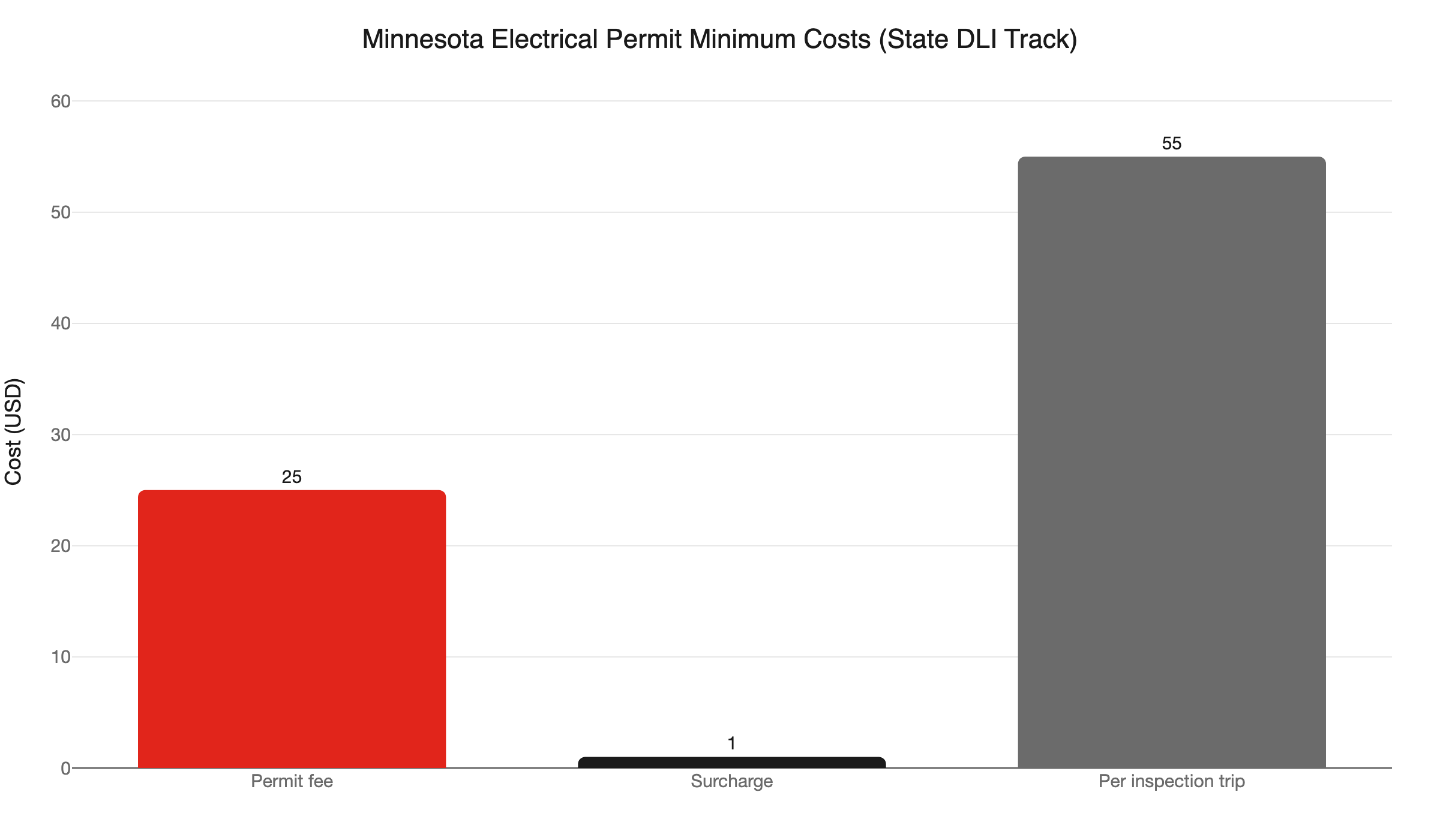
Short answer: Through the state DLI, the minimum is about $81: a $25 permit fee, a $1 surcharge, and one $55 inspection trip. Local AHJ fees vary by city. Each failed inspection adds at least $55 to the total. Permits expire after 12 months if work is not complete.
The DLI permit instructions PDF breaks down the state fee structure in full. For a small project with one inspection that passes on the first try, the total comes to around $81.
Costs climb in three situations:
- Failed rough-in: One re-inspection trip at minimum $55. Your project also stalls until the inspector can return - often three to ten business days in the metro.
- Larger project scope: Higher inspection fees raise the total. Fees above $1,000 trigger a different permit expiration timeline.
- Permit expiration: If you do not complete the work within 12 months (for projects with fees under $1,000), the permit expires. Fees are non-refundable. A new permit starts the clock and the cost over again.
For smaller projects, the DIY math often works. For anything that takes multiple weekends, risks a failed rough-in, or involves opening walls you have already drywalled, the cost comparison with a licensed electrician closes fast.
When Is Hiring an Electrician the Smarter Call, Even If You Could DIY?
Short answer: Panel work, aluminum wiring, any 240V circuit, generator transfer switches, and pool or spa bonding. The technical complexity and safety stakes on these jobs exceed what the homeowner exemption was designed for - even if your property otherwise qualifies.
Here are the specific situations where we recommend a licensed electrician regardless of exemption status:
Main panel work. A live 240V service entrance with no safe margin for error. Mistakes here cause fires and electrocution.
Aluminum wiring. Minneapolis, St. Paul, and first-ring suburbs have a substantial amount of aluminum branch circuit wiring from the 1960s and 70s. A homeowner opening a wall for a simple outlet addition can hit aluminum wiring. That discovery immediately changes the legal and safety picture. Proper remediation requires CO/ALR connectors, antioxidant compound, and technique specific to aluminum. See our guide on aluminum wiring dangers and fixes for what to expect.
Knob-and-tube wiring. Older Minneapolis and St. Paul homes sometimes still carry knob-and-tube. Touching a circuit in that system during a new rough-in can trigger a broader rewire requirement under the 2023 NEC.
240V circuits. EV chargers, electric dryers, ranges, and large appliances run on 240V. Wrong wire gauge, wrong breaker size, or wrong outlet type at 240V is a fire or electrocution risk.
Generator transfer switches. Back-feeding the utility grid can kill utility workers restoring power after an outage. Transfer switch installation must be done correctly, every time.
Pool and spa bonding. Improper bonding creates electric shock drowning risk. There is no acceptable margin here.
For panel and service work specifically, our electrical panel upgrade service covers what to expect when you bring in a licensed electrician.
What Happens If You Skip the Permit?
Short answer: Skipping the permit triggers an investigation fee, can require opening finished walls, and may void your homeowner’s insurance for related claims. It can also stall a future home sale. The permit process protects your investment - bypassing it does not save money in any realistic scenario.
The specific consequences:
Investigation fee. Starting work before a permit is filed triggers an investigation fee on top of standard permit costs. You pay more for the same permit you would have needed anyway.
Open walls. An inspector can order you to expose finished work that was never inspected. If you drywalled over a rough-in that was never signed off, you open it - at your expense, on the inspector’s schedule.
Insurance denial. Homeowner’s insurance claims for damage caused by unpermitted work are commonly denied. A fire traced to unpermitted wiring can leave you without coverage.
Sale complications. FHA and VA loans require code compliance at closing. An open or unpermitted electrical project can delay or kill a sale. See what to do about unpermitted electrical work when buying or selling a home for how this plays out in the Twin Cities market.
Inspection history gaps. Future buyers’ inspectors will find evidence of work with no permit record. That becomes a negotiating point or a deal-breaker.
A passed inspection is documentation. It shows anyone who looks that the work was done to code, by the right person, at the right time. That documentation has real value if you sell the home or file a claim.
Call 763-200-5956 or Book Online
If your project falls into Bucket 3, or you want the work done right without navigating the permit process yourself, our team is locally owned and operating across the Twin Cities metro. We are America’s On-Time Electrician(R), and every job carries the UWIN(R) 100% satisfaction guarantee.
For larger jobs - panel upgrades, EV charger installations, or whole-home rewires - ask about financing options when you call.
Call 763-200-5956 or book online. We will give you a straight answer on what your project needs.
Frequently Asked Questions
Can a homeowner do their own electrical work in Minnesota? +
Do I need to hire an electrician to pull an electrical permit in Minnesota? +
What is the minimum cost of an electrical permit in Minnesota? +
What electrical work requires a licensed electrician in Minnesota even if I own the home? +
Need an electrician now?