
Generator Backfeed Danger: Why Your Dryer Outlet Can Kill
Key Takeaways
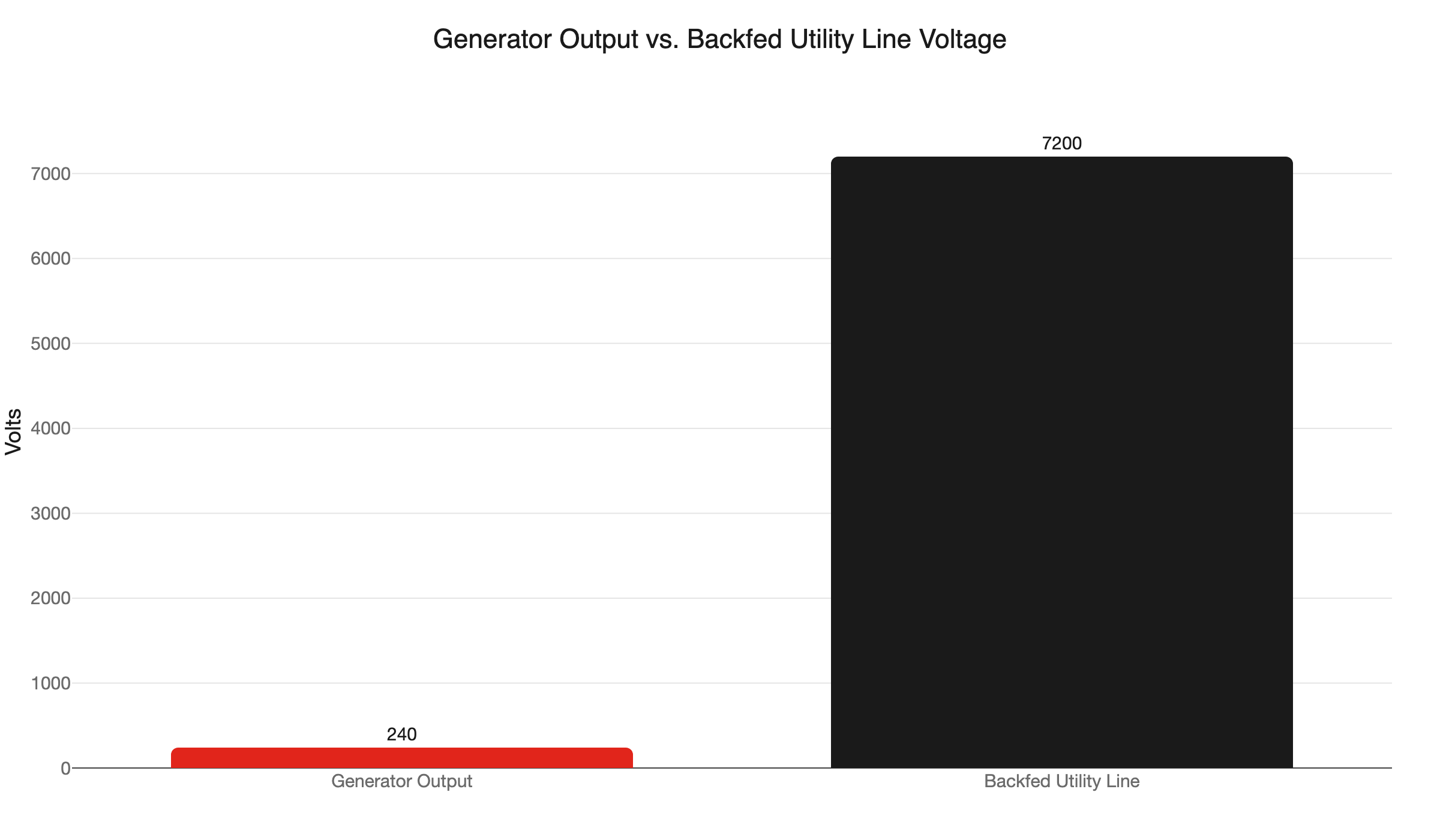
- Connecting a generator to any home outlet without a transfer switch sends electricity backward through your panel and transformer, putting roughly 7,200 volts onto utility lines.
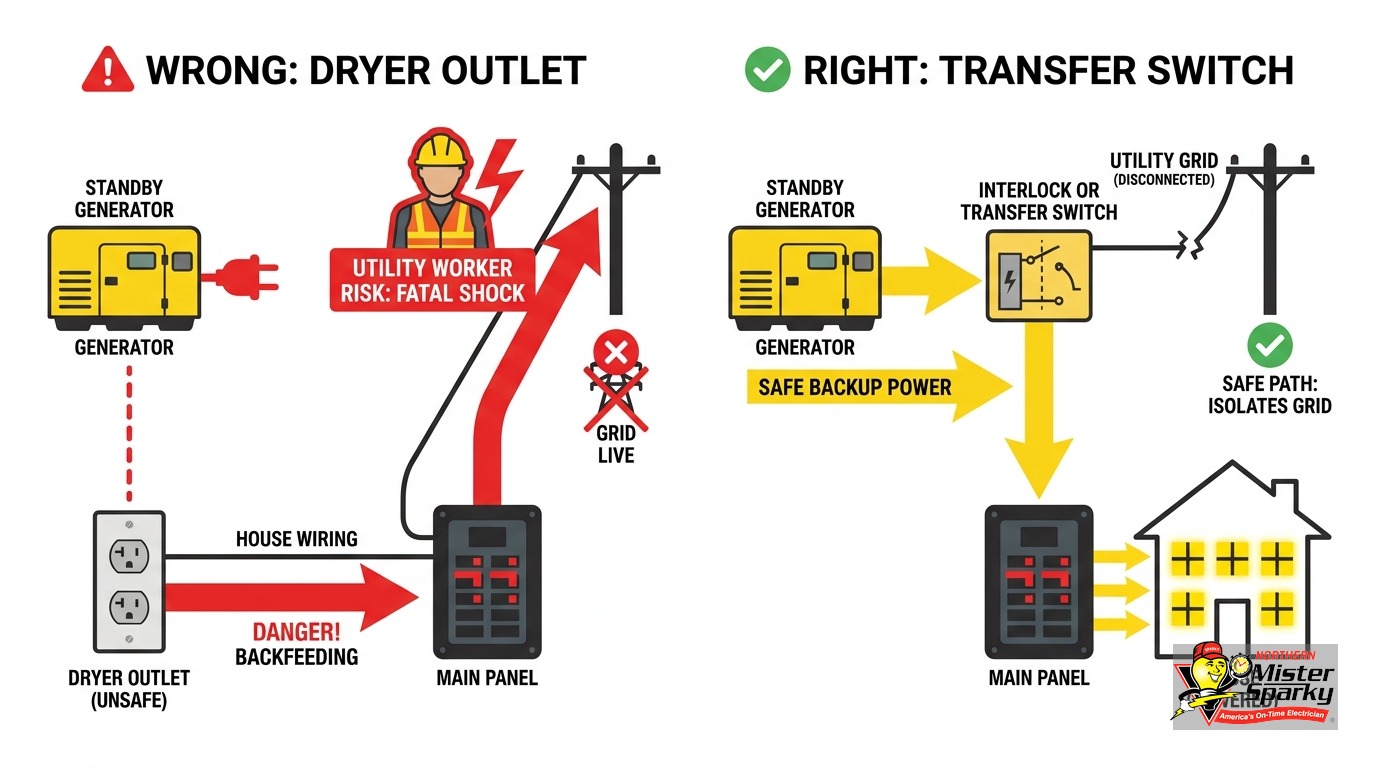
- The dryer outlet is the most dangerous entry point: it is already a 30A/240V circuit wired directly back to your service entrance.
- A transformer runs in both directions. Your 240V generator output becomes roughly 7,200V on the utility side.
- The lineworker who dies may be working a mile away on the same feeder - with no idea your generator is running.
- Smart meters in the Twin Cities can detect and log reverse power flow, creating a record for code enforcement or prosecutors.
- Criminal negligence charges are possible if a worker dies because of your generator hookup.
- The only compliant connection requires a permitted transfer switch, interlock kit, or manual subpanel installed by a licensed electrician.
- See the detailed guide on transfer switch and interlock options for portable generators for a side-by-side breakdown of the three code-compliant methods.
What Is Generator Backfeed Danger?
The short answer: Backfeed happens when a portable generator connected directly to a home outlet pushes electricity backward through your electrical panel and utility transformer, re-energizing power lines at roughly 7,200 volts. A utility worker on those lines can be electrocuted with no warning.
Every winter storm and summer derecho that knocks out Twin Cities power is also a generator backfeed event waiting to happen. The scenario is almost always the same: someone on the block starts a generator, wants to run the whole house, and reaches for the outlet that looks built for it - the dryer outlet. The physics of what comes next are not complicated. The consequences are fatal.
Generator backfeed danger is the reason electrical codes require transfer equipment on every generator installation. It is the reason OSHA writes utility-worker safety guidance around it. And it is the reason this hazard is worth understanding at the physics level, not just as a rule to follow.
Why the Dryer Outlet Is the Most Dangerous Entry Point
Walk into most garages or laundry rooms and the dryer outlet stands out. It is a heavy-duty NEMA 14-30 or NEMA 10-30 receptacle - 30 amps, 240 volts, four wires on modern installs and three on older ones. It is close to the panel. It accepts a large plug. To a homeowner trying to keep the refrigerator cold and the furnace fan running during an outage, it reads as the right connection point.
That instinct is exactly what makes it the most dangerous entry point in the house.
Your dryer outlet sits on a dedicated 30A/240V circuit fed by a double-pole breaker. That breaker connects to the panel’s main bus bars. The bus bars connect to the service entrance conductors. The service entrance conductors connect to the utility transformer outside your home. Plug a generator into the dryer outlet and you have a direct, uninterrupted electrical path from the generator into the utility distribution system.
Every wire between that plug and the street is now energized from your generator. Not just the laundry room. Not just the panel. The street.
There is also an amperage dimension. A 30A/240V circuit can carry up to 7,200 watts in either direction. That is a substantial backfeed current - enough to kill a lineworker several wire spans away, enough to arc at a damaged transformer or splice point, and enough to start a fire in equipment the utility crew assumes is de-energized.
The dryer outlet feels permanent, heavy-duty, and built for serious loads. It is all three of those things. That is the problem. It is a high-capacity, direct electrical highway to the utility grid.
What Happens Inside the Transformer During Backfeed?
The short answer: A residential step-down transformer runs in both directions. Feed 240 volts from the home side and the transformer steps it up to approximately 7,200 volts on the utility side - the same voltage the primary distribution lines carry under normal operating conditions.
The transformer on the utility pole outside your home has one normal job: take 7,200 volts from the primary distribution line and deliver 240 volts to your service entrance. That is a step-down function, and it works reliably for decades.
Transformers do not have a one-way valve built in. They are bidirectional by physics. When a generator backfeeds through the secondary winding, the device reverses its function and steps the voltage up. Two hundred forty volts in becomes approximately 7,200 volts on the primary side.
That 7,200 volts goes onto the distribution line feeding your block, your neighborhood, and every span of line connected to that feeder - and it gets there instantly, without any alarm, without any change a utility worker would notice from where they are standing.
Under normal outage conditions, a utility crew is dispatched to find and repair the fault. They follow lockout and tagout procedures, verify the line is de-energized, and begin work. Your generator, started after they cleared the substation, invalidated their lockout without their knowledge. They have no way to know. There is no signal, no sound, no visible indicator.
OSHA recognizes this scenario explicitly: the agency’s portable generator safety guidance requires that the main circuit breaker be off and locked before starting any generator, specifically to prevent backfeed from energizing utility lines that workers believe are dead. OSHA can publish that guidance. It cannot make your breaker behave correctly unless the right hardware is installed.
Does “A Mile Away” Really Mean a Mile Away?
The short answer: Yes. Your generator does not just backfeed your immediate block. It feeds into the feeder circuit serving a large geographic area. A worker making repairs half a mile or a full mile away on that same feeder can be killed by the voltage your generator puts on the line.
This is the part most generator backfeed discussions skip over entirely. When homeowners imagine the danger, they picture a utility worker at their own pole, close enough to hear the generator running. That is not how distribution systems are built.
Field safety guides put it plainly: a single house backfeeding through its transformer can re-energize an entire span of primary distribution line at lethal voltage with no warning to anyone on it. The person most at risk is often a worker a mile away who has no idea a generator is running anywhere near that feeder.
Primary distribution feeders serve large areas. A crew dispatched after an outage works somewhere on the same electrical circuit your home is part of. They set their safety procedures based on the condition of the line when they started. Your generator changes that condition immediately and invisibly.
You never see the person. You may never know their name. The feedback loop that would otherwise give you any indication that something went wrong is completely absent. That spatial disconnect - your generator in your garage, the lineworker a mile away - is the reason this hazard is so persistent and so deadly.
Isn’t Using a Regular 120V Outlet Safer Than the Dryer Outlet?
The short answer: No. Backfeed through a 120V outlet still reaches the transformer. The voltage step-up still happens. The lineworker is still at risk. The dryer outlet carries more current and connects more directly, but no outlet provides a safe backfeed path.
The reasoning behind this misconception makes a certain surface-level sense: a regular wall outlet is 120V, single-pole, and is not a direct connection to anything heavy. If you use that instead of the dryer outlet, maybe the backfeed is too small to matter.
Your home’s wiring is all connected through the neutral-bonded main panel. Every outlet, every circuit, every hot leg feeds back to the same service entrance. A generator plugged into a kitchen outlet sends current through that circuit’s breaker, into the bus bar, through the service entrance, and back to the transformer.
The transformer still steps it up. The primary line is still energized. A partially energized 7,200-volt distribution line is not meaningfully safer to touch than a fully energized one.
The only safe condition is zero backfeed. That requires physically disconnecting the home from the utility before the generator is connected. A wall outlet - any wall outlet - does not accomplish that.
The Three Legal Consequences You Face
Generator backfeed danger is not a code technicality you can sort out later. It operates on three separate legal tracks, and any one of them can affect your finances or your freedom.
Criminal liability. If a utility worker is killed because your generator backfed through an unprotected connection, you face criminal negligence charges under Minnesota law. This has been prosecuted. “I did not know” is not a complete defense when the hazard is documented in the NEC, in OSHA publications, and in utility safety notices that have been publicly available for decades. The knowledge is assumed.
Insurance denial. Unpermitted generator wiring voids your homeowner’s insurance. If a fire, arc fault, or injury is traced to unpermitted wiring - including an extension cord jury-rigged into the panel - the insurer has documented grounds to deny the claim. That denial can cover the structure fire, the liability claim from an injured worker, and the medical costs. The permitted transfer switch installation process creates the documentation your policy requires.
Code enforcement. Minnesota is currently on the 2023 NEC, with the 2026 NEC applying to permits filed on or after August 17, 2026. NEC Article 702.5 requires transfer equipment on any optional standby system. A portable generator hookup qualifies as an optional standby system. Plymouth, Maple Grove, and St. Paul each operate their own electrical inspection departments - violations can be referred locally or through the state Department of Labor and Industry.
These three consequences are not hypothetical. They are the reason every electrician and code official gives the same answer when asked about generator connections: get a transfer switch or interlock kit, pull a permit, and get it inspected.
Can a Smart Meter Detect Backfeed?
The short answer: Yes. Xcel Energy’s smart meters, deployed across the Twin Cities, can detect and log reverse power flow. In some jurisdictions, utilities report backfeeding to code enforcement. Your meter may create a permanent record of the event.
Most homeowners think of what happens inside their panel as private. Modern smart meters changed that. The reverse power detection built into these meters exists primarily to track net metering for solar installations - but the same sensor logs generator backfeed. The meter does not distinguish between a permitted solar installation exporting surplus and an unauthorized generator pushing electricity backward through the transformer.
Xcel Energy requires an Interconnection Agreement for any generation operating in parallel with the utility grid. Portable generator backfeed is not a covered interconnection. It is an unauthorized, uncoordinated parallel operation. An inadvertent export event lasting more than 30 seconds is a reportable event under Xcel’s technical specifications.
If your meter logs backfeed during an outage, that record can be obtained through a utility inquiry, subpoenaed in a civil case, or used in a criminal proceeding. It is timestamped and tied to your service address.
The no-malarky version: the meter is watching. Do not give it anything to log.
What Does NEC Article 702.5 Actually Require?
The short answer: NEC 702.5 requires transfer equipment that physically prevents a generator from operating in parallel with the utility. That means a device - an interlock kit, transfer switch, or equivalent - that makes it mechanically impossible to have both the utility connection and the generator connection active at the same time.
The code is not asking you to follow a procedure. It is asking you to install hardware that makes the wrong procedure physically impossible.
An interlock kit mounts on your existing panel and creates a mechanical interference: when the main breaker is on, the generator breaker cannot be. When the generator breaker is on, the main breaker cannot be. You cannot forget the step because the equipment does not allow the mistake. NEC 702.4(B) is explicit that the main breaker must be physically locked out before the generator breaker can engage. “Locked out” means mechanically prevented - not just switched off, and not a sticky note reminding you of the procedure.
A transfer switch accomplishes the same physical isolation through a different mechanism: it disconnects the home from the utility feed entirely before the generator circuit is activated. Either approach satisfies the code. The choice between an interlock and a dedicated transfer switch comes down to panel space, how many circuits you want to back up, and budget - those are installation-day decisions, not code decisions.
Transfer switch and interlock kit installation both require an electrical permit in Minnesota. Homeowners cannot self-permit this work under MN Stat. 326B.35. The permit creates an inspection record that confirms the installation is code-compliant - which matters to your insurance carrier and to any future buyer of your home.
What Is the Only Safe Way to Connect a Portable Generator?
The short answer: A transfer switch, interlock kit, or manual subpanel - installed by a licensed electrician with a permit - is the only compliant option. All three physically isolate your home from the utility grid before the generator is connected.
The transfer switch post on this site covers the three compliant options in detail. The short version:
- Interlock kit: A mechanical slide installed on your existing panel. Lower cost than a full transfer switch. Requires a licensed electrician and a permit. You control which circuits the generator powers by selecting breakers manually.
- Manual transfer switch: A separate subpanel with dedicated circuits chosen at installation time. Simpler to operate under stress - flip one switch rather than juggling multiple breakers in the dark.
- Automatic transfer switch (ATS): Detects the outage and switches to generator power automatically. Standard for whole-home standby generator installations. Not typical for portable setups but available if convenience is the priority.
None of these are DIY projects under Minnesota code. All three require a permit and a licensed electrician. All three require an inspection. All three leave a paper trail your insurance carrier can verify.
If cost is a concern for a larger generator or panel project, ask us about financing options when you call. We will lay out what fits your panel and your budget without pressure.
Getting This Done in the Twin Cities
Outages in Minnesota are not hypothetical. Ice storms hit in November. Derechos roll through in July. Every homeowner with a generator has already run through the mental checklist: where does it go, what gets plugged in, how do I keep the furnace fan running.
The answer to every one of those questions is the same: a permitted transfer switch or interlock kit, installed before the next outage, by a licensed electrician who knows the inspection requirements for your city.
We are locally owned and operated in the Twin Cities. As America’s On-Time Electrician(R), we show up on time, pull the permit, get the inspection scheduled, and leave you with a setup that works every time the lights go out - without putting anyone on the distribution system at risk.
Call us at 763-200-5956 or book online. We will size the right solution for your panel and get it done right.
Frequently Asked Questions
What is generator backfeed danger? +
Is it legal to plug a generator into a dryer outlet? +
What is the only safe way to connect a portable generator? +
Need an electrician now?