
Whole House Standby Generator Installation Cost in Minnesota
Key Takeaways
- A complete standby generator installation in Minnesota typically runs $12,000-$22,000.
- That range sits above the national average because cold-weather kits are a reliability requirement here and Twin Cities labor rates are higher than the national baseline.
- Four line items most quotes miss: permit and inspection fees, gas line extension, transfer switch type, and cold-weather kit.
- Minnesota issues most electrical permits through the state DLI, but 66 cities run their own inspections. Check before your contractor files anything.
- There is no federal tax credit and no CenterPoint or Xcel rebate for a natural gas standby generator in 2026.
- Call 763-200-5956 or book online to schedule a site assessment.
Power outages in January are not minor inconveniences in Minnesota. When the grid goes down during a polar vortex, your furnace stops, your sump pump goes silent, and pipes can freeze within hours.
A whole house standby generator changes that. It senses a utility outage and starts itself within seconds. No trips to the garage. No extension cords. But before you call, you need to understand the real whole house standby generator installation cost in Minnesota - specifically the four line items most national guides skip entirely.
What Does a Whole House Standby Generator Installation Cost in Minnesota?
Quick answer: Most complete standby generator installations in Minnesota run $12,000-$22,000. That covers the generator unit, a concrete pad, an automatic transfer switch, electrical and gas labor, and the permit. The range is wide because generator size and site conditions move the number significantly.
National cost data from Fixr puts the typical install at $10,000-$25,000. The full range runs $4,500-$55,000 for very large or complex sites. Minnesota jobs land in the upper half of that band. Cold-weather kits are not optional here. Twin Cities labor rates also sit above the national baseline.
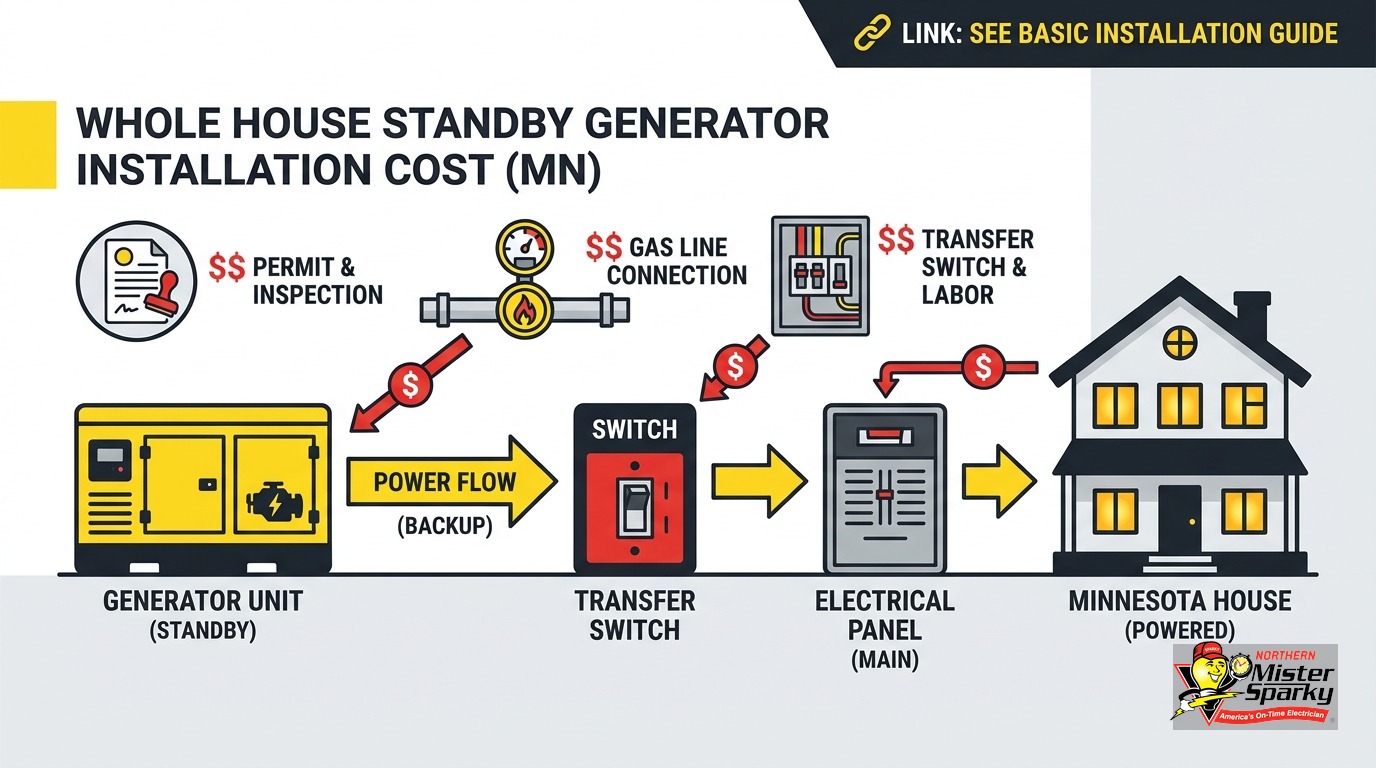
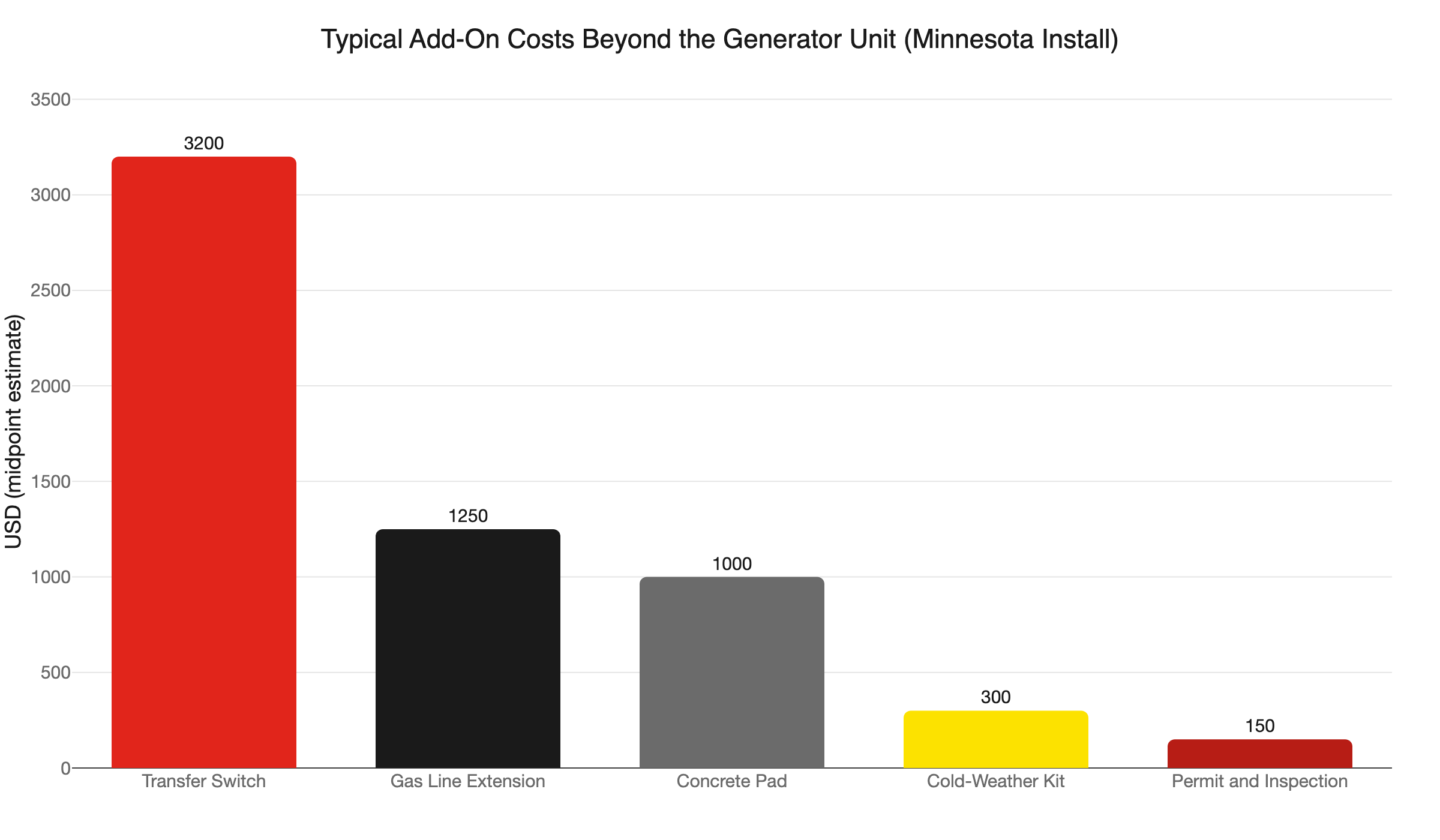
Here is how the major cost buckets break down for a typical Minnesota home:
- Generator unit (14kW): $3,500-$5,000 for the unit alone. A 14kW unit handles essential loads: furnace, sump pump, refrigerator, lights, and outlets.
- Generator unit (20-26kW): $5,000-$9,000 or more. A larger unit handles the full house, including central air.
- Automatic transfer switch: Roughly $900 in material plus $1,800-$2,800 in labor, depending on panel configuration.
- Concrete pad: $500-$1,500. A level, frost-stable pad is standard for Minnesota installs.
- Gas line extension: $500-$2,000 depending on distance and run type.
- Cold-weather kit: $200-$400 plus installation labor.
- Electrical permit and inspection: $80-$300 for most residential jobs.
Not sure how much generator your home needs? Our home generator sizing guide walks through the load calculation before you commit to a unit size.
The Four Line Items Most Quotes Leave Out
National cost guides consistently cover the generator unit and a rough labor estimate. They skip four items that change the real cost of a Minnesota installation. Each is priced independently. Each can push a final bill 20 to 30 percent above an initial phone estimate.
Those four items are: the electrical permit and inspection fees, the gas line extension, the transfer switch type, and the cold-weather kit. The sections below address each one.
Understanding these costs before signing a contract lets you compare quotes honestly. Contractors who quote over the phone without a site visit typically underprice all four. A site visit is the only way to know your actual gas line distance, your panel’s configuration, and whether your preferred pad location meets local setback rules.
What Does the Electrical Permit Cost in Minnesota?
Quick answer: A Minnesota residential electrical permit for a standby generator typically runs $80-$150 minimum through the state DLI. That covers the $25 base fee, the $1 surcharge, and the $55 minimum inspection fee per visit. A complex install or a second inspector visit adds to that total.
The DLI fee schedule breaks it down clearly: $25 base permit fee, a $1 state surcharge, a $55 minimum inspection fee per site visit, and a generator or service connection fee of $35-$100 by amperage. Most residential generator installs land between $80 and $150 for a clean, single-visit inspection.
Your contractor must pull the permit before work starts. A generator install without a permit fails any future home inspection. It can also create a gap in your homeowner’s insurance coverage if a claim ever involves unpermitted work. The permit cost is a small line item against the total job. Do not skip it to save $150.
That said, the above assumes DLI has jurisdiction. Many Twin Cities homeowners live in cities that run their own programs.
Does Your City Use the State Inspector or Its Own?
Quick answer: Sixty-six Minnesota cities run their own electrical inspections instead of the state DLI. If you live in one of those cities, the permit goes to the city, not the state. Check the DLI inspector lookup at ims.dli.mn.gov before filing. Filing with the wrong authority means your permit is not valid.
Deephaven recently moved its electrical inspections back to the state system, which shows how fluid the jurisdiction question can be from one year to the next. Your electrician should know which body covers your address, but confirm it before work starts.
One more code note worth knowing: Minnesota adopted the 2023 NEC on July 1, 2023. Any permit filed today is inspected under 2023 code requirements. That matters for how the transfer switch must be wired (covered in the section below).
How Much Does a Gas Line Extension Add to the Whole House Standby Generator Installation Cost?
Quick answer: Gas line extension in Minneapolis runs $15-$25 per linear foot. A 20-foot run from the meter costs $250-$500. A run of 20-100 feet from the main line costs $500-$2,000. Setback requirements often push the generator pad farther from the meter than homeowners initially expect.
Angi’s Minneapolis gas line cost data places local per-foot rates at the high end of the national range. Fixr’s national estimate puts underground gas line installation at $11-$27 per foot, with a 20-foot extension running $250-$500 and a longer run from the main line reaching $500-$2,000.
Three variables move that number:
- Distance from the meter to the pad. Generators require 5 feet of clearance from any door, window, or fresh-air intake. The pad location is often not close to the meter.
- Above-ground vs. underground run. Underground runs cost more per foot and require more labor.
- Existing line capacity. A whole house generator adds significant BTU load to your gas system. If the existing line is undersized, it may need upsizing before the generator can be commissioned.
If your home runs on propane rather than natural gas, the gas contractor should assess your tank size and regulator pressure alongside the line extension. Most propane tanks sized for home heating are adequate, but confirm it before install.
Gas line work in Minnesota requires a licensed plumber or gas piping contractor, not an electrician. We coordinate that work as part of a complete installation quote.
Which Transfer Switch Type Does a Whole House Standby Generator Need?
Quick answer: A whole house standby generator requires an automatic transfer switch (ATS) that prevents the utility and the generator from connecting at the same time. NEC 702 requires this backfeed protection. Whether you use a load-side or service-entrance rated ATS determines how much panel work the job involves.
Two main ATS configurations exist for whole house installs.
Load-side ATS: Connects downstream of your main breaker. It is the simpler configuration and does not change your main panel’s classification as service equipment. Many whole house installs use this approach when the existing panel has adequate capacity.
Service-entrance rated ATS: Connects at the service entrance. The utility meter feeds the ATS, and the ATS feeds the main panel. That classification makes the ATS the service equipment under the 2023 NEC. When the ATS becomes service equipment, the main panel becomes a sub-panel: neutrals and grounds must be isolated inside it, and the bonding jumper must be removed. NEC 230.85 also requires the ATS to be clearly labeled on the building exterior as an emergency disconnect.
In either case, the generator disconnect must be within sight of the generator unit. It must also be within 50 feet of the building, per NEC 445.18 and 702.12.
Getting the transfer switch wrong is dangerous. Backfeed onto a utility line can injure or kill a lineworker. Our generator backfeed danger guide explains exactly how that happens and why the ATS installation must pass inspection before the generator runs.
Does Minnesota Require a Cold-Weather Kit for a Standby Generator?
Quick answer: No state regulation requires a cold-weather kit. But a generator that will not start reliably at -20 degrees Fahrenheit is not a backup power system. Minnesota hits that temperature regularly during polar vortex events. Any installer who omits a cold-weather kit from their scope should explain that decision in writing before you sign.
Cold-weather kits include a battery heater, an oil filter heater, and the wiring to keep those components warm during extended cold snaps. Generac’s kit for 8-26kW units requires swapping to 5W-30 synthetic oil at installation. Briggs and Stratton kits are rated to -25F. Kohler kits add a fuel regulator heater and a breather tube heater on top of the battery and oil warmers.
Top Line Electric’s guide to Minnesota standby generators treats cold-weather kits as a standard requirement for any Minnesota install, not an upgrade.
Budget $200-$400 for the kit, plus labor. Your installer should include this in their scope automatically. Ask for it by name if they do not.
Setback and Zoning: A Brief Checklist
Minnesota has no statewide setback rule for standby generators. Local zoning governs placement, and the rules vary by municipality. The typical minimums across Twin Cities communities are:
- 18 inches minimum clearance from the house structure
- 5 feet from any door, window, or fresh-air intake
- 36 inches of clear service-side clearance for maintenance access
- 3-5 feet from the property line, with some cities requiring 10 feet or more
StandbyGenPros’ generator placement guide covers the general placement framework, but your city’s zoning code is the final authority. Verify the local rules before the concrete is poured.
Two additional checks before you choose a pad location:
HOA requirements. HOA approval is separate from the city permit. You may need both. Some associations restrict pad placement, require visual screening, or require a board vote before approving the install.
Utility easements. If a CenterPoint or Xcel easement runs through your yard, the generator pad cannot sit on it. Most city GIS portals show easement boundaries. Your title documents will note them as well.
Are There Any Rebates or Tax Credits for Standby Generators in 2026?
Quick answer: No federal tax credit, no CenterPoint rebate, and no Xcel rebate applies to a natural gas or propane standby generator in 2026. The federal credits that briefly applied to battery-paired generator systems expired in July 2025. If a contractor mentions a rebate, ask them to show you the specific program page before you rely on it in your budget.
Here is the full picture:
Federal tax credit: The Section 25C and 25D residential energy credits never applied to fossil-fuel standby generators. Battery-paired installs qualified through December 31, 2025 only. Those credits expired under the One Big Beautiful Bill Act, signed in July 2025. Generac confirms this on their own support site: their home standby generators do not qualify for any energy tax credit.
CenterPoint Energy rebates: CenterPoint’s Minnesota Conservation Improvement Program covers furnaces, heat pumps, water heaters, and similar efficiency equipment. Standby generators are not on the list.
Xcel Energy rebates: Xcel’s residential rebate programs focus on energy efficiency upgrades. Generators do not qualify.
StandbyGenPros’ 2026 tax credit summary confirms no federal credit applies to fossil-fuel standby units this year.
No malarky: the value of a whole house generator is the power you have when your neighbors do not. Plan the budget around the actual installed cost.
Ready to Schedule a Site Assessment?
A legitimate whole house standby generator installation quote requires a site visit. A phone estimate cannot account for your gas line distance, your panel configuration, or your local setback constraints. All three affect the final number.
When our team visits, here is what we assess:
- Distance from the gas meter to the best available pad location
- Panel type and the appropriate ATS configuration for your home
- Whether a panel upgrade is needed before the generator install
- Permit jurisdiction (DLI or city) and the correct filing process
- Cold-weather kit selection matched to your generator brand and engine size
Northern Mister Sparky is locally owned and operated in the Twin Cities. We pull the permits, file with the right authority, and back every job with the UWIN(R) 100% satisfaction guarantee.
Before you call, review the full scope of what a standby install involves from first call to final inspection in our whole house generator installation guide.
Call 763-200-5956 or book online to schedule your assessment. As America’s On-Time Electrician(R), we show up when we say we will.
Frequently Asked Questions
What does a whole house standby generator installation cost in Minnesota? +
Are there any rebates for standby generators in Minnesota in 2026? +
Does a whole house standby generator installation require a permit in Minnesota? +
Need an electrician now?