Manual Transfer Switch vs Interlock Kit for Generator
Key Takeaways
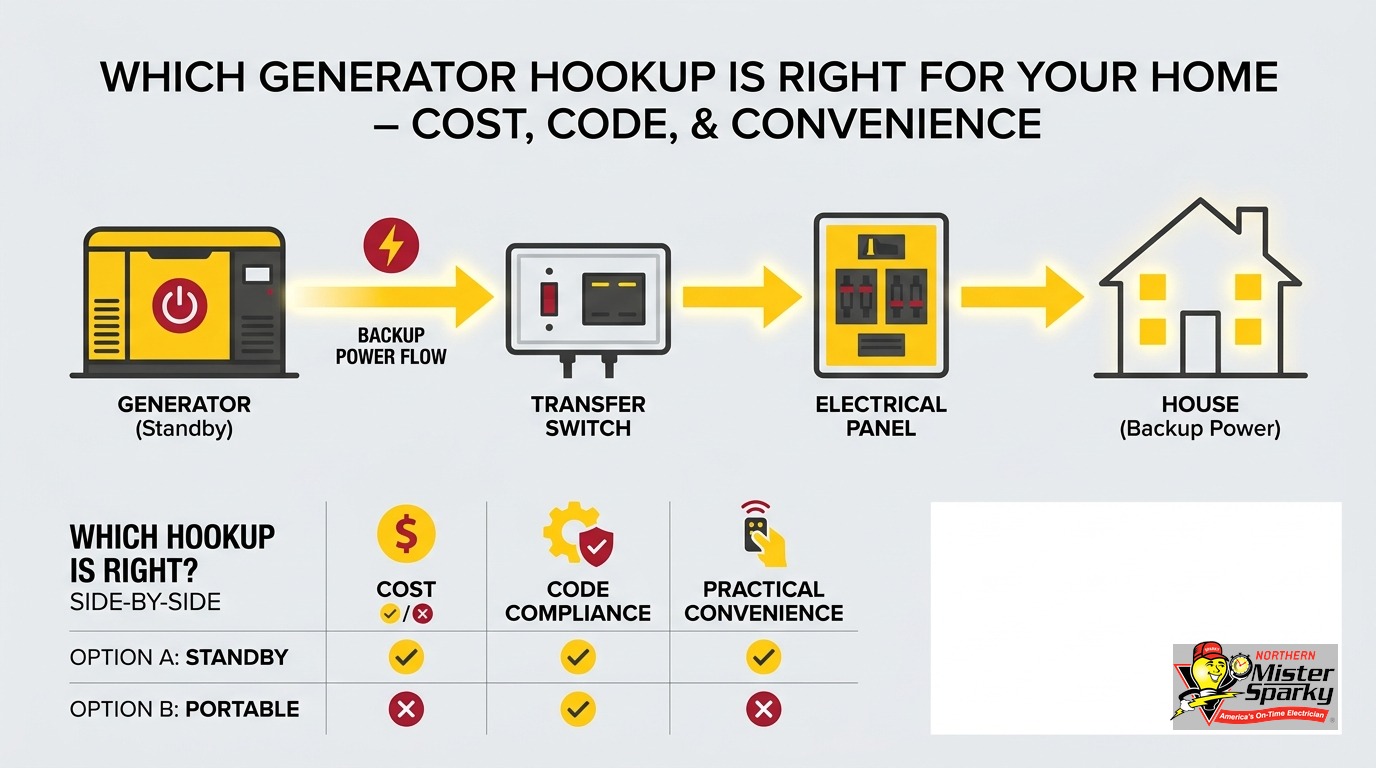
- Both an interlock kit and a manual transfer switch satisfy NEC Article 702.5 for residential portable generator hookups. Neither requires an automatic transfer switch for optional standby use.
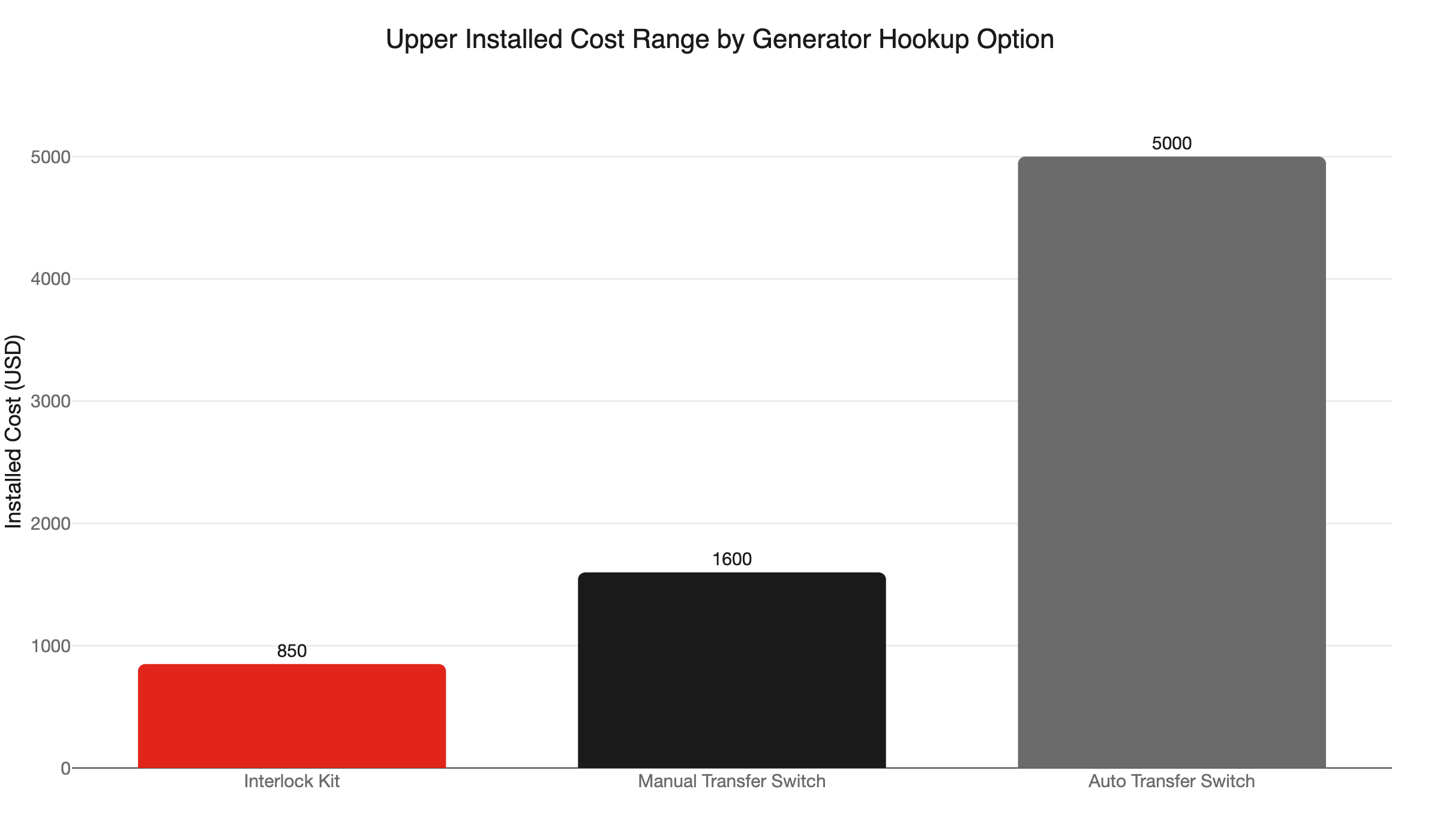
- Installed costs overlap more than most homeowners expect. Interlock kits run approximately $400-$850 installed. Manual transfer switches run approximately $400-$1,600+ installed.
- An interlock kit gives you access to every circuit in the house. But it puts every load-management decision on you at every outage, in the dark.
- A manual transfer switch pre-selects your priority circuits. One switch and the right circuits come on. Nothing to figure out during a storm.
- Interlock kits are code-legal only with the OEM kit listed for your exact panel brand and model. A generic third-party kit does not automatically qualify.
- Both options require an electrical permit in Minnesota. Confirm whether your city or DLI handles the permit before work begins.
- The DLI homeowner permit fee starts at $35 per power source. Skipping the permit also skips the inspection that confirms the hookup is safe.
What Is an Interlock Kit and How Does It Work?
Short answer: An interlock kit is a machined metal bracket that installs on your existing panel. It blocks the main breaker and the generator input breaker from being on at the same time. It costs less than a transfer switch but puts every load-management decision on you during an outage.
An interlock kit does not add a sub-panel. It mounts directly to your existing panel door. A mechanical slide prevents the main utility breaker and the generator input breaker from being on simultaneously. That physical interlock is what satisfies the code requirement against inadvertent backfeed onto the utility lines.
Here is the process at every outage:
- Shut off every circuit breaker in the panel.
- Flip the main breaker off.
- Slide the interlock bracket to expose the generator input breaker.
- Connect the generator to the exterior inlet box via a heavy-duty cord.
- Start the generator and turn on the generator input breaker.
- Turn on only the circuit breakers your generator can handle.
Step six is where most homeowners run into trouble. Your panel contains every circuit in the house. Your generator has a firm wattage limit. Large loads - an electric water heater, electric range, central electric heat, or EV charger - can exceed a portable generator’s capacity on their own. You have to know which breakers to leave off. In the dark. In the cold.
The exterior inlet box is a separate piece of the system. An electrician mounts it on the outside wall and runs conduit from it through the wall to the panel. That wiring adds labor and material cost to both the interlock and transfer switch options.
There is also a code requirement that DIY guides routinely skip. NEC 408.36(D) requires any breaker used in a back-fed configuration to be secured with a hold-down retainer. That is separate hardware beyond the interlock bracket itself. It is required for a code-compliant installation.
For a detailed walkthrough of the installation process, see our post on generator interlock kit installation.
What Is a Manual Transfer Switch and How Is It Different?
Short answer: A manual transfer switch is a dedicated sub-panel wired to 6-10 priority circuits. When the power goes out, you connect the generator and throw one switch. No breaker counting, no load management - just the circuits you already picked.
An electrician installs the transfer switch sub-panel next to your main panel and rewires your priority circuits into it. Common choices: the furnace blower, refrigerator, sump pump, a lighting circuit or two, and a general-purpose outlet. Everything else in the house stays off during an outage.
That restriction is also the advantage. The decision about what to power has been made in advance, before the storm, with a clear head. You do not need to think through it at midnight in January. One switch and you are done.
A manual transfer switch also makes it easier to size your generator accurately. You know exactly which loads it will carry. That helps you choose the right generator capacity and avoid buying more machine than you need.
The higher installed cost comes directly from the rewiring. Running new conductors from selected circuits to the sub-panel takes more labor than mounting an interlock bracket on an existing panel. That additional wiring is the primary reason installed transfer switch costs exceed an interlock kit.
Is an Interlock Kit Code-Legal in Minnesota?
Short answer: Yes - but only with the OEM kit listed for your exact panel brand and model. A third-party or generic kit does not automatically satisfy Minnesota code. Your inspector has final authority.
NEC Article 702.5 requires all optional standby transfer equipment to be “listed.” For interlock kits, that means the kit must carry a listing for your specific panel brand and model number. The UL panelboard standard states that panels are suitable for Article 702 use only “when provided with interlock kit Cat No. ____.” That blank holds an OEM part number, not a generic aftermarket option.
A third-party kit may fit the panel physically. It may even work mechanically. But it does not satisfy the listing requirement unless your Authority Having Jurisdiction explicitly approves it. Some inspectors will accept a well-documented third-party kit; many will not.
Minnesota adopted the 2023 NEC on July 1, 2023. DLI published review minutes dated September 25, 2025, as the state works through 2026 NEC adoption. Permits filed today are inspected under the 2023 NEC. The 2026 NEC is expected to formally name interlock kits as listed transfer equipment in Article 702. That change has not taken effect yet.
One clarification worth making: the NEC requires emergency systems to use an automatic transfer switch. A residential portable generator hookup is an optional standby system under Article 702, not an emergency system. Manual transfer equipment is explicitly permitted for this use. You do not need an automatic transfer switch for a portable generator setup.
Not every panel has an OEM interlock kit available. Some discontinued panel brands common in Twin Cities older homes - Federal Pacific and Zinsco are examples - have no manufacturer-supported interlock kits. If your panel falls into that category, a manual transfer switch or a panel replacement is the right path.
How Much Does Each Option Cost, Installed?
Hardware cost alone understates the true difference between these options. Labor, the exterior inlet box, wiring, the permit, and inspection fees all contribute to the total. Here is a realistic breakdown based on national benchmarks:
Interlock kit - installed total: approximately $400-$850
- Interlock kit hardware: $60-$140
- Exterior inlet box: $50-$150
- Wiring, conduit, and labor: varies by panel location and wall distance
- Permit and inspection: $35+ (DLI) or city rate
Manual transfer switch - installed total: approximately $400-$1,600+
- Transfer switch sub-panel (6-10 circuit): $300-$700
- Rewiring selected circuits to the sub-panel: primary labor cost
- Exterior inlet box: $50-$150
- Permit and inspection: same as above
The low ends of these ranges overlap. Labor drives both options. If your main panel is in a tight location or the inlet box requires a long run through the wall, an interlock install can approach the lower end of a transfer switch job. Get quotes for both before assuming the interlock is the cheaper choice.
If your city has local inspection authority, its fee schedule differs from DLI’s. Some cities charge flat rates; others charge per-circuit or per-job fees. Call your city’s building department for the current schedule. Budget the permit cost as a line item from the start.
A whole-home standby generator with an automatic transfer switch is a third option, priced well above either manual choice at $1,500-$5,000+ installed. That is outside the scope of this post. For the full picture, see whole-house standby generator installation cost in Minnesota.
Xcel Energy does not currently offer a rebate for portable generator transfer equipment. Xcel’s rebate programs cover panel upgrades tied to heat pumps, EV chargers, and solar - not generator hookup hardware.
Which Is Easier to Use During a Minnesota Winter Outage?
Short answer: A manual transfer switch is the right call for most Twin Cities households. Pre-selected circuits mean no decisions during a stressful outage. An interlock kit offers more flexibility but requires clear thinking under difficult conditions.
This is not a hypothetical scenario here. A July power outage is an inconvenience. A January ice storm that cuts power for 24-48 hours is a different situation. Your furnace blower, sump pump, and a few working lights are not luxuries during that window.
With an interlock kit, you must turn off every large load before re-energizing the panel. You need to know which breakers control your electric water heater, electric range, EV charger, and electric heat - before flipping the generator input breaker on. Forgetting one of those loads overloads the generator or trips breakers immediately. The practical case for pre-selected circuits is stronger in cold-weather states than in warmer ones.
A few safety rules apply regardless of which option you choose:
- Place the generator at least 20 feet from any home opening: windows, doors, or vents.
- Minnesota Power states that an improperly connected generator “creates a dangerous level of electricity that puts crews at risk of severe injury or death.”
- Minnesota law requires a CO alarm within 10 feet of every sleeping room. Operate the generator outside only. Never in an attached garage.
Do You Need a Permit in Minnesota for Either Option?
Short answer: Yes. Both an interlock kit and a manual transfer switch require an electrical permit in Minnesota. The first question is whether your city handles permits locally or whether the job goes through the state via DLI.
Approximately 66 cities in Minnesota have adopted their own local electrical inspection authority. Plymouth, Maple Grove, and Minneapolis are examples. If you live in one of those cities, you file the permit with the city, not DLI. The answer changes the fee schedule and inspection timeline. Confirm this before work begins.
For permits processed through DLI, the homeowner permit fee is $35 per power source for generators and feeders up to 400 amps. Homeowners can self-permit on a homesteaded single-family residence. You cannot self-permit on a condo or any rented portion of a property.
One timing detail: a permit with an inspection fee of $1,000 or less expires 12 months from the filing date. Work not complete and inspected by then requires a new permit.
When you hire a licensed electrician, they pull the permit as part of the job. You do not have to navigate the process yourself. Our post on electrical permits in Minnesota covers the full permit process. For what homeowners can and cannot self-permit, see homeowner electrical permit exemption in Minnesota.
Which Option Is Right for Your Home?
Short answer: Most Twin Cities homeowners will be better served by a manual transfer switch. The pre-selected circuits and single-switch operation pay off quickly during a winter outage. An interlock kit is the right call when full-panel access matters and your household can manage load decisions under pressure.
Use this framework to decide:
Choose an interlock kit when:
- Your panel brand and model has a listed OEM kit available
- You want access to any circuit in the house during an outage
- Your generator output is large enough to run most priority loads
- Budget is the deciding factor
Choose a manual transfer switch when:
- You want zero decisions during a power outage
- Elderly family members or young children may need to operate the generator alone
- You plan to use the generator primarily in Minnesota winters
- You want a cleaner, more permanent installation
Consider a whole-home standby generator when:
- You want power restored automatically with no manual steps
- You need whole-home coverage
- A higher installation cost fits your budget
Whatever you choose, get it permitted and inspected. An unpermitted generator hookup can void homeowner’s insurance coverage for fire or electrical damage tied to the generator installation. The inspection is also what confirms that the hold-down retainer is in place, the inlet box is weatherproofed, and the wiring meets code. These are not formalities.
Schedule Your Generator Hookup Before the Next Storm
We are locally owned and operated in the Twin Cities. Our team installs interlock kits and manual transfer switches, pulls the permit, and schedules the inspection. You get a code-compliant installation and a clear recommendation for your specific panel and generator.
Call 763-200-5956 or book online. We will give you a straight answer about which option makes sense for your home. No malarky. That is what we do as America’s On-Time Electrician(R).
Our work is backed by the UWIN(R) 100% satisfaction guarantee. If you are not satisfied, we make it right.
Ready before the next outage? Call 763-200-5956 or schedule online today.
Frequently Asked Questions
Can I install a generator interlock kit myself in Minnesota? +
Does an unpermitted generator hookup affect my homeowner's insurance? +
What size generator do I need for a manual transfer switch? +
How long does generator hookup installation take? +
Need an electrician now?