
Propane vs Natural Gas Standby Generator: Minnesota Guide
Key Takeaways
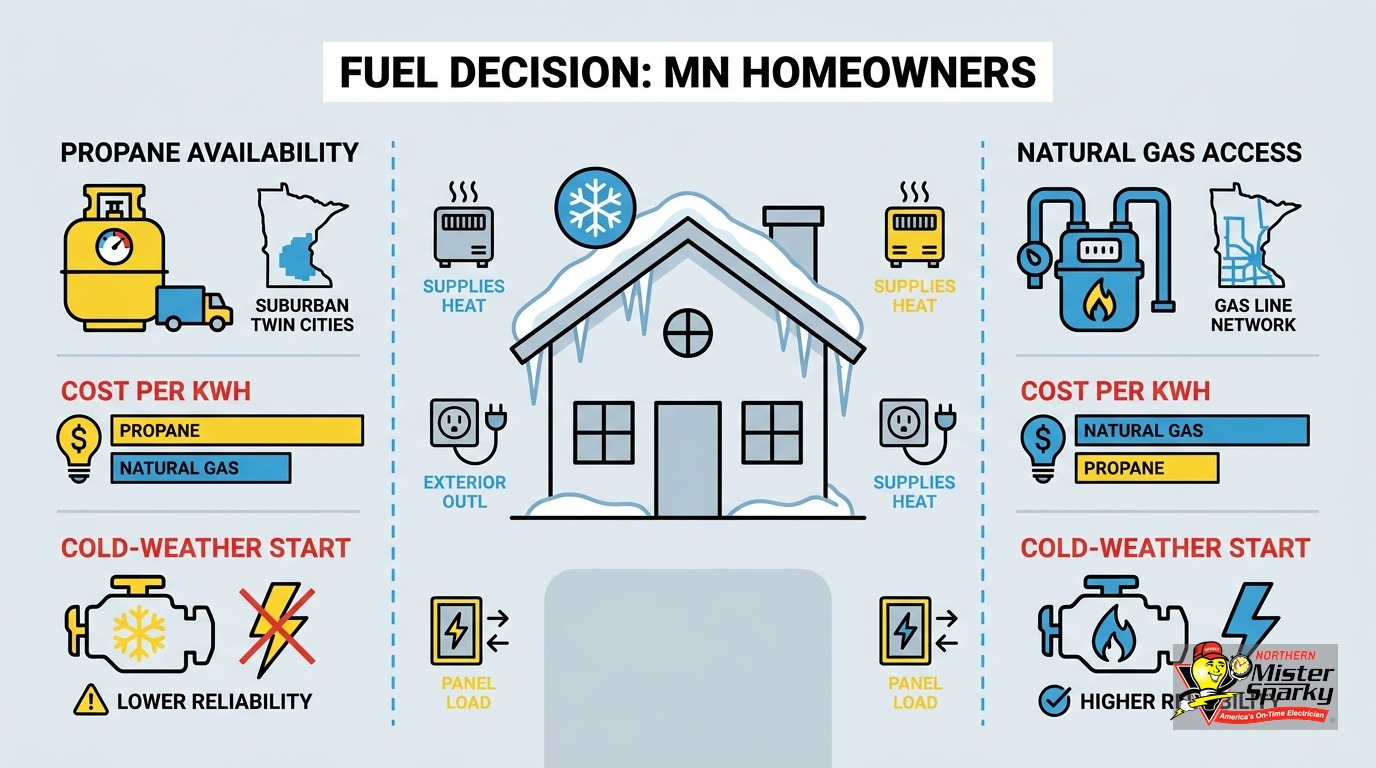
- For most Twin Cities homeowners, natural gas is the right default. CenterPoint Energy serves Minnesota customers across the established suburbs. If you have a gas line at the meter, use it.
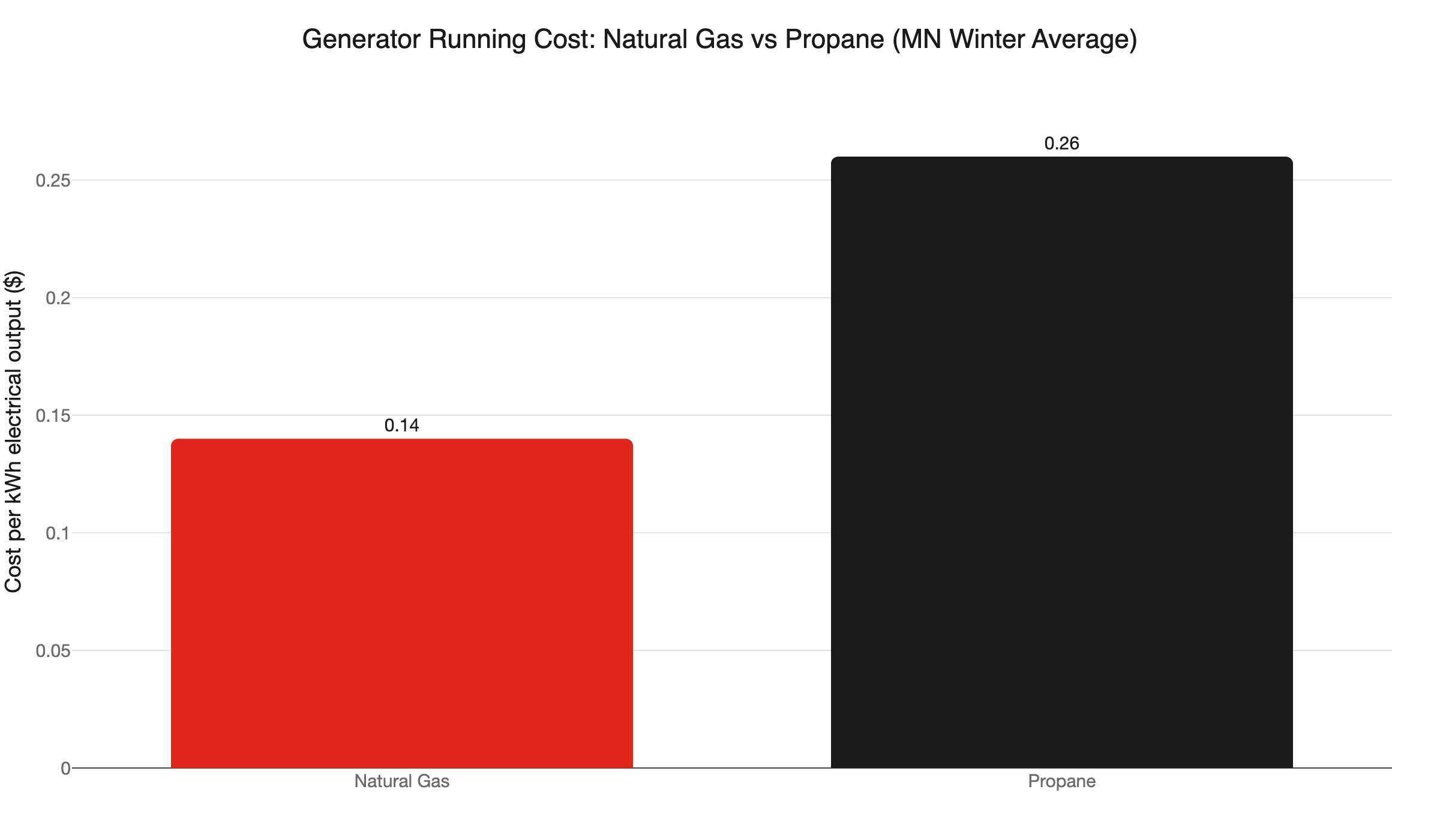
- Natural gas costs roughly $0.14 per kWh of generator output in a Minnesota winter. Propane runs about $0.26 per kWh, nearly twice as expensive.
- Aboveground propane tanks can stall a generator near 0°F. That is not a defect. It is physics, and it matters in January in the Twin Cities. Underground tanks stay warm enough to hold stable vapor pressure.
- Propane tanks in the 125-500 gallon range must sit at least 10 feet from buildings and property lines under NFPA 58. Many suburban lots cannot meet that setback.
- Minnesota adopted the 2026 NEC effective August 17, 2026. Every standby generator installation requires a permit, through DLI or your city if it runs its own inspections.
- Natural gas generators produce about 5-10% less output than the same engine on propane. Size up slightly to account for the derate.
Which fuel is right for most Twin Cities homeowners?
If CenterPoint Energy serves your address, natural gas is almost certainly the better choice. It costs about half as much per kWh to run, requires no on-site tank, and never runs out during an extended outage. Propane is the right answer for homes without gas service, large rural lots, or specific fuel-storage priorities.
CenterPoint Energy serves customers across Minnesota, including Apple Valley, Bloomington, Plymouth, Richfield, Fridley, Golden Valley, Chanhassen, Rogers, Rosemount, and dozens more established Twin Cities suburbs. For most homeowners in those communities, the “do you have a gas line?” question is yes before they even look it up.
That shifts the real decision to generator size and transfer switch setup. Still working out what whole-house coverage will cost? The total installed cost for a standby generator in Minnesota is a useful starting point before picking fuel type.
Is it cheaper to run a generator on natural gas or propane?
Natural gas is cheaper: roughly 1.9x in a Minnesota winter. At current MN rates, natural gas runs a whole-house generator at about $0.14 per kWh of electrical output. Propane comes in near $0.26 per kWh. The gap is real and it compounds over a multi-day outage.
Here is how those numbers are built.
Natural gas
Minnesota residential natural gas winter 2025 prices ran $11.17 per MCF in January and $13.03 per MCF in February (divide by 10 to convert to per-therm). One therm contains 100,000 BTU, or about 29.3 kWh of thermal energy. At 30% generator efficiency, that works out to roughly $0.14 per kWh of electrical output.
Propane
Minnesota residential propane prices in October 2026 were up from $1.901 the prior week. Midwest winter demand pushed prices higher in the 2025-26 heating season. Peak prices reached $2.09-$2.20 per gallon in January and February. One gallon of propane holds 91,500 BTU, or about 26.8 kWh thermal. At 30% efficiency, that is roughly $0.26 per kWh of electrical output.
Over a 72-hour outage running a 22kW unit at half load, that fuel cost gap adds up to roughly $40-$50. Not catastrophic, but meaningful when a storm runs five or six days.
One counterintuitive fact: natural gas generators produce 5-10% less output than the same engine running on propane. A unit rated 22kW on propane typically delivers about 19.5kW on natural gas. This is a known characteristic of NG combustion, not a defect. Account for the derate when sizing.
What are the downsides of using a propane generator?
Propane has real tradeoffs: higher per-kWh fuel cost, strict tank setback rules, delivery logistics dependency, and cold-weather vaporization risk in aboveground tanks. Each can be managed with proper planning, but natural gas carries none of them.
Fuel cost. As shown above, propane runs about twice as expensive per kWh as utility natural gas in a Minnesota winter.
Tank space and setbacks. NFPA 58 requires tanks in the 125-500 gallon range to sit at least 10 feet from buildings, property lines, and ignition sources. A standard suburban lot in Brooklyn Park or Woodbury may not have that clearance on any usable side of the house. This is a hard rule, not a guideline. No workaround exists short of using a smaller, less capable tank.
Delivery dependency. A propane standby system depends on a delivery truck keeping your tank above 30-40% before storm season. During a widespread regional outage, propane deliveries back up. A generator that burns through its tank on day three of a storm is not protecting your family on day four.
Cold-weather performance. This gets its own section below. For Minnesota homes, it is the most important downside on this list.
Cold Weather and Propane: What Minnesota Homeowners Need to Know
Most standby generator guides acknowledge that propane and cold weather can conflict, then move on. Here is the detail they skip.
Propane remains liquid down to -44°F, well below any Minnesota low. The problem is not the freezing point. It is vapor pressure. A propane generator does not burn liquid; it burns vapor. As temperature drops, an aboveground tank’s vapor pressure drops with it. According to Generac, practical vaporization problems for aboveground tanks begin near 0°F. The generator may crank and start, then fail to carry load. This tends to happen when you need the system most: a January cold snap following a major storm.
Why underground tanks solve this. Soil temperature a few feet below grade holds around 50°F even when air temps are far below zero. An underground tank stays above the vapor pressure threshold through the worst Minnesota cold snap. If propane is the fuel for your install, underground is the correct tank configuration for this climate. It is not an upsell. It is the spec for the region.
Cold weather kit. A block heater and battery warmer, typically $150-$400 installed, are standard on any cold-climate outdoor propane installation. They protect against cold-start issues and extend battery life. This is a required addition on any Minnesota propane install, regardless of tank type.
The bottom line. Aboveground propane plus a Minnesota cold snap is a risk the competitor guides do not explain clearly. If you choose propane and choose an aboveground tank for cost reasons, plan for the possibility that a hard cold snap following an outage may degrade generator performance at the worst time. Underground tank, cold weather kit, and 500 gallons minimum are the correct spec for a Minnesota propane installation.
Should I use gas or propane in my generator?
Use natural gas if you have a CenterPoint line. Use propane if you do not, your lot can clear the setbacks, and you install underground with a cold weather kit. Outside those conditions, propane carries risk or practical constraints that natural gas simply does not.
A plain-language decision tree:
- Do you have natural gas service? Check your utility bill or call CenterPoint. If yes, go natural gas.
- Is a gas line extension feasible? If you have gas in the street but not at the generator location, a licensed plumber can extend the line. Get a quote before defaulting to propane.
- Can your lot clear the setbacks? Tanks need 10 feet of clearance from buildings and property lines on all sides. If the site cannot meet NFPA 58, propane is off the table.
- Are you in an outer-ring or rural area without gas service? Propane is your fuel. Budget for an underground tank and a cold weather kit.
- Do you want a fuel reserve independent of the utility? A 500-gallon underground propane tank is a real argument for fuel independence in a disaster scenario.
For most Twin Cities homeowners in established suburbs, the answer is natural gas. The exceptions are real, but they are the minority.
Not sure which category your home falls into? The Twin Cities whole-house generator installation guide walks through the site assessment and what to expect from start to finish.
How long will 250 gallons of propane last on a whole house generator?
At half load, a 22kW whole-house generator burns roughly 1.5-2 gallons of propane per hour. That puts 250 gallons at about 125-165 hours of runtime: roughly five to seven days. Actual runtime depends on generator size and how much of the house you are powering.
A few sizing benchmarks:
- 11-13kW generator at half load: roughly 1-1.5 gallons per hour, 165-250 hours on 250 gallons
- 22kW generator at half load: roughly 1.5-2 gallons per hour, 125-165 hours on 250 gallons
- 22kW generator at full load: roughly 2.5-3 gallons per hour, 83-100 hours on 250 gallons
A 250-gallon tank is a common residential size, but it is not large for a whole-house system in winter. Running heat, refrigerators, lights, and charging through a sustained storm can drain a 250-gallon tank in four or five days. A 500-gallon tank is a more practical starting point for whole-house propane backup in Minnesota. Underground installation of a 500-gallon tank also resolves the vapor pressure problem described above.
Keep the tank above 30% before storm season. Many propane suppliers offer automatic delivery that monitors tank level remotely. Set it up before October.
Lot Size, Tank Setbacks, and the Suburban Reality
Natural gas eliminates the footprint problem entirely. The service line runs underground from the street, the generator ties into your existing gas meter, and there is no surface storage equipment beyond the unit itself.
Propane requires room. NFPA 58 specifies that tanks in the 125-500 gallon range need at least 10 feet of clearance from structures, property lines, and ignition sources. On a typical suburban lot in Bloomington or Maple Grove, finding a clear 10-foot run on all sides is not guaranteed. On smaller or zero-lot-line properties, propane may not be possible at all.
This is not something to eyeball. A site visit is required to confirm tank placement before any equipment is purchased. We do this as part of every generator consultation. A lot that looks like it has room may not pass when you measure actual property lines and setbacks on both sides.
Minnesota Permits and the 2026 NEC
Every standby generator installation in Minnesota requires a permit. This is not optional. Skipping it creates real exposure at resale and on the insurance side.
Minnesota adopted the 2026 NEC effective August 17, 2026. Permits filed before that date used the 2023 NEC. Any installation permitted on or after August 17 uses the 2026 NEC. If you are planning an install now, the 2026 NEC applies.
The DLI fee schedule for a generator installation includes a per-power-source fee, plus a $25 statewide fee and a $1 surcharge. That is not why anyone skips the permit, but it removes any cost argument for doing so.
The important wrinkle: approximately 66 Minnesota cities run their own electrical inspection programs. In those municipalities, the permit goes to the city, not to DLI. Fees and processes vary by city. We handle permit filing as part of every installation. We know which Twin Cities municipalities run their own programs.
Our guide to electrical permits in Minnesota explains the full process if you want to understand the steps before calling.
When Is Propane Actually the Better Fuel for a Minnesota Home?
Propane is the right answer for homes without natural gas service, large-lot acreage properties, and homeowners who want a substantial on-site fuel reserve independent of the utility. For those cases, it is not a compromise. It is the correct call, sized and installed properly.
Specific situations where propane wins:
No gas service at the address. Outer-ring suburbs in fast-growing areas - parts of Chaska, Shakopee, Lino Lakes, and rural townships outside the CenterPoint footprint - may not have natural gas available. Propane is the only standby fuel option, full stop.
New construction in unpiped areas. Some newer developments have not yet had gas infrastructure built out. Propane works immediately. A conversion to natural gas is possible later if the street gets piped.
Acreage properties where running a gas line is cost-prohibitive. Extending a gas service main to a rural property can cost thousands of dollars before the generator is purchased. Propane eliminates that cost entirely.
Customers who want fuel independence. A 500-gallon underground propane tank delivers several days of whole-house backup with no utility dependency. Natural gas depends on CenterPoint’s distribution staying intact. That is nearly always true, but not guaranteed in a major regional event.
In all four cases, the spec is the same: underground tank at 500 gallons or more, cold weather kit installed, and NFPA setbacks confirmed before any equipment is ordered.
If you are still weighing whether a standby generator is the right investment versus a whole-home battery system, the battery backup vs. standby generator comparison covers the tradeoffs specific to the Twin Cities climate.
We are locally owned and operated in the Twin Cities, and we install standby generators on both natural gas and propane. We know the CenterPoint service map, suburban lot realities, and which Twin Cities municipalities run their own permit programs.
Call 763-200-5956 or book online to schedule a site consultation. We will confirm your fuel type, size the unit for your load, pull the permit, and handle the inspection. Every installation is backed by the UWIN(R) 100% satisfaction guarantee and the service standard of America’s On-Time Electrician(R).
Frequently Asked Questions
Can a propane standby generator be converted to natural gas if my street gets piped later? +
Need an electrician now?