
Whole Home Battery Backup vs Standby Generator: MN Guide
Key Takeaways
- The 30% federal tax credit for home battery storage expired December 31, 2025. It does not apply to any 2026 install.
- Minnesota’s battery rebates (up to $7,000) require pairing with solar. A standalone outage-backup battery does not qualify.
- The typical Hennepin County outage lasts about 7.8 hours. A battery handles that comfortably.
- The Powerwall 3 is rated down to -4 degrees F. Minnesota’s coldest nights can go below that.
- CenterPoint’s underground gas distribution holds pressure during outages, giving natural gas generators a real reliability edge here.
- A standby generator costs $7,500 to $11,000 installed on natural gas. A whole-home battery costs $16,000 to $20,000, with no federal credit in 2026.
- Both systems require an electrical permit and a licensed electrician in Minnesota.
What Changed in 2026 That Every Homeowner Should Know First
The One Big Beautiful Bill Act, signed July 4, 2025, eliminated IRS Section 25D roughly a decade ahead of schedule. Section 25D is the Residential Clean Energy Credit. It covered 30% of the cost of a home battery system with at least 3 kWh of capacity. Systems installed between 2022 and 2025 qualified. Systems installed in 2026 do not.
There is no phase-down. The credit ended cleanly on December 31, 2025.
If you have an unused prior-year credit, you can still carry it forward on IRS Form 5695. But a battery purchased new in 2026 carries no federal subsidy.
This changes the financial comparison significantly. A battery that cost $16,000 and netted down to roughly $11,200 after the old credit now costs $16,000 with no offset. A natural gas standby generator runs $7,500 to $11,000 installed with no incentive to miss. That gap is wider than most comparison articles acknowledge.
What Does a Typical Twin Cities Power Outage Actually Look Like?
Most outages here are hours-long, not days-long. Hennepin County’s average restoration time is reported through state reliability data. The statewide median is about 2.7 hours. Summer storm damage accounts for 39% of all recorded outage events. That context matters more than almost any other factor in this decision.
A battery does not need to run for days to earn its cost. It needs to bridge most households through one overnight period. A 13.5 kWh battery running essential loads handles that with energy to spare.
In July 2025, storms with 60-plus mph winds knocked out power to roughly 74,000 Xcel Energy customers across the Twin Cities metro. Xcel restored the vast majority within 24 hours. That is the scenario most Twin Cities homeowners are actually preparing for.
The scenario where a generator clearly wins is a multi-day winter outage. Widespread ice storms can keep crews off the road for two, three, or four days. Those events have happened in Minnesota. They are not the norm. But if you cannot afford to wait out a four-day outage, that possibility matters for your decision.
Whole Home Battery Backup vs Standby Generator: How Each System Works
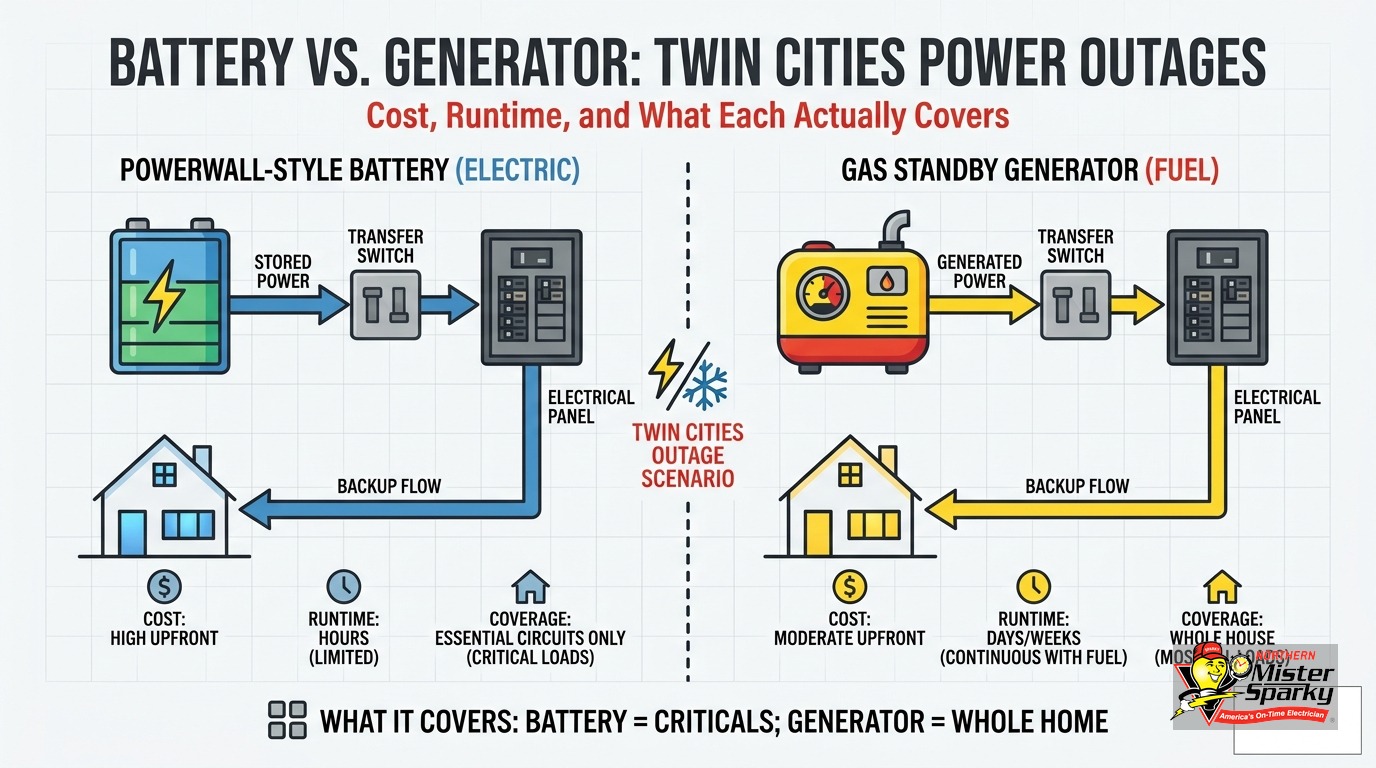
A whole-home battery stores electricity. It charges from the grid or from a connected solar array. When it detects a grid outage, it switches on automatically, typically within milliseconds. There are no moving parts, no fuel to manage, and no exhaust. The transition is seamless enough that sensitive electronics and medical equipment experience no disruption.
A standby generator burns fuel. It detects a grid outage through an automatic transfer switch and starts on its own. A natural gas unit connects to the same underground distribution lines that feed your furnace. As long as fuel pressure holds, the generator runs. A propane unit runs until the tank empties.
The tradeoff is simple. A battery is silent, instant, and maintenance-free, but carries a fixed energy ceiling. Once it depletes, it is done until the grid restores or solar recharges it. A generator is loud, needs annual maintenance, and depends on a fuel supply. But it has no storage limit. It runs as long as fuel flows.
Neither is objectively better. The right choice depends on the outage length you are preparing for, the loads you need to cover, and your budget.
How Much Does Each Option Cost in Minnesota in 2026?
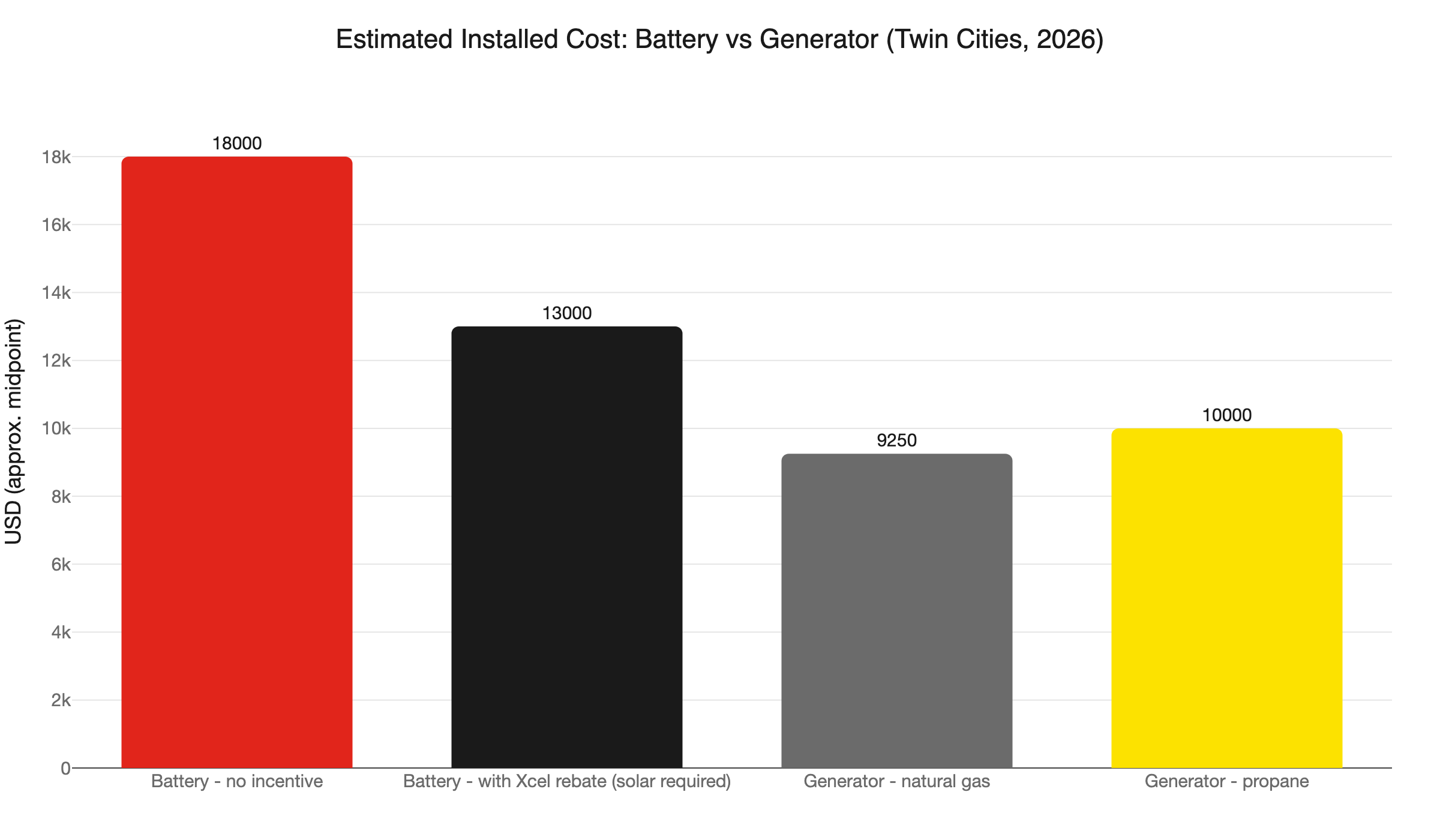
A whole-home battery runs $16,000 to $20,000 installed. A natural gas standby generator runs $7,500 to $11,000. Neither carries a federal incentive for 2026 purchases.
Here is the full breakdown:
Whole-home battery:
- Installed cost: approximately $16,000 to $20,000
- Federal tax credit in 2026: none
- Xcel Energy rebate (solar pairing required): $175/kWh, capped at $5,000. Net cost with rebate: roughly $11,000 to $15,000, but only if you are also installing solar panels
- Ongoing cost: essentially zero; charges from the grid or sun
- Maintenance: no routine maintenance required
22 kW natural gas standby generator:
- Installed cost on natural gas: pricing varies depending on the installation.
- Propane version: $8,000 to $12,000
- Running cost on natural gas: approximately $2 to $5 per hour; roughly $60 to $120 for 24 hours of continuous operation
- Maintenance: annual service, oil and filter changes, periodic load testing
Without solar, the rebate path for the battery is closed. The generator costs $5,000 to $9,000 less upfront, with no conditions. The Xcel rebate at $175/kWh capped at $5,000 meaningfully closes the gap for Xcel-territory homeowners who plan to add solar at the same time. But the full solar-plus-battery project carries a higher total price than a generator alone.
The battery makes financial sense if you value zero maintenance, silent operation, and the ability to charge from solar. The generator makes sense if cost efficiency is the primary driver.
Will a Home Battery Backup Work in Minnesota’s Winter?
Yes, down to about -4 degrees F, which is the Powerwall 3’s rated lower limit. Below that, Heat Mode may not fully maintain performance. Minnesota’s coldest nights regularly hit -20 degrees F or colder, so this is a real caveat. It is not a dealbreaker, but it is worth planning around.
The Powerwall 3 datasheet lists an operating range of -20 degrees C to 50 degrees C, or -4 degrees F to 122 degrees F. Tesla’s Heat Mode actively warms the battery cells as temperatures fall. It heats at 6.7 degrees C per hour and draws roughly 200 Wh while active. This is real cold-weather engineering.
The Minnesota reality is that extreme cold snaps regularly push temperatures to -20 degrees F (-29 degrees C). That exceeds the battery’s rated lower limit by 25 degrees Fahrenheit. At those temperatures, Heat Mode may not fully compensate. Cell performance can degrade.
This is not a reason to avoid a battery system. Most Minnesota winters, on most cold nights, the Powerwall 3’s range is more than sufficient. But homeowners should know the edge exists. If you lose power at 2 a.m. during a -25 degrees F cold snap, call for help before the battery runs out rather than waiting for it to fail.
A natural gas standby generator does not have a meaningful cold-weather performance limit. These units are engineered to start and run in extreme cold. And CenterPoint Energy’s underground gas distribution operates independently of the power grid. The lines run underground, protected from wind, ice, and falling trees. Gas pressure typically holds even during major storm events.
One important clarification: gas pressure alone does not keep your home warm. Your furnace’s ignition system, control board, and blower motor all require electricity. A generator restores that electricity. Without it, a gas furnace sits idle regardless of what is in the line.
What Are Minnesota’s Battery Rebates, and Do You Actually Qualify?
Both available rebate programs in Minnesota require pairing your battery with solar. A standalone battery for outage backup does not qualify for either. If you are buying a battery for outage protection only, neither state program applies to you. Most comparison articles never say that plainly.
Here is what each program actually offers:
Xcel Energy service territory (Minneapolis, St. Paul, most of the Twin Cities metro):
- Standard rebate: $175/kWh, capped at $5,000
- Income-qualified rate: $370/kWh
- Solar pairing is required
- Program runs through June 30, 2027, or until available funds are claimed
Outside Xcel territory (MN Department of Commerce program):
- Standard rate: $250/kWh, up to $7,000
- Income-qualified rate: $1,000/kWh, up to $15,000
- Requires an active solar interconnection agreement
- As of September 2026, more than $1.4 million remains in the fund
The rebates are real and meaningful. They just do not help if you are buying a standalone battery for outage protection. Xcel-territory homeowners who plan to add solar can stack the rebate on the battery purchase and cut costs significantly. That is a strong scenario for the battery. Everyone buying battery-only pays full price.
What Does a Battery or Generator Actually Power in a Real Outage?
A single Powerwall 3 (13.5 kWh, 11.5 kW continuous) powers lights, a refrigerator, chargers, and a TV for 12-plus hours. It works harder when central A/C is in the mix. A 22 kW standby generator covers the whole home at once, including the A/C, stove, furnace, and everything plugged in simultaneously.
Running a refrigerator and freezer, LED lighting for a full floor, phone and laptop charging, and a television draws roughly 700 to 800 watts total. At that rate, 13.5 kWh lasts about 16 hours. That is more than enough for a typical outage.
Central air conditioning changes the picture. A 3-ton unit draws 3,500 watts or more when running. Add the A/C to the essentials and you are drawing 4,000 to 4,500 watts. The same 13.5 kWh battery now lasts about three hours at full load. Running the A/C intermittently through a summer night is realistic. Running it continuously is not.
An electric stove adds another 3,000 to 5,000 watts when active. Running the stove and the A/C at the same time would exceed the Powerwall 3’s continuous output. Most homeowners manage this with some load awareness during outages.
A 22 kW standby generator does not ask you to prioritize. The A/C, furnace, electric range, refrigerators, and lights all run together. That is a meaningful difference for larger homes or households that cannot manage loads during an outage.
Does Either Option Require a Permit in Minnesota?
Yes. Both require an electrical permit and a licensed electrician. There is no homeowner self-install path for either system. About 66 Minnesota cities have their own inspection authority, so the permit may go to your local building department rather than the state DLI. Your electrician will know which applies.
Minnesota adopted NEC 2023 on July 1, 2023. Article 706 (Energy Storage Systems) governs home battery installations. Requirements include:
- UL 9540 listing for the battery unit. An unlisted system cannot be permitted or installed.
- Accessible disconnect rated for the system
- Outdoor emergency shutoff device
- Maximum 100 VDC for conductors exposed in occupied spaces
Both battery and generator installs require a permit from DLI or the local authority. Many Minnesota cities administer their own electrical inspection programs. If you live in one, you apply locally, not through DLI.
See our full Minnesota electrical permit guide for more on how the process works. If either install requires a panel upgrade, our guide to whole-house standby generator installation costs in Minnesota covers what that adds to the project.
Which Option Is Right for Your Twin Cities Home?
There is no universal answer. Here is how to think through it.
A whole-home battery is likely the better fit if:
- Your main concern is summer storm outages lasting under 12 hours
- Seamless, silent switching matters to you (sensitive electronics, medical equipment, light sleepers)
- You are adding solar, which opens the rebate path and offsets the battery cost
- Generator exhaust or noise is a problem (small lot, HOA rules, attached garage concerns)
- You prefer zero-maintenance operation over the life of the system
A standby generator is likely the better fit if:
- You want reliable whole-home coverage for any outage length, including multi-day events
- You are not adding solar and the rebate path for a standalone battery is closed
- Your home has heavy electric loads: electric range, well pump, large A/C, workshop equipment
- Upfront cost is the primary constraint
- You are especially concerned about extended winter outages
Consider both if:
- You have medical equipment that cannot tolerate any interruption
- You want battery coverage for fast, silent switching on typical outages and a generator backstop for extended winter events
Our home battery backup and Powerwall wiring guide and our home generator sizing guide go deeper on each path.
Get a Straight Answer From Your Local Twin Cities Electrician
Both systems require a licensed electrician, a permit, and an inspection. The install is not complicated when done right. But getting the permit pulled, the transfer switch wired correctly, and the inspection passed is not a weekend project.
Northern Mister Sparky is locally owned and operated in the Twin Cities. We are America’s On-Time Electrician(R): we show up when we say we will, we pull the permits, and we stand behind every install with our UWIN(R) 100% satisfaction guarantee.
Tell us what you are trying to accomplish. We will recommend the right system for your home and your budget, no oversell.
Call us at 763-200-5956 or book your estimate online. We serve Minneapolis, St. Paul, Bloomington, Brooklyn Park, Woodbury, Blaine, Maple Grove, Plymouth, and the surrounding Twin Cities area.
Frequently Asked Questions
Is there still a federal tax credit for home battery backup in 2026? +
Will a Powerwall-style battery work in a Minnesota winter? +
Do I need a permit for a home battery or standby generator in Minnesota? +
Need an electrician now?