
Home Battery Backup System Installation in Minnesota
Key Takeaways
- A home battery backup system installation in Minnesota requires a permit, a licensed electrician, and in most cases a utility interconnection application.
- The federal 30% tax credit expired for systems placed in service on or after January 1, 2026. Many installer pages still advertise it incorrectly.
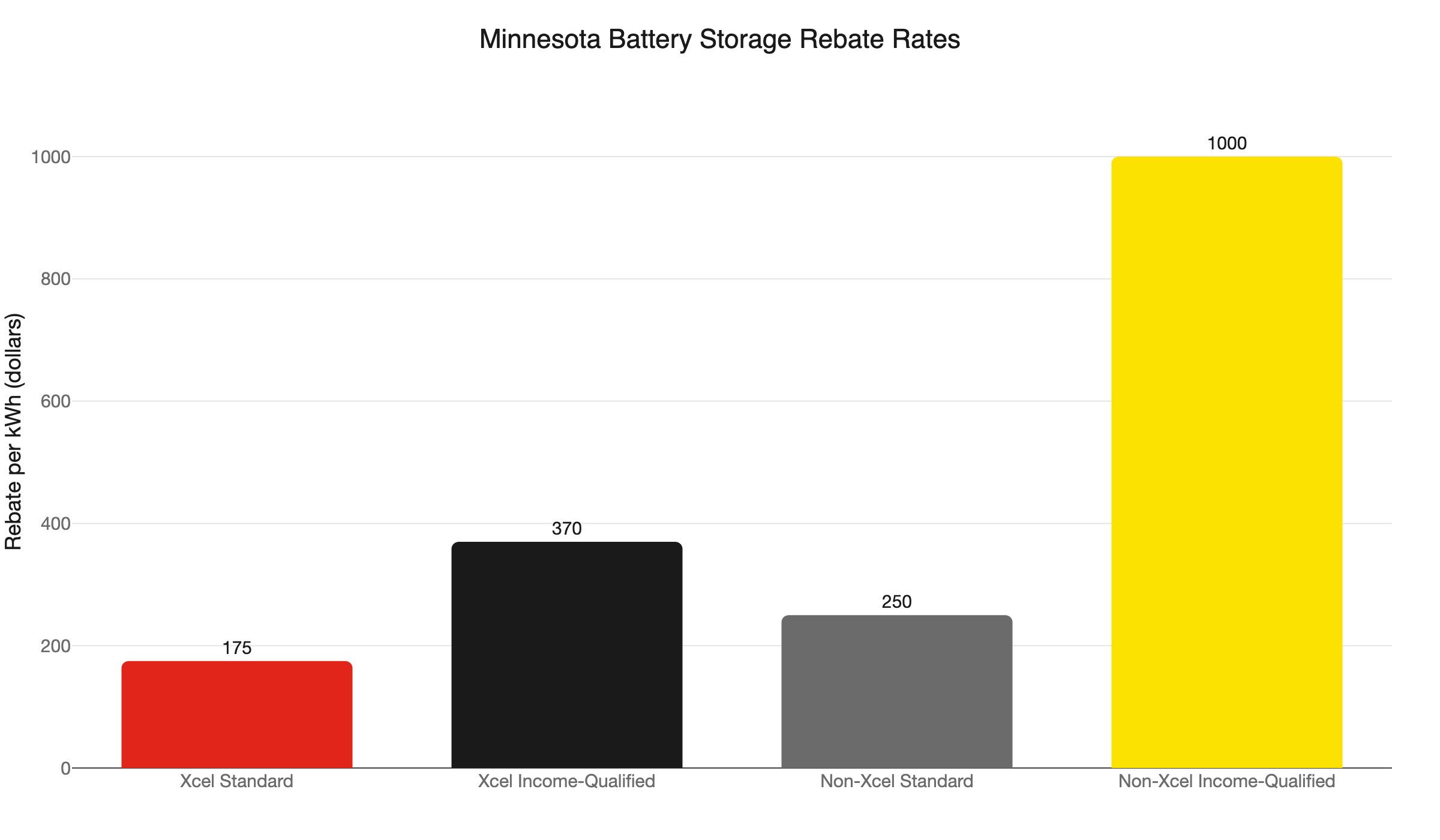
- Minnesota offers rebates of $175 to $1,000 per kWh depending on your utility and income level. Solar pairing is required for both programs.
- A battery-only install (no solar) is legal and permitted, but it does not qualify for the state rebate.
- Xcel Energy’s interconnection review can take up to three months. Plan your project timeline around that.
- The garage is the preferred install location in Minnesota for both cold-weather performance and fire-code reasons.
- Size for essentials, not comfort. Most Twin Cities homes need 5-10 kWh for critical loads. Add a furnace blower and a well pump and you are looking at 13-20 kWh.
What Is a Home Battery Backup System?
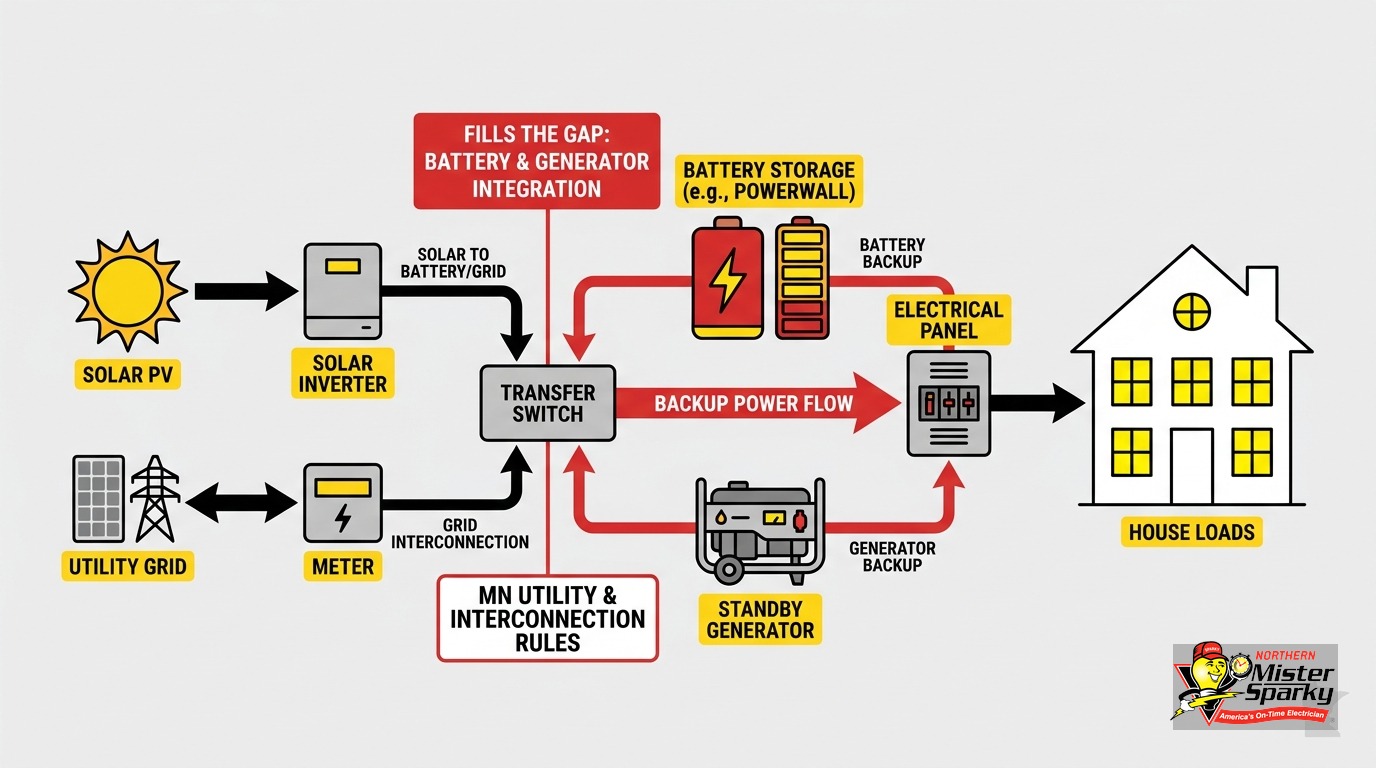
Short answer: A home battery backup system stores electricity and releases it when the grid fails. It sits between your meter and your panel, charging from solar, the grid, or both. Most residential units store 5 to 15 kWh and can be stacked for more total capacity.
Modern residential batteries use lithium-iron phosphate (LFP) chemistry. LFP is more thermally stable than older lithium-ion types. That matters in a Minnesota winter, and it matters if the unit will be in a garage that sees real temperature swings.
The main difference from a generator: a battery is silent, starts instantly, and needs no fuel. The main limitation: it stores a fixed amount of energy. It cannot refuel during a multi-day outage. A standby generator running on propane or natural gas can. That tradeoff matters when you are planning for a Minnesota ice storm.
Is Home Battery Backup Worth It in Minnesota?
Short answer: For backup power and resilience, yes. For cutting your monthly electricity bill, the math is weaker here than in states with time-of-use pricing.
Minnesota is a net metering state. Excess solar power you send to the grid earns a credit at roughly the average retail rate. You already get paid for solar surplus. Storing that energy in a battery and using it later saves you only the marginal difference in time-of-use rates. Xcel does not currently charge most residential customers time-of-use rates, so the bill-savings case is thin.
The resilience case is different. A single ice storm in the Twin Cities can knock out power for two to five days. If you have a sump pump, a medical device, or a well pump, an outage is not just inconvenient. It can be costly or dangerous.
There is also a rate-hedge argument. Minnesota electricity rates rose in 2024, and Xcel has filed for additional increases. A battery stores energy bought at today’s rate for use later. That is speculative, but not irrational.
That said, if your home has frequent medical equipment needs, a home office, or young children who need heat and light during a storm, the calculus shifts. A battery system can be a sound investment even where the bill-savings math does not pencil out.
We recommend a battery system for homeowners who already have solar or plan to add it. The backup case works well. The bill-savings case is weaker, and we will say so clearly before you spend $10,000 to $20,000. Our whole-house generator installation guide compares both backup options side by side if you want the full picture before deciding.
How Much Battery Do You Actually Need?
Short answer: Plan for 5-10 kWh to cover household essentials. Add a gas furnace blower and a well pump and you are looking at 13-20 kWh. Do not size for whole-home comfort. A battery drains quickly under air conditioning or EV charging loads.
Here is a practical Minnesota sizing framework:
Essentials tier (fridge, lights, internet router, sump pump): 5-10 kWh covers roughly 24 hours of outage.
Winter add-on (gas furnace blower, or one zone of electric baseboard): Add 3-5 kWh per day of runtime needed.
Well pump add-on (submersible pump at 1-2 kW): Add another 3-5 kWh depending on run cycles.
Comfort tier (central AC, electric stove, EV charger): 30-plus kWh and multiple batteries. The economics rarely work at this level without substantial solar production.
The biggest overspend we see is homeowners sizing for whole-home comfort. Cooling a 2,500-square-foot home in July draws 3-5 kW continuously. At that rate, a 13.5 kWh battery lasts about three hours.
We run a real load calculation on every job. Not a ballpark, not a sales floor estimate. If you want to preview that math, the home generator sizing guide uses the same approach and walks through how to build a circuit-by-circuit load list for your home.
What Minnesota Rebates Are Available?
Short answer: Xcel Energy customers get $175 per kWh, up to $5,000. Non-Xcel customers get $250 per kWh, up to $7,000. Income-qualified rates are significantly higher. Solar pairing is required for both.
Minnesota’s battery storage incentive program is authorized under Minn. Stat. § 216C.379. Here is how it breaks down:
Xcel Energy territory:
- Standard rate: $175 per kWh, up to $5,000 total
- Income-qualified rate: $370 per kWh
- Requirements: new battery, solar-paired, installed on or after August 1, 2024, and 50 kWh or less
Non-Xcel territory (municipal utilities and electric cooperatives):
- Standard rate: $250 per kWh, up to $7,000 total
- Income-qualified rate: $1,000 per kWh, up to $15,000 total
- Contact storageincentive.comm@state.mn.us to confirm your utility’s participation
The solar-pairing requirement is firm. A battery-only install does not qualify for the rebate. That said, a battery-only system is still legal, permitted, and a valid job for a licensed electrician. You just will not receive the rebate payment.
Minnesota also has a property tax rule worth knowing. If the battery exclusively stores solar power with no grid charging, it may be exempt from property tax as part of the solar system. If it also charges from the grid, that exemption does not apply. The Minnesota Department of Revenue covers this in detail. Ask your tax professional before deciding on your charging configuration.
One more wrinkle: if your home already has solar and you want to add storage later, a new interconnection application is required. You cannot amend your existing solar filing. Minn. Stat. § 216B.164 governs this process. Build that into your schedule before signing a contract.
What Happened to the Federal Tax Credit?
Short answer: The §25D Residential Clean Energy Credit ended for systems placed in service on or after January 1, 2026. The One Big Beautiful Bill, enacted July 2025, repealed it. Many installer pages still say “30% through 2032.” That is no longer accurate.
This is the single biggest piece of misinformation in the home battery market right now. The 30% federal credit that covered purchase and installation costs, including a standalone battery with no solar paired, is gone for 2026 installs. It was repealed when the bill was signed in July 2025.
If you placed a qualifying system in service during 2025, you may still claim the credit on IRS Form 5695. To qualify under the 2025 rules, the battery needed at least 3 kWh of capacity. Onsite labor costs for installation were includable in the credit basis. Confirm your eligibility with a tax professional.
For 2026 and forward, the Minnesota state rebate is the primary financial incentive available. Plan and size your project around what that rebate actually covers.
Where Should the Battery Go?
Short answer: The attached garage. It stays above battery operating temperature minimums through a Minnesota winter, and it requires a less stringent fire separation than an interior installation.
NFPA 855 sets fire-separation requirements for battery storage systems. Here is what those rules mean for Minnesota homeowners:
- Living space (basement, utility room inside the home): 2-hour fire rating required on all surrounding surfaces.
- Attached garage: 1-hour fire rating required on the shared wall with the home’s living space only.
Most attached garages in the Twin Cities already have a fire-rated wall between the garage and the house interior. That wall typically satisfies the 1-hour requirement with no additional work. Moving the same battery into a finished basement utility room would require significant fire-blocking upgrades to meet the 2-hour standard.
Cold weather is the other factor. Most LFP batteries stop operating between -4°F and 14°F, depending on the manufacturer’s specs. A heated or semi-conditioned attached garage in Minnesota typically stays well above that threshold through January. An unheated detached garage is a higher risk.
Shorter conduit runs from a garage to the main panel also reduce installation cost. We assess the garage, the panel location, and the proposed circuit layout on every job before finalizing a plan.
What Code Requirements Apply to Home Battery Installation in Minnesota?
Short answer: Minnesota adopted NEC 2023 on July 1, 2023. Article 706 governs energy storage systems and requires UL 9540 listing, an accessible disconnect, a 100VDC ceiling for dwellings, and an outdoor emergency shutoff device.
The key requirements from NEC 2023 Article 706:
- UL 9540 listing required. The battery unit must carry UL 9540 certification. An unlisted product cannot be permitted or installed.
- Accessible disconnect. A clearly labeled service disconnect must be reachable by the homeowner and by emergency responders.
- 100VDC ceiling for dwellings. One- and two-family homes have a 100-volt DC limit for exposed conductors. This affects how battery strings are wired and labeled.
- Outdoor emergency shutdown device. Required, clearly marked, and accessible to fire personnel. Typically installed near the utility meter.
NFPA 855 adds fire separation and spacing requirements on top of the NEC rules. The AHJ enforces both at inspection. Neither requirement set appears on most solar installer pages.
The person pulling this permit and doing this install should be a licensed Minnesota electrician. This work is code-specific and inspection-bound. A solar panel crew that wires batteries as a side service is not the same thing.
If the battery install reveals your panel is out of breaker slots or undersized for new circuits, that is a separate but related conversation. Our signs you need an electrical panel upgrade post covers the most common triggers.
Do You Need a Permit for Home Battery Backup System Installation Minnesota?
Short answer: Yes. And you need to file with the right jurisdiction. About 66 Minnesota cities handle their own permits as local AHJs. The rest route through DLI. Filing with the wrong office wastes days.
Minneapolis, St. Paul, and most first-ring suburbs are local AHJs. Confirm yours before filing anything.
The general permit and interconnection sequence:
- Confirm your AHJ with DLI’s online inspector lookup.
- Submit the electrical permit application to your AHJ. Include UL 9540 product documentation and a single-line diagram.
- Receive permit approval before beginning installation.
- Submit the interconnection application to your utility. Many utilities ask for a permit number in the application.
- Schedule rough-in and final inspections with your AHJ.
- Receive utility interconnection approval, then activate the system.
Do not flip steps 3 and 4. Installing before permit approval can delay both your inspection and your interconnection review.
Our electrical permit in Minnesota guide covers the permit process for residential electrical work, including which projects require permits and how timelines differ between local AHJs and DLI.
We file the permit and coordinate with the AHJ on every job. You do not have to manage this yourself.
How Does Utility Interconnection Work in Minnesota?
Short answer: Xcel Energy’s residential review can take up to three months. Non-Xcel utilities vary. Submit your interconnection application early and do not count on a faster timeline.
Interconnection is the utility’s review and approval of a grid-tied battery system. Minn. Stat. § 216B.164 governs this in Minnesota. Approval comes from the utility and is entirely separate from your city permit.
Xcel Energy’s residential queue has been active and sometimes slow. The MPUC approved Xcel’s Capacity*Connect program to deploy up to 200 MW of utility-owned battery storage by 2028. Residential interconnection requests move through the same environment.
Key facts for Minnesota interconnection:
- Adding storage to an existing solar system requires a new interconnection application. It is not an amendment to the solar-only filing.
- Do not energize the battery before interconnection approval. Activating early can trigger disconnection of your existing solar and potential fees.
- For non-Xcel utilities, contact your cooperative or municipal utility directly. Review timelines vary from a few weeks to several months.
Build the interconnection timeline into your project from day one. If you need backup power before a specific date, work backward from that date and account for up to 90 days of Xcel review.
Ready to Schedule Home Battery Backup System Installation in Minnesota?
No malarky: home battery backup system installation in Minnesota involves permits, code compliance, utility paperwork, and a licensed electrician on every step.
As locally owned and operated Twin Cities electricians and as America’s On-Time Electrician(R), we handle all of it. Our team confirms your AHJ, pulls the permit, designs the system to NEC 2023 Article 706, installs to code, and coordinates the utility interconnection application. We run a real load calculation before recommending a system size. We give you a straight answer about what the system will and will not do for your home.
The UWIN(R) 100% satisfaction guarantee backs every job we do. If something is not right, we make it right.
Call 763-200-5956 or book online to schedule a consultation. We will assess your panel, your loads, your utility territory, and your site location, and give you an honest recommendation.
Frequently Asked Questions
Does Minnesota offer rebates for home battery backup systems? +
Is the federal 30% tax credit still available for battery backup in 2026? +
Do I need a permit for home battery backup installation in Minnesota? +
Need an electrician now?