
Home Energy Monitor Installation: What MN Homeowners Need to Know
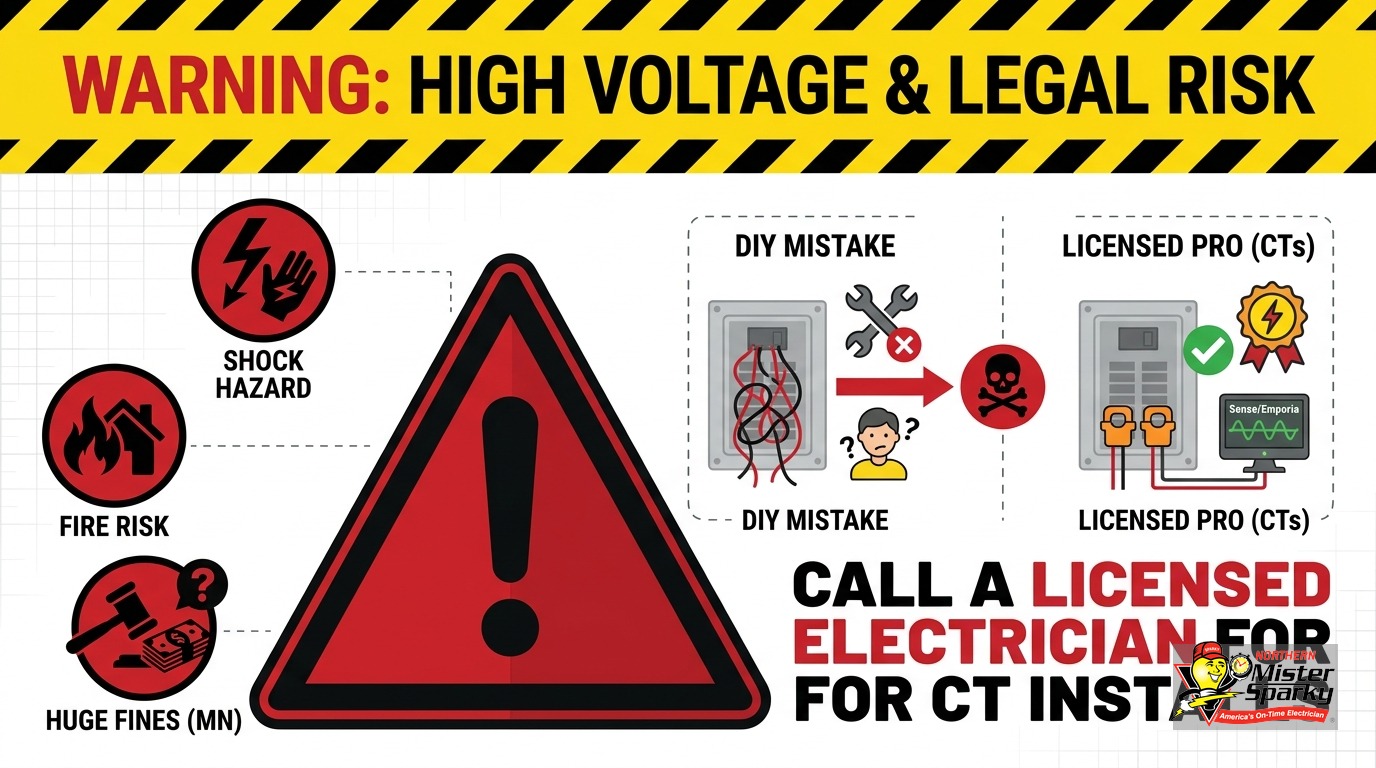
Key Takeaways
- CT sensors must clamp your service entrance conductors - live 240V wires that the utility controls, not your main breaker.
- Minnesota requires a permit and a state electrical inspection for this type of panel work. MN Statute 326B governs electrical licensing statewide.
- Minnesota adopted the 2026 NEC, effective August 17, 2026. Any permit pulled on or after that date must meet the current code cycle.
- A homeowner exemption exists but does not waive the permit or inspection requirement.
- The IRS 25C credit does not cover monitor hardware, but a professional home energy audit qualifies for 30% of cost up to $150.
- A licensed electrician handles the panel portion in 15-30 minutes and delivers a capacity read on your service at the same time.
Home energy monitor installation looks simple on paper. You clip two CT sensors around conductors inside your panel, snap in a breaker, connect to Wi-Fi, and watch a dashboard fill in. The setup guide that ships with a Sense or an Emporia Vue makes it look about as involved as installing a new outlet.
Here is what the manual does not cover: the conductors those CT sensors clamp around are your service entrance wires. Xcel Energy controls them, not your main breaker. They run live at 240V AC every minute of every day, regardless of whether every circuit in your home is switched off. In Minnesota, opening your load center and working near those conductors requires a permit. The work must pass inspection.
That changes the calculation. This post covers what home energy monitor installation actually involves, why the load center step warrants a licensed electrician in Minnesota, and what you gain from a professional visit that a DIY install does not give you.
What Does a Home Energy Monitor Do?
A home energy monitor clips current-sensing (CT) sensors around the two main conductors inside your electrical panel. Those sensors measure the amps flowing through the conductors in real time. Software on the connected device translates that data into whole-home consumption, tracks patterns over days and weeks, and uses machine learning to identify individual appliances by their electrical signatures.
The Sense Home Energy Monitor and the Emporia Vue are the two most common consumer devices in this category. Both require CT sensor placement on the service entrance conductors inside the load center. The monitor draws power from a dedicated double-pole breaker, typically 15A or 20A, that is installed in an available panel slot as part of setup.
The data payoff is real: a live dashboard, appliance detection, and monthly breakdowns that show exactly where your electricity dollars go. The hardware install is where the safety and legal questions concentrate.
What Are Service Entrance Conductors, and Why Does It Matter?
Service entrance conductors are the utility’s wires. They stay live at 240V even when your main breaker is off.
When you flip your main breaker to the off position, you disconnect everything downstream - every outlet, light, and appliance on the load side. The conductors feeding your main breaker from the outside do not respond to that switch. They stay energized. Only Xcel Energy can de-energize them, by disconnecting service at the meter or the pole.
The CT sensors have to go on those conductors. The monitor must measure every amp entering your home, which means it must be upstream of the main breaker. Upstream means live 240V conductors throughout the installation.
NEC Article 230.82 defines what may be connected ahead of the service disconnecting means. The list is narrow and specific. Everything else - including CT clamp installation for an energy monitor - requires working at the panel with live service conductors present. NEC Section 110.26(A) requires a minimum three-foot clear working space in front of service equipment when exposed live parts are present. A residential panel with the dead front removed and service conductors exposed qualifies exactly under that rule.
This is not a theoretical concern. It is the physical reason home energy monitor installation carries a different risk profile than swapping a light fixture or adding a GFCI outlet. The manual does not change that physics.
Does Minnesota Law Require a Permit for Home Energy Monitor Installation?
Yes. If the install involves opening your load center, Minnesota requires a permit and a licensed state electrical inspection.
Minnesota adopted the National Electrical Code through Chapter 1315 of the Minnesota State Building Code. The Board of Electricity administers licensing under MN Statute 326B. Any wiring work that goes beyond cosmetic changes falls under this framework.
Homeowners can apply for an electrical permit on their own primary residence, so the exemption path exists. But pulling the permit is not optional, and the completed work must pass inspection by a licensed state electrical inspector before it is legally finished.
Skipping the permit does not make the work go away legally. It makes it unpermitted. Unpermitted electrical work can void coverage for a related insurance claim, triggers a disclosure obligation when you sell, and is often flagged by buyers’ inspectors who check permit history. Some lenders require permit records as part of the underwriting process on refinances. These are concrete consequences, not theoretical ones.
When Did Minnesota Update Its Electrical Code?
Minnesota adopted the 2026 NEC, effective August 17, 2026. Any permit pulled on or after that date is governed by the 2026 National Electrical Code. Permits pulled before that date fell under the 2023 NEC.
If you are scheduling home energy monitor installation now, your permit and inspection will reference the 2026 code cycle. A licensed electrician tracks these transitions and pulls permits under the correct code automatically.
What Does Home Energy Monitor Installation Involve, Step by Step?
Here is the actual sequence for a CT-based energy monitor installation:
- Shut off the main breaker. All load-side circuits go dead. The service entrance conductors above the main breaker remain live at 240V.
- Remove the dead front cover. This exposes all conductors inside the panel, including the live service entrance wires at the top of the enclosure.
- Clamp CT sensors around the two service conductors. This is the step the manual illustrates as routine. The wires being clamped are live throughout this step.
- Install a dedicated double-pole breaker for the monitor’s power supply in an available slot.
- Route monitor power leads and CT leads to the device, mounted near the panel.
- Restore power and commission the monitor through the app.
Steps two and three are where the risk concentrates. The cover is off. The conductors are live. This is a job that warrants trained hands, correct PPE, and a permit on file. If your panel is already out of breaker slots, that surfaces immediately and needs a solution before the monitor install can proceed.
Is There a Homeowner Exemption in Minnesota?
Yes, but it does not waive the permit or inspection, and the service conductors stay just as live either way.
MN Statute 326B includes a homeowner exemption that allows an owner to perform electrical work on their own primary residence. The conditions are specific:
- The property must be your primary residence. Rentals, vacation cabins, and investment properties do not qualify.
- You must pull a permit before starting the work.
- The completed work must pass inspection by a licensed state electrical inspector.
The exemption is a legitimate path with its own rules, not a loophole. When most homeowners look at it honestly, they decide that a 15-30 minute panel job is worth handing to a licensed electrician who carries the permit, the insurance, and the liability. The exemption does not change what the conductors are doing while the panel cover is off.
What Does an Electrician Actually Do During Home Energy Monitor Installation?
A licensed electrician typically completes the panel portion in 15-30 minutes. The visit covers:
- Safe work at live conductors: The electrician uses correct PPE and follows NEC working clearance requirements throughout.
- Accurate CT placement: Sensors go on the correct conductors, oriented correctly for clean and accurate readings.
- Breaker sizing and installation: A correctly sized double-pole breaker is installed in an appropriate slot, with the right wire gauge for the run.
- Device mounting and wiring: The monitor is mounted and connected per the manufacturer’s specification.
- Commission and verification: The device is confirmed to read correctly before the panel cover goes back on.
- Permit documentation: The work is recorded for the state inspection file.
There is a practical byproduct worth naming. Your electrician has the panel open. That is the best possible moment to find out whether your service is sized for the EV charger or heat pump you have been thinking about adding. You get a capacity assessment at no extra travel cost, and that information shapes every electrical upgrade conversation you have afterward.
What Can an Electrician Tell You While Looking at Your Panel?
Quite a bit - and for Twin Cities homeowners planning a major upgrade, the timing is useful.
Minnesota averages about 7,981 heating degree days per year (NOAA 1991-2020 normals for Minneapolis/St. Paul). That is a heavy seasonal electrical load, and it tends to accelerate plans for heat pumps, electric water heaters, and EV charging. Knowing your current panel capacity before you book any of those jobs saves a wasted trip and a surprise cost estimate.
With the panel open during a monitor install, an electrician can:
- Count available breaker slots and calculate remaining load headroom.
- Spot signs that your panel needs an upgrade - heat damage, double-tapped breakers, corrosion, or outdated equipment.
- Confirm whether your service entrance amperage supports the next load you want to add.
- Identify any existing concerns with breaker condition or wiring.
If your panel has room and your service entrance is sized correctly, great - you have that confirmed in writing. If it is not, you know before you order an EV charger or a heat pump, not after.
Does a Home Energy Monitor Qualify for a Tax Credit or Utility Rebate?
The hardware does not qualify for the IRS 25C credit. A professional home energy audit does. Xcel Energy does not currently rebate the hardware directly.
The IRS Energy Efficient Home Improvement Credit (Section 25C) covers insulation, windows, doors, heat pumps, central AC, water heaters, and similar systems. It also covers professional home energy audits at 30% of cost, up to $150, under IRC Section 25C(b)(4). Monitor hardware is not in the qualified product list.
Xcel Energy’s Home Energy Squad program subsidizes in-home assessments but does not currently offer a direct rebate on Sense or Emporia hardware. Check mn.my.xcelenergy.com for current offers, as programs change periodically.
The ROI case for the monitor is behavioral, not rebate-driven. Households that track consumption actively tend to find meaningful savings by changing habits and identifying energy hogs: a plug-in space heater left running, a water heater thermostat cycling too long, high phantom draw from devices in standby. The monitor pays for itself through what you learn and change.
What Does Professional Home Energy Monitor Installation Cost in the Twin Cities?
Expect the device cost plus one to two hours of licensed electrician labor. The panel work itself is typically under one hour.
Monitor hardware runs roughly $200-$350 for a Sense or Emporia Vue system, depending on whether you add individual circuit sensors for granular tracking. Labor in the Twin Cities reflects one to two hours of residential electrician time for a standalone install.
If you already have an electrician scheduled for another job - a panel inspection, a new circuit, a safety walkthrough - the monitor install stacks efficiently onto that visit. One truck roll, two jobs, one permit.
Minnesota permit fees for low-scope residential permits are typically a flat fee, often under $75. Your electrician handles the permit application in most cases. Our Twin Cities electrician cost guide covers what to expect across a range of residential electrical work if you want context on labor rates before you call.
Making the Most of Your Energy Monitor Data
Once the monitor is commissioned, you have a live picture of your home’s consumption. Here is where to focus first:
- Always-on baseline: What does your home draw at 2 a.m. with everything off? A baseline above 300-400W typically signals phantom draw worth investigating - always-on electronics, a second refrigerator, a freezer in the garage running year-round.
- High-cycle loads: Electric water heaters and resistance heating elements cycle frequently. If you see sustained high draw from those circuits, the monitor can confirm whether a thermostat is running longer than it should or a heating element is failing.
- Individual circuit sensors: The Emporia platform supports add-on CT sensors on specific circuits. An electrician can install these on your highest-draw circuits - electric dryer, EV charger, HVAC equipment - for circuit-level data rather than whole-home totals.
- Shoulder-season spikes: Twin Cities homes see bill changes in spring and fall when both heating and cooling cycle within the same week. A monitor captures exactly when and how long each system runs, which is useful for scheduling and identifying equipment that is working harder than it should.
If the data shows you are running close to panel capacity, that is the right moment to have a conversation about a panel upgrade or a dedicated circuit for the next load you want to add. The monitor surfaces the question; an electrician answers it.
Ready to Schedule Home Energy Monitor Installation?
Northern Mister Sparky is locally owned and operated in the Twin Cities. We know the Minnesota permit process, we track the code cycle as it changes, and we know what the install involves inside your panel. The panel portion takes roughly 15-30 minutes, you get a permit on file, and we can tell you what your current service capacity looks like while we are already in the panel.
As America’s On-Time Electrician(R), we show up when we say we will. The UWIN(R) 100% satisfaction guarantee means we stand behind the work.
Call 763-200-5956 or book online to schedule. If the monitor install surfaces a capacity question for your next upgrade, we can scope that in the same conversation.
Frequently Asked Questions
Do I need a permit to install a home energy monitor in Minnesota? +
Can a homeowner install a Sense or Emporia monitor under the MN homeowner exemption? +
Does a home energy monitor qualify for the IRS 25C tax credit? +
Does Xcel Energy rebate a home energy monitor in Minnesota? +
Need an electrician now?