
The Real Electrical Reasons for Your High Electric Bill
Key Takeaways
- Xcel Energy has raised rates five consecutive years. The same wiring inefficiency that cost $80 in 2021 costs more today, even if the wiring has not gotten worse.
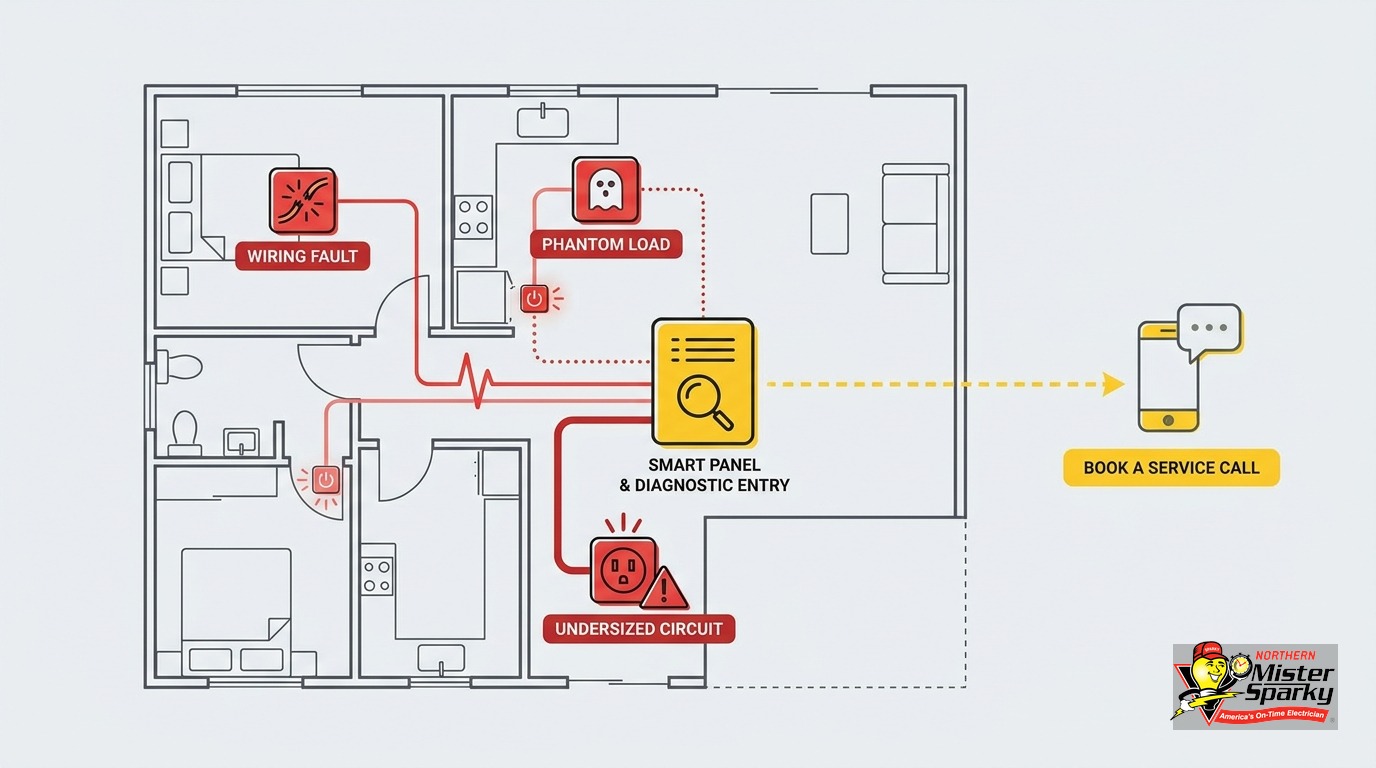
- Loose connections and damaged insulation turn electricity into heat your walls absorb, not power your appliances use.
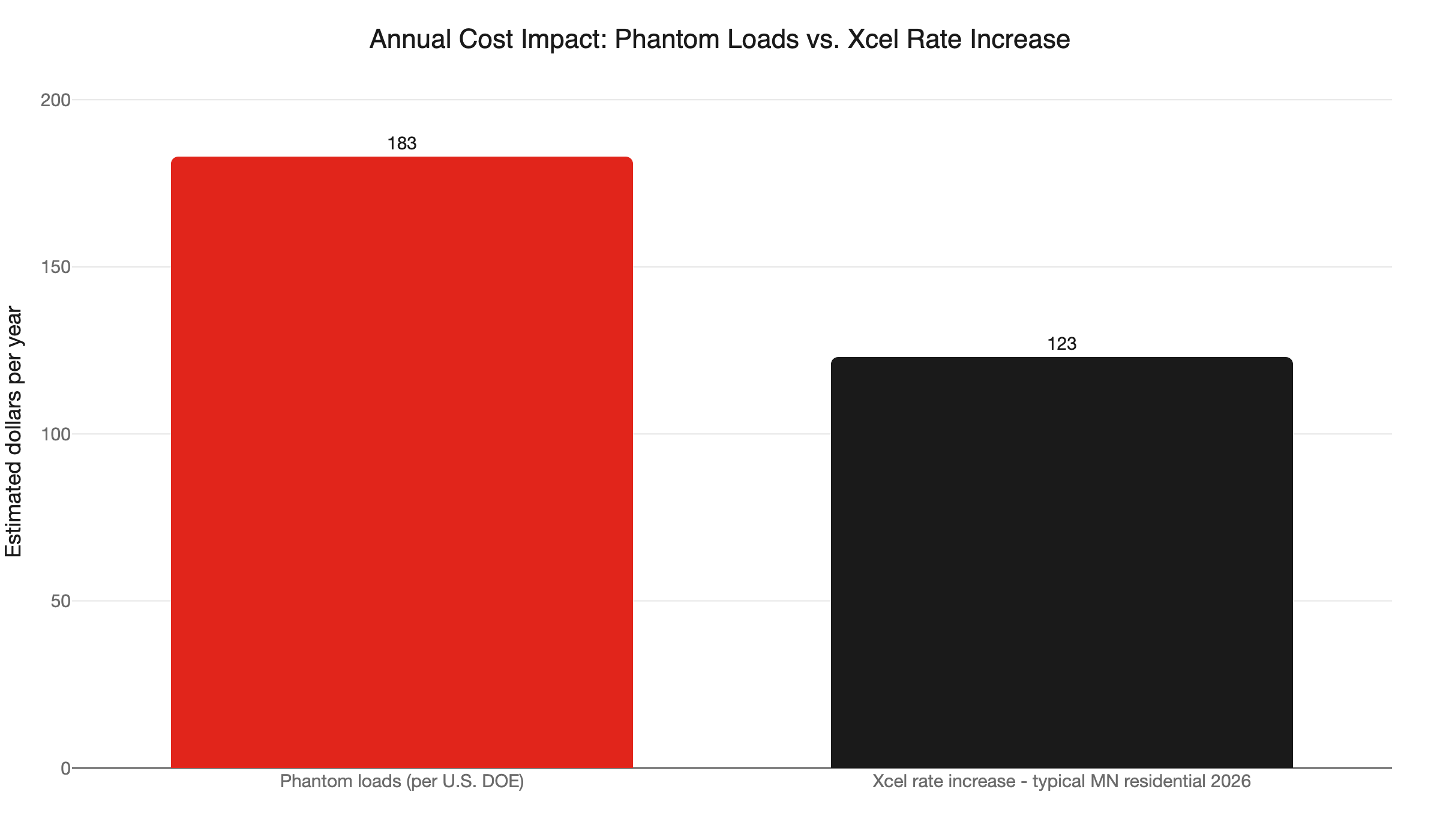
- According to the U.S. Department of Energy, phantom loads cost the average household up to $183 per year. Wiring problems multiply that waste on top of it.
- Homes built before 1970 often have panels and wire gauges designed for far fewer devices than today’s households run.
- Wiring faults, overloaded circuits, and panel problems require a licensed electrician to diagnose and fix safely. No thermostat tip will touch them.
- Call Northern Mister Sparky at 763-200-5956 or book online if you see unexplained bill spikes.
Why Your Electric Bill Keeps Going Up in the Twin Cities
Xcel Energy completed its fifth consecutive rate increase in June 2026. The Minnesota Public Utilities Commission finalized that hike, allowing Xcel to collect 5.8% more from Minnesota customers. According to the Citizens Utility Board of Minnesota, the typical residential customer pays roughly $123 more per year under this rate case. Interim rates that took effect January 1, 2025, had already added about $5.39 per month while the case was pending.
That context matters for one specific reason. Every watt your electrical system wastes costs more than it did last year. A wiring inefficiency that added $80 to your bill in 2021 costs more today in dollar terms, even if the wiring has not deteriorated further.
Most articles you find when you search for electrical reasons for a high electric bill cover behavior and appliances. Turn off lights. Upgrade your thermostat. Unplug chargers. That advice is accurate, but incomplete. It skips the electrical system itself.
Wiring faults, overloaded circuits, and an aging panel add invisible costs to your Xcel bill month after month. Most homeowners never connect those problems to the number at the bottom of their statement. This post does.
Can Bad Wiring Actually Cause a High Electric Bill?
Yes. Loose connections and damaged insulation create resistance in your wiring. Resistance converts electricity into heat. That heat exits through your walls, not through your lights or appliances. Your meter still counts every watt, but you get nothing useful from it.
The physics are simple. Electricity flowing through a clean, properly sized conductor moves efficiently. When a connection is loose or corroded, current meets resistance at that point. The resistance converts electrical energy to heat. That heat dissipates into the wall cavity or junction box. Your appliance still gets power, but the delivery system wasted some along the way.
Damaged wire insulation creates a related problem. A crack or break in insulation allows small amounts of current to leak to ground. That leakage forces devices on the circuit to draw more current to maintain their rated performance. Your refrigerator was designed to run at a specific voltage. If the circuit delivers low voltage because of insulation leakage, the compressor draws more current to compensate. You pay for that extra draw on every billing cycle.
Research on the connection between wiring faults and energy bills confirms that loose connections and undersized conductors are a documented cause of elevated electricity consumption in homes. The waste is invisible. Your breaker does not trip. Your lights do not flicker. The energy simply leaves as heat inside your walls, and the bill climbs.
This is the gap in almost every article that ranks for this topic. The national sites cover rate hikes, weather, and appliance age. None mention that your wiring itself can be the problem. If your bill spiked without a change in behavior, appliances, or season, the electrical system is worth a look.
What Are Phantom Loads and How Much Do They Cost You?
Phantom loads are the electricity your devices draw while switched off or on standby. The U.S. Department of Energy estimates standby power accounts for 5-10% of residential electricity use, up to $183 per year for the average household. That number rises when wiring inefficiency compounds the loss.
The Lawrence Berkeley National Laboratory measured standby power across ten homes and found an average standby load of 67 watts. The range ran from 14 watts in a leaner household to 169 watts in a heavier one. Across those homes, standby accounted for 5-26% of total annual electricity consumption. The average home had 19 standby appliances drawing power at all times.
Walk through your house mentally. The television in the living room, plugged in but off, draws power. The microwave clock draws power. The cable box, the gaming console, the phone charger with nothing connected to it, the smart home hub, the laser printer in the home office, all of them pull a small but constant load.
Individually, each device is a modest number. Nineteen devices at a combined average of 67 watts adds up fast. In a Minnesota home where Xcel charges more per kilowatt-hour than it did a year ago, the cost of that standby load is higher than numbers in older articles suggest.
Some phantom load is manageable with smart power strips and unplugging rarely used devices. But wiring resistance compounds the problem. A device drawing 10 watts on standby over a high-resistance circuit costs more in practice than 10 watts on a clean circuit. The delivery inefficiency is added on top, and you pay for both.
How Do Loose Connections and Corroded Wiring Waste Energy?
Loose or corroded connections act like a restriction in a pipe. Current still flows, but it encounters friction at the restriction point. That friction converts electrical energy into heat at the connection. The heat exits the wall. You paid for that energy and got nothing useful from it.
The problem is invisible from where you stand. You cannot see inside your outlets, junction boxes, or panel. The cover plate looks normal. The breaker has not tripped. But resistance at that connection point is converting your electricity to heat around the clock.
Corrosion is a particular issue in older homes. Aluminum wiring, common in Twin Cities homes built between 1965 and 1973, oxidizes at connection points over time. Aluminum expands and contracts at a different rate than the copper terminals it connects to, which gradually loosens those connections. Loose aluminum-to-copper connections waste energy and present a known fire hazard. If your home was built in that window, understanding aluminum wiring risks is a worthwhile first step.
Even in homes with all-copper wiring, connections degrade. Outlets installed using the backstab method, where the wire is pushed into a spring clip rather than wrapped around a screw terminal, can loosen after years of use. A loose neutral connection can cause voltage to fluctuate across the circuit. Appliances on that circuit draw more current to compensate for inconsistent voltage, and your bill reflects that extra draw every month.
An electrician can locate high-resistance connections with a thermal imaging camera. A connection point running 15 to 20 degrees warmer than its surroundings tells the story. These problems are fixable. You just have to find them first.
What Happens When a Circuit Is Overloaded?
An overloaded circuit carries more amperage than it was designed to handle. The conductors run hotter than their rating. That heat is wasted electricity. Sustained near-overload also degrades wire insulation over time, creating resistance that compounds the waste in a slow, invisible cycle.
Pre-1970 Twin Cities homes often have 60-amp service panels and wire gauges sized for the modest loads of that era. A 15-amp kitchen circuit from 1958 was designed for a percolator, a toaster, and an overhead light. That same circuit today may carry a microwave, a coffee maker, an air fryer, and a refrigerator simultaneously.
When you run more amperage than a circuit can cleanly handle, the conductors run warm. The breaker may not trip if you stay just under the threshold. But that sustained near-overload generates heat that the insulation absorbs over months and years. The insulation degrades. Degraded insulation creates resistance. Resistance wastes energy. The cycle repeats, and your bill reflects each step.
If your circuit breaker keeps tripping, that is the obvious signal. The subtler signal is a circuit that consistently runs warm, a wall plate that feels slightly heated, or a breaker that runs noticeably warmer than the others in your panel.
Dedicated circuits for appliances solve this problem at the source. A refrigerator on its own dedicated circuit runs at its designed efficiency. A microwave on a dedicated 20-amp circuit does not compete with the coffee maker for headroom. Dedicated circuits remove the sustained near-overload condition and let each appliance operate the way its manufacturer intended.
Does an Outdated Electrical Panel Raise Your Electric Bill?
A failing or undersized panel does not directly waste electricity, but it creates the conditions that do. A panel at capacity forces overloaded circuits. A panel with a degraded neutral bus delivers inconsistent voltage, which causes appliances to draw more current than their spec sheets assume.
The panel is also where symptoms become visible. A breaker that feels warm to the touch, a neutral bus with signs of past overheating, or a panel where every slot is doubled up are signs the system is working harder than it should.
Twin Cities homes with original 60-amp or 100-amp service panels are increasingly out of spec for modern loads. The signs you need an electrical panel upgrade include frequent breaker trips, lights that dim when large appliances cycle on, and a panel full enough that any new circuit requires a tandem breaker squeezed into an existing slot.
Minnesota adopted the 2026 National Electrical Code effective August 17, 2026. Any permitted work filed on or after that date must comply with the 2026 NEC. If you have been considering a panel upgrade, any permit you pull now falls under the updated rules. Your electrician will walk you through what that means for your specific home and load profile.
A panel upgrade is a larger investment. For qualifying homeowners, financing can spread that cost over time. It addresses the root cause rather than treating symptoms, and in a rising-rate environment, the efficiency gains pay dividends every month.
Older Twin Cities Homes Face a Compounded Problem
Minneapolis-Saint Paul has significant pre-1960 housing stock. Many of those homes still have knob-and-tube wiring, undersized service panels, and circuits that were never designed for the loads today’s households place on them.
Knob-and-tube wiring has no ground conductor. It relies on open-air clearance to dissipate the heat it generates during normal operation. When those wires get buried under blown-in attic insulation, a common step in modern energy efficiency upgrades, the heat has nowhere to go. The wiring runs hotter than it was designed to. That heat is wasted electricity, and the sustained overtemperature accelerates degradation of cloth insulation that is already 60 to 80 years old.
Minnesota winters amplify the problem in ways the national averages do not capture. An undersized or high-resistance circuit serving electric baseboard heat runs at or near capacity for weeks during January and February. A connection that wastes 5 watts in a mild climate wastes that same 5 watts here, but for far more hours per year. The efficiency penalty is larger in the Twin Cities than in any average you will find in a national article.
The combination of older wiring, original panels, modern device loads, and a cold climate creates layered inefficiency. Each factor adds a small percentage. Together, they can account for a meaningful share of your Xcel bill, and the 2026 Xcel rate increase amplifies every percentage point.
If your home is pre-1960 and has not had a licensed electrician review the wiring, the electrical system itself may be one of the larger contributors to your monthly bill.
What Can You Do Before Calling an Electrician?
Log into your Xcel account and review your hourly usage data. Look for a flat overnight baseline that runs higher than it should. That pattern points to phantom loads or a continuously running device. Then check for physical symptoms: warm outlet plates, repeated breaker trips, and lights that flicker when large appliances start up.
Here is a practical checklist to work through this week:
- Pull up your Xcel usage history online. Find the overnight floor, the minimum draw when everyone is asleep and devices are off. A floor above 300-400 watts in a modest home is worth investigating.
- Walk each room and identify devices that stay plugged in but are rarely used. Plug them into smart power strips that cut phantom load automatically when the main device is off.
- Feel the cover plates on your outlets and switches. Warm or hot to the touch means something is wrong. Do not file this away and forget it.
- Note which breakers trip repeatedly. A breaker that trips more than once a month under normal household use is telling you the circuit is running overloaded.
- Stand near your panel and listen. Buzzing, crackling, or any sound beyond a faint hum means call an electrician today. Do not wait.
- Check whether your panel has any open breaker slots. A panel full of tandem breakers and no room left is a setup for sustained overloads and the degradation that follows.
Xcel also offers a Home Energy Squad visit for $50 to $100, which includes an in-home energy audit and up to $400 in installed efficiency materials. That program is a solid first layer. It assesses behavior and appliance efficiency. It will not diagnose your wiring.
The checklist and the Xcel program address what you can see and control. The structural problems, loose connections, overloaded circuits, degraded insulation, undersized panels, need a licensed electrician with the right diagnostic tools. No amount of behavior change fixes resistance in your wiring.
When Should You Call an Electrician About Your Electric Bill?
Call an electrician if your bill is rising without explanation, if your home is pre-1970 and has not had a wiring inspection, or if you notice warm outlets, flickering lights, or repeated breaker trips. Wiring problems do not self-correct. In a five-year rate-hike environment, every month of delay costs more than the month before.
These are not problems that go away when you unplug your phone charger. They are structural, and they compound. Degraded insulation creates more resistance. More resistance wastes more energy. Higher rates mean that waste costs more dollars per watt than it did the year before. The math works against you the longer the problem sits.
As America’s On-Time Electrician(R), Northern Mister Sparky is locally owned and operated right here in the Twin Cities. We serve Minneapolis, St. Paul, Bloomington, Brooklyn Park, Woodbury, Blaine, Maple Grove, Plymouth, and the surrounding metro. We show up when we say we will, diagnose what is actually causing your bill to climb, and fix it. No malarky.
The UWIN(R) 100% satisfaction guarantee backs every job. If you are not satisfied, we make it right.
Call 763-200-5956 or book online to schedule a diagnostic visit. If the diagnosis points to a panel upgrade, dedicated circuit work, or a wiring repair, ask about financing options when you call.
Frequently Asked Questions
Can bad wiring cause a high electric bill? +
What are phantom loads and how much do they cost? +
When should I call an electrician about my electric bill? +
Need an electrician now?