
Xcel Energy Time of Use Rate Savings: Electrical Upgrades
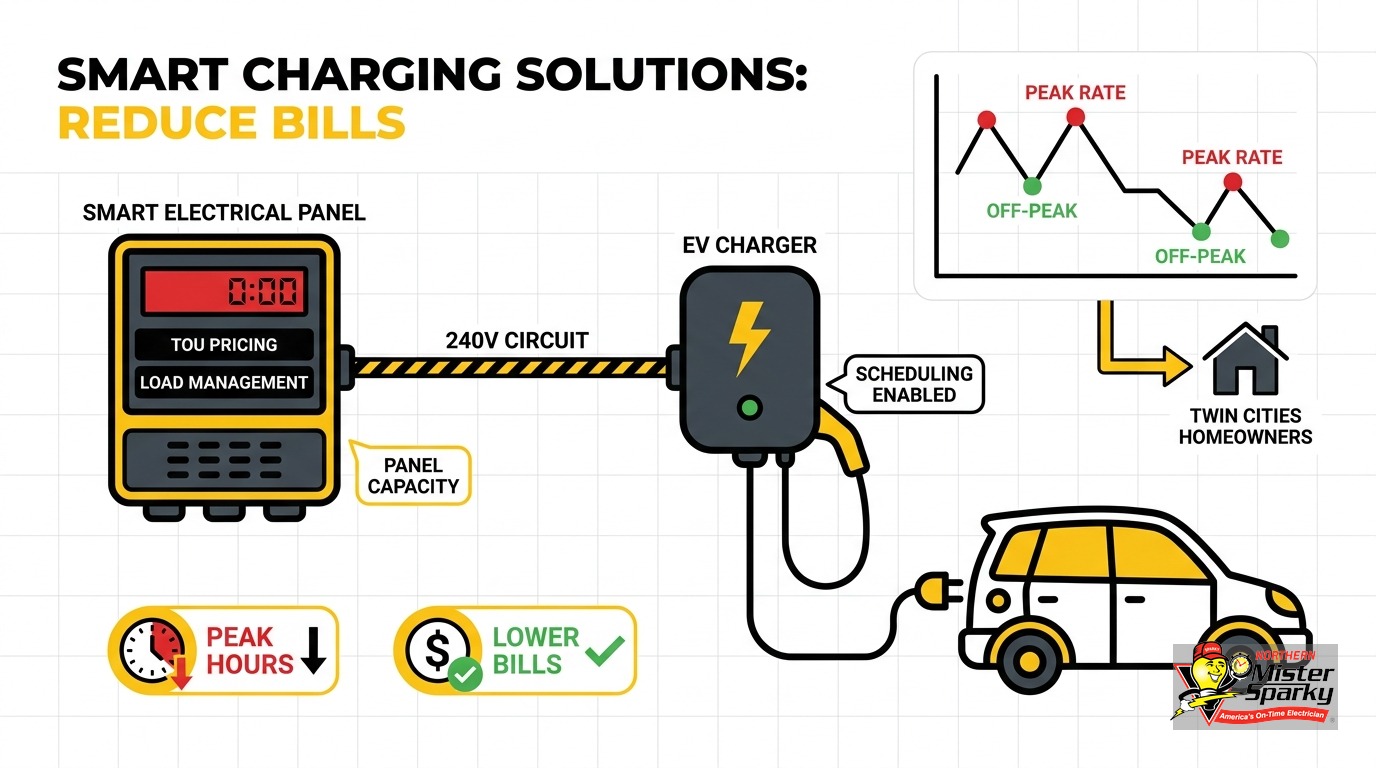
Key Takeaways
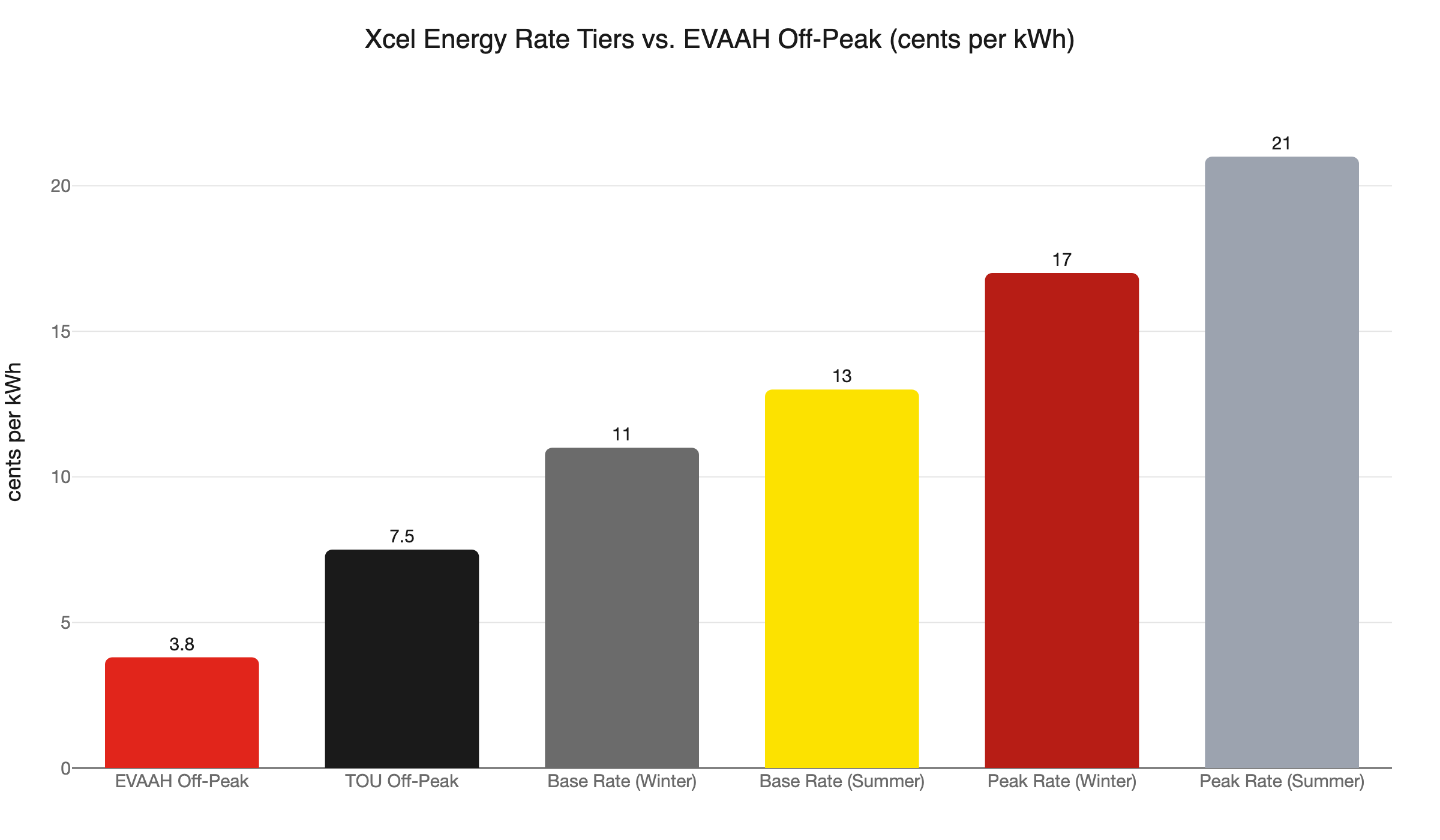
- Xcel Energy’s time of use (TOU) rate has a summer peak tier of about 21 cents per kWh, nearly 2.8 times the off-peak rate of 7.5 cents.
- If you own an EV, the EVAAH program offers 3.8 cents per kWh off-peak, roughly half what whole-home TOU charges for the same overnight window.
- Xcel’s two-year pilot showed only a 1.5% reduction in peak demand from behavioral shifts alone. Hardware automation is what drives real, consistent savings.
- NEC 625.48, now governing Minnesota permits pulled after August 17, 2026, allows a listed EVEMS to cap your EV charger load on paper. That often eliminates a $3,000 to $8,000 service upgrade.
- A SPAN smart panel automates TOU scheduling and can manage a 48-amp Level 2 charger on a 100-amp service without a service upgrade.
- Getting Xcel Energy time of use rate savings from electrical upgrades means treating your rate plan, your hardware, and the governing code as one connected decision, not three separate conversations.
What Are Xcel Energy Time of Use Rate Savings?
Xcel’s Flex Pricing plan charges different rates by time of day. Off-peak hours from midnight to 6 a.m. run about 7.5 cents per kWh year-round. Base hours run about 13 cents in summer and 11 cents in winter. Peak hours on weekday evenings from 6 to 9 p.m. run up to 21 cents per kWh in summer and 17 cents in winter.
The plan is opt-in. You sign up voluntarily through Xcel’s website, and your meter tracks usage by time slot. Any load you shift to the midnight through 6 a.m. window gets billed at the off-peak rate. If you shift nothing, you typically pay more than you did on a flat rate. Peak-hour usage now costs more than the old blended average.
The CUB Minnesota summary of PUC approval covers the rate structure and the regulatory process that made Flex Pricing optional rather than mandatory. What it does not cover is the hardware that makes those savings automatic rather than aspirational. That is where the electrician’s role begins.
Who benefits most from TOU? Households with EV chargers, heat pump water heaters, or battery storage systems. These are large, controllable, time-flexible loads. For a household running only lights, a refrigerator, and small appliances, the savings potential is modest. For a household with a Level 2 EV charger drawing 9 to 12 kilowatts per session, the arithmetic changes significantly.
How Large Is the Peak-to-Off-Peak Rate Gap?
In summer, Xcel’s peak rate is about 21 cents per kWh versus 7.5 cents off-peak, a 2.7-to-1 ratio. In winter, peak drops to roughly 17 cents while off-peak holds at 7.5 cents, a ratio of about 2.2 to one.
That spread matters most for large, time-flexible loads. An EV charger running at 48 amps on a 240-volt circuit draws about 11.5 kilowatts per hour. At the summer peak rate, one evening charging session costs roughly $2.42. The same session at the 7.5-cent off-peak rate costs about 86 cents. Over 300 sessions per year, the difference exceeds $460 on EV charging alone.
The gap is growing. The Minnesota PUC approved two rounds of rate increases for Xcel: 9.6% for 2025 and additional increases for 2026. Each increase widens the dollar value of avoiding peak consumption. Enrolling in TOU before your home is equipped to automate the shift means you are exposed to higher peak costs without reliably capturing the off-peak discount.
Why Do Most Homeowners See Modest Savings Without Hardware?
A Minnesota Reformer analysis of Xcel’s two-year TOU pilot found only a 1.5% reduction in peak demand across Longfellow and Eden Prairie participants. Without hardware automation, behavioral shifts are inconsistent. Most households capture a fraction of the available savings.
The reason is not willpower. Peak hours run 6 to 9 p.m. on weekdays. That window aligns exactly with when most Twin Cities households cook dinner, run the dishwasher, do laundry, and charge devices. Asking a family to defer all of that every weekday evening is an unrealistic ask. Some shifting happens. Most does not.
The math on partial shifting is unforgiving. If you move 20% of your peak consumption to off-peak, you capture 20% of the potential savings. But your base costs rise slightly, because the flat-rate blended average is no longer on the table. Without enough load shifting, some households on TOU pay more than they did before enrollment.
Hardware flips this dynamic. A smart panel or EVEMS monitors your home’s load in real time and moves scheduled loads, primarily EV charging, to off-peak windows automatically. You set the parameters once. The system handles every night. That is the difference between a $460-per-year opportunity and a $460-per-year reality.
What Is an EVEMS, and Can It Help You Avoid a Service Upgrade?
An EV Energy Management System (EVEMS) is a listed device that monitors your home’s total electrical load and automatically throttles your EV charger to keep aggregate demand within your service capacity. Under NEC 625.48, a compliant EVEMS lets the permit load calculation use the capped value instead of the charger’s nameplate rating, often eliminating a service upgrade entirely.
Here is the code context that changes the project economics.
Under NEC 625.42, an EV charger is classified as a continuous load. A continuous load requires a branch circuit sized at 125% of the rated current. For a 48-amp Level 2 charger, that means a 60-amp dedicated circuit minimum. On a loaded 100-amp service, adding a 60-amp circuit often pushes the total load calculation past the service rating. The result is a required service upgrade. Service upgrades in the Twin Cities typically run $3,000 to $8,000, depending on whether the meter base, service entrance cable, or the panel itself needs replacement.
NEC 625.48 is a 2026-cycle addition. SparkShift’s guide to NEC 2026 EV charger changes explains the mechanism clearly: when a listed EVEMS automatically limits the aggregate EVSE load to service capacity, the 125% continuous-load multiplier does not apply. The permit load calculation uses the managed, capped value. That capped value frequently fits within the existing service rating, avoiding the upgrade cost entirely.
Minnesota adopted the 2026 NEC on August 17, 2026, per the Department of Labor and Industry’s electrical codes page. Permits pulled before that date fall under the 2023 NEC. Permits pulled now are governed by 625.48. The timing of your application affects which code applies, so do not wait if you are already planning the project.
The practical result: a correctly spec’d EVEMS lets you install a 48-amp Level 2 charger on a 100-amp service without a service upgrade. Often it saves more than the EVEMS device costs. Our EV load management guide walks through the load calculation in more detail.
Which Smart Panel Is Right for TOU Load Management?
SPAN is the full-featured option: $2,800 to $4,000 installed, 32 controllable circuits, active load shedding, and native TOU scheduling. Leviton’s Smart Load Center 2.0 costs $1,200 to $2,200 but does not include active load shedding, so it requires a separate EVEMS device to qualify under NEC 625.48.
Two smart panels have clear market positions for Twin Cities homeowners right now.
SPAN replaces your main distribution panel and gives you per-circuit monitoring and control through a phone app. Its active load management watches total consumption in real time and throttles the EV charger when your HVAC, oven, or electric dryer draws heavily. SPAN’s April 2026 firmware update added AI predictive load management that forecasts household consumption two to four hours ahead, making the throttling smoother and less intrusive. SPAN’s built-in scheduling sends your EV charger to off-peak windows automatically. On a 100-amp service with a 48-amp Level 2 charger, SPAN qualifies as the EVEMS under 625.48 and actively keeps the load within your service capacity. You get code compliance, service upgrade avoidance, and TOU scheduling from one device.
Leviton Smart Load Center 2.0 released in February 2026 as a lower-cost option with 42-circuit monitoring and Matter smart-home protocol support. Its limitation for TOU purposes is that it monitors load but does not actively shed it. It does not throttle the EV charger when the house draws heavily. For NEC 625.48 compliance, you need a separate EVEMS device alongside it. The Leviton is a solid choice for a homeowner who wants circuit-level visibility and remote control without paying for full active management. For service upgrade avoidance and automated TOU scheduling, it is not a complete solution on its own.
For a deeper look at installed cost ranges and what each panel delivers, see our smart electrical panel upgrade cost post.
Is EVAAH a Better Deal Than Whole-Home TOU for Your EV?
Yes, for most EV owners. EVAAH offers 3.8 cents per kWh off-peak, roughly half the 7.5-cent whole-home TOU rate for the same overnight window. The trade-off is a monthly program fee and a Wi-Fi-connected charger requirement. You cannot be enrolled in both EVAAH and whole-home TOU at the same time.
The Xcel EVAAH program page lists two tiers, both effective July 1, 2026:
- Pay-as-you-go: A $7.77 monthly program fee, then 3.8 cents per kWh for off-peak charging.
- Subscription: $37.11 per month, which includes 1,000 kWh of off-peak charging per month.
For an EV with a 75 kWh battery pack charged fully from empty, EVAAH costs about $2.85 per charge. The same charge at the summer base rate of 13 cents costs $9.75. At the summer peak rate, it climbs to $15.75. The program fee erases in a few charging cycles for most EV owners.
The hardware requirement is a Wi-Fi-connected Level 2 charger. A standard NEMA 14-50 outlet with a portable Level 1 cord does not qualify. A hardwired Level 2 charger with app connectivity does. When you are already installing Level 2 charging for faster overnight replenishment, there is no added hardware cost to qualify for EVAAH. You specify the right charger model at install time and the program is available from day one.
Our EV charger installation guide for Twin Cities homeowners covers charger selection criteria, including which models satisfy EVAAH’s connectivity requirement and what the installation looks like from a permit and wiring standpoint.
Stacking Scheduling Credits on Top of Xcel TOU Rate Savings
The rate savings from EVAAH or Flex Pricing are the floor. Two additional Xcel programs layer bill credits on top for minimal extra effort, and both are worth enrolling in at install time.
Optimize Your Charge offers a $50 annual bill credit for committing to charge during defined off-peak windows: either 11 p.m. to 7 a.m. or 10 p.m. to 6 a.m. If you are already scheduling off-peak charging for the rate discount, this credit is essentially free. Enrollment is through Xcel’s Optimize Your Charge page. It does not require a smart panel. It does require a Wi-Fi-connected charger so Xcel can verify your charging patterns.
Charging Perks via WeaveGrid pairs the WeaveGrid app with your charger and lets Xcel schedule sessions around renewable energy availability within a window you define. The incentive is a $50 sign-on credit plus $70 per year. The app operates within your preferences; it does not override your charge times without your consent. It pairs naturally with a smart charger that accepts remote schedule commands.
Neither credit requires a smart panel upgrade. Both require a Wi-Fi-connected Level 2 charger with remote scheduling capability. Think of the charger install as the moment you lock in your program options for years. A hardwired Level 2 charger without Wi-Fi connectivity forecloses EVAAH, Optimize Your Charge, and WeaveGrid in a single decision. Specifying the right model adds no installation cost and keeps every option open. When you stack EVAAH’s 3.8-cent off-peak rate, the $50 Optimize Your Charge credit, and the $70 WeaveGrid credit, the charger install pays back faster than the electrical cost alone suggests.
What Does a Full TOU-Ready Electrical Project Look Like?
A complete TOU-optimized EV charging project for a Twin Cities home typically includes a panel capacity assessment, an EVEMS or smart panel selection, a Level 2 charger install, and program enrollment guidance. The electrician’s job is to spec the whole system as a unit, not just run a circuit and hand you a receipt.
Here is how our team walks through a TOU-ready project:
1. Panel capacity assessment. We measure your current service size, evaluate the existing load, and calculate available headroom. On a 100-amp service, we determine whether an EVEMS or smart panel keeps the 625.48 load calculation inside capacity. On a 150-amp or 200-amp service, we confirm there is room without additional hardware.
2. Charger and EVEMS selection. We match charger amperage (32, 40, or 48 amps) to your EV’s onboard charger rating, your available circuit capacity, and your target charging window. A 40-amp charger fully replenishes most EVs overnight, even starting at midnight. If EVEMS is the right path over a full smart panel, we specify a listed device that satisfies NEC 625.48.
3. Permitted installation. The branch circuit, panel connections, charger mount, and any EVEMS hardware go in under permit. A rough-in inspection and a final inspection close the permit properly. Open permits cause problems at resale and they are avoidable.
4. Program enrollment guidance. We walk you through the EVAAH signup process, Optimize Your Charge enrollment, and WeaveGrid setup so you leave with the full rate savings stack in place. We do not file the utility forms for you, but we explain exactly what to submit and in what order.
Level 2 EV charger installation in the Twin Cities runs $800 to $2,500 for the electrical work. Cost varies by panel proximity, circuit run distance, and whether a subpanel is needed. Add a smart panel at $1,200 to $4,000 depending on the model, or a standalone EVEMS device at lower cost when the only goal is service upgrade avoidance. For homes that need a panel upgrade regardless, Xcel’s rebate program offers up to $1,500 toward the panel. Our Xcel Energy electrical rebates post covers the full rebate stack, including income-qualified amounts up to $1,200 on the charger itself.
Schedule Your Evaluation With Northern Mister Sparky
Xcel Energy time of use rate savings and electrical upgrades are not separate conversations. The rate plan you choose, the hardware you install, and the code that governs the permit are all connected. Making a good decision on each one requires seeing all three together.
We are locally owned and operated here in the Twin Cities. As America’s On-Time Electrician(R), we show up when we say we will. Our team assesses your current panel capacity, walks through EVEMS versus smart panel options based on your service size and your EV, helps you choose the right charger for EVAAH eligibility, and handles the permit and inspection from start to finish. UWIN(R) 100% satisfaction guaranteed.
No malarky. Just a clear project plan, a permitted install, and a crew that knows Minnesota code.
Call 763-200-5956 or book online to schedule your evaluation.
Frequently Asked Questions
What is Xcel Energy's time of use rate? +
Can an EVEMS help me avoid a panel upgrade? +
What is EVAAH and how does it compare to whole-home TOU? +
Does a SPAN smart panel automatically schedule EV charging for off-peak hours? +
Need an electrician now?