
Smart Electrical Panel Upgrade Cost: Span vs. Leviton
Key Takeaways
- Smart panels add circuit-level monitoring and app control to a standard load center. Span also adds active load management. Leviton does not.
- Leviton Smart Load Center 2.0: $1,200-$2,200 installed. Per-circuit monitoring, app control, AI anomaly alerts. Limited EV and solar orchestration.
- Span Smart Panel: $2,800-$4,000 installed. Automatic load shedding, predictive AI 2-4 hours ahead, native solar and battery integration.
- Standard 100A-to-200A upgrade: $1,500-$4,000 panel only; $3,000-$6,000 with full service replacement.
- Xcel Energy rebate: Up to $1,500 for eligible Twin Cities panel upgrades. The Minnesota HEAR program has not launched. The federal 25C credit appears lapsed after 2025.
- NEC 2026 took effect August 3. Whole-home surge protection is now required on all panel upgrades.
- Every Minnesota panel upgrade requires a permit and inspection, no exceptions.
What Does a Smart Electrical Panel Actually Do?
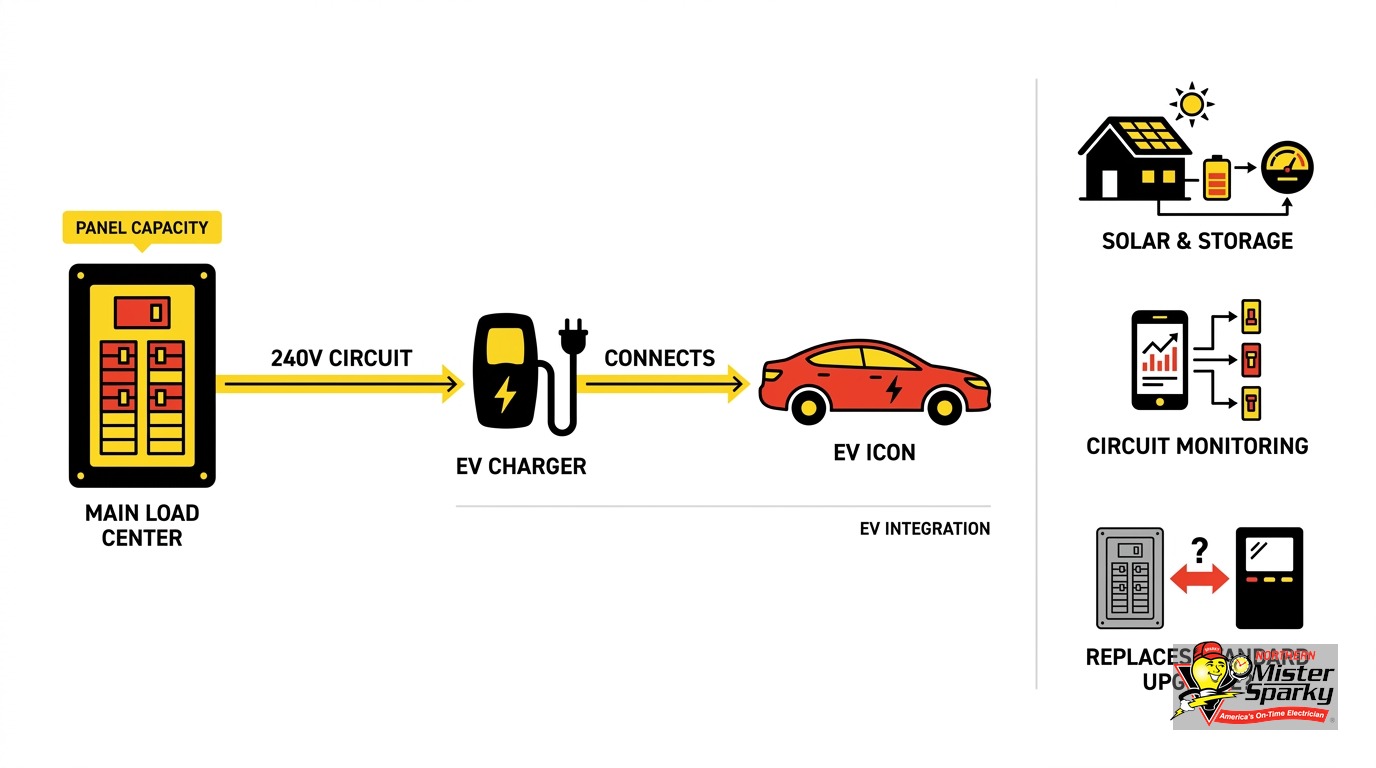
Short answer: A smart panel replaces your load center with a unit that monitors each circuit in real time, lets you control breakers from a phone app, and - in certain models - automatically manages loads so your service capacity is never exceeded.
Your standard breaker panel has one job: trip when a circuit overloads. It does this mechanically. No data. No connectivity.
A smart panel adds intelligence on top of that core protection. You can see exactly how much power each circuit is drawing right now. You get alerts when a circuit runs unusually hot - often the first sign of a failing appliance.
The more significant upgrade, in certain models, is active load management. This is where Span and Leviton diverge sharply. It matters most for homes with heat pumps, EV chargers, or solar arrays.
How Much Does a Smart Electrical Panel Upgrade Cost?
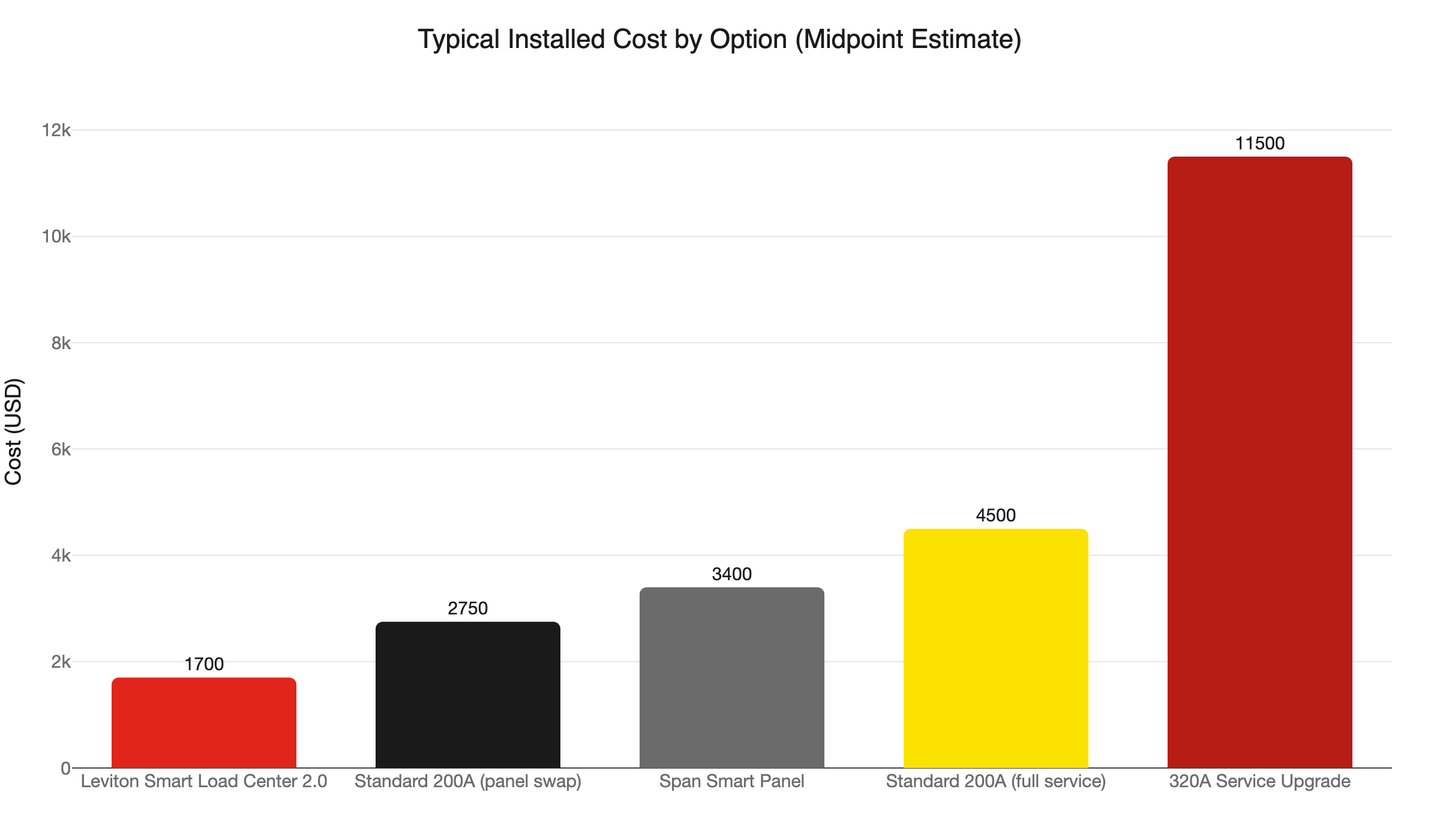
Short answer: Expect $1,200-$2,200 installed for a Leviton Smart Load Center 2.0 and $2,800-$4,000 for a Span Smart Panel. A standard 200A upgrade runs $1,500-$6,000 depending on whether the service entrance needs replacement too.
“Panel upgrade” covers several different scopes of work, and the price swings accordingly:
- Panel swap only: Replace the load center but keep the existing meter socket, weatherhead, and service entrance cable. This is the lower-cost scenario.
- Full service upgrade: Replace everything from the utility connection point to the new panel. According to hvacbase.org, this typically represents a significant cost for 200A service.
- 320A service upgrade: When calculated load genuinely exceeds 200A, a 320A upgrade carries a substantially higher cost. This is where a smart panel can save real money.
Smart panels replace the load center - they don’t add a separate cost tier on top of a standard upgrade. A Span panel, at $2,800-$4,000 installed, can substitute for a 320A upgrade by keeping peak demand below 200A. That math can favor the smart panel by $5,000 or more.
Leviton vs. Span: What Is the Real Difference?
Short answer: Both offer real-time circuit monitoring and app control. The critical gap is active load management. Leviton shows you data and lets you toggle circuits manually. Span automatically sheds and throttles loads to prevent overloads - no human required.
A direct technical comparison of both platforms puts the specs side by side:
Leviton Smart Load Center 2.0 (released February 2026):
- 42 circuits, per-circuit real-time monitoring
- Matter-certified, WiFi 2.4GHz, AI anomaly detection
- Solar and EV integration described as “basic” - limited orchestration
- Installed cost: $1,200-$2,200
Span Smart Panel (Firmware 4.2, April 2026):
- 32 circuits, 1-second real-time monitoring
- Predictive AI load management 2-4 hours ahead
- Native integration with Tesla, Enphase, SunPower, and Generac
- Automatic load shedding - no app interaction required
- WiFi plus cellular backup
- Installed cost: $2,800-$4,000
The load management gap matters most in high-draw scenarios. Say your heat pump kicks on. Your Level 2 EV charger is already running. Someone starts the electric dryer. Leviton shows you the data. Span automatically dials back EV charging speed to keep total load under your service capacity.
For a home with gas heat and one EV, Leviton may be more than sufficient. For an all-electric home with two EVs, a heat pump, and a home battery, Span earns the price difference.
One more consideration: Leviton’s UL listing for its smart panel was still pending at the time of this writing. Under NEC 2026 Article 705, UL 3141 certification is required for service upgrade avoidance. The AHJ - your local inspection authority - must accept the smart panel in lieu of a larger service upgrade. A Leviton install may still require a full utility service upgrade depending on your inspector’s reading of that provision.
Does a Smart Panel Replace a Standard Upgrade?
Short answer: Yes - a smart panel is the load center, so you buy one or the other, not both. But if your utility service is undersized, you may still need a service upgrade at the same time. A load calculation tells you which scenario applies.
A smart panel physically replaces your existing breaker panel. You don’t install Span in addition to a standard panel. You install it instead.
What a smart panel cannot change is your service entrance - the cable running from the utility transformer to your meter and into the panel. If your home has 100A service and your calculated load requires 200A, you still need a service upgrade. The smart panel lives inside that scope of work.
Where smart panels genuinely displace an upgrade is the 200A-to-320A scenario. A load calculation showing peak demand over 200A traditionally means a 320A service upgrade at $8,000-$15,000. A smart panel with active load management staggers high-draw loads and keeps the peak below 200A. Span handles this automatically.
If your existing panel is showing signs it’s undersized - breakers tripping regularly, no open slots for new circuits - start there. A smart panel does not fix an undersized service entrance.
Will My Twin Cities Home Benefit from Active Load Management?
Short answer: It depends on your load profile. A gas-heated home with one EV likely does not need Span’s active management. An all-electric home with two EVs and a heat pump almost certainly does - a Minnesota winter night can push a 200A service to its limit.
Here is how to read your own situation using realistic load calculations for Minnesota homes:
- Gas heat, no EV: Calculated load often 60-90A. A 100A panel may be sufficient. No smart panel needed.
- Heat pump plus one Level 2 EV charger (48A): Calculated load of 130-170A. A 200A panel is workable but tight. Both Leviton and Span help you track headroom.
- All-electric home plus two EVs and a hot tub: Calculated load of 200-280A. This is the range where active load management pays for itself. A 320A service upgrade would otherwise be the only alternative.
The cold-climate angle is real. Consider a Twin Cities January. A heat pump, an electric water heater, and overnight EV charging can all run at once. That combination can push a 100A panel to its absolute limit and strain a 200A panel too.
Span’s predictive load management sees two to four hours ahead. It begins throttling EV charging before the compressor fires up - not after the breaker trips.
If you’re planning an EV charger installation in the Twin Cities and you already have a heat pump or plan to add one, this is the conversation to have before the charger goes in.
What Rebates Apply in Minnesota?
Short answer: Xcel Energy offers up to $1,500 for Twin Cities panel upgrades using a licensed electrician. The Minnesota HEAR program has not launched as of August 2026. The federal 25C credit for panel components appears to have lapsed after 2025.
Xcel Energy Panel Upgrade Rebate
Xcel offers rebates for residential panel upgrades in its service territory. The rules:
- Single-family homes or buildings up to four units
- Work must be done by a licensed electrician
- Submit your invoice and approved permit; Xcel pays in 6-8 weeks
- Funds are limited and not guaranteed
This rebate applies to Xcel territory, which covers most of the Twin Cities metro. A standard upgrade to a higher-amperage panel qualifies. A smart panel upgrade qualifies as well. CenterPoint gas customers do not receive a utility panel rebate - they are waiting on Save Energy Minnesota, which has not launched.
Minnesota Save Energy / HEAR Program
As of August 2026, the Minnesota HEAR program is still awaiting formal DOE approval. There is no launch date. Rebates will not be retroactive - work done before launch is ineligible. Do not count on this funding for a project you are scheduling now.
Federal 25C Energy Efficient Home Improvement Credit
IRS guidance states this credit applied “until 2025.” Panel components meeting NEC requirements were capped at $600 per item. As of 2026, this credit appears to have lapsed. Do not plan your project around a 30% federal credit on a panel job.
What Changed Under NEC 2026?
Short answer: Minnesota adopted NEC 2026 on August 3, 2026. Permits pulled on or after that date fall under the new code. The most homeowner-visible change: whole-home surge protection is now required on all panel upgrades.
If your permit was pulled before August 3, your project runs under NEC 2023. Pull a permit today and you are in NEC 2026 territory. The code your permit is filed under governs the inspection - not when you schedule the work.
The surge protection requirement means a whole-home surge protector is now a code item on a panel upgrade, not an optional add-on. Factor it into your project budget. You can read more about how whole-home surge protection works and what it covers.
The other NEC 2026 change relevant to smart panels is Article 705, which governs load management. This provision allows a smart panel with UL 3141 certification to satisfy an inspector in lieu of a larger service upgrade. Span holds that certification. Leviton’s certification was still pending as of mid-2026. AHJ acceptance of a Leviton install under this provision is not guaranteed, so verify with your local inspector before committing to either product.
Do You Need a Permit for a Panel Upgrade in Minnesota?
Short answer: Yes, always. Every panel upgrade in Minnesota requires a permit and inspection regardless of who does the work. Homeowners may pull their own permit on owner-occupied single-family homes, but service and meter work always requires a licensed contractor.
Minnesota electrical permit requirements work as follows:
- Permits are required for all panel upgrade work, no exceptions
- Minneapolis, St. Paul, and many first-ring suburbs are local AHJs with their own inspectors
- Homes outside major cities typically fall under the state Department of Labor and Industry
- Homeowners may pull their own permit and do work on an owner-occupied home, but never for service entrance or meter work
- Smart panel installs include a software commissioning step that happens after the physical installation is done
Skipping the permit is not a shortcut. Unpermitted panel work creates insurance liability and can block a home sale. It also leaves you with no inspector sign-off confirming the work is safe.
As a locally owned and operated Twin Cities electrician, our team handles the permit, the installation, and the inspection coordination. That is part of what the job costs - and why you hire a licensed electrician rather than someone who skips the paperwork.
How Do You Choose the Right Smart Electrical Panel Upgrade?
Short answer: Start with a load calculation. Gas-heated homes with one EV often come out ahead with a standard upgrade. All-electric homes with heat pumps and two EVs are the best candidates for a Span smart panel - which can replace a 320A upgrade and save thousands in service costs.
Here is a plain-language decision guide based on common scenarios we see in the Twin Cities:
Standard 200A upgrade - consider this if:
- Your current panel is 100A, overfused, or has recall-listed breakers
- You have gas heat and no plans for EV charging or solar
- You want the Xcel $1,500 rebate on the simplest qualifying path
- Budget is the primary driver
Leviton Smart Load Center 2.0 - consider this if:
- You want circuit monitoring and app control without paying for active load management
- You have one EV and gas or hybrid heating
- Your local AHJ has confirmed it will accept the Leviton unit under NEC 2026 load management provisions
- Budget for the panel component is $1,200-$2,200
Span Smart Panel - consider this if:
- You have or plan an all-electric home with a heat pump and at least one EV
- You want to avoid a 320A service upgrade and its associated cost
- You have solar and want native battery and EV orchestration
- You want automated load management that works without monitoring an app
Our panel upgrade service starts with a load calculation and a straight answer about which option fits your home’s actual numbers - not a sales pitch for the most expensive product.
The Bottom Line
Smart panels are not a marketing gimmick. They represent a real shift in how a home manages electrical load. For the right house, Span can save you money over a 320A service upgrade. It also delivers capabilities a standard panel never will.
The key is knowing which scenario you are in. A gas-heated home with no EV has little use for active load management. The ideal candidate is an all-electric Twin Cities home. Heat pump. Level 2 charger. First full winter coming. Span was built for exactly that household.
What Leviton and Span share: both require a licensed electrician, a permit, and a real load calculation. A real load calculation requires someone who knows Minnesota homes, Minnesota winters, and the AHJ governing your address.
As America’s On-Time Electrician(R), we show up when we say we will and give you straight answers. We back every job with the UWIN(R) 100% satisfaction guarantee.
Call 763-200-5956 or book your panel assessment online. We will tell you exactly which option fits your home - no malarky.
Frequently Asked Questions
How much does a smart electrical panel upgrade cost in Minnesota? +
Does a smart panel replace a standard electrical panel upgrade? +
Is there a rebate for electrical panel upgrades in Minnesota? +
Need an electrician now?