
Solar-Ready Electrical Panel Upgrade: What to Spec Now
Key Takeaways
- A 225A copper busbar paired with a 200A main breaker gives a solar system roughly 45A of backfeed headroom under the NEC 120% rule - enough for a 7kW-plus AC system via a standard load-side connection.
- A meter-main combo (meter and main breaker in one enclosure) closes off the supply-side tap interconnection method. A separated meter base keeps every option open.
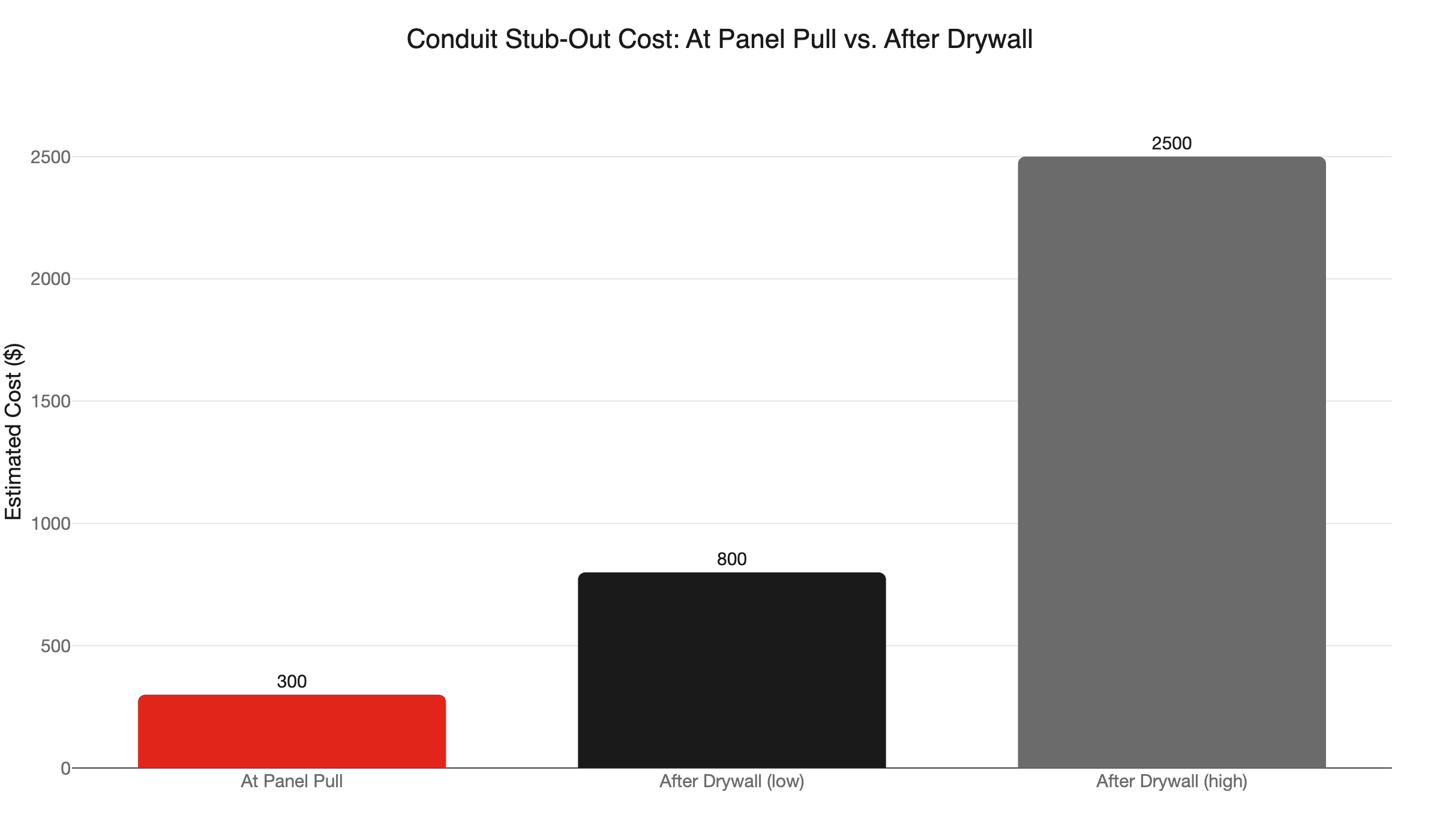
- Running a conduit stub-out from the panel to the roof at panel-pull time costs roughly $300 total. Retrofitting it after drywall costs $800 to $2,500.
- Minnesota adopted the 2023 NEC on July 1, 2023. All permits filed on or after that date must comply.
- Xcel Energy’s Solar*Rewards program requires pre-approval before you purchase any solar equipment - even if the solar is years away.
- The 30% federal Investment Tax Credit (ITC) is in effect through 2032 under current law.
Three Decisions That Determine Your Solar Future
You are not going solar today. You are replacing a 40-year-old Federal Pacific panel that trips breakers and worries your home inspector. But solar might look attractive in two or three years. The decisions made during today’s panel upgrade will either make that future install clean and affordable, or force a second panel pull and a lot of unnecessary spending.
This is the electrician’s angle on a solar-ready electrical panel upgrade: what to build in now, why it matters, and what it costs to skip it.
Why Does the Solar-Ready Decision Happen at the Panel Pull?
Quick answer: At panel pull, the wall is open, framing is exposed, and specs like conduit stub-outs and busbar upgrades cost a fraction of what they cost after drywall closes. The window is open exactly once. These three decisions close with it.
A panel upgrade is a major disruption. Your electrician opens the wall, pulls the old panel, runs new feeders, and brings the service up to current code. Drywall comes off, and then goes back on.
That open-wall window is the moment. A conduit run that takes an afternoon during rough-in takes two days and significant patching after the walls close. A busbar upgrade that costs a modest premium at equipment selection requires a full panel replacement to correct later. The three decisions covered in this post are inexpensive to get right the first time. They are expensive to correct after the fact.
What Busbar Rating Should You Choose for a Solar-Ready Electrical Panel Upgrade?
Quick answer: Choose a 225A copper busbar with a 200A main breaker. This gives you roughly 45A of solar backfeed headroom under the NEC 120% rule - enough for a 7.2kW AC solar system via a load-side connection, with no supply-side workarounds required.
Here is the math. NEC 705.12(B)(3)(2) - the 120% Rule limits how much solar inverter output you can backfeed into a panel on the load side. The formula: 120% of busbar rating, minus the main breaker amperage, equals available headroom.
With a standard 200A bus and a 200A main breaker:
- 200A x 1.20 = 240A
- 240A minus 200A = 40A of headroom
- The solar breaker must also sit at the bus end opposite the main, which limits practical system size further
With a 225A copper bus and a 200A main breaker:
- 225A x 1.20 = 270A
- 270A minus 200A = 70A of headroom
- That supports a robust residential solar system without a supply-side tap
Eaton’s solar-ready meter breakers offer a 225A copper bus that maxes PV input at 70A with a 200A main disconnect. That enables a clean load-side connection without derating. The cost difference between a 200A bus and a 225A bus is modest at equipment selection. The cost to correct an undersized busbar later is not.
The busbar choice is made before the panel is ordered. It is not something you retrofit.
What Is a Meter-Main Combo - and Why Does It Limit Your Solar Options?
Quick answer: A meter-main combo puts the utility meter socket and the main breaker in one enclosure. Because the line-side conductors are enclosed and inaccessible, a supply-side tap is not available. A separated meter base keeps every solar interconnection method open.
There are four interconnection methods for residential solar under NEC 705.12: load-side connection, supply-side tap, utility-side connection, and a dedicated solar-ready breaker position. When the meter and main share one enclosure, the supply-side tap is off the table. The line-side conductors are not accessible.
That matters most when the load-side calculation leaves you short. A supply-side tap bypasses the 120% rule entirely. Solar installers often prefer it on homes where busbar headroom is tight. A meter-main combo forecloses that option permanently.
A separated meter base also makes future meter work simpler and less disruptive. Our post on meter base and socket upgrade costs covers what that work typically runs in the Twin Cities.
The meter base choice is made at the same time as the busbar rating - one conversation, one visit, one chance to get both right.
Should You Run a Conduit Stub-Out During the Panel Upgrade?
Quick answer: Yes. A conduit stub-out from the panel to the roof at panel-pull time costs roughly $80 to $180 in materials plus two to four hours of labor - around $300 total. Retrofitting the same conduit after drywall closes costs $800 to $2,500, depending on attic access and framing.
A conduit stub-out is the physical raceway path from the panel location to the roof. The solar installer pulls the actual wire through it when the time comes. During rough-in, the framing is open. Your electrician can run the conduit in a few hours. After drywall, that same run requires cutting finished walls, fishing wire through insulation and framing, patching, and repainting. The cost is five to ten times higher. The disruption is considerably worse.
What to spec for the stub-out:
- Conduit size: 1-inch EMT at minimum. Go 1.5 inches if the solar design may include a large string inverter or battery backup.
- End caps: Cap both ends so the conduit stays clean until needed.
- Accessible endpoint: The roof-side end should terminate in the attic, not buried in a wall cavity.
- Labeling: Mark both ends “Solar - Future Use” so no one questions it during the solar install.
This is cheap insurance. The solar installer thanks you. Future-you thanks you too.
What “Dedicated Breaker Space” Means in Practice
A solar inverter connects to the panel through a dedicated double-pole breaker. Under NEC 705.12, that breaker must sit at the end of the bus opposite the main breaker - a specific location requirement. It cannot share a slot or end up mid-bus.
When your electrician selects the new panel, leaving two dedicated slots at the load end of the bus is a zero-cost decision. It is purely a matter of which panel model you order. If the panel is filled to capacity and the solar breaker ends up mid-bus, you may need a tandem breaker or a supply-side tap - adding cost and engineering to what should be a straightforward connection.
Practical steps to take now:
- Select a panel with at least 40 spaces. A 200A/40-space panel costs only modestly more than a 200A/24-space panel.
- Leave the last two slots at the load end of the bus empty on day one.
- Label those slots “Reserved - Solar” on the panel directory from the start.
A panel that has no room to grow creates problems before the solar conversation ever starts. If your current panel is already cramped, our post on signs you need a panel upgrade covers what to look for before the situation becomes urgent.
What Does Minnesota Code Require for a Solar-Ready Panel Upgrade?
Quick answer: Minnesota adopted the 2023 NEC on July 1, 2023. Any panel permit filed on or after that date must comply with current code. A licensed electrician pulls the permit. A final inspection is required before the panel is energized.
For the panel upgrade itself, DLI or the local AHJ issues the electrical permit. The inspector will check:
- Service entrance size and condition
- Main breaker and busbar ratings
- Grounding and bonding
- AFCI and GFCI protection requirements under 2023 NEC
- Panel clearance under NEC 110.26 - 36 inches of clear working space in front of the panel
When solar is eventually installed, Minnesota requires four separate approvals: an electrical permit through DLI or local AHJ, a building permit for roof load, zoning approval, and a utility interconnection agreement with Xcel or another utility. Final electrical inspection is mandatory before the system activates. A licensed electrician is required throughout the process.
The 2023 NEC also added NEC 705.10, which requires a “CAUTION: MULTIPLE SOURCES OF POWER” directory label at every service equipment location once PV is connected. Plan where that label goes on your new panel now - before the solar inspector asks.
Minnesota also has $2 million in state funds under Minn. Stat. 216C.48 to help local governments adopt the NREL SolarApp+ streamlined solar permitting platform, available through June 30, 2028. More Twin Cities municipalities adopting SolarApp+ means faster permit timelines when you are ready to go solar.
Our post on electrical permits in Minnesota breaks down the full permit process for homeowners.
How Does Xcel Energy’s Solar*Rewards Program Affect My Panel Decision?
Quick answer: Xcel requires pre-approval through Solar*Rewards before you purchase or install any solar equipment. That requirement stands even if the solar is two or three years away. Start the pre-approval conversation early - before making any solar purchasing decisions.
Solar*Rewards pays a production-based incentive of $0.03 per kilowatt-hour over 10 years, regardless of self-consumption. Income-qualified customers receive up to $3.00 per watt upfront on systems up to 6kW. The 30% federal ITC applies to solar equipment costs and is in place through 2032 under current law.
Your panel upgrade does not qualify for the ITC - only the solar equipment does. But the busbar rating and interconnection method chosen at panel-pull time determine how large a system you can connect. System size drives your ITC dollar amount. The panel decision is upstream of everything.
There is also a backlog problem. More than 400 applications were waiting in Xcel’s Minnesota interconnection queue due to grid capacity constraints. Panel decisions that narrow your interconnection options - a meter-main combo blocking a supply-side tap, or an undersized busbar capping load-side connection size - reduce your flexibility when navigating a slow queue. Fewer options means less room to problem-solve.
Getting the panel specs right today gives your future solar installer the widest possible set of tools. That matters when the queue is long.
What Does It Cost to Skip These Decisions Now?
Quick answer: If you skip the solar-ready specs today and decide to go solar later, you will pay for the conduit stub-out two to eight times over, and potentially face a full panel replacement if the busbar is undersized. The add-on cost at panel pull is small. The retrofit cost is not.
Here is a direct comparison.
If you include the solar-ready package at panel-pull time:
- 225A busbar over 200A: modest premium at equipment selection
- Separated meter base instead of combo: decided in the same conversation, same visit
- Conduit stub-out, capped and labeled: roughly $300 total
- Two reserved load-end breaker slots: zero incremental cost, just panel model selection
If you skip it and come back later:
- Conduit stub-out retrofit through finished drywall: $800 to $2,500
- Busbar headroom shortfall: potentially requires a full panel replacement
- Engineering around a meter-main combo for supply-side tap: additional design and labor cost on top of whatever the solar installer charges
The decision is not really about solar. It is about whether to buy the option cheaply now or expensively later. The panel pull is the one time both choices are available.
What to Ask When You Get Your Panel Upgrade Quote?
Quick answer: Ask: “Can you add the solar-ready package?” That means a 225A copper busbar, separated meter base, conduit stub-out to the roof, and two reserved load-end slots labeled for solar. Get the add-on line item in writing so you can compare it against the retrofit cost later.
When you call or book online with our team, we walk through each of these decisions during the estimate visit. The solar-ready package is not a separate product line. It is a set of specifications built into the standard panel upgrade when you ask for it. We pull the electrical permit through DLI, manage the inspection schedule, and leave you with a panel that works today and stays ready for what comes next.
No guesswork. No second panel pull. No malarky.
Call 763-200-5956 or schedule your panel upgrade estimate online. Ask for the solar-ready package when you book.
We are locally owned and operated, serving Minneapolis, St. Paul, Bloomington, Brooklyn Park, Woodbury, Blaine, Maple Grove, Plymouth, and the surrounding Twin Cities area. As America’s On-Time Electrician(R), we show up when we say we will and do the work right the first time. If for any reason you are not satisfied, our UWIN(R) guarantee backs the work 100%.
Your panel is not going to last forever. Neither is the window to get these decisions right for free.
Frequently Asked Questions
What makes a panel upgrade solar-ready? +
Does upgrading my electrical panel in Minnesota require a permit? +
How does Xcel Energy's Solar*Rewards program work? +
Need an electrician now?