
Electric Baseboard Heater Thermostat Replacement in Minnesota
Key Takeaways
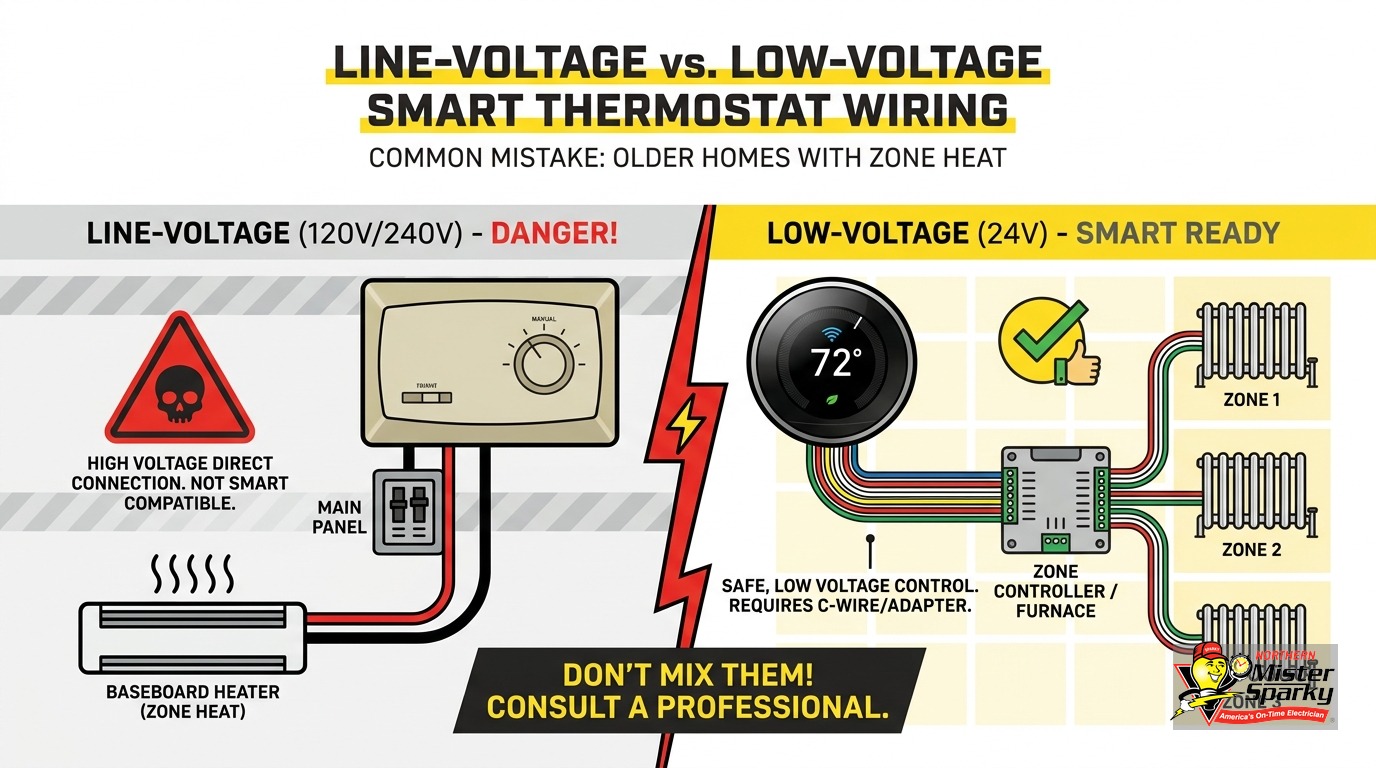
- A Nest, Ecobee, or any standard smart thermostat runs on 24V. Your electric baseboard heater circuit runs on 120V or 240V. Connecting them destroys the thermostat and can create a fire hazard without tripping a breaker.
- Electric baseboard heater thermostat replacement is not the same as swapping a furnace thermostat. The hardware, wiring, and code requirements are completely different.
- A 240V baseboard circuit requires a double-pole, 4-wire line-voltage thermostat under NEC 424.20(A). A single-pole swap is a code violation.
- Minnesota adopted the 2026 NEC effective August 17, 2026. Any permit pulled after that date must comply with the updated code.
- Many Twin Cities homes built between 1968 and 1985 with baseboard heat also have aluminum branch-circuit wiring. That changes what a thermostat swap involves.
- Smart line-voltage thermostats exist, but many older Minnesota homes were wired with only 2 conductors. Upgrading may require new wire pulls, not just a device swap.
- Xcel Energy has no current rebate for baseboard smart thermostat upgrades. The federal 25C credit expired December 31, 2025.
- Call us at 763-200-5956 if you want a straight answer for your specific home.
Can You Use a Nest or Ecobee With Electric Baseboard Heat?
Short answer: No. A Nest or Ecobee is a low-voltage device that runs on 24V. Your baseboard circuit is 120V or 240V. Wiring a 24V thermostat onto a 240V circuit destroys it instantly. In the worst case, it creates a fire hazard without ever tripping a breaker.
This is not a compatibility footnote. It is a physics problem. Line-voltage thermostats handle the full 120-240V circuit directly. Low-voltage devices like the Nest and Ecobee run on 12 to 24V, supplied by a transformer inside a forced-air furnace. They have no rated capacity for line voltage. No adapter wiring changes that.
The scenario plays out constantly in the Twin Cities. A homeowner with 1970s zone heat googles “smart thermostat” and buys whatever ranks first at the hardware store. The Nest dominates that result. The box says “works with most heating and cooling systems.” The fine print says it requires a 24V system with a C-wire. Nobody reads the fine print until after the thermostat is wired in and the lights flicker.
If you have baseboard heaters, you need a line-voltage thermostat. Not a workaround. A thermostat that is rated and built for line voltage. That distinction drives everything else in this post.
What Is the Difference Between Line-Voltage and Low-Voltage Thermostats?
Short answer: Line-voltage thermostats sit directly in the circuit and switch the full 120V or 240V load themselves. Low-voltage thermostats send a 24V signal to a separate control board that does the switching. The two types are not interchangeable at any price point.
When you turn up a low-voltage thermostat like a Nest, it sends a 24V signal to your furnace’s control board. The thermostat is just a messenger. It never carries the full heating load.
A line-voltage thermostat works entirely differently. It sits directly in the hot wire feeding your baseboard heater. When you call for heat, it physically closes the circuit and runs full line voltage through its own contacts. It has to be built and rated for that load. A low-voltage thermostat is rated for nothing close to it.
This distinction matters for wiring, for code compliance, and for safety. It is also why a thermostat from your last house with a gas furnace will not work in a baseboard-heated home, even if the wire colors look identical and the mounting plate fits.
For more on how baseboard circuits are wired and what that wiring involves, see our guide on electric baseboard heater wiring and installation.
Why Older Twin Cities Homes Are Especially at Risk
Electric baseboard heat saw its biggest adoption in Minnesota during the late 1960s through the mid-1980s. The 1970s energy crisis pushed homeowners away from fuel oil. Baseboard heat was a cheap, zone-controllable alternative that fit well into the split-level and rambler construction common across Bloomington, Edina, Richfield, South Minneapolis, and the first-ring suburbs.
Homes from that era are now 40 to 55 years old. Their thermostats are original or close to it. When those thermostats fail or a homeowner wants to upgrade, the instinct is to grab whatever is on the smart thermostat display at the hardware store. Those displays are dominated by low-voltage devices aimed at central forced-air systems. The gap between what a homeowner buys and what their home actually needs is where the problem lives.
There is a second complication specific to this housing stock. Homes built between roughly 1965 and 1985 that used baseboard heat frequently have aluminum branch-circuit wiring alongside it. Aluminum wiring is not automatically a hazard, but it requires specific handling during any electrical work. Terminations loosen over decades of thermal cycling. An electrician who does not know they are working with aluminum can create a new problem while solving the old one.
These two factors together, aging line-voltage thermostats and aluminum wiring in the same walls, mean that a thermostat swap in one of these homes deserves more than a Saturday afternoon and a YouTube tutorial.
What Does Minnesota Code Require for Electric Baseboard Heater Thermostat Replacement?
Short answer: For a 240V fixed baseboard heater, NEC 424.20(A) requires a double-pole thermostat that interrupts both ungrounded conductors. A single-pole thermostat on a 240V circuit is a code violation, not just a poor choice.
This is the code section most DIY guides skip entirely. NEC 424.20(A) requires that all ungrounded conductors be interrupted on a 240V fixed electric space heater. That means a 4-wire, double-pole line-voltage thermostat. A single-pole thermostat switches only one leg of the 240V circuit. That leaves the heater energized on one conductor even when the thermostat calls for off. That is a shock and fire hazard.
Single-pole thermostats cost less and are simpler to wire. That is why some older Minnesota installations used them on 240V circuits. Some online tutorials still show them. Neither fact makes them legal under current code.
Minnesota adopted the 2026 NEC effective August 17, 2026. Any permit pulled on or after that date must comply with the 2026 code. The 424.20(A) double-pole requirement has been stable across recent NEC cycles, so this is not a new constraint. But if you are working on an older installation that was last touched a decade ago, confirm with your inspector what the original permit specified and what the inspection will evaluate.
Do You Need a Permit for Electric Baseboard Heater Thermostat Replacement in Minnesota?
Short answer: A straight like-for-like swap using the same wire count may fall under a controls exemption. Any modification including adding a relay, pulling new wire, or changing the wire count requires a permit. Confirm with your AHJ before you start.
Minnesota allows homeowners to pull their own electrical permit on a single-family home they own and occupy. But the homeowner must perform the work themselves. A neighbor, friend, or unlicensed handyman cannot pull the permit for you, even with you supervising. That rule is firm.
There is another layer that catches people off guard. Minneapolis, St. Paul, and most first-ring suburbs are their own Authority Having Jurisdiction. If you live in Minneapolis or St. Paul, you file for your permit with the city, not with the state Department of Labor and Industry. Use DLI’s inspector lookup tool to confirm which AHJ covers your address before you start anything.
The permit process also triggers an inspection. An inspector who finds a single-pole thermostat on a 240V circuit, a non-listed device wired directly to line voltage, or a relay added without a permit will issue a correction order. Resolving that after the fact costs more time and money than doing it right from the start.
For a full breakdown of how electrical permits work across Minnesota, see our post on electrical permits in Minnesota.
Smart Thermostats That Actually Work With 240V Baseboard Heaters
Good news: smart line-voltage thermostats exist. Devices like the Mysa V2, Sinope, and EcoNet-BH are built specifically for 240V baseboard circuits. They connect directly to line voltage, support app control and scheduling, and carry the UL listing required for the application. These are legitimate solutions. They are just not the devices you find at the front of the smart home aisle.
The practical catch is wiring. Smart line-voltage thermostats typically require a neutral wire or both legs of the 240V circuit plus a dedicated control leg. That means a 3-wire or 4-wire run to each thermostat location. Many older Minnesota baseboard installations were wired with just 2 conductors. If your home falls into that category, upgrading to a smart thermostat is not a device swap. It requires pulling new wire to each thermostat.
Depending on your home’s construction, new wire pulls can range from a few hours of work to a multi-day job with drywall repair. Finished walls, tight attic access, and balloon-framed construction all raise the difficulty. Get a quote before you commit to the upgrade. The math on smart baseboard thermostats often makes more sense as part of a broader project than as a standalone swap.
The other path is the relay and transformer approach. If you are committed to using a Nest or Ecobee, a correctly sized transformer and relay can bridge from 240V line voltage down to 24V low voltage. This is viable, but it adds $150 to $300 in parts, requires a licensed electrician in most configurations, and introduces components that can fail independently of the thermostat. It also adds complexity to a system that was originally straightforward.
What If Your Home Has Aluminum Wiring?
Short answer: If your home was built between 1965 and 1980 with baseboard heat, there is a real chance you also have aluminum branch-circuit wiring. Thermostat work in a home with aluminum wiring requires specific termination methods, and getting them wrong creates a fire hazard.
Aluminum wiring expands and contracts more than copper with heating and cooling cycles. Over decades, that movement loosens connections at switches, outlets, and thermostats. A loose connection creates resistance. Resistance creates heat. That sequence is how electrical fires start in walls with no obvious warning signs.
Aluminum wiring in a well-maintained home is not automatically dangerous. But any time you open an electrical device in one of these homes, the work needs to be done by someone who knows the protocol. That includes using devices rated for aluminum (marked AL-CU or CO/ALR), applying the correct antioxidant compound at terminations, and torquing connections to spec with the right tool.
A thermostat that was installed correctly 40 years ago may have loose connections today because of age and thermal cycling alone. That is another reason to treat a thermostat swap in a 1970s baseboard-heated home as a job for a licensed electrician rather than a DIY project.
For a full overview of what aluminum wiring means for your home and what remedies are available, see our post on aluminum wiring dangers and fixes.
Are There Rebates for Baseboard Smart Thermostat Upgrades?
Short answer: No. Xcel Energy’s smart thermostat rebates apply to central HVAC systems, not baseboard heat. The federal Section 25C tax credit expired December 31, 2025 and does not apply to installations in 2026.
This is worth saying plainly because several national articles on this topic imply that rebates are available without specifying which systems actually qualify. Xcel Energy’s 2024-2026 residential rebate summary covers central air conditioning, heat pump upgrades, and central system smart thermostats. There is no dedicated rebate for line-voltage baseboard smart thermostat upgrades. If you are an Xcel Energy customer in the Twin Cities planning a baseboard thermostat swap, do not budget for a rebate.
The federal Section 25C tax credit covered qualified energy-efficient home improvements including smart thermostats through December 31, 2025. It expired at the end of last year and does not apply to purchases or installations in 2026.
If you are considering converting from baseboard heat to a heat pump or mini-split system entirely, there may be rebates that apply to that larger project. But for a baseboard thermostat upgrade on its own, no current rebate program applies to Xcel Energy customers in the Twin Cities.
When to Call a Licensed Electrician
Most electric baseboard heater thermostat replacement jobs in the Twin Cities should involve a licensed electrician. Here is the short list of situations where that is not a judgment call:
- Your circuit is 240V and you are not certain whether your current thermostat is single-pole or double-pole
- Your home was built between 1965 and 1985 and you suspect aluminum wiring
- You want to install a smart thermostat and are not sure how many wires your current setup has
- Your thermostat has been sticking, tripping, or running inconsistently
- You want to add a relay and transformer to use a low-voltage smart device
- You need to pull new wire to support a smart line-voltage thermostat
- You are in Minneapolis, St. Paul, or a first-ring suburb and need to confirm your AHJ before pulling a permit
We are locally owned and operated here in the Twin Cities. As America’s On-Time Electrician(R), we show up when we say we will and we tell you what you actually need. No malarky. Call 763-200-5956 or book online to schedule an assessment.
For electrical repair work beyond thermostats, see our home wiring repair services.
Frequently Asked Questions
Can I replace my electric baseboard heater thermostat with a Nest or Ecobee? +
Do I need a permit to replace a baseboard thermostat in Minnesota? +
What smart thermostats work with 240V electric baseboard heaters? +
Are there rebates for upgrading a baseboard smart thermostat in Minnesota in 2026? +
Need an electrician now?