What to Check Electrically After a Power Outage in Minnesota
Key Takeaways
- Unplug sensitive electronics before power returns, not after. The restoration surge is the most dangerous moment.
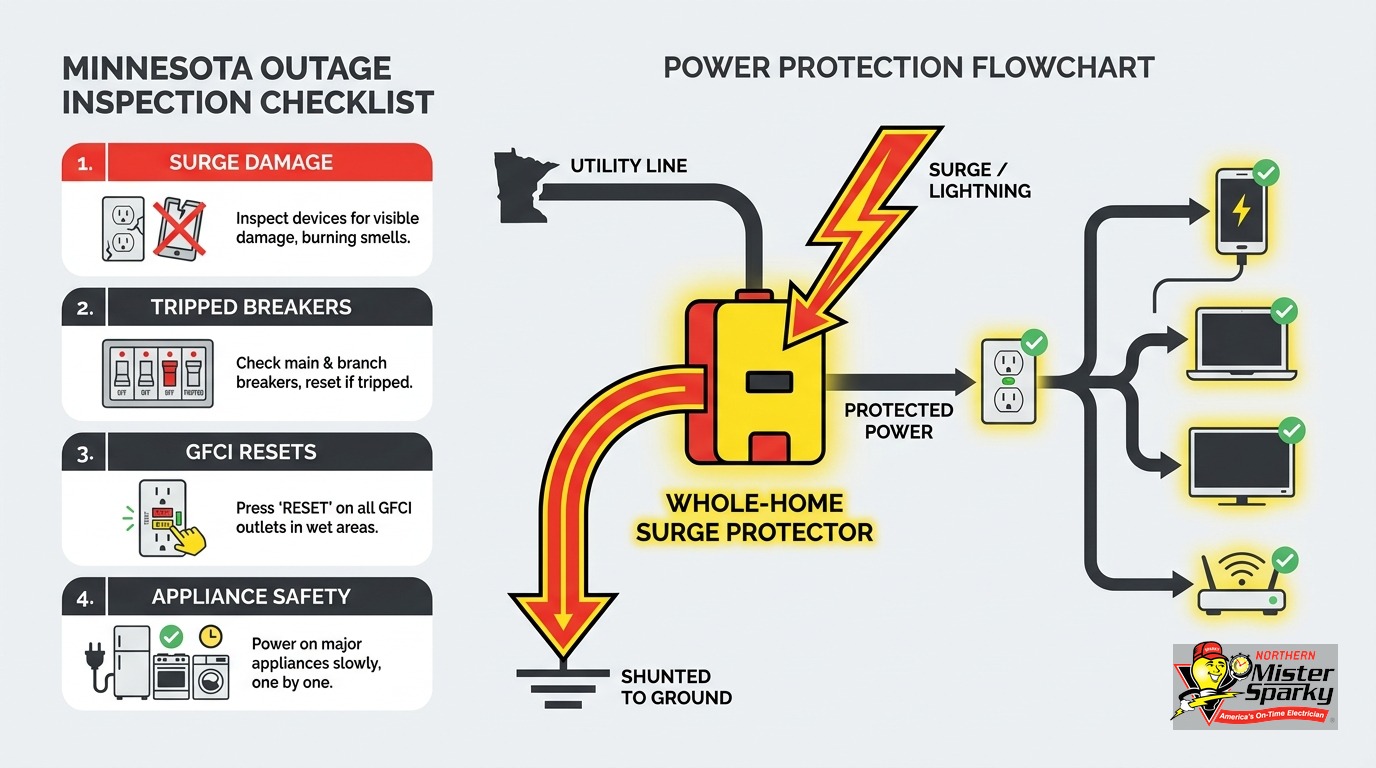
- Work in order: main panel first, GFCI outlets second, regular outlets third, appliances one at a time last.
- A “lost leg” outage can destroy 240V equipment like your HVAC compressor, dryer, and well pump without tripping a single breaker. It is common after Minnesota ice storms.
- Five situations mean stop and call a licensed electrician: burning smell, a breaker that trips again immediately, a GFCI that will not reset, lights that flicker after power returns, and any scorch marks near outlets or the panel.
- Minnesota adopted the 2026 NEC on August 17, 2026. Whole-house surge protection is now required on new or replaced residential electrical services.
- Call 763-200-5956 or book online if anything seems off after following this checklist.
Why the Moment Power Returns Is More Dangerous Than the Outage Itself
When the grid reconnects after an outage, power does not flow back smoothly. Voltage transients and momentary spikes travel down the line at the instant of reconnection. Power may return with momentary surges or spikes that can cause damage. Those spikes can fry electronics, shorten motor lifespans, and push already-stressed circuits into failure.
The safest move is to unplug sensitive electronics and appliances before power returns, not after. If you are still in the outage window, unplug now. If power just came back, wait five to ten minutes before reconnecting anything. That window gives grid voltage time to settle.
Leave one lamp plugged in as a signal. When it turns on, power has returned. Then wait your five to ten minutes before anything else goes back into an outlet.
The Red Cross also recommends unplugging appliances and electronics to avoid power overloads or damage from power surges. Every device left plugged in draws current the moment power restores. That simultaneous load can trip your main breaker or overload circuits that were already stressed before the outage started.
What to Check Electrically After a Power Outage: The Right Order
A list of tips is not enough here. Order matters because problems at the panel level affect every circuit downstream. If you skip ahead to appliances without checking the panel first, you may restore power to a circuit that should stay off. Work through these steps without skipping.
Step 1: Go to your main electrical panel first.
Open the panel door and scan every breaker. A tripped breaker sits in a middle position between ON and OFF, or it has switched fully to OFF. Some panels label the tripped position; others do not. If you see a breaker that looks slightly off-center compared to the others, that is your tripped breaker.
Note every circuit that tripped. Do not reset them yet.
Check for any visible scorch marks, melted plastic, or a burning smell inside the panel. If you see or smell any of those, close the panel door and call a licensed electrician before you touch anything else. Scorch marks inside a panel are a stop-everything situation.
Step 2: Reset tripped breakers correctly, one at a time.
For each tripped breaker, push it firmly to the full OFF position first, then push it back to ON. That complete OFF-then-ON cycle resets the internal mechanism. Skipping the full OFF step is the most common homeowner mistake and explains why many resets seem to fail.
If a breaker trips again immediately after a correct reset, leave it in the OFF position. The Red Cross advises contacting an electrician to inspect tripped breakers before restoring power to those circuits. A breaker that will not hold points to a circuit fault, not normal outage recovery.
See our detailed guide on what to do when a circuit breaker won’t reset for step-by-step diagnostics.
Step 3: Locate and reset every GFCI outlet in the house.
GFCI outlets are the ones with the TEST and RESET buttons. They protect kitchens, bathrooms, garages, exterior outlets, and anywhere near a water source. An outage trips many of them.
Walk every room and press RESET on each GFCI outlet. If a downstream outlet is dead, the cause is almost always a tripped GFCI upstream, not a wiring fault. Reset the GFCI and recheck before assuming a bigger problem.
Step 4: Test regular outlets with a tester before plugging anything in.
A simple outlet tester from any hardware store costs a few dollars. Plug it into each outlet and confirm a normal reading. A dead outlet with no upstream GFCI trip may point to a circuit-level wiring issue worth noting for a follow-up inspection.
Step 5: Reconnect appliances one at a time, simplest loads first.
Lamps first. Small plug-in appliances next. Then televisions, computers, and home theater gear. Your HVAC system last, and only after checking for the lost-leg scenario described in the next section.
Pause between each device. Watch for a breaker trip, a burning smell, or unusual sounds. Any of those: stop, unplug, and investigate before you continue.
What Is a “Lost Leg” Outage, and Why Should Twin Cities Homeowners Know About It?
A lost leg outage occurs when one of the two 120V legs in your home’s 240V service drops while the other stays live. Half your home has power; the other half does not. It is common after Minnesota ice storms and can silently destroy HVAC compressors, dryers, and well pumps without tripping a single breaker.
This is a more destructive failure mode than a clean full outage. Here is why.
Your home runs on two 120V legs that combine to supply 240V circuits. Appliances like your HVAC compressor, electric dryer, and well pump all need both legs to run correctly. When one leg drops, those motors try to start on half the voltage they need. Running under-voltage forces excess current through the motor windings. That excess current generates heat. Given enough time, the winding insulation fails and the motor burns out permanently.
No breaker necessarily trips during this process. The damage builds quietly, and you may not know it happened until the first cold morning the furnace will not come on.
What to look for: power in some rooms but not others, in a pattern that does not clearly trace to one tripped breaker. Lights on half a floor may work while the other half is dark. The HVAC may hum briefly and shut off, or simply not start at all.
What to do: check the main panel for a tripped main breaker or a tripped double-pole breaker on a major 240V circuit. If you cannot identify a clear cause, do not run the HVAC, electric dryer, or well pump until a licensed electrician has confirmed your supply voltage is normal. In a Minnesota January, that call is urgent: no heat means pipe-freeze risk within hours in an older home.
See our full guide on half-house power loss and the lost-leg pattern for detailed diagnostics.
How Do You Reset a Tripped Breaker After an Outage?
Push the breaker firmly to the full OFF position first, then push it back to ON. The full OFF step resets the internal mechanism. If the breaker trips again immediately, leave it off and call a licensed electrician. Repeated tripping means the circuit has a fault or overload that needs inspection before it is safe to restore.
A breaker that has tripped repeatedly over its lifespan may also have a fatigued spring mechanism. The wear makes it harder for the breaker to hold a reset. Replacing a fatigued breaker costs far less than the downstream damage a failed one causes.
Never force a breaker that resists being pushed to ON. Resistance is a signal. Stop and have the circuit inspected.
How Do You Reset a GFCI Outlet After Power Returns?
Press the RESET button firmly until it clicks. If it does not click or hold, press TEST first to confirm the mechanism can trip, then try RESET again. A GFCI that will not reset may have moisture intrusion, a wiring fault on the load side, or it may have failed from the surge event itself.
GFCI outlets do not last forever. Most are rated for 10 to 15 years. An older GFCI that will not reset after an outage is a reasonable candidate for replacement, not a target for repeated forcing.
For persistent failures, see our guide on GFCI outlets that won’t reset.
How Long Is Your Food Safe During and After an Outage?
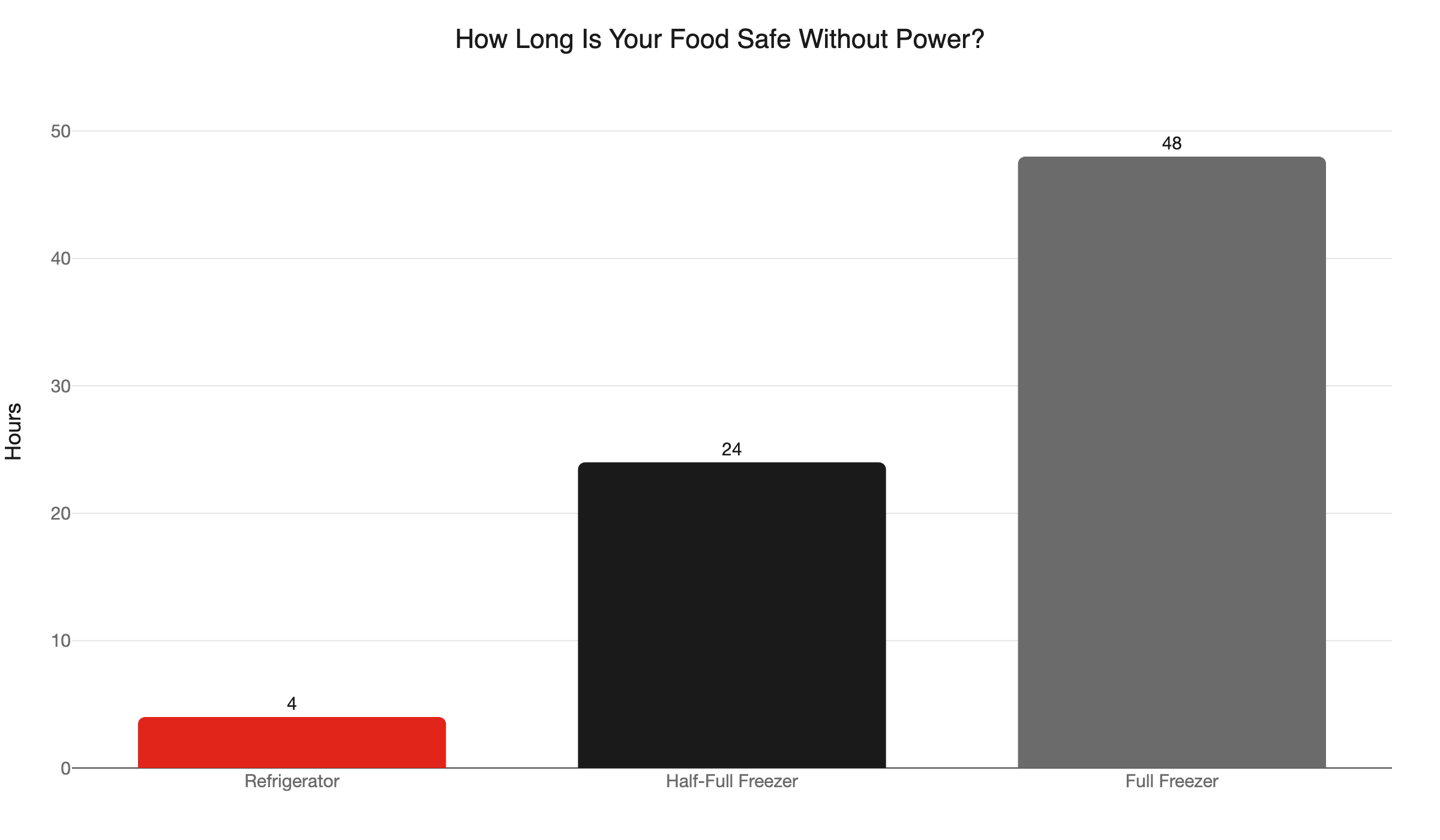
A full freezer holds food safely for 48 hours. A half-full freezer holds for 24 hours. Your refrigerator holds for about four hours. Keep the doors closed throughout. Discard any refrigerator food that reaches 40 degrees Fahrenheit once power returns.
These windows assume you do not open the doors. Every time you open the refrigerator or freezer, you trade cold air for warm room air and shorten your safe window.
When power returns, check temperatures with a thermometer before consuming anything from the refrigerator. When in doubt, throw it out.
What About Generator Safety in a Minnesota Winter?
Never run a generator inside your home, basement, or garage, or within 20 feet of any window, door, or vent. Carbon monoxide is colorless, odorless, and lethal. Install CO alarms on every level of your home and outside every sleeping area, and test them before each winter season.
A Minnesota January outage puts homeowners under serious pressure. No heat means pipe-freeze risk in hours. That urgency is exactly when unsafe generator decisions happen.
The CDC is direct: never use a generator or gasoline-powered engine inside your home, basement, or garage or less than 20 feet from any window, door, or vent. Sealing your home against below-zero cold makes CO accumulation faster and more dangerous than it would be in summer. Use an extension cord at least 20 feet long to keep the generator at a safe distance from any opening into your living space.
Install CO alarms in central locations on every level of your home and outside sleeping areas. Check the batteries before outage season, not during it.
One more rule: never plug a portable generator into a wall outlet to backfeed your home. Backfeeding energizes the utility lines running back to your transformer and creates a lethal hazard for line workers restoring service in your neighborhood. A properly installed transfer switch or interlock kit is the only safe way to connect a portable generator to your home’s wiring. If you are unsure whether your current generator setup is safe and permitted, have a licensed electrician inspect it before the next storm season arrives.
When Should You Stop and Call an Electrician After a Power Outage?
Stop the checklist and call a licensed electrician if you encounter any of the following. These are not wait-and-see situations. Electrical faults can worsen quickly after a surge event, and a burning smell in particular means stop right now.
- Burning smell at the panel, at any outlet, or anywhere in the house after power returns.
- A breaker that trips again immediately after a correct full OFF-then-ON reset.
- A GFCI that will not reset despite correct steps, with no obvious cause like standing water or a shorted appliance.
- Lights that flicker or dim after power has fully returned and stabilized. Post-outage flickering often points to a loose connection that heated during the surge.
- Scorch marks, discoloration, or melted plastic at any outlet, switch, or panel location.
- Half-house power loss with no clear panel cause. That is the lost-leg pattern.
- 240V appliances that behave strangely: HVAC that starts and immediately shuts off, a dryer that runs but produces no heat, or a well pump that hums but does not pump.
Call Northern Mister Sparky at 763-200-5956 or book online. We are locally owned and operated in the Twin Cities. Every job is backed by the UWIN(R) 100% satisfaction guarantee and our commitment as America’s On-Time Electrician(R).
What Changes Under Minnesota’s 2026 Electrical Code?
Minnesota adopted the 2026 NEC effective August 17, 2026. Any permit filed on or after that date must comply with the new code. The key change for post-outage repairs: new or replaced residential services now require a whole-house surge-protective device under Article 230.67. If surge damage leads to a panel replacement, the SPD must be part of the permitted scope under current Minnesota law.
This matters in two ways.
First, if the outage revealed that your panel is struggling, now is the right time to get an evaluation done. A panel replacement under the 2026 code comes with whole-house surge protection included in the permitted work. You do not have to request it separately.
Second, any unlicensed or unpermitted work discovered during an inspection costs far more to correct than permitted work upfront. Minnesota requires a licensed contractor for nearly all residential electrical work, including panel replacements and service upgrades. You can verify any electrician’s license through the DLI website before you hire.
One Last Line of Defense: Whole-Home Surge Protection
Every outage ends with a restoration surge. That surge is not something the utility can eliminate entirely. What you can control is what happens between the surge and your appliances.
A whole-home surge-protective device installs at the main panel and clamps incoming voltage transients before they reach any circuit in the house. Point-of-use surge strips protect the devices plugged directly into them. They do not protect hardwired appliances: HVAC systems, electric water heaters, well pumps, and anything else wired directly to a circuit.
Whole-home SPD installation is a straightforward job for a licensed electrician. Under the 2026 NEC, it is now required on new and replaced residential services in Minnesota. If your current panel does not have one, the outage you just experienced is a reasonable prompt to add it. The cost is modest compared to replacing an HVAC compressor or major appliance it would have protected.
Our full breakdown of options is in the whole-home surge protection guide. If you want to talk through what makes sense for your home, call 763-200-5956 or book a visit online. No malarky - we will tell you exactly what your home needs and nothing it does not.
Frequently Asked Questions
How long after power returns should I wait before plugging appliances back in? +
Can I reset my own tripped breakers after a power outage? +
What is a lost leg power outage? +
Need an electrician now?