
Oil to Electric Heat: Electrical Panel Requirements
Key Takeaways
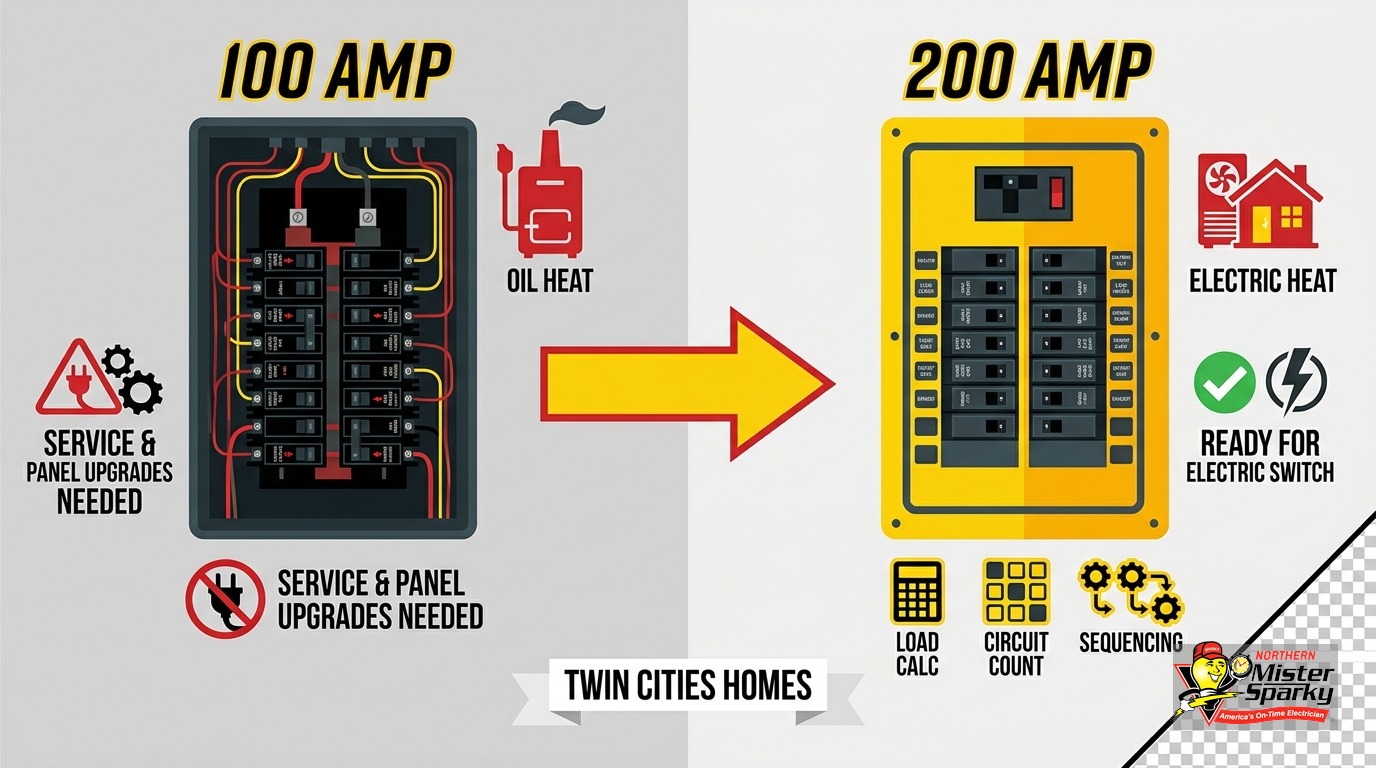
- Most Twin Cities homes built with oil heat have 100-amp service. Electric heat requires at least 200 amps.
- Get an electrical assessment and load calculation before you call an HVAC contractor. Sequencing matters.
- This project involves three separate permits: oil tank decommission, electrical upgrade, and HVAC install. Do not reverse the order.
- In Minnesota, homeowners cannot pull HVAC electrical permits. A licensed electrical contractor must handle that.
- Minnesota adopted the 2026 NEC on August 17, 2026. Permits filed now are under a different code than permits filed in June.
- The federal 25C tax credit expired December 31, 2025. Utility rebates from Xcel and CenterPoint are still active in 2026.
- Call 763-200-5956 or book online to schedule your electrical assessment first.
Why Most Twin Cities Homes on Oil Heat Need a Panel Upgrade
Oil heat is almost entirely mechanical. The furnace needs a blower motor, an ignition circuit, and a thermostat wire. A 100-amp service panel covered that load comfortably when your home was built. It still handles most lights and outlets today.
The problem starts when you want to go electric. A cold-climate heat pump draws continuous, sustained power on a January night in Minneapolis. That load is nothing like a blower motor. It is an entirely different category of electrical demand. Your current 100-amp panel was sized for the furnace era. It was not sized for the heat pump era.
Add a refrigerator, a dryer, and an electric range. Factor in the background loads across every room. A 100-amp service runs out of headroom before the heat pump even cycles on.
The gap between what oil heat required and what electric heat requires is real. It is the starting point for every oil-to-electric conversion our team assesses. Before an HVAC contractor quotes your system, you need to know what your electrical panel can actually support. That is always the first call to make.
What Does a Load Calculation Actually Tell You?
Short answer: A load calculation adds up every electrical load in your home, applies demand factors from the NEC, and determines the minimum service size your home needs. For most oil-heated Twin Cities homes, adding a heat pump pushes that number past 100 amps.
The standard tool is the NEC 220.82 optional method. It starts with your home’s square footage and adds fixed appliance loads: range, dryer, water heater. For heating and cooling, it uses the larger of the two loads. It does not add both unless they run at the same time.
On a 200-amp service, the practical working threshold is 160 amps. That is 80% of rated capacity. It is the point where the system operates without sustained stress. Your load calculation needs to land at or below 160 amps to make 200-amp service viable for a heating conversion.
The calculation also reveals open breaker slots and circuit availability. A heat pump needs a dedicated 240-volt circuit. If your current panel is full, you may need a new main panel or a subpanel before the HVAC contractor can run a single wire.
If you are adding a heat pump and an EV charger at the same time, those loads stack. Our post on home electrical load calculations explains how multiple large loads interact and what the math looks like for common Twin Cities home sizes.
Is 200-Amp Service Enough for an Oil-to-Electric Conversion?
Short answer: For most single-family Twin Cities homes, yes. A heat pump alone typically fits within 200-amp service. Adding an EV charger or electric water heater at the same time may push the load calculation past what 200 amps can handle.
Converting from oil to electric heat almost always requires upgrading from 100-amp to 200-amp service at minimum. The heat pump draws sustained load that 100-amp service cannot support safely.
Whether 200 amps is the ceiling depends on your project scope. A heat pump plus a Level 2 EV charger plus a new electric water heater in the same panel could push your load calculation past 160 amps on a 200-amp service. At that point, 400-amp service is the right answer, not a workaround.
The cost difference is substantial. A 100-to-200-amp upgrade in the Twin Cities typically runs $1,800 to $4,500. Upgrading to 400-amp service runs $8,000 to $12,000 for the electrical work alone. Planning both projects together almost always costs less than upgrading to 200 amps now and upgrading again next year when an EV enters the household. If an EV charger is anywhere on your five-year list, bring that up at the assessment.
The Sequencing Problem Nobody Mentions
Here is where most Twin Cities oil-to-electric conversions lose time.
A homeowner calls an HVAC company first. That is the obvious move. It is a heat pump. The contractor comes out, quotes the system, and then mentions that the electrical panel will need upgrading. The homeowner calls an electrician. The electrician finds a 100-amp panel with no open slots and says the panel must come out before the HVAC circuit can run.
Now the project is three weeks behind. The HVAC company cannot finish. The homeowner is holding a heat pump quote that cannot move forward.
The right order for a Twin Cities oil-to-electric conversion:
- Electrical assessment and load calculation first. Know your service size and panel capacity before calling an HVAC contractor. This sets the scope for everything else.
- Oil tank decommissioning. This requires a separate environmental contractor and a separate permit. It can run in parallel with your electrical planning, not after it.
- Panel or service upgrade permit. Filed with your local AHJ or the state DLI. The electrical work must be inspected before the HVAC circuit is added, or the two permits must be co-filed as a coordinated project.
- HVAC permit for the heat pump, with backup heat specified. The HVAC contractor pulls this permit only after the electrical work is complete or the permits are co-filed together.
Starting with an electrician saves weeks. It also gives you a real electrical number to plan your HVAC budget around before committing to any scope.
What Permits Do You Need, and Who Pulls Them?
Short answer: Three separate permits: oil tank decommission, electrical upgrade, and HVAC install. In Minnesota, HVAC electrical circuits require a licensed contractor. Homeowners cannot pull that permit themselves.
Minnesota’s Department of Labor and Industry is explicit on this point. On owner-occupied single-family homes, homeowners can pull some general electrical permits. HVAC circuits are not in that category. The licensed electrical contractor must pull the permit, schedule the inspection, and stand behind the work.
There is also the question of where to file. Minneapolis, St. Paul, and most first-ring suburbs are local authorities having jurisdiction, or AHJ. They run their own permit offices with their own fees, forms, and inspection schedules. How a local AHJ electrical permit process works differs from the state DLI process in meaningful ways. Filing with the wrong office adds delays and sometimes requires starting over.
Our team works across all Twin Cities municipalities. We know which cities run local AHJ processes and which fall under DLI. We pull the permits, schedule the inspections, and handle follow-up so the project does not stall on a paperwork detail.
Why Do Heat Pump Permits Get Rejected in Minnesota?
Short answer: The most common rejection is a missing backup heat specification. Minnesota is in Climate Zone 6. Permit reviewers require backup heat to be listed on the application. Submitting a heat pump with no backup source is the fastest way to get the application returned.
Climate Zone 6 requirements reflect the reality of Minnesota winters. A heat pump loses efficiency as outdoor temperatures drop. On the coldest days, it cannot carry the full heating load alone. Reviewers know this and will not approve an application that does not account for backup heat.
The backup can be electric resistance strips built into the air handler, a gas furnace in a hybrid dual-fuel configuration, or another approved heat source. The key is that it appears on the permit application with enough detail to satisfy the reviewer.
This is a coordination failure point. The HVAC contractor typically submits the HVAC permit. But the electrician is the one who knows whether the panel can support resistance heat strips. If the two contractors are not talking to each other before the application goes in, it comes back rejected. Getting your electrician and HVAC contractor aligned from the start prevents this specific, common delay.
The 2026 NEC Adoption: What Changed on August 17
Minnesota adopted the 2026 National Electrical Code effective August 17, 2026. According to the Minnesota DLI NEC adoption committee, permits filed on or after that date must comply with 2026 code requirements. Licensing exam transitions follow on September 8, 2026.
A permit filed in June went through under the 2023 NEC. A permit filed this week is under 2026 NEC. The practical differences depend on your project scope. Grounding requirements, arc-fault protection standards, and load calculation details all carry updates in the new cycle.
This is not a reason to delay your project. It is a reason to confirm that the electrician you hire is current on the code. Northern Mister Sparky tracks DLI code adoption so our customers do not have to monitor DLI bulletins themselves.
How Much Does a Panel Upgrade Cost in the Twin Cities?
Short answer: A 100-to-200-amp upgrade typically runs $1,800 to $4,500 in the Twin Cities. Homes that need 400-amp service for a multi-load project can run $8,000 to $12,000 for the electrical work.
Regional cost data for panel and service upgrades shows that the spread within each range reflects several variables:
- Whether the meter base and service entrance cable need replacement, which is common in older Twin Cities homes
- Whether your service runs overhead or underground
- The panel’s current location and how accessible the work space is
- Your city’s permit fees, which vary across municipalities
Labor and materials are roughly consistent across the metro. City permit fees introduce the most variability on smaller projects.
Our panel upgrade service covers the full scope of work, from the load calculation through final inspection. If you are not yet sure whether you need a panel upgrade or just a few additional circuits, our post on signs you need an electrical panel upgrade can help you gauge where your home stands before you pick up the phone.
What Rebates Are Still Available in 2026?
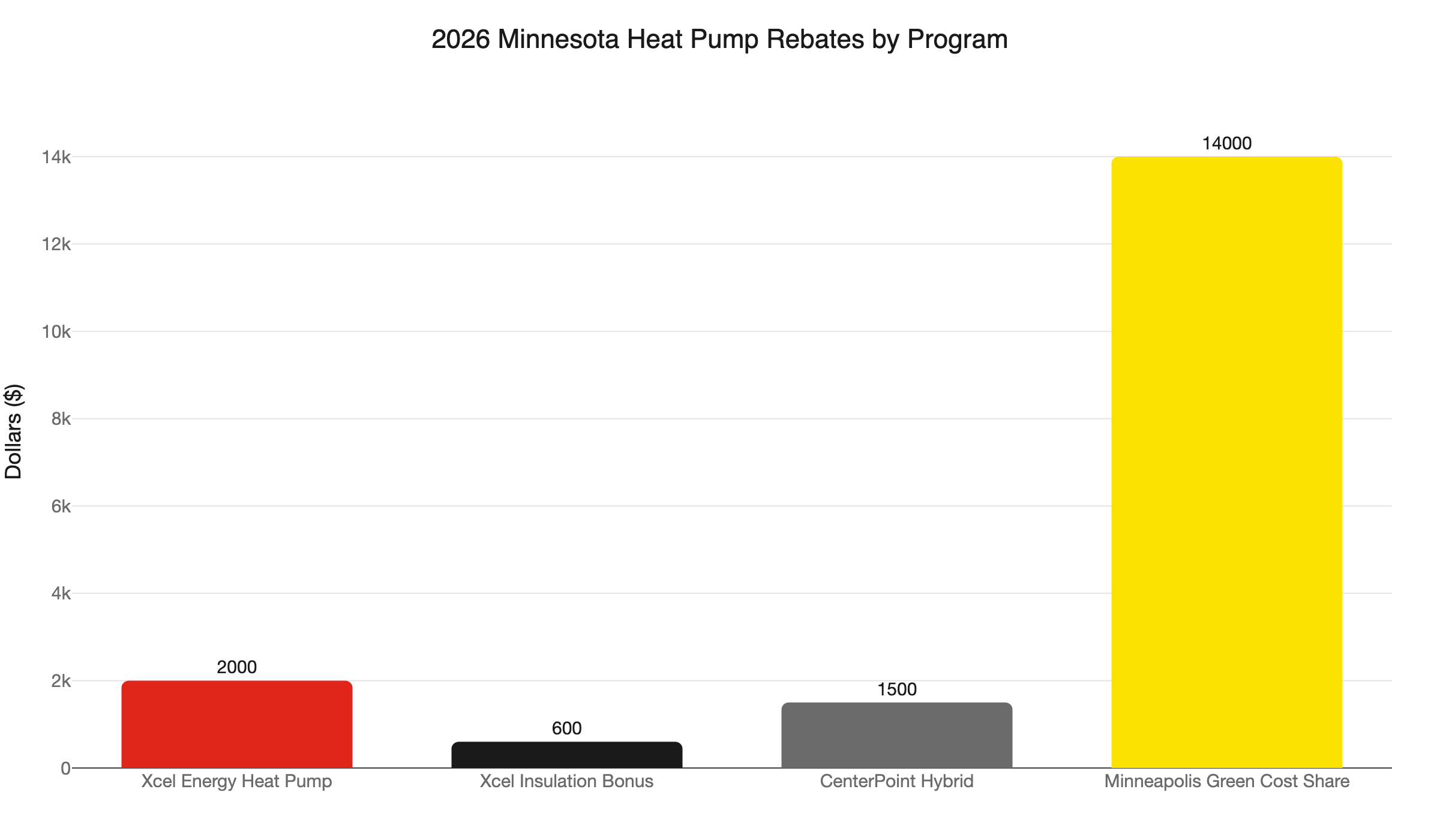
Short answer: The federal 25C energy efficiency tax credit expired December 31, 2025. It is not available. Utility rebates from Xcel Energy and CenterPoint, plus the Minneapolis Green Cost Share program, are still active in 2026.
Many articles online still mention the 25C credit. It ended at the close of 2025. Do not build your project budget around a tax credit that no longer exists. Any article that lists it as available is out of date.
Here is what is currently on the table:
Xcel Energy: Up to $2,000 for a qualifying cold-climate heat pump, plus a $600 bonus if qualifying insulation or air-sealing work was completed before the HVAC install. The bonus requires using a Trade Ally contractor for both projects.
CenterPoint Energy: Up to $1,500 for a ducted hybrid dual-fuel heat pump paired with a 92%+ AFUE gas furnace, with a switchover point at or below 40 degrees Fahrenheit. Current rebate details vary by contractor and are worth confirming before you sign an HVAC proposal.
Minneapolis Green Cost Share: Up to $14,000 for homeowners in designated Green Zones. This program stacks on top of utility rebates. Zone eligibility and program details are available through Minnesota home energy resources and worth checking if you live in Minneapolis proper.
All of these rebates apply to the HVAC side of the project. The electrical upgrade is the prerequisite that makes them possible. No upgraded panel, no heat pump. No heat pump, no rebate.
Planning a Heat Pump and EV Charger Together
If an EV charger is on your list, plan both projects at the same time. Doing them separately means two assessments, two permit rounds, and two separate mobilizations inside your home.
A Level 2 EV charger on a 50-amp dedicated circuit adds up to 12,000 watts of potential load. If a heat pump already pushes your load calculation close to 160 amps on a 200-amp service, the EV charger is the addition that moves the project to 400-amp service. It is better to find that out in one assessment than to upgrade to 200 amps now and face the same conversation next year when you buy an electric vehicle.
Our EV charger installation service can be scoped alongside your panel upgrade. One project, one permit round, one mobilization.
Ready to Get Started
The plain version: most oil-heated Twin Cities homes cannot safely run a cold-climate heat pump on their current electrical service. The panel upgrade comes first. The HVAC permit comes after. Getting that order right is the single thing that keeps these projects from stalling mid-conversion. No malarky about that part.
Northern Mister Sparky is locally owned and operated in the Twin Cities, backed by America’s On-Time Electrician(R). We do the load calculation, pull the permits in your city, and coordinate with your HVAC contractor so the sequencing stays clean from the start.
Call 763-200-5956 or book online to schedule your electrical assessment. We serve Minneapolis, St. Paul, Bloomington, Maple Grove, Woodbury, Brooklyn Park, Blaine, Plymouth, and the surrounding metro.
Frequently Asked Questions
Do I need a panel upgrade to convert from oil to electric heat? +
Who pulls the electrical permit for a heat pump conversion in Minnesota? +
What rebates are available for oil-to-electric heat conversions in Minnesota in 2026? +
Need an electrician now?