
Electric vs. Gas Appliances Cost Comparison: Minnesota 2026
Key Takeaways
- Xcel Energy’s all-in residential average is 16.98 cents/kWh, below the Minnesota state average. This is the right number to use for operating cost math.
- Running an induction range costs about $27 more per year than a gas range at current Xcel rates. The annual gap is real but small.
- A heat pump dryer and a gas dryer cost almost the same to run annually. The difference is about $3 per year.
- The real financial question is the circuit installation: $300-$700 for a 30-amp dryer circuit, $400-$1,100 for a 50-amp range circuit in the Twin Cities.
- Federal tax credits for electric appliances ended December 31, 2025. The One Big Beautiful Bill eliminated Section 25C for installations in 2026 and beyond.
- Minnesota’s HEAR rebate program for induction appliances has not launched as of October 2026. No current state rebate covers induction cooktops or heat pump dryers.
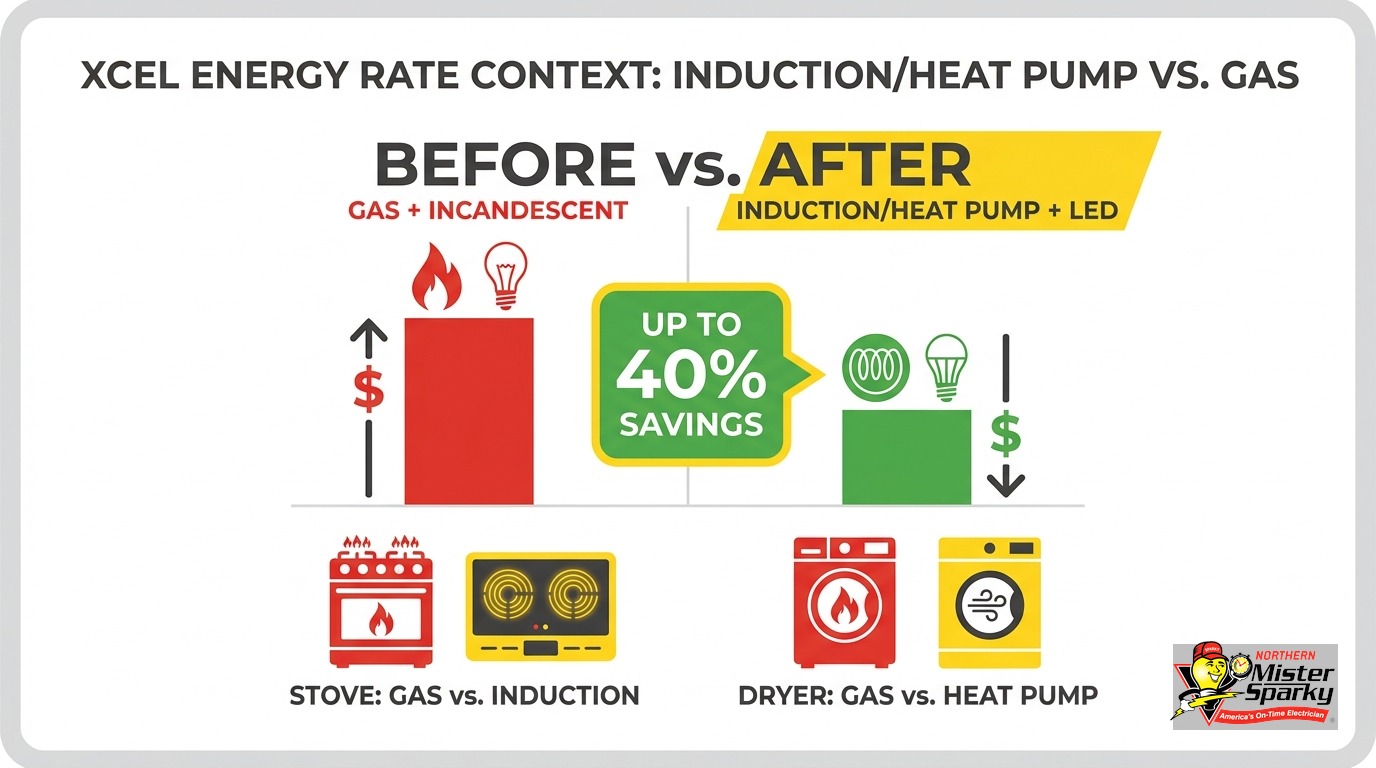
- For most Twin Cities homeowners, switching to induction is not primarily a cost-savings decision at current Xcel rates. The heat pump dryer conversion is closer to financially neutral.
Does Electric or Gas Cost More to Run in Minnesota?
Short answer: For appliances, the annual operating cost gap is smaller than most people expect. Running an induction range costs about $27 more per year than a gas range at current Xcel rates. A heat pump dryer costs about the same as a gas dryer annually. The circuit upgrade to wire an electric appliance where gas ran before is the cost that actually dominates the comparison.
That answer surprises most homeowners. The internet is full of articles claiming major monthly savings from switching to electric appliances. Much of that content was written when federal tax credits covered $2,000 or more of the project cost and when gas prices were higher. Both of those conditions have changed.
What is moving now on the gas side: Xcel Energy’s 6.8% interim natural gas rate increase took effect January 1, 2026. A proposed settlement could drop the final increase to 4.1%, with refunds on the difference pending approval. Until that settles, gas customers are paying more than they were in 2025.
What has changed on incentives: the federal Section 25C tax credit no longer exists for 2026 installations. Minnesota’s state rebate for induction appliances has not launched. We cover both programs in detail in the rebates section below.
What has not changed: Xcel’s electricity rate is lower than most national benchmarks. That puts Minnesota homeowners in a better position for electric appliances than people in higher-rate states. It does not flip the cost comparison dramatically, but it narrows the gap.
How Much Does 1 kWh Cost in Minnesota?
Short answer: Xcel Energy’s all-in residential average is 16.98 cents/kWh based on 2024 EIA data. The base energy charge runs $0.088/kWh from October through May and $0.103/kWh from June through September. Rate riders stack on top of that base. The Transmission Cost Recovery rider adds $0.004436/kWh effective January 2026.
Your actual rate depends on usage tier and which riders apply to your account. The 16.98 cents all-in figure is the most reliable benchmark for operating cost comparisons.
The winter base rate being nearly 30% lower than the summer rate matters for appliances. Minnesota has roughly seven months of cooler weather where the lower rate applies. If your appliances run year-round, the effective blended rate you pay is close to the 16.98-cent average. That is the number to use in your math.
Xcel approved roughly $211 million in electric rate increases for 2026, about 60% below what Xcel originally requested. The average residential impact is about $2.78/month. The Minnesota state average reached 17.45 cents/kWh as of July 2026, up 3.1% from July 2025. Xcel customers run just below that state average, which is an advantage for anyone running electric appliances in the Twin Cities.
Induction vs. Gas Range: What Does Cooking Actually Cost?
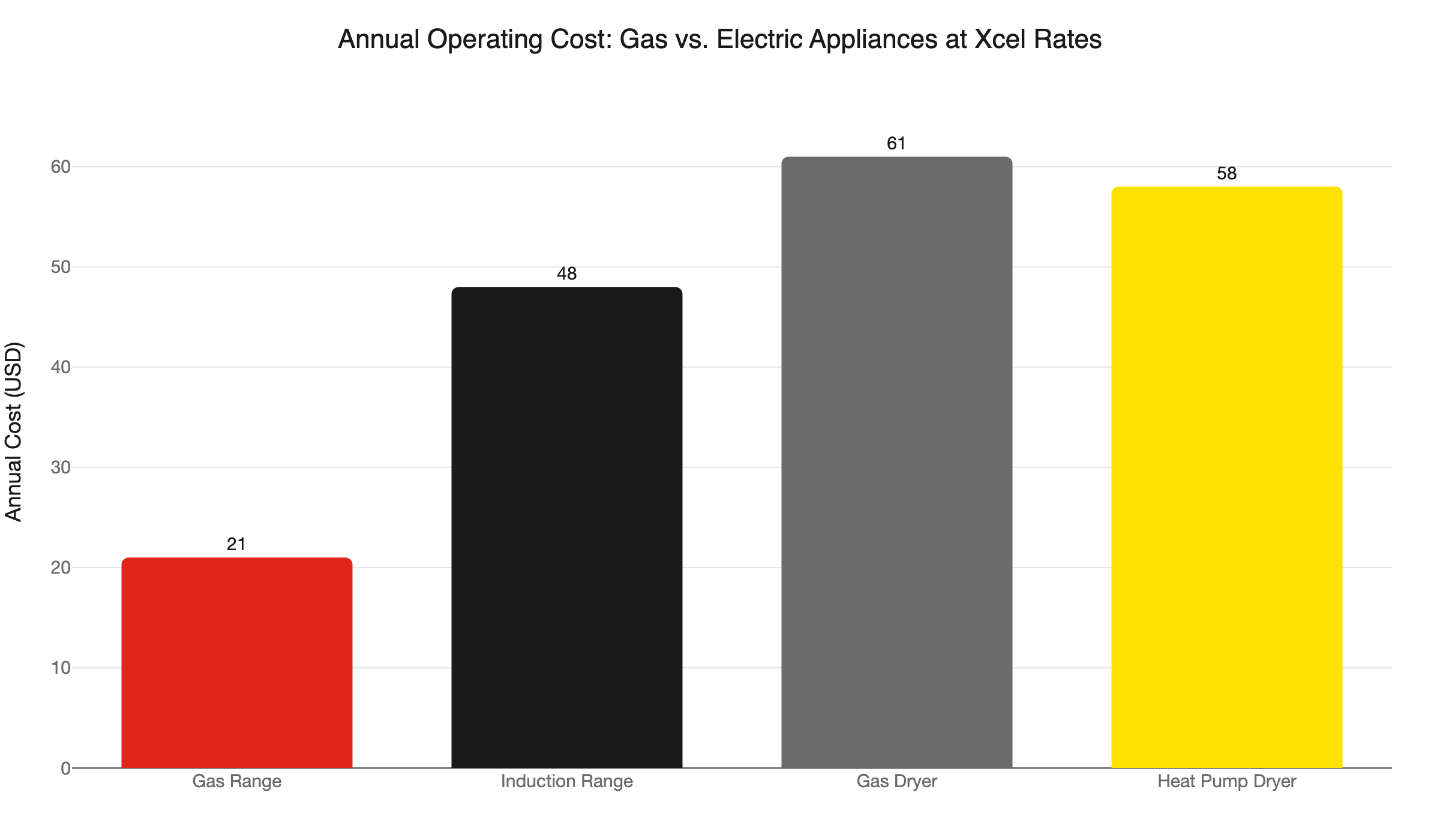
Short answer: Gas cooking costs about $21 per year at the $1.06/therm all-in Minnesota benchmark. Induction runs about $38-$58 per year at Xcel’s average rate. The annual gap is $17-$37. That is a real difference but not large enough to justify a circuit upgrade on its own.
The efficiency story strongly favors induction. Induction transfers about 85% of its energy to the pan, compared to 32-40% for a gas open flame. A gas burner wastes most of its heat into the kitchen air. Induction wins on efficiency per cooking unit delivered. By a wide margin.
The reason gas still wins on operating cost, despite that efficiency disadvantage, is that gas is cheap per unit in Minnesota. The average household uses roughly 20 therms per year for cooking. At an all-in Minnesota gas benchmark of $1.06/therm, that is about $21/year. Even at induction’s superior efficiency, producing the same cooking output at 16.98 cents/kWh costs $38-$58 annually. The efficiency advantage is real, but gas is priced low enough that it offsets the gain.
There is also the cookware question. Induction requires magnetic-bottom pots and pans. If your current cookware is not induction-compatible, factor in a replacement set. Quality induction cookware runs $100-$500 for a full set. That adds to the total cost of switching.
The financial case for induction is not monthly savings. It is cooking precision, kitchen air quality, and a cooktop surface that stays cool outside the pan. Induction responds to temperature changes as quickly as gas. It produces no combustion byproducts in your kitchen. The cooktop does not get hot enough to cause burns from contact. Those are real quality-of-life improvements worth having the conversation about.
If you are ready to think through the wiring, our post on converting a gas stove to electric covers the circuit and permitting requirements in detail, including when a panel upgrade becomes necessary.
The Cost Nobody Includes in the Comparison: Circuit Upgrades
Here is the gap in almost every online electric-vs-gas article.
Operating cost comparisons almost never include what it actually costs to wire the electric appliance into your home. If you already have a 240V dedicated circuit in the right location, the wiring cost is zero and the comparison holds. If you are converting from gas, you almost certainly need a new circuit run from your panel. That cost is often larger than several years of operating cost savings combined.
Here is what dedicated circuit installation costs in the Twin Cities, based on Minneapolis-area installation data:
- 30-amp, 240V circuit (heat pump dryer): $300-$700 installed
- 50-amp, 240V circuit (induction range): $400-$1,100 installed
- Panel upgrade if slots are full: add $2,000-$4,500
- Permit (required in Minnesota for any new circuit): $50-$350
These figures assume your panel has open breaker slots and the wire run is a reasonable length. In an older home with a 100-amp service or a fully loaded panel, costs climb quickly. A long wire run through finished walls on a different floor from the panel also adds labor.
The payback math is honest but sobering:
For an induction range, you save roughly $17-$37 per year over gas. At $400-$1,100 for the circuit, the payback on circuit cost alone takes 12-65 years depending on your specific situation. If you also need a panel upgrade, payback extends well beyond any reasonable planning horizon.
For a heat pump dryer, operating savings of about $3/year never pay back a $300-$700 circuit on their own. The decision rests on installation advantages, not operating economics.
Where the economics improve: if you are already doing other electrical work, the marginal cost of adding one more circuit drops considerably. The labor is on-site, the panel is already open. If a panel upgrade is happening anyway for an EV charger or a home addition, bundling a range circuit into that project changes the calculation. Minnesota winters also bring other electrical considerations. If your home has heat tape on pipes in an unheated space, knowing what circuits are already loaded matters before adding new ones. Our guide on heat tape electrical requirements for Minnesota homes covers what that wiring involves.
Heat Pump Dryer vs. Gas Dryer: The More Practical Switch
Short answer: A heat pump dryer costs about $58/year at Xcel’s average rate. A gas dryer costs about $61/year. They are essentially the same on operating cost. The heat pump dryer requires no gas line and no exterior exhaust duct, which can simplify installation in certain layouts. The 30-amp circuit is also cheaper to install than the 50-amp needed for a range.
Standard electric dryers use about 754 kWh per year. Heat pump dryers cut that to roughly 340 kWh per year, about 55% less. At 16.98 cents/kWh, the annual bill for a heat pump dryer runs about $58. A gas dryer running 260 loads per year at 0.22 therms each costs about $61/year at the $1.06/therm benchmark. Close enough to call it a wash.
So what tips the decision?
The heat pump dryer makes practical sense in specific situations. If you are building out a laundry space that does not already have a gas connection, running a 30-amp circuit is almost always cheaper than running a gas line. If your laundry area is an interior room without an exterior wall, the heat pump dryer eliminates the need for an exhaust duct entirely. It recirculates and dehumidifies air internally. That is a real installation simplification for finished basements and interior closets.
The heat pump dryer also generates far less heat into the room during operation. For a laundry area in a finished space, that is a comfort benefit through the warmer months.
The trade-off is upfront appliance cost. Heat pump dryers run $500-$1,200 more than comparable gas models. At $3/year in operating savings, the appliance premium does not pay back through utility savings. The decision is practical, not financial. If you need a new dryer and you do not have a good gas hookup in the laundry space, the 30-amp circuit often makes sense. If your gas dryer works fine and the hookup is already there, the case is weaker.
Our post on gas dryer to electric conversion wiring in Minnesota details exactly what the circuit installation involves for this conversion.
Are There Any Rebates for Switching to Electric Appliances Right Now?
Short answer: No, not as of October 2026. The federal tax credits that backed the most significant incentives ended December 31, 2025. Minnesota’s state HEAR rebate has not launched. Any article citing “$840 for an electric stove” or a “30% federal tax credit” is describing programs that no longer exist.
Here is the current state of each program:
Federal Section 25C tax credit: Terminated effective December 31, 2025 under the One Big Beautiful Bill, Public Law 119-21, signed July 4, 2025. This credit covered heat pump water heaters and was the pathway that funded the $840 induction appliance incentive. No federal credit exists for these appliances installed in 2026 or later. The same bill terminated the Section 25D solar and battery credit on the same date.
Minnesota HEAR rebate: Would have offered up to $840 for an induction cooktop and $840 for a heat pump dryer at incomes below 80% of area median income, and $420 at 80-150% AMI. The program had not launched as of its June 2026 status update. Work completed before the program launches does not qualify retroactively. The launch timeline remains uncertain as of this writing.
Xcel Energy CIP rebates: Active for the 2024-2026 program cycle, but these do not cover induction cooktops or heat pump dryers. Xcel’s current CIP rebates apply to heat pump water heaters ($400-$500), cold-climate heat pumps for space heating ($2,000 for gas customers), and insulation work when paired with a qualifying heat pump. If a heat pump water heater is part of your appliance upgrade plan, that rebate is real and worth pursuing before it changes.
The plain summary: budget your electric appliance conversion without counting on any rebate. If the HEAR program launches and you qualify, that is upside. Do not plan around it. Our post on Xcel Energy electrical rebates in Minnesota stays current on what programs are actually open for enrollment.
Which Is More Expensive to Heat a Home, Gas or Electric?
Short answer: For whole-home heating, natural gas is still less expensive per BTU in most Minnesota scenarios. Even at Xcel’s relatively low electric rate, gas holds a per-unit cost advantage for straight heating comparisons. High-efficiency cold-climate heat pumps narrow that gap, but gas generally wins on raw heating cost per dollar in most Twin Cities homes.
This post focuses on kitchen and laundry appliances. Whole-home heating is a different analysis because the volumes involved are much larger and the efficiency of your delivery system matters as much as fuel cost. A 98% AFUE gas furnace compared to a 300% COP cold-climate heat pump is not a simple fuel-price comparison. It is a system performance comparison with more variables.
Northern Mister Sparky handles the electrical side of a heat pump HVAC conversion: the panel capacity assessment, the dedicated circuit for the air handler, and any service upgrade the system requires. For the heating and cooling equipment itself, our sister brand Northern One Hour serves Twin Cities homeowners.
Does Switching to Electric Actually Make Sense for Your Home?
Before you call for a quote, run through four quick questions.
1. Does your panel have open slots? An induction range needs a 50-amp breaker slot. A heat pump dryer needs a 30-amp slot. If your panel is full, you are looking at either a panel upgrade or load management before either appliance can be added. That changes the cost picture significantly.
2. How long is the wire run? A panel in the utility room with a laundry closet 10 feet away is a short, inexpensive run. A panel in the basement with a kitchen on the second floor is a substantially larger job. Distance drives cost almost as much as panel capacity does.
3. Are you already doing other electrical work? If you are adding an EV charger, finishing a basement, or upgrading a panel for another reason, bundling a range or dryer circuit into that project drops the marginal cost considerably. The electrician is already on-site and the panel is already open.
4. What is your actual goal? Induction cooking is a better cooking experience: precise, fast, and clean. Heat pump dryers are more versatile in spaces without exterior venting. Both are legitimate reasons to make the switch. But if the goal is primarily monthly utility savings, set realistic expectations. At current Xcel rates in Minnesota, the payback on a circuit upgrade through operating savings alone is long for a range and essentially never for a dryer.
We are locally owned and operated here in the Twin Cities, and as America’s On-Time Electrician(R), we show up when we say we will. When we come out, we will tell you what the circuit actually costs for your specific panel and run length. If the numbers do not work for your situation, we will tell you that too. No malarky.
Call us at 763-200-5956 or book online to schedule a panel and circuit assessment.
Frequently Asked Questions
Is it better to have gas or electric appliances? +
What are the disadvantages of electric stoves? +
Need an electrician now?