
Heat Tape Electrical Requirements for Minnesota Homes
Key Takeaways
- Heat tape installation is electrical work under Minnesota law. A permit and inspection are required before work starts.
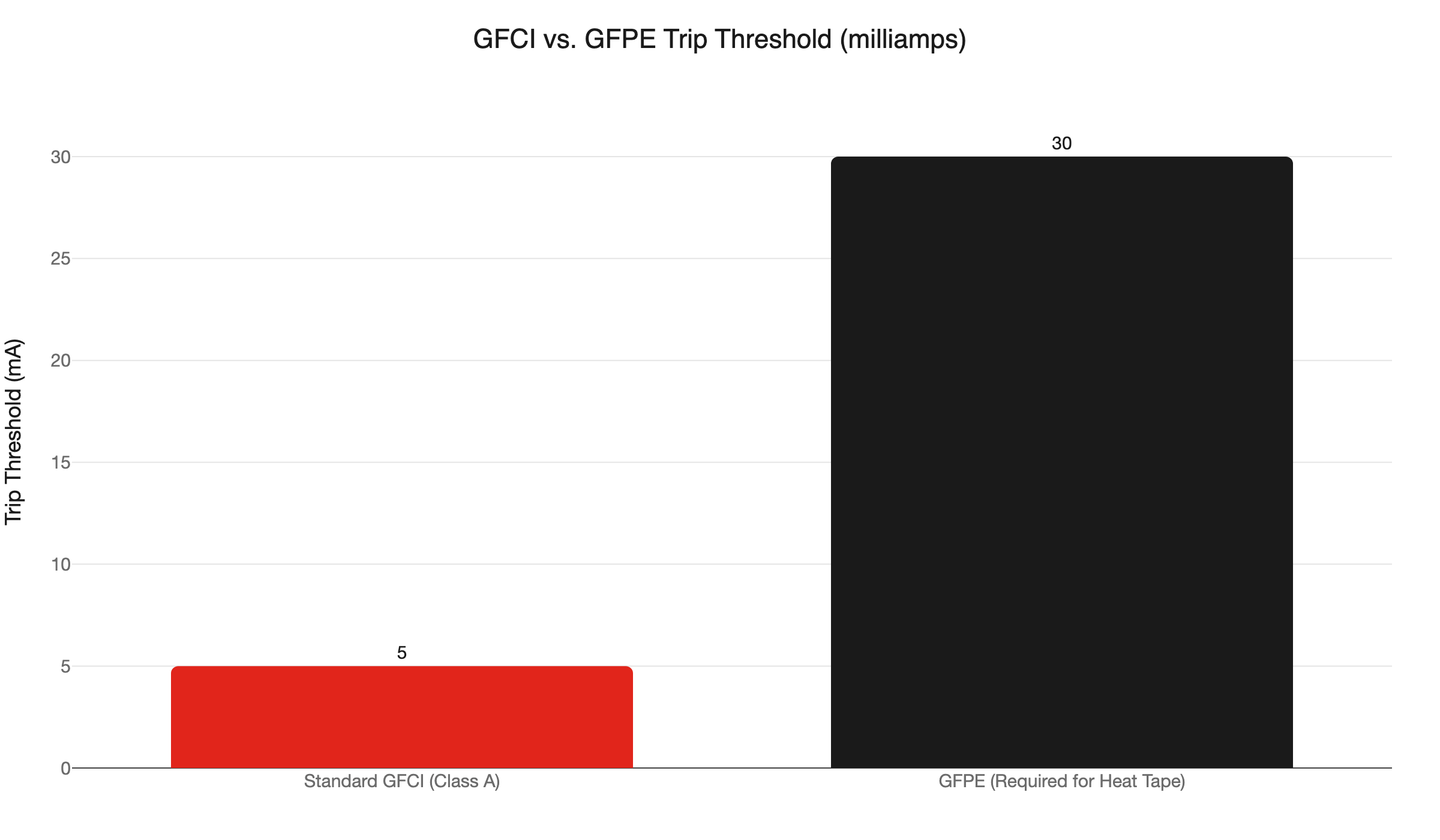
- NEC Article 427 governs heat tape. It requires GFPE protection (trips at 30 mA), not a standard GFCI outlet (trips at 5 mA). The wrong protection type nuisance-trips and leaves your pipes exposed without warning.
- Minnesota adopted the 2026 NEC on August 17, 2026. Jobs permitted on or after that date must comply with the new code.
- Heat tape is prohibited in concealed spaces such as walls, ceilings, and floor cavities. Exposed crawl space and basement runs are acceptable.
- PVC and plastic pipe requires self-regulating heat tape only. Constant-wattage tape can overheat and damage plastic pipe.
- Replace heat tape older than three years, per CPSC guidance, even if it appears to be working.
- Self-regulating cables draw significantly more current on cold startup than at steady state. Breaker sizing must account for inrush current, not just the label wattage.
- The Twin Cities average 22 days per year at or below 0°F. Crawl space pipes face sustained thermal stress, not a single cold night.
Why Heat Tape Is a Minnesota Problem Worth Getting Right
The Twin Cities average 22 days per year at or below 0°F, with 60 to 70 days per heating season where the daily high never reaches freezing. That is not a one-night cold snap. It is weeks of cumulative thermal stress on every uninsulated pipe in your crawl space or against a basement exterior wall.
Pipes become vulnerable below 20°F. In Minnesota, 20°F is a warm January afternoon.
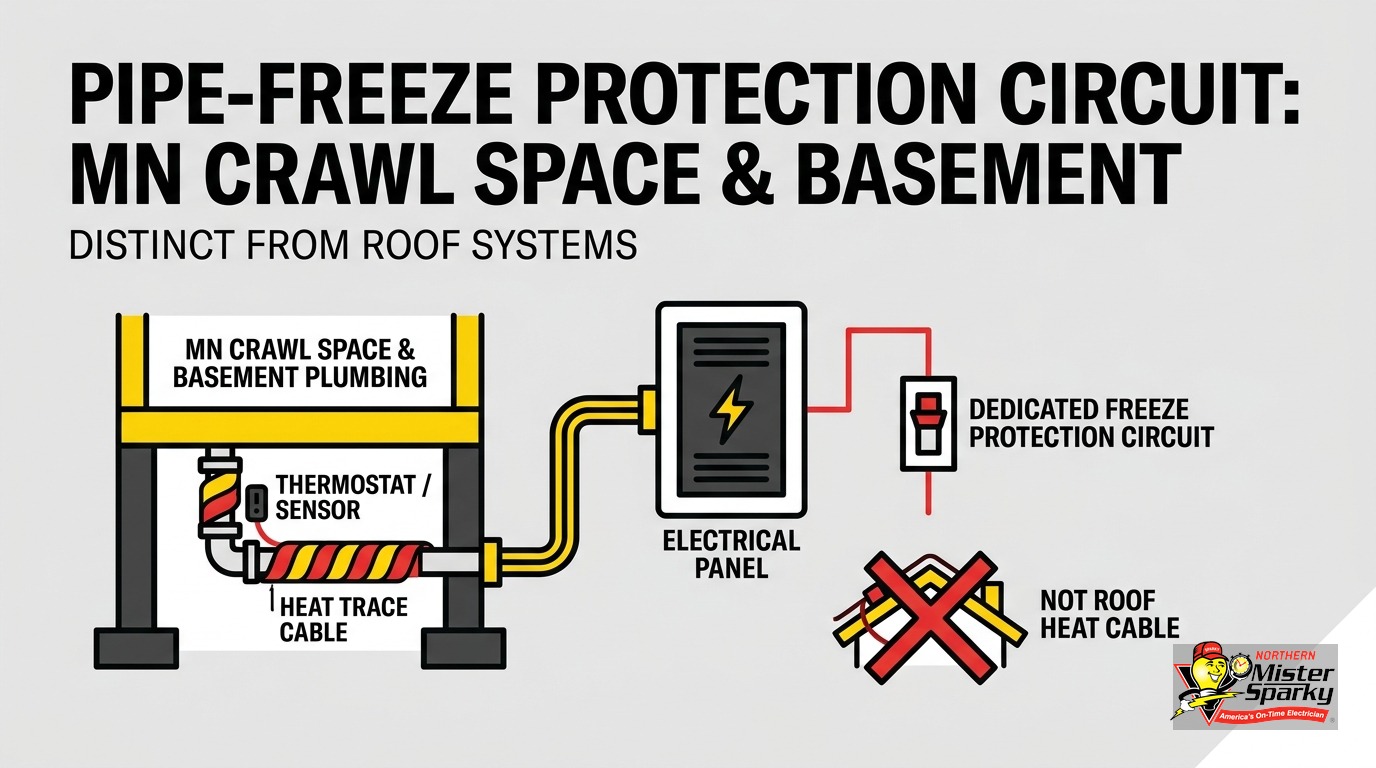
Heat tape, also called heat cable or heat trace, is a resistive heating element that runs along the outside of a pipe and keeps the pipe surface above freezing. It draws electricity and converts it to heat. At its best, it is a reliable, low-maintenance tool for pipes that cannot be re-routed or adequately insulated on their own. At its worst, it is a fire hazard.
The CPSC estimates that heat tapes and heating cables are involved in approximately 3,300 residential fires per year. Most of those fires trace back to old product, incorrect protection devices, or installations that were never inspected.
The financial stakes cut both ways. State Farm alone paid $628 million on more than 20,000 frozen pipe claims from 2024 through June 2025. The cost of a frozen pipe is real. So is the cost of a heat tape fire. Getting the electrical side right is what determines which risk you carry into winter.
What Are the Heat Tape Electrical Requirements Under the NEC?
Heat tape is classified as a resistance heating element under NEC Article 427. The code requires GFPE protection, a circuit sized for inrush current, and installation practices that go well beyond plugging a cord into a wall outlet.
NEC Article 427 covers all resistance heating systems used for freeze protection. Sections 427.14 through 427.23 and 427.55 through 427.57 spell out the rules: how the cable must be secured, what protection is required, how connections must be made, and what documentation is needed. This is not a plug-and-play product category from a code standpoint. Even when heat tape comes with a standard plug attached, the installation behind that plug must meet code.
The protection type is the requirement most online guides miss. NEC 427.22 requires Ground Fault Protection of Equipment (GFPE), which trips at 30 milliamps. A standard Class A GFCI outlet trips at 5 milliamps. That gap is the subject of a dedicated section below. For now: using the wrong device is a code violation and a practical failure mode.
Ground fault protection for heat tapes has been a code requirement since the 1987 NEC. It was not invented recently. Any installation that predates 1987, or was wired without proper protection, is out of compliance. It should be inspected before the next heating season.
Minnesota adopted the 2026 NEC effective August 17, 2026. If you are planning a heat tape installation this fall, the 2026 code is the one that applies to your permit.
Does Minnesota Require a Permit to Install Heat Tape?
Yes. Minnesota classifies heat tape installation as electrical work, specifically the installation of apparatus for heat purposes. An electrical permit and inspection are required before any work begins, not after.
The Minnesota Department of Labor and Industry oversees electrical licensing and code adoption in the state. Any permit filed on or after August 17, 2026 must comply with the 2026 NEC. Permits filed before that date must comply with the 2023 NEC. That transition is current. If you are booking an installation this fall, the 2026 code governs the job.
The permit requirement protects you. An uninspected heat tape circuit that trips a breaker silently in January leaves your pipes unprotected. It may also create liability if a fire or water loss follows. An inspection record proves the work was done correctly, and that matters at sale time.
If you are thinking about pulling the permit yourself and doing the wiring, stop there. Minnesota requires a licensed electrician for heat trace circuit work. The homeowner exemption does not cover it. You can apply the tape to the pipe yourself, but the wiring and protection device must be installed by a licensed contractor.
See our overview of how electrical permits work in Minnesota if you want to understand the full process before your electrician arrives.
What Is the Difference Between GFCI and GFPE for Heat Tape?
A standard Class A GFCI trips at 5 milliamps of ground fault current. GFPE trips at 30 milliamps. Heat tape has normal operating leakage current that can fall between those two thresholds. A standard GFCI outlet will nuisance-trip on that leakage, cutting power to your pipes. If it trips while you are away and you do not notice, your pipes freeze anyway.
This is the single most important technical point in this entire post.
Many online guides, including some written for homeowners who want to protect pipes themselves, tell you to plug your heat tape into “any grounded outlet” or to use an extension cord if needed. That guidance is flat wrong from a code standpoint. It creates a failure mode where the protection you installed stops working without warning.
The GFPE requirement has been in the NEC since 1987. It exists for a specific reason. Heat tape produces enough leakage current during normal operation that a 5 mA trip threshold will false-trip. But a true fault can generate enough current to cause a fire before a 30 mA device trips. The two thresholds serve different purposes, and neither can be substituted for the other in this application.
In practice, the outlet or circuit protection for a heat tape installation must be a purpose-built GFPE device or a breaker with GFPE functionality. These are not the standard GFCI outlets you find at the hardware store. They look similar and behave very differently. An electrician will know the correct part and where to source it.
For more on how ground fault protection works and where it is required in your home, see our post on GFCI outlet requirements explained.
What Circuit Does Heat Tape Actually Need?
In most residential applications, heat tape requires a dedicated 120V circuit protected with GFPE, sized to handle the cable’s inrush current, not just its steady-state draw.
The dedicated circuit requirement matters for a practical reason. Heat tape runs continuously during cold weather, sometimes for days at a stretch. Putting it on a shared circuit alongside kitchen appliances, lighting, or other loads risks tripping the breaker during high-demand moments. A tripped breaker leaves your pipes unprotected, the same outcome as a nuisance-tripping GFCI, and it may take you days to notice.
The inrush current issue is one that most homeowners have never heard of. Self-regulating heating cables change their electrical resistance based on temperature. When the cable is cold, its resistance is low, and it draws significantly more current than it does at operating temperature. A cable rated at 2 amps at operating temperature may draw substantially more on a cold startup. Your electrician needs to calculate that inrush figure and size the breaker from it. Looking at the label wattage and dividing by 120 is not enough.
The breaker sizing calculation also accounts for total cable length. Heat tape is rated in watts per linear foot. A 40-foot run at 5 watts per foot is 200 watts, roughly 1.7 amps at steady state. But that same run will demand more current on a cold start. The wiring and breaker must handle that peak without tripping.
If the panel is already crowded and there is no room for a new dedicated breaker, your electrician will flag that during the load calculation. That is a separate conversation about panel capacity, but better to have it before the install than after.
Where Can You Install Heat Tape, and Where Can You Not?
Exposed pipe runs in crawl spaces, unfinished basements, and garages are acceptable locations. Heat tape is prohibited inside walls, ceilings, and floor cavities. The line is: if you can see and inspect it, it can go there. If it is hidden, it cannot.
Heat tape is prohibited in concealed spaces by the International Plumbing Code Commentary. The prohibition exists for three reasons. You cannot inspect concealed tape for damage. It can accumulate heat in enclosed cavities. And a failure inside a finished wall is a fire risk with no early warning. If a pipe inside a finished wall is freeze-prone, the correct solution is added insulation or re-routing, not heat tape.
Exposed crawl space pipe runs are the most common residential application in the Twin Cities. The tape must be listed for damp or wet locations, because Minnesota crawl spaces see standing water, condensation, and rodents across a season. While your electrician is working in the crawl space, it is worth having them check for existing wiring damage while they are down there. Crawl space conditions are hard on all electrical equipment, not just heat tape.
A few additional installation rules from CPSC guidance:
- Never overlap tape unless the manufacturer’s documentation explicitly permits it. Overlap creates a hot spot that can ignite the tape or damage the pipe.
- Use a grounded outlet or circuit. A 2-prong receptacle is not acceptable.
- Do not staple through the tape. Use the manufacturer’s attachment clips only.
- Check the insulation rule. Some tapes require airflow and cannot be covered. Others are designed to be insulated over, which improves efficiency. Check the product documentation before adding insulation on top.
Which Type of Heat Tape Fits Your Pipe Material?
If you have PVC, CPVC, or any plastic pipe, you must use self-regulating (self-limiting) heat tape. Constant-wattage tape will overheat and deform or fail plastic pipe. For copper and steel pipe, either type may be suitable, subject to the manufacturer’s guidance.
Constant-wattage tape on plastic pipe is a known failure mode. The tape reaches a temperature the pipe material cannot sustain. You end up with a worse problem than a frozen pipe.
Self-regulating cable works by changing its electrical resistance as temperature changes. It draws more power when cold and less when warm. That makes it inherently safer on plastic pipe and more energy-efficient overall. It also cannot overheat itself, even if the cable crosses over itself briefly, though you should still follow manufacturer guidance on overlap.
Constant-wattage tape outputs the same heat regardless of ambient temperature. It costs less upfront and performs well on metal pipe. It requires a thermostat or manual control to avoid wasting energy when temperatures climb above freezing.
Regardless of pipe material, only install tape that carries UL or CSA certification. Do not reuse tape from a previous season if it shows any visible wear. And do not buy tape based on length alone: confirm the watt-per-foot rating is appropriate for your climate, your pipe diameter, and whether you plan to add pipe insulation on top.
When Should You Replace Your Heat Tape?
Replace heat tape that is more than three years old. Replace any tape with cracked, frayed, or brittle insulation, regardless of age. Per CPSC guidance, worn insulation is the leading factor in heat tape fires, and degradation is not always visible from the outside.
Three years sounds short. It is not. Heat tape lives in harsh conditions: repeated temperature cycles from below zero to above freezing, moisture, and rodent exposure in crawl spaces. Consumer-grade residential tape has a limited service life. If you do not know when your tape was installed, treat it as expired and replace it.
A visual inspection before each winter season is the minimum baseline:
- Look for cracks, brittleness, or melted spots anywhere along the outer jacket.
- Check that all connection points and end seals are fully intact.
- Verify the thermostat or control unit, if any, is cycling correctly.
- Test the GFPE device: it should trip and reset cleanly.
If any of these checks fails, do not splice or repair the damaged section. Replace the entire run. Spliced heat tape in a crawl space creates a connection point that is exposed to moisture and rodents, and it may not be rated for the environment.
What About Pipe Insulation and Utility Rebates?
Insulation and heat tape are not mutually exclusive. Used together correctly, they reduce the tape’s runtime, lower energy draw, and improve overall reliability. And there is a utility rebate on the table that makes the combination financially attractive.
Xcel Energy offers $5 to $9 per linear foot for adding insulation to existing bare pipe. That rebate is not heat-tape-specific. But a heat tape installation is a natural time to also insulate the surrounding pipe run, claim the rebate, and reduce how hard the tape has to work across the heating season.
No Minnesota utility rebate exists specifically for the heat tape wiring circuit. The Xcel pipe insulation rebate is the adjacent incentive worth capturing. Ask your electrician to note the pipe run lengths during the install so you or a plumber can calculate the insulation claim before the project closes.
One caution: check the tape’s product documentation before adding insulation. Some tapes require airflow to dissipate heat and cannot be covered. Others are listed for installation under insulation, which is the more efficient configuration. Adding insulation over a tape that requires airflow creates a concentrated heat buildup. Follow the manufacturer’s guidance exactly.
What Happens When We Wire a Heat Tape Circuit
As locally owned and operated electricians serving the Twin Cities, we have wired plenty of heat tape circuits over the years. We have also responded to calls where someone’s DIY or unpermitted installation was the source of the problem.
A proper heat tape circuit installation follows these steps:
1. Permit pull. We pull the electrical permit before any work starts. That is a legal requirement in Minnesota and it protects you when you sell the home.
2. Load calculation. We calculate the cable’s inrush current based on the run length, watt-per-foot rating, and expected pipe temperature conditions. We size the breaker and wire gauge from that number, not from the steady-state amperage on the product label.
3. Dedicated circuit. We run a new circuit from your panel. No sharing with other loads.
4. GFPE protection. We install the correct protection device. Not a standard GFCI outlet from the hardware store.
5. Proper termination. All connections are made to code, weatherproofed for the crawl space environment, and secured with the manufacturer’s attachment clips. No improvised fasteners.
6. Inspection. We schedule the inspection with the authority having jurisdiction and are on-site for it. You receive a passing inspection record.
7. Test and documentation. We confirm the GFPE trips and resets correctly, verify the circuit functions under load, and leave you with documentation of the installation.
No malarky and no cutting corners on protection type because it is “just a crawl space.” If your panel is running low on open breaker slots, we flag that during the load calculation rather than letting you find out during the first hard freeze. Our post on what to do when your panel is out of breaker slots covers your options if that is already on your radar.
Ready to Protect Your Pipes Before the First Hard Freeze?
The 2026 NEC took effect this month. Winter is not far off. If your heat tape is over three years old, call us now. Same if the installation was done without a permit. Same if the tape is currently plugged into a standard GFCI outlet.
We serve Minneapolis, St. Paul, Bloomington, Brooklyn Park, Woodbury, Blaine, Maple Grove, Plymouth, and the surrounding Twin Cities metro. As America’s On-Time Electrician(R), we show up when we say we will. Every job is backed by the UWIN(R) 100% satisfaction guarantee.
Call 763-200-5956 or book online to schedule your heat tape circuit inspection or new installation. If the job involves a panel upgrade or additional circuits, ask about financing options when you call.
Frequently Asked Questions
Do I need a permit to install heat tape in Minnesota? +
What is GFPE and why does heat tape need it instead of standard GFCI? +
What NEC article covers heat tape? +
How often should I replace residential heat tape? +
Need an electrician now?